Growth Hacking 101: Leveraging Freelance Marketers to Scale Fast

Growth Hacking 101: Leveraging Freelance Marketers to Scale Fast
1. The New Paradigm of Scaling
The velocity of global markets has become exponential in nature—capable of evolving and traveling at the speed of light of a single viral meme or an algorithm change. If a marketing team at a startup requires approval from their corporate headquarters to “hire” someone , by the time that corporate bureaucracy has gone through the vetting process and given that team the green light for onboarding said individual.
The opportunities for leveraging said contract to completion have most likely all already been seized by competitors already utilizing that same marketer on a fractional contract basis in order to remain competitive. In short, the outdated methods for scaling as used by successful startups of prior generations is rapidly becoming an extinct practice.
Growth Hacking is a cross-functional method of innovation that focuses on the customer lifecycle from acquisition to activation to retention to referral, by combining the work of Product, Engineering and Marketing by using data to maximize each aspect. It is the science to sustainably grow fast by Testing and Iterating a lot.
There is also a growing fractional workforce of top 1% marketers who are being released from the shackles of the 9-to-5 grind. Rather than being tied to a single company, the best-in-class are being channeled through a number of curated marketplaces and platforms that allow them to pick and choose from the very best projects, companies, and challenges that exist. They can use their skills to solve the biggest problems of growth at multiple companies, all without ever having to take on the overhead of a full-time executive salary at any one organization.
2. The Core Challenge: Why Businesses Fail to Scale
When a company is still in the traditional corporate model for hiring (finding someone to fill a Talent Gap of a Marketing Generalist), it can take 3-6 months from start to finish of the process to get a new hire up to speed and productivity.
While this person is going through the process of being hired, market conditions change and before you know it, your 3-6 month window to launch a campaign has expired. While large corporations can afford to spend time and resources to get the perfect candidate, in a fast growing market, that amount of time lost between when you start and when you launch can be enough to give up first-mover advantage to more agile competitors.
Organizations simply do not have the internal resources to carry out a marketing strategy at scale. And in most organizations, the bulk of the work is carried out by the Marketing Manager (or equivalent), a generalist, who tries to implement the broadest array of techniques and channels, but is never quite able to develop sufficient expertise in any one area.
The highly specialized nature of the techniques that now comprise marketing continues to rapidly evolve, at a pace that far exceeds that of the vast majority of marketing organizations.
The result? The creation of significant amounts of technical debt, as outdated techniques and suboptimal strategies are implemented on a daily basis, in the hopes that at some point, they will bear fruit. But the principal failing here is that, in the interim, the vast majority of such organizations’ online content will remain unindexed and invisible on search results, thereby rendering them virtually irrelevant.
The fixed cost of hiring a large team can be silently destroying your company’s progress. The team has been scaling up in headcount before reaching product-market fit or before figuring out which marketing channels actually work.
Now, the funds that are being spent on the salaries and benefits of the large team are unable to be used for all of the necessary experimentation to find the right growth hacking vector for the company.
3. Why Freelance Marketers? The Strategic Advantage
Unrivaled agility.
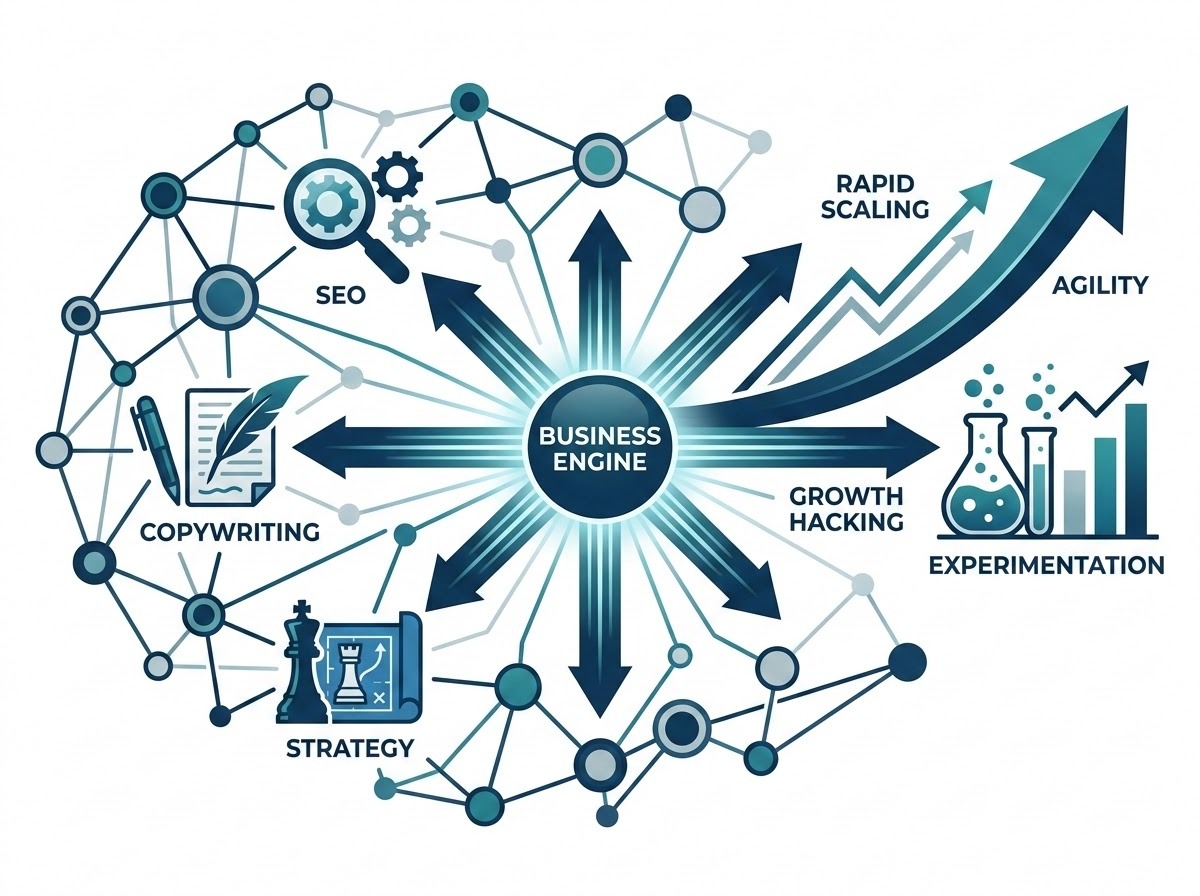
With a freelance-led engine, a founder can engage a world-class specialist for a 3-weeks-intense project (e.g. a technical site migration or a product launch). He can then turn-off the associated cost once the specific objective of that project has been met. Contrary to a traditional resource allocation that is often rigid and sees capital stuck in idle overheads, growth through a freelance-led engine is deployed only where it is actively adding value to growth hacking objectives.
Deep specialization over shallow breadth.
Let’s bust another marketing growth myth: the generalist marketer. As a rule of thumb, hiring for specialized marketing resources will create far better results for your company than a generalist who can only pretend to ‘help grow your brand’.
In reality, hiring highly specialized freelancers such as an SEO Specialist, focused on highly complex Site Audits and Schema Markup creation for example, or a Conversion Copywriter – focusing entirely on the buy button and psychology of conversion will inevitably deliver far greater results for your business, locked within a specific niche.
Global talent arbitrage.
Innovation is no longer only located in innovative cities and countries around the world. By accessing high-caliber talent through the best freelancing marketplaces, companies can reach the best individuals from over 90 countries worldwide, whilst bypassing talent scarcity and overinflated salary expectations of local teams. When hiring remotely, growth-oriented businesses only hire the best for the job, based on their merit, past performance and skill to complete the job successfully, rather than geographic location.
Experimentation at scale.
Growth hacking by numbers requires the highest amount of experiments to validate growth in a quick manner and find that one channel to scale in the long run. Having a bulk of a company’s workforce consisting of Freelancers will allow for having a high amount of tests running in parallel (i.e. 5 channels: influencer, social media, programmatic SEO, content, paid search).
All without the insurmountable costs associated with full-time salaried employees. Validate what is working for you quickly and cut the losers even faster with a cut-throat-like approach.
4. Integrating Freelancers into Your Growth Hacking Engine
Gap Analysis: Data-First Delegation
Identify where your current funnel is leaking in order to hire the right person to fill the gap. Looking at your current stats will help to rule out a lot of different scenarios. For example, are you getting a decent amount of traffic coming through to your offer, but the conversion rate is terrible.
Could be a problem with your landing page(s), or with the offer itself.. On the flip side, are you getting conversions but you're not getting enough reach/top of the funnel traffic? This could be an issue that requires some SEO and top of the funnel content in order to drive more traffic to the rest of your sales funnel.
Defining Atomic Tasks
By dividing up big goals into atomic tasks i.e. small projects with clear deliverables, you can get the best work out of your freelancer for your buck. Instead of hiring a Marketing Consultant for Growth, hire someone to Optimize 10 landing pages for SEO (including H1 tags and meta descriptions for each page) for you. Your freelance work can start immediately without wasted hours of indecision of what you can do for your client..
Workflow Synchronization
As you scale, this kind of team member must integrate seamlessly into your workflow. The only way to do this is to put your freelancer in your existing ecosystem – your Slack, Trello, Jira, or Asana instance. By adding them to relevant project boards, and including them on relevant channels, your freelancer will get to understand the underlying rationale for the work they’re doing. Instead of just executing on a task, they’ll be part of a functioning team.
The Onboarding Blueprint
Get this right and you can get anyone up to speed to replicate your brand’s unique voice and mission instantly. That is to create a Growth Infrastructure that is running at full potential when done correctly. As a result, your freelance-powered growth engine will run as smoothly and as efficiently as an in-house team but with the increased agility of an elite fractional workforce.
5. The GigMint Advantage: Streamlining the Integration
The AI Task Pipeline: From Concept to Brief in Seconds
The AI Task Pipeline for the GigMint platform automatically creates a properly scoped out project plan in the form of a high quality project brief that outlines a proper project plan, complete with defined deliverables, properly scoped out out technical work to complete the appropriate milestones, and even properly identifies out the right Specialist to complete the project work for the founder or marketing manager.
The founder or marketing manager just puts in a very rough approximation of the business objectives of the founder or marketing manager, and GigMint’s AI does the rest of the work for the founder or marketing manager in a matter of seconds, rather than hours or even days of work that a single marketing manager would have to do in the past to scope out a properly sized and scoped out project to complete the right work for a founder.
The 1% Quality Bar: Elite Talent Only
Marketplace fatigue associated with low quality talent pools is one of the reasons founders experience so much pain from freelancing in the first place. To combat this, GigMint runs all applicants through a very deep and multi faceted screening process. In the end, we only accept fewer than 1 in 100 applicants and every single one of them has been thoroughly vetted for skills, for ability to communicate, and for reliability. We don’t list talent on the platform who cannot deliver high quality results for our customers and that is why we call it the 1% Quality Bar.
Trust, Security, and Global Velocity
GigMint has created a financial infrastructure capable of scaling at speed with payment functionality for Instant Global Payouts directly to Stripe’s network in over 90 countries. The use of GigMint’s platform coupled with Escrow Protection, means payments are held in trust until release by the client. All releases are on a per deliverable basis as agreed by the parties prior to the Specialist commencing work. So all payments are risk-free for clients of GigMint.
Near-Instant Speed to Market
In a traditional hiring process, hiring is a marathon, for GigMint it is a sprint. Utilizing AI to match best projects with the ideal specialists stored in a pre-vetted pool of world-class talent, GigMint facilitates connection near instant in time. Thus, what used to take months of tedious interviews and long verification processes to finally find “the one” is now accomplished in hours allowing for swift reaction to seize any market opportunity quickly.
6. Best Practices for Managing Freelance Growth Hacking Teams
When implementing a fractional workforce, achieving scalability in work with team members is only achieved by transitioning from a transactional relationship to a fully integrated model. This transition is initiated by going to high-performance Communication Rhythms for high-performance teams.
Communication Rhythms
Enabling a global team of remote specialists to function as a team and deliver on the promise of a fractional workforce requires transitioning from transactional relationships to a structured integrated model and implementing Communication Rhythms for high performing teams. These asynchronous Communication Rhythms should be the default and should only very occasionally require real time synchronous communication.
Selecting the right tools to enable each specialist’s best work, such as Loom for video, followed by work, and then communication of complex ideas to receive simple feedback from team members via channels such as Slack, is critical.
It is also important to remember that time spent in synchronous communication should be restricted to problem solving and aligning on strategic objectives, in order to avoid interfering with the work of the team in between. Time zones and geography should present no problems.
KPIs and Accountability.
Also keep in mind that when working with elite freelancers, they are most motivated by impact (ie. doing the best work possible to achieve great results) rather than being constrained by hours of work (ie. being treated like employees). Thus, setting up a team of fractional specialists to hit results-oriented KPIs (ie. reduce CPA by 15%, get to top-3 for high-intent terms) and holding them accountable to hit the “what” creates a culture of ownership that’s very difficult to create with full-time employees.
The Partner Mindset.
Partner with top freelance experts (your butchers) on your Amazon Mechanical Turk-like platform and treat them like you would treat consultants for your company’s growth roadmap. It is very valuable to get their perspective. The freelancer has most likely worked for several other companies in many different industries, which makes them able to identify both new opportunities and risks for their clients. It is very important to keep your best specialists for as long as possible, since they are your growth engine of high caliber.
Quality Control Frameworks. High technical & high style standards for large volumes of content, executed via SEO content audits of produced content and an editorially configured peer review process.
7. Pitfalls to Avoid
The Micromanagement Trap
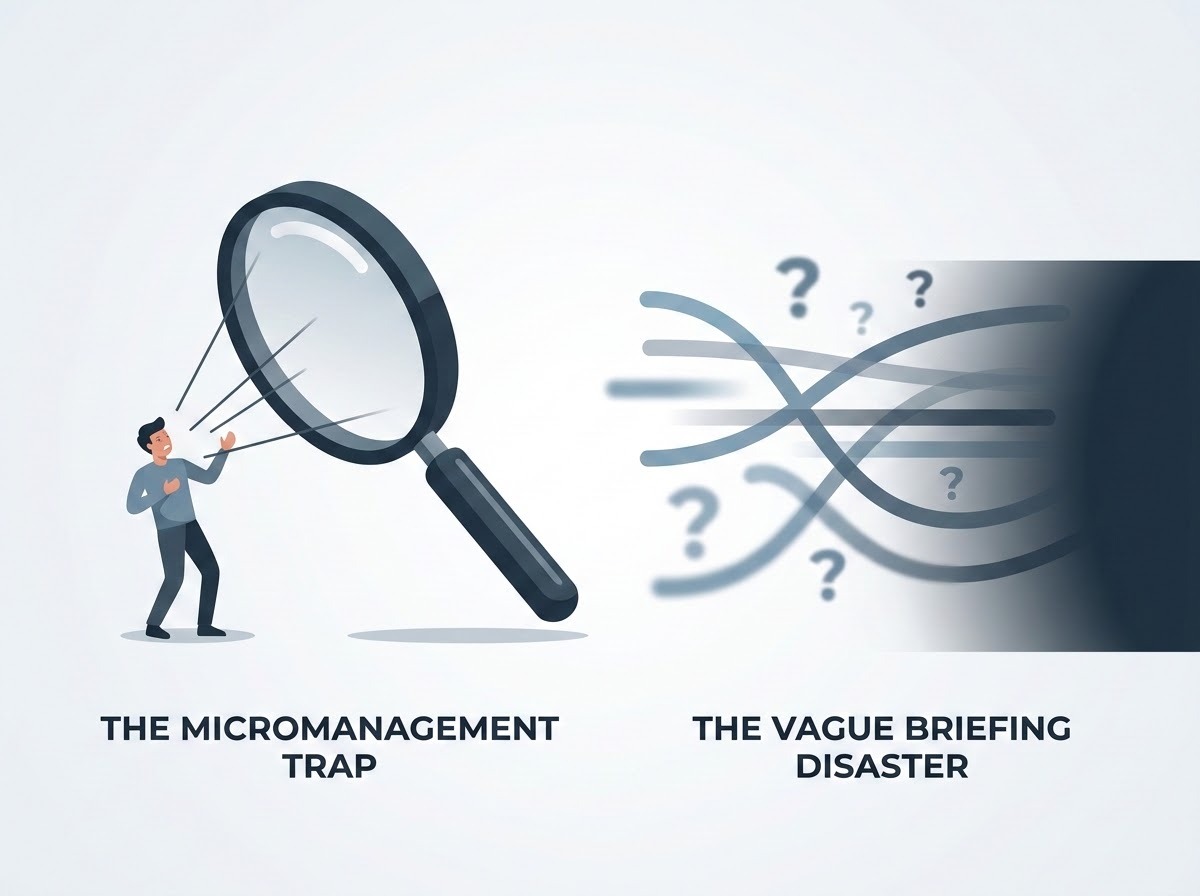
Overmanaging Your Elite Freelancer In the end, it’s all about results. But while you’re growing your growth anchor (that key part of your business that’s delivering the results you want), your kill (the thing that will ultimately kill your business) is your growth kill – that part of your business that’s currently not bringing the results you want. That could be anything from an underperforming employee to a costly outsourcing error to an ill-fitting product line. If you’re making your elite freelancer your growth anchor (putting them in a box where they have to perform within a very narrow scope), you risk turning them into your growth kill.
The Vague Briefing Disaster
Let’s be real here – ambiguity kills ROI. When your project brief doesn’t outline the most important elements like the meta tags, targeted keyword phrases, and intended user, then your financial return on your work as a freelancer is severely compromised.
Aproject brief that doesn’t convey a clear definition of user intent will only lead to failed iterations on your work, blowing your precious budget and ultimately failing to rank for your target keywords to capture that much needed high-intent search traffic and drive conversions for your client.
Ignoring the Culture of Remote Work
It’s true that when you bring in outside contractors you are paying for their expertise alone. But even a highly skilled freelancer must be directed in some fashion and the context that a company provides for its staff—particularly in terms of a company’s long term vision and core values—is not typically something that a highly paid freelancer wants to be informed of.
Until he or she is provided with both, the freelancer’s work will be downgraded by half in value—because, unless you are hiring the highest-end project managers as well (which, again, you aren’t), his or her efforts will be guided only by the orders he or she receives, with little room for higher-level strategic guidance in between.
A company’s culture functions as an overall brand “ethos” or “trajectory”, and until a highly paid freelancer is able to comprehend that as well as the rest of your staff, the work that they perform will not have the same level of strategic substance.
Over-reliance on a Single Channel
Spread your growth initiatives across channels and bring in specialists in each area to create a portfolio of experiments. By having a variety of growth initiatives in place you create a resilient acquisition engine that can withstand the inevitable downturn in performance of a single channel. The decline in performance of a single channel will not bring the whole of your acquisition engine crashing down around you and you will be able to quickly make changes to the underperforming channel in order to get it performing well again.
8. Future-Proofing Your Marketing Stack

Instead of the fixed skill set based in-house departments of old, a freelance dominant model provides the ultimate competitive advantage of strategic fluidity to tackle the ever changing landscape of a volatile market. The search engine algorithm, the market trend, all can change overnight and with a freelance dominant model you can switch specialists faster than it takes to retrain in-house staff from other departments.
A distributed workforce operating at scale requires bank-grade security. When growth is scalable, data integrity must be preserved. By operating in a scalable remote environment with SOC 2 compliant infrastructure, firms can be confident that their business intelligence and IP are safe from harm.
The main advantage of this approach is that your company can scale extremely quickly. This means you can increase your operation in hours, rather than months – perfect for a season of growth, or if a product suddenly becomes a viral hit. And with flexible freelance staff, you can scale up and down as needed, using your resources to maximum effect. It’s a very cost-effective way to achieve your business goals.
9. Start Your Growth Engine
The new playbook combines growth hacking (using data to create and execute experiments with high return) with a freelance army of top notch specialized skills, thus creating a sustainable “moat” around a company. Instead of marketing being a slow department in a large company, with a separate siloed budget and often even separate bonuses, it should become a lean, experimental engine for growth that can pivot as fast as the market changes.
The fractional workforce model is more than cost cutting, it is access to expertise required to grow faster than your competition. Thousands of founders have used GigMint to redefine their operating model, post your first project for free today and connect with the best marketing talent in the world.
Post your first project for free today and start matching with the best marketing talent in the world, top 1% – we are redefining the way companies operate in the modern economy. The prize for growing successfully is no longer given to the company with the biggest team or biggest budget. It is given to the most adaptable company. Start building your growth engine today and turn your marketing department from a bottleneck to your biggest competitive advantage.