In-House vs. Freelance: When to Outsource Your Next Big Project
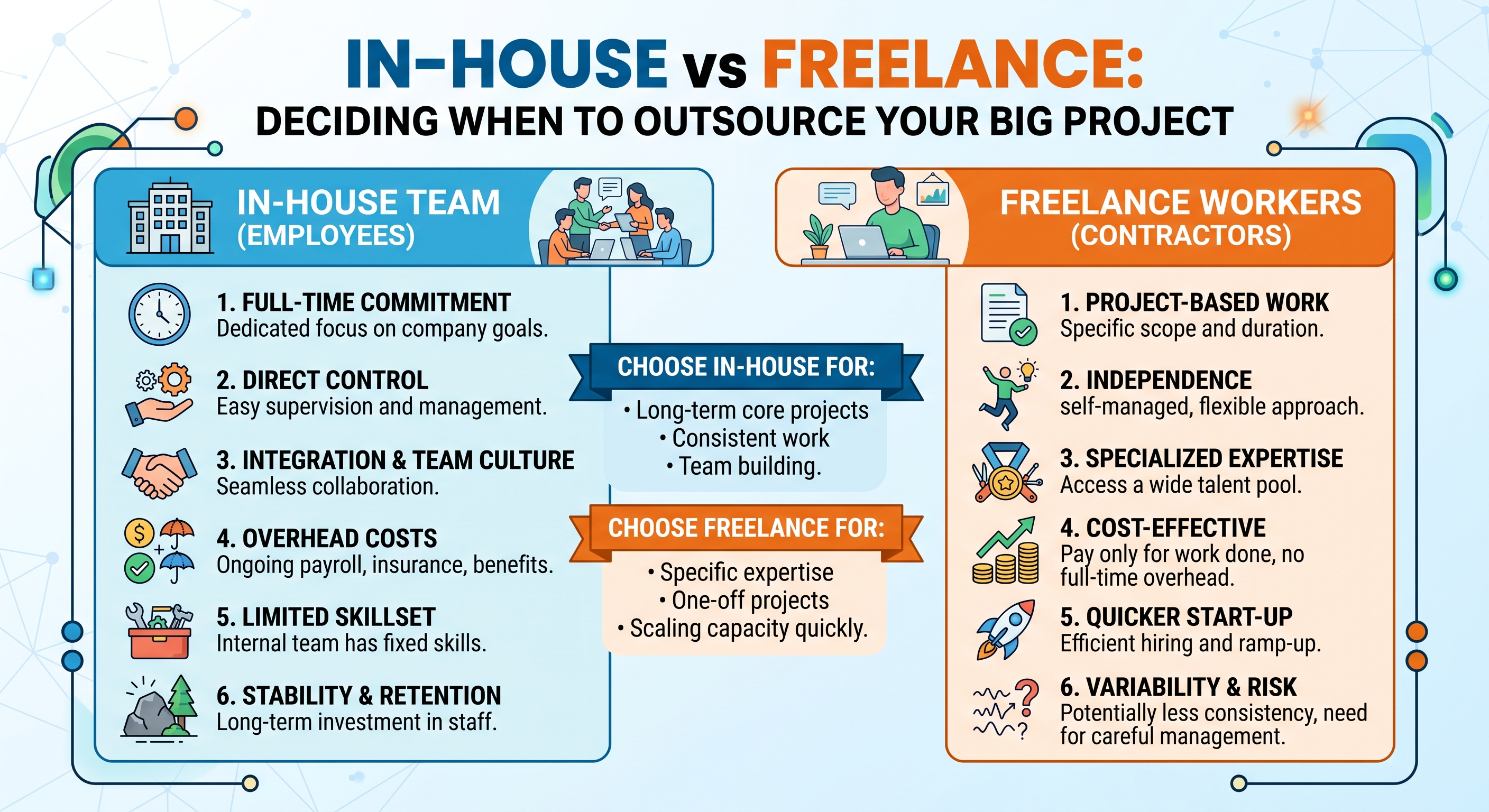
In-House vs Freelance: When to Outsource Your Next Big Project
The Modern Talent Landscape
Encourage your freelance partners to host training sessions, perform code reviews, or do "office hours" with your in-house team members. If an excellent freelance developer works with your juniors and middle-level employees, it means that they are actually providing you with valuable skills. By the end of the project, you don't only have a finished assignment, but also improved employees who won't need any outside help in this field anymore.
The Evolution of the Talent Ecosystem
From "Office-Centric" to "Liquid Talent"
For many years, the traditional formula for growth in business was quite simple—hire and grow. If something new had to be done, the immediate reaction would be to create a department within the organization. But times have changed dramatically.
Now, we are seeing the development of what is known as the "liquid talent" economy, in which the old office-centric way of doing things is now facing rapid challenges through a more flexible, project-oriented way of thinking. Organizations do not necessarily need someone on staff to deal with each and every problem that arises. The best organizations are tapping into global talent as required.
Defining Success Beyond the Headcount
This progression means that leaders must reassess the way in which they measure success. Are you trying to build up your headcount, or are you trying to accomplish truly impactful business results? Effective growth in the modern world does not involve an either-or choice of in-house reliability or freelance flexibility; rather, it involves developing a proper mix of the two. The key to success lies in balancing the reliable foundation you have built in your company with the "burst" capabilities of outside specialists. This article will offer the guidance necessary for making these decisions.
The In-House Advantage: Building from Within
Branding Consistency Through Internal Staff Members
Another major advantage of having an in-house team is the level of cultural integration they have. Unlike freelancers who only get a sense of the “tone” of the business, the in-house staff members are constantly living through the culture. Therefore, everything that they produce – whether it is customer engagement or products or any other kind of content – is consistent with the brand in question.
Even if you brief the freelance specialist about your “tone,” he/she will not have the same intrinsic connection that you get by attending town halls of the company and seeing how the leadership reacts to various situations. In case you prioritize consistency in branding, the internal staff acts as the natural buffer between you and fragmentation of your messaging.
The Guardians of Institutional Knowledge
All organizations have their own "history in the shadows"—the background story of why some projects had to be left undone, the history of how a certain type of technical debt was accrued, or the reason why a certain marketing strategy didn't work out three years ago.
Long-time employees act as guardians of that institutional knowledge. They provide the necessary context which helps avoid the costly "re-inventing the wheel" effect. If you are working on a new project, your experienced colleague will most likely point out to you some previously tried solutions or strategies which are not listed in any onboarding guide or Jira issue.
It is a very efficient mechanism; it gives you the chance to stand on the shoulders of your predecessors, rather than make the same mistakes. As for the freelancer, he comes to the project with a clean slate and needs considerable time investment to learn about the context which is familiar to your team.
The Hidden Benefits of Proximity and Serendipity
It could be the proximity offered by the physical presence in an office or the proximity created by Slack huddles and collaboration in real-time; the always on-the-go culture of in-house teams creates a special kind of serendipity.
The ability to collaborate on the fly in the form of an impromptu conversation at your desk solving a difficult bug or even collaborating and brain-storming in informal meetings and coming up with an important pivot in the product is extremely hard to create within the framework of remote workers who come in intermittently. The in-house team enjoys the advantage of being part of an environment with a bandwidth of communication and problem solving taking place in real-time.
Specialized Talent on Demand
While internal teams give businesses continuity, the fast-paced business environment requires flexibility. The “freelance power” concept is not just about hiring externally but rather about having flexible access to the best and most specialized talent when needed.
Access to Hyper-Specialized Expertise and Innovation
With the ever-evolving technology landscape, a general skill set won’t be sufficient anymore. Whether your team needs someone with extensive experience of working with Rust in a microservice environment, a specialist in building RAG-pipelines in the context of AI, or a consultant on regulatory compliance for entering a particular market, the process of finding a full-time hire might easily take several months.
Using freelance talent changes this equation completely. Instead of spending time on a search, you get access to professionals who already solved the same issues. It is not about getting just “extra pairs of hands,” but hiring specialists who bring proven solutions to the table. You do not have to train them in-house because they already have all the knowledge.
Achieving Cost-Efficiency and Elastic Scalability
There is a completely different financial structure when hiring freelance talent. You incur substantial overheads when you are hiring full-time because you have to pay salaries, equity, benefits, offices, and management costs. On the other hand, through freelance talent, you have the option to pay for results rather than paying per hour.
When the need arises, you can ramp up your resources during such a period as product launch or API refreshing, then you ramp down to zero once the objective is accomplished. Your resources go into levers that spur growth rather than being tied up in nonproductive overheads.
Accelerating Velocity Through Specialized "Burst" Capacity
The only way to get ahead is by going fast. The conventional corporation’s process of recruiting people is usually slow enough that it cannot keep up with fast innovation cycles. By the time the job description is finalized and the candidate is on board, the window for opportunity will have passed.
Freelance professionals act as a form of “burst capacity.” You can recruit, onboard, and integrate them into your workflow within days. This is essential to Proof of Concept (PoC) to Production workflows, which enable your company to prove hypotheses, make iterations, and execute projects faster than your competition can discuss allocating their resources internally.
The Selection Framework
Making the determination of whether you need an internal team or freelancer should never be just a yes/no call. It should be a deliberate decision making process. In order to get past “gut feelings” and unreliable anecdotes—which have been rendered very dangerous in the current era of information overload—you must establish a sound selection criteria process.
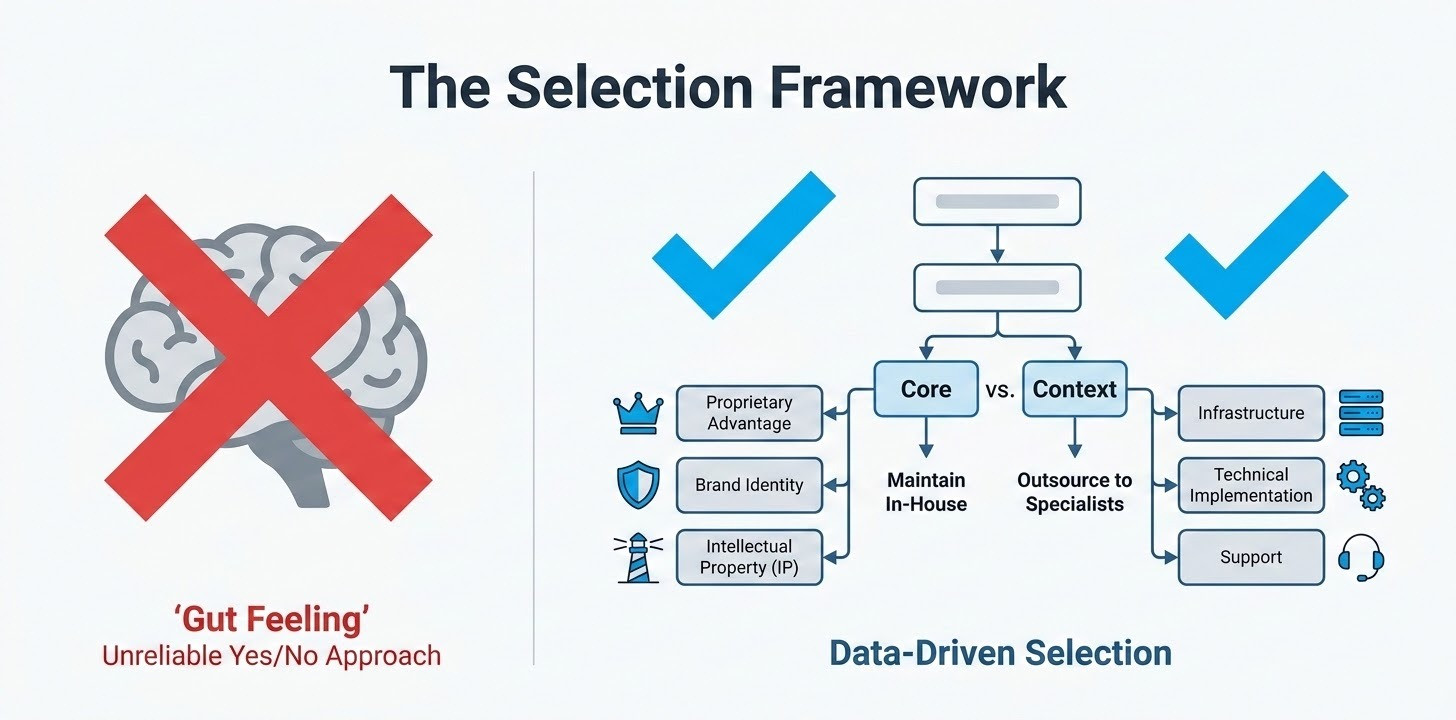
"The Core vs. The Context Strategy"
The best way to grow starts with identifying what constitutes "Core" versus what comprises "Context." "Core" is made up of those activities which represent your proprietary advantage—the things that make your company unique and set it apart from other companies in terms of its brand identity and its intellectual property. They are activities that need to be deeply immersed into your culture.
On the other hand, "Context" is composed of activities which while necessary are not proprietary. Technical implementation of infrastructure optimization are examples of such activities. They don’t define the soul of your brand. By outsourcing these "Context" activities to specialists, your core team members will be able to concentrate on meaningful results and not be bogged down with special challenges that someone else has already overcome before.
Evaluating Timeline, Urgency, and Internal Bandwidth
Urgency is usually the driving factor behind liquid talent. Hiring within a corporate framework is notoriously slow; by the time you go through all the paperwork and the onboarding process, you miss out on your opportunity. When you need to hire for a specific "burst" project, such as a fast MVP launch or API updates, freelancers can help you get there.
Leaders should take stock of their existing capacity. Training your internal generalist for a single-shot, risky venture may create unnecessary complications and waste of effort ("re-invent the wheel"). If your team is already at its capacity limit, adding an additional strategy will only add up to what is commonly referred to as "growth paradox"; you'll get your users quickly enough, but the clunky experience you've created will drive away many of them.
Calculating the Total Cost of Ownership (TCO)
One common flaw in strategy is considering only the freelancers’ hourly rates and not looking at the Total Cost of Ownership (TCO). The specialist’s hourly rate might lead to “sticker shock,” but this is a surgical cost. When employing full-time, there are many other expenses including salary, ownership shares, perks and the inherent cost of administration and turnover.
Other TCOs include the “cost of trial and error.” The internal team which is gaining experience through the process can take 2,000 hours to complete a project which a seasoned professional would complete in 100 hours. And the cost of a poor hiring decision pales in comparison to the opportunity cost of wasted time. Efficient strategizing calls for buying proven tactics to skip the learning period altogether.
Addressing Key Person Dependency
The issue of "Key Person Dependency" must be considered. The dependency on the veteran in the company to provide the "shadow history" is a single-point failure. On the other hand, the "blind hiring" in general marketplaces is the "vetting nightmare."
To resolve the issue, companies need to develop a hybrid approach in which they retain strategic control internally, while leveraging elite platforms such as GigMint to recruit the top 1% of candidates who are capable of working independently without much supervision. In this way, technical documentation and user stories will become the "single source of truth" to protect from both internal paralysis and external "ghosting."
.
Navigating Potential Pitfalls
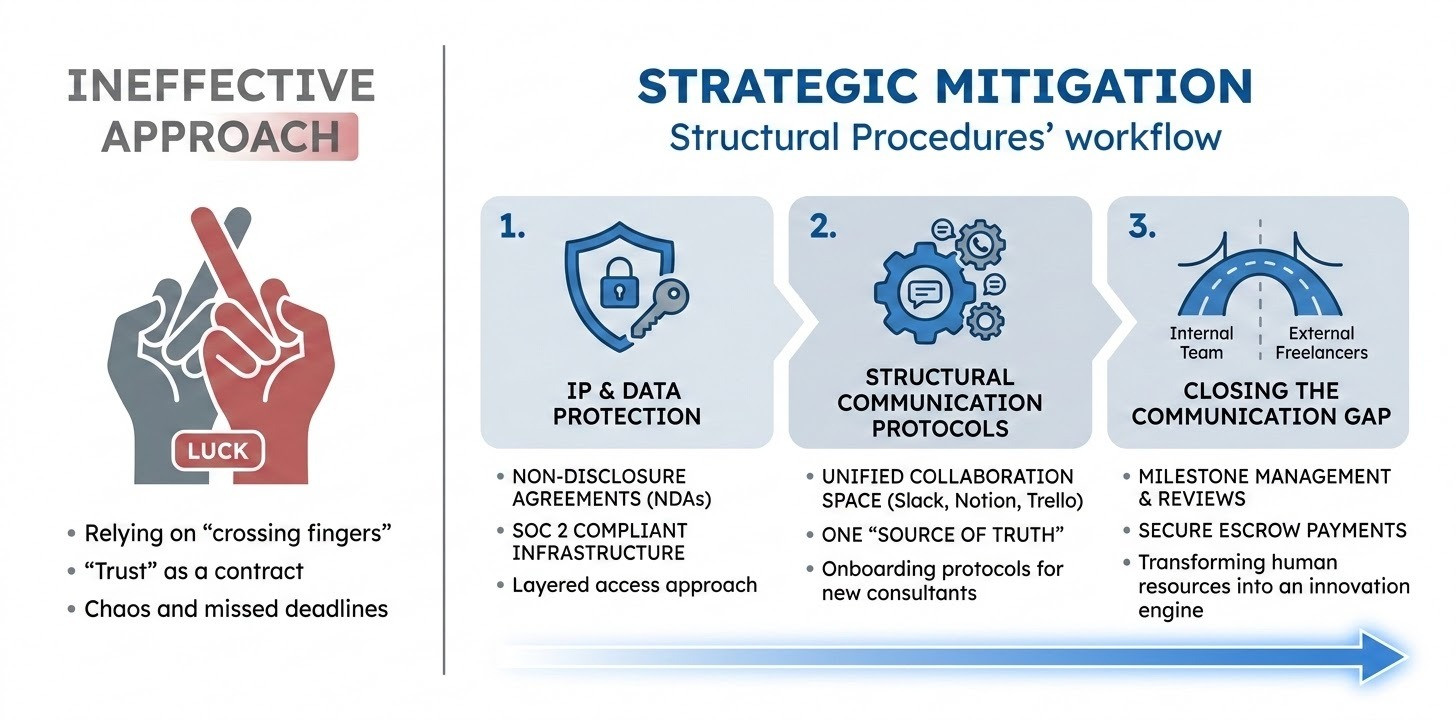
The hiring of an external agency or top-notch freelance consultant for carrying out specific jobs certainly poses some inherent risks. But this doesn’t mean that these are some failures per se. These are just certain weaknesses which, once pinpointed, can be strengthened through structural procedures. In order to ensure the security of your business expansion process, you need to go beyond “crossing fingers.”
Protecting Intellectual Property and Data Security
When you let the outside world into your internal data systems, you’re letting in your prized possessions. Security here is a must. Relying on an oral contract and "trust" as the basis of your engagement carries major risks. Rather, safeguard your intellectual property by implementing an extensive, layered security approach.
Enforce non-disclosure agreements (NDAs) at every single point prior to starting a project. Secondly, choose the ones that run their services on a SOC 2-compliant infrastructure, thus giving you maximum protection according to all data protection standards.
Avoid the old "pay-and-pray" approach of freelancers. Employ secure escrow accounts that hold funds until certain milestones are met. In other words, your financial investment will be protected along with your code and data.
Closing the Communication Gap: Tools and Protocols
The problem of "out of sight, out of mind" is the main reason why there is a lack of organization in freelance projects. Distance doesn't equal disorder. In order to address this problem, it is important not to fall into the trap of "email only" communications, because of their chaotic nature and lost files.
In order to resolve this issue, it is recommended to build up a unified space through Slack, Notion, or Trello, for example. You need to have one "source of truth" in order to have all consultants work from it.
The onboarding process needs to be conducted for each new consultant. Access to internal servers shouldn't be given immediately. Consultant will be provided with access only to the folder or environment needed for the task completion.
Maintaining Brand Standards at Scale
Quality control is not only about delivering a good product at the end but more about the entire review process. No matter how good your vetted experts are, you will need to create a certain rhythm when it comes to reviewing their deliverables. Here comes "milestone management" to help.
Never allow any scope to be indefinite. Split your project into milestones like wireframes, draft, or prototyping and review them before giving your expert a green light to move on to the next milestone.
In this way, you won't allow any scope creep and will be sure that the tone, the technical side, and your brand voice will meet all your criteria from the very beginning. With clear guidelines and briefs, you take away the guessing game, getting the production-ready content right away without any reworking on your part. Your risk of "brand dilution" will turn into a high-output machine.
The "Best of Both Worlds" Approach
The vast majority of leaders fall into the trap of the dichotomy "in-house vs. freelance," seeing them as two completely different options. In reality, the most successful companies understand that there are no dichotomies here, but complementary approaches to be used together. The "Hybrid Model" is not only a question of number balance but a question of creating an efficient team.
Managing Strategy (In-House) vs. Execution (Outsourced)
The most effective application of the hybrid approach depends on the distinct difference between "Strategy" and "Execution." You need your internal team of people to be the "internal brain." It should possess the product roadmap, the company vision, and make all the architectural decisions. In this way, you guarantee that regardless of how many external contractors work with your company, the fundamental nature of the business will stay the same.
External specialists should be responsible for the high-speed "Execution." Whenever there is a particular challenge you face in terms of your business needs, such as API refactoring, AI integration, or an increase in the volume of the content, outsourcing helps you avoid lengthy recruitment processes.
Leveraging Mentorship Loops for Internal Growth
Another often ignored strength of the hybrid approach relates to the ability to develop the skills of your team from within. Freelancers should never be viewed as “black boxes” taking input and producing code.
Creating Cohesive Workflows with Integrated Project Management
The last obstacle in the path to a successful hybrid strategy is communication friction. To avoid the "us against them" attitude, one needs to establish a unified environment where the external expert feels a part of the team.
One should not rely on email communication only. One needs to integrate freelancers in your current project management tools . Establishing a "single source of truth" where all documentation, deadlines, and updates are available for all participants will make the external expert independent from the managers of your company, as the expert will be aware of the work being done by the whole team.
Your Path to Strategic Growth
The discussion between having an in-house team and going with a freelance expert, is a false choice. In the next decade, the best companies will not be the ones which follow the rigid line between one option and another, but those which know how to orchestrate the two in their strategic advantage. The key to doing so lies in thinking about talent as a fluid resource rather than a static expense.
Transforming Human Resources into an Innovation Engine
This change in mentality – considering your employees as a combination of core stability and burst-capacity agility – is the greatest competitive edge. Rather than employing staff just for “roles,” you build the company around “results” and make it more robust. You liberate your core from the boredom of doing repetitive work and from switching contexts all the time, enabling them to concentrate on the strategy of the business itself.
Not only is it a question of resource management but it’s also about the culture. By recognizing external experts as collaborators rather than competitors, your internal team allows itself to adopt new approaches and even become mentored, thus “leveling up” the whole company.
A Final Framework for Project Leaders
Audit your queue of projects using this one question: "Is this an integral part of our business operation and thus a key component of our intellectual property, or is it an implementation within context that a specialist can do much more quickly?" Use this as the filter through which you view all the strategies outlined in this article.
Maintain the core in-house, outsource the context, and develop a process that makes best use of "the best of both worlds."
The path to growth will be built on your decision about where to source your talent. It is not enough to staff the position that you are filling; you need to create a flexible and innovative workforce that will deliver results for your projects tomorrow.
Frequently Asked Questions
Q: How should I deal with communications drifting in my remote contractors?
A: Avoid the “email only” approach. Have something in the realm of a project management system (Slack, Notion, Trello), which will serve as your “one-stop-shop”; set up proper communication protocol from the get-go to ensure your external professionals feel like part of your team.
Question: How am I supposed to tell apart tasks which need to be in-house from tasks which should be outsourced?
Answer: Consider "Core vs. Context." The core processes of the business, the ones which make up your Intellectual Property and your brand, belong to the in-house category since institutional memory is essential here. For everything else, outsourcing is the way to go, especially when you consider that these are context operations, in which external specialists are able to perform better than you internally can.
Question: Is there any risk of sensitive information being exposed if I work with freelance external specialists?
Answer: There is always some security risk, but you can mitigate it. Always make sure you have NDA agreements in place and use SOC 2 compliant platforms for your collaboration. Escrow payment solutions can provide an additional safety net.
Q: Is there an effective way to integrate the in-house team with freelancers?
A: While keeping strategy and vision in-house, you can take advantage of freelancers when it comes to implementation. Such a combination allows for flexibility but does not mean compromising on the architecture of your company from the long-term perspective.
Q: But isn't hiring a freelancer really cheaper than a full-time employee?
A: The overhead associated with hiring full-time employees is considerable (health benefits, equipment, management); freelancers bring you "surgical costs"—you're paying for success, not for idleness, and that tends to deliver a better ROI on your projects.
Q: How fast can I train my freelancer?
A: Very quickly compared to a permanent recruit. Thanks to using pre-vetted experts who are already "battle-tested," you save yourself from months of hiring and integration efforts.
Q: How can I make sure of cultural fit while recruiting a freelance worker working remotely?
A: Begin with small “trial” projects to see how well they communicate and respond. Seek those who ask questions to clarify rather than perform tasks blindly, as that means they are considering the impact on the business.
Q: What is the basic legal and taxation compliance while recruiting freelancers?
A: Although legalities may differ according to regions, there must be a definite “Contractor Agreement” or “Statement of Work (SOW)” detailing the deliverables, timeline, and ownership of the intellectual property (IP). The most important thing to always make sure is that the person is classified as an independent contractor.
Q: What should I do when the freelancer ceases all communication or fails to meet deadlines?
A: That’s precisely why it is important to have project management and milestone payment in place. If you've worked on the platform offering escrow and project management options such as Slack or Jira, you have all documentation of the process and can take appropriate actions if necessary; you can even shift the work to another partner using documented milestones.