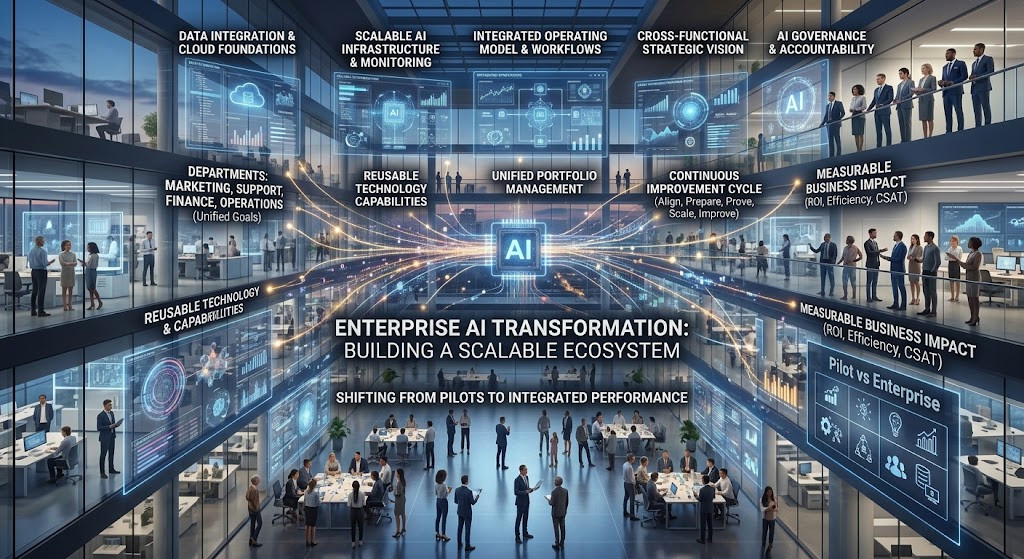
Leading in the Machine Age: The Future of AI Leadership Era
Leading in the Machine Age: The Future of AI Leadership Era
While AI is transforming organizations in multiple ways, its greatest contribution may not come in terms of technology, but in terms of the new requirements for decision-making, management, and leadership in conditions of permanent changes.
At the moment, AI systems are capable of performing research, analysis, content creation, forecasting, coding, processing, and managing repetitive tasks and activities.
The integration of all of these skills into daily operations opens up a possibility to process information and deliver outputs faster than would be possible without the use of artificial intelligence.
Yet the availability of more data doesn't mean better AI leadership.
What counts is to know what to do with it, which decisions to take with the help of the algorithms, and which ones require human judgement.
Also, there is a need for a good understanding of how to help people adjust to the new situation of coexisting with machines in the office.
That is why being an AI leader means having not only technological skills but also such fundamental qualities of an AI leader as judgment, strategic mind, ability to communicate, flexibility, empathy, and responsibility.
How AI Changes The Concept Of Leadership
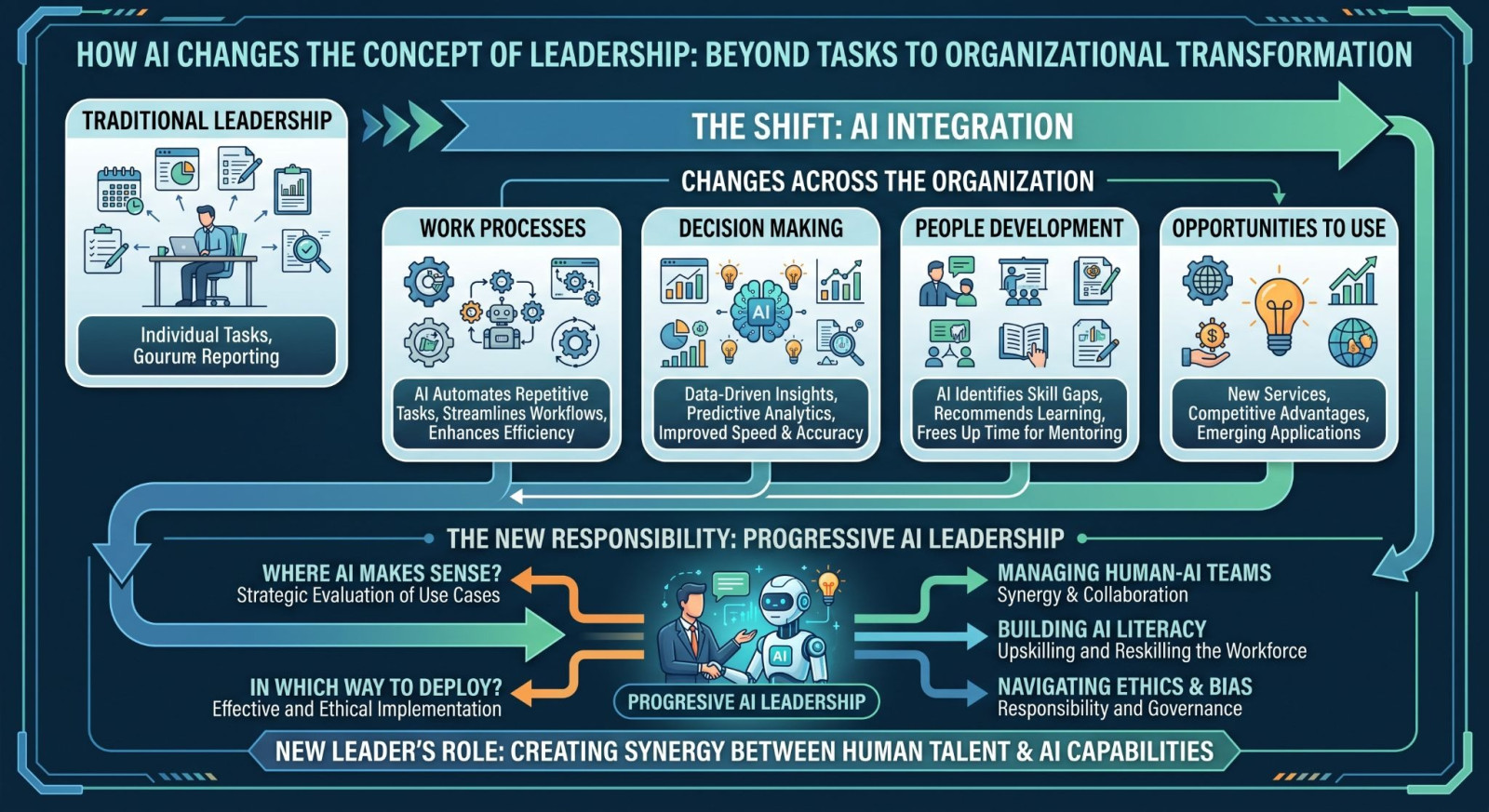
The changes do not occur only at the level of certain tasks, but also at the organizational level where AI affects the work process, decision making, people development, and opportunities to use
This implies a new responsibility for managers because the problem now becomes not only whether to employ AI within organizations, but also in which way and where AI makes sense under progressive AI leadership.
From Expert Decision-Maker to AI-Augmented Leader
For many years, leaders have depended on experience, institutional knowledge, specialized knowledge, and information obtained from their staff in making decisions.
AI can now be used to assist in some of these activities through arranging the information, recognizing patterns, comparing different scenarios, and creating solutions.
This doesn’t mean that the leader becomes unnecessary. What changes is the place where his focus should be placed.
Rather than wasting too much time on the collection and interpretation of information, the leader can devote more time to analyzing the implications of the information.
Strategic AI leadership should challenge assumptions, think about the implications, consequences, and ask whether a decision can be integrated into the overall goals of the organization.
The key difference here is in the process of creating information vs. making judgments.
AI can help in the former. The latter still belongs to leadership.
From Managing Tasks to Orchestrating People and Machines
Effective AI leadership would increasingly require coordination between various types of work processes.
The team could include people, AI assistants, automatic work processes, software, and other digital tools. Each of those might do some particular activity.
It is up to the leader to find the way those pieces are to fit together.
There are some processes that would be automated since they are routine and predictable.
Other activities would be assisted by AI but would still require human involvement.
There are activities that would stay exclusively human due to strategic nature, social component, moral values or other aspects.
Organizational design would become one of the critical AI leadership activities.
Instead of discussing who does some specific thing, humans or machines, we would need to figure out how to work together effectively.
From Stability to Continuous Adaptation
Classic leadership paradigms often assume that an organization can design a strategy, implement processes, and gradually improve them.
But AI creates a more dynamic situation.
Technology changes. People’s expectations change. New technologies emerge. Old processes can be reinvented. Skills that were relevant yesterday can be supplemented with other skills tomorrow.
Leaders need to develop organizations that are capable of learning and adaptation.
This does not imply jumping on each and every AI technology out there.
It implies developing an approach to experimenting, measuring, learning, and adapting.
The best AI leadership approach to technology is not perpetual reaction. It is developing a capacity for intelligent reactions.
The Core Leadership Skills of the AI Era
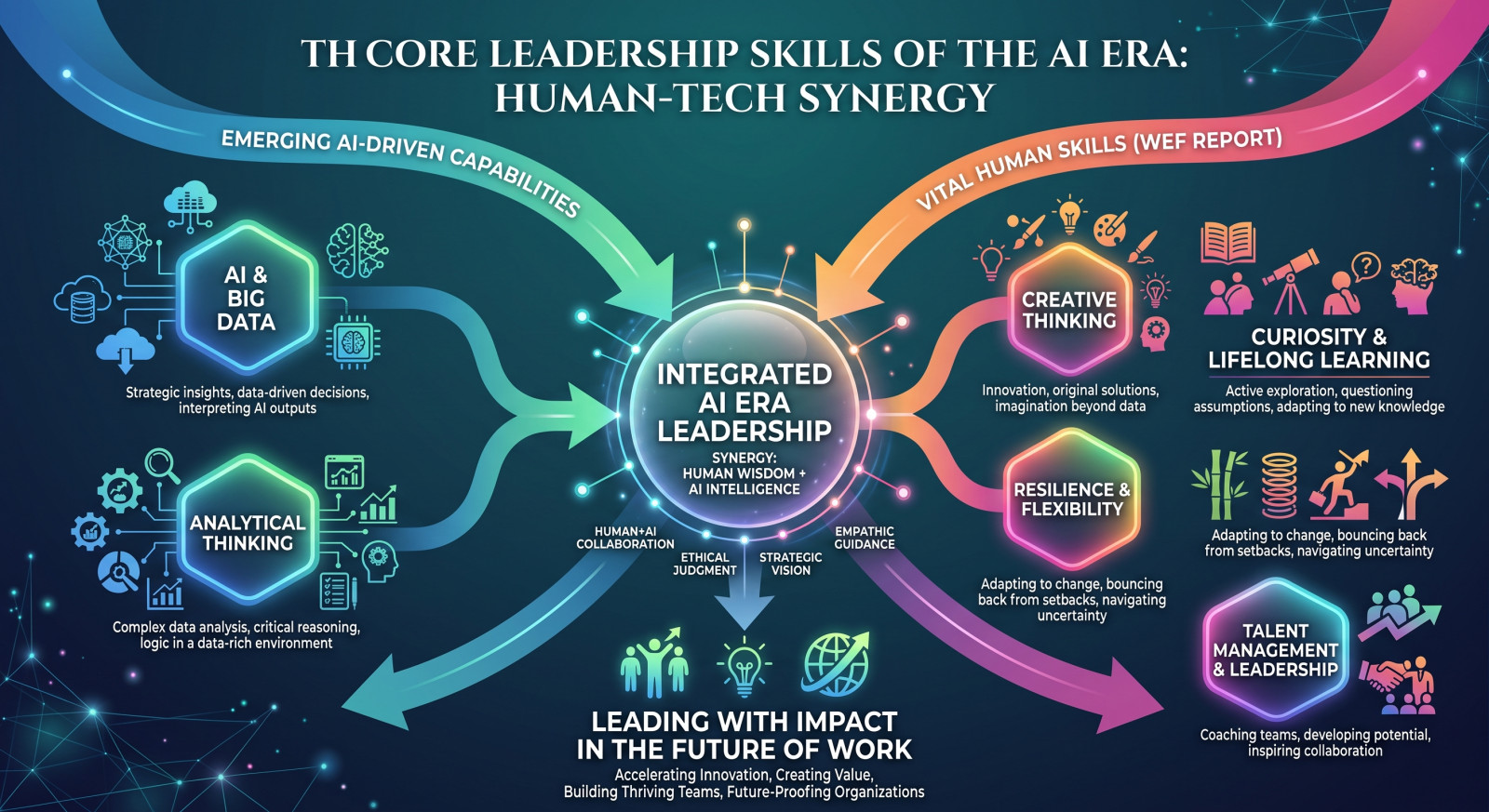
While AI influences the technologies that leaders have access to, it also influences the capabilities that leaders must develop.
According to the World Economic Forum's Future of Jobs Report 2025, AI and big data are some of the fastest growing skills along with creative thinking, resilience, flexibility, curiosity, analytical thinking, leadership, and talent management.
This is significant – human capability and technological capability are being developed hand-in-hand.
AI Literacy Without Becoming a Technologist
It is not necessary for leaders to become AI engineers.
What is necessary is that they be literate enough in AI to ask relevant questions.
This involves knowing the purpose of the AI model, its dependencies, possible mistakes, the way it should be tested, and what sorts of business problems are suited for AI solutions.
An AI-literate leader can have a meaningful conversation with tech teams without attempting to have the expertise of the technologists.
More significantly, the leader will be able to critically assess the AI proposal from the business perspective.
In other words, the leader would not only be able to raise the question of the possibility of construction of something, but also why it should be done and what it would lead to.
Strategic Thinking and AI Fluency
There are a tremendous number of potential uses for AI. Not all of them are worth investing in.
The task of the leader is to establish the connection between the AI solution and the organizational need.
As opposed to posing the question of "What can we do with AI?", the leader should ask himself, "What organizational problem can be solved with AI?"
This helps technology not become the strategy.
The leadership team may find a number of potential applications including elimination of routine tasks, improvement of access to the knowledge in the organization, customer service, information analysis, and assistance in performing difficult tasks by employees.
Still, the leader must consider the cost, risks, capabilities, and value of each application.
AI fluency should therefore go hand in hand with strategic thinking.
Critical Thinking and Judgment
The answer from the AI may be given very rapidly, that does not necessarily ensure correctness, pertinence, or wisdom of that answer.
It is necessary for the leadership to analyze the assumptions about the given information provided by AI and determine whether the recommendation would fit the organization.
This includes:
What data are there to support this recommendation?
What assumptions are used in the recommendation?
Is some information lacking?
What would be the consequence of the incorrect recommendation?
Who would be impacted by this decision?
Does it match our objectives and principles?
All the above-mentioned questions are particularly critical in case of uncertainty and important consequences of decisions.
Sound AI leadership is all about taking responsibility for making the right decision, not necessarily the quickest decision.
Communication and Influence
AI transformation has an impact on people rather than on systems.
Employees may ask themselves what will happen with their job. Managers may require redesign of the workflow.
New skills may be needed for teams. There may be some questions from the customers regarding the use of technology.
It is important for leaders to explain this to people.
There should be an understanding of what happens, what people should do, what resources they will get, and how their success will be evaluated.
It is important for communication to let employees voice their problems.
If the leader starts implementing AI transformation without giving explanations, then people will not understand. Communication must be viewed as a process by the leader for things to be much better.
Adaptability, Curiosity and Continuous Learning
The rapidity at which AI evolves is such that the leader cannot take for granted the knowledge they currently possess.
Curiosity turns into a tangible leadership competency.
Leaders have to stay open to learning about new capacities, challenge existing practices, experiment cautiously, and change their views if facts contradict them.
This does not mean being constantly exposed to new technologies.
It means having an attitude of AI leadership that implies continuous learning.
Human Judgment Will Become More Important, Not Less
Perhaps one of the greatest misconceptions regarding AI leadership involves the idea that improved technology means less human leadership.
As AI gets better at generating insights and facilitating decision-making, leaders will have more opportunities to pay attention to the areas of responsibility that cannot be delegated to any system.
AI Can Provide Insights for Decision-Making, but the Leader Will Have to Make the Decision
Take into account the following chain:
AI-generated insight → Human assessment → Decision-making by the leader → Organizational accountability
The system may be useful for a leader who wants to make a comparison or find out potential threats in advance.
Still, the leader will have to make the decision.
It is significant because the assumption is made about the fact that decisions which are being made by the organization affect real life of real people in one way or another. These people can be customers, employees, investors, partners, and so on.
Empathy, Trust, and Emotional Intelligence
Here in another situation, the manager needs to persuade his employee regarding the fact that he had to take such a decision to help him overcome his fear.
Everything requires its context.
Empathy allows the leader to better grasp how people experience change; emotional intelligence enables them to react to emotions properly; trust allows workers to be confident in their leader’s responsible decision-making.
AI can help with preparing for communication, analyzing, or acquiring information. Yet the relationship aspect remains.
In the age when technology takes on more and more tasks, good human interaction might become even more crucial.
Creativity and Vision
Leadership also entails figuring out what doesn’t even exist yet.
Even an organization that possesses vast quantities of information might not have a good sense of where to go.
Leaders envision possibilities, set priorities, question assumptions, and develop a sense of purpose regarding change.
AI can offer creative solutions. But leaders have to determine which solutions really count.
Imagination is just as important as making judgments.
In this regard, the most useful question posed by leaders about AI may be: “What are we aiming to create, and how can AI get us there?”
The New Model of Human-AI Collaboration
Leadership in the future will not be about a choice between human beings and AI.
It will be about creating productive collaboration between humans and artificial intelligence.
A 2025 structured review of leadership studies found that there are 24 competencies which pertain to leadership during the era of AI and noted communication and cooperation between humans and machines as vital skills for the leaders.
AI as a Thought Partner
A leader may use AI in order to question his or her own opinion on something.
For example, the leader may request AI to point out possible risks, to create an alternative scenario, to question assumptions or to give an argument from a different stakeholder's perspective.
This, of course, does not imply acceptance of the result as a fact.
In this case, AI becomes a tool of structured examination of various possibilities before making a decision.
AI as an Execution Partner
AI can also help cut down the time spent by leaders and workers on repetitive knowledge tasks.
This technology can help to draft documents, summarize data, arrange research findings, compile reports, draft first drafts, and assist in various routine operations.
The point is not only in saving minutes.
The bigger picture here is to direct people’s energy into doing tasks that need some decision-making skills, creativity, teamwork, relationship building, and strategizing.
If AI does more preparatory tasks, the leaders will have more time to work with their teams.
Knowing What Should Remain Human
Everything doesn’t need to be automated.
It will be beneficial to classify tasks into four categories:
Automate routine tasks where automation is feasible and manageable.
Enhance work when AI can assist a person in doing his/her job better without relieving him/her of responsibility.
Delegate decisions to AI-based systems in those cases when the scope of delegation is clear.
Let humans make decisions where strategic, ethical, social, and organizational considerations weigh heavily.
Such an approach avoids reducing AI implementation to an attempt to automate for automation's sake.
The objective is not to automate everything. The objective is good work.
How AI Is Reshaping the Role of Managers
Not only will AI impact the jobs of the CEO and other C-level executives.
It is bound to impact the day-to-day activities of managers as well.
Manager Becomes An Orchestration of Work
Up till now, managers had always invested considerable time in coordinating work, evaluating work, overseeing progress and tackling operational problems.
AI could help managers with some of these activities.
This makes it possible for managers to allocate their time to higher value-added activities like mentoring and problem solving.
The job of the manager is reduced from overseeing all activities to facilitating good performance.
Developing People in an AI-Enabled Workplace
As AI transforms jobs, managers must assist their employees in comprehending the transformation of their jobs.
This involves much more than the assignment of training programs.
The manager must know what skills the employee should acquire, the ways in which the AI can assist them and the areas that still require the human touch.
He must also ensure that they have the chance to exercise their judgment.
With AI taking care of most routine tasks, the employees would not get many opportunities to acquire certain skills through practice.
The anager must therefore create opportunities for them to solve problems, make decisions, get feedback and learn.
Talent development is the key element of AI leadership.
Outcome Measurement Rather Than Activities
AI will render traditional metrics of productivity useless.
With the technology taking less time to perform any task, the measurement of effort or the number of hours expended may no longer be useful for the leader to judge the contribution made.
Under progressive AI leadership, the manager must increasingly think in terms of the outcomes.
Did the work solve the customer's problem? Was the quality improved? Was unnecessary effort eliminated? Were organizational goals achieved? Was AI used responsibly?
Building an AI-Ready Leadership Culture
Culture defines how people will experiment with AI, deal with failures, communicate, and change.
Foster Culture of Responsible Experimentation
People must have freedom to explore applications of AI.
This experimentation must be within certain limits.
The management needs to set expectations regarding confidential data, precision, verification, protection, and responsible use.
Innovation and responsibility will become balanced.
Failure prevention is not the aim here. Learning through experiments without taking any unnecessary risks is the aim.
Make AI Governance a Leadership Responsibility
The issue of governance of AI technologies shouldn't be left solely to the technical department.
Leaders must have knowledge about their company's policies on accountability, data protection, human control, risks and responsible AI usage.
The details of this policy may be dependent on industry specifics, company infrastructure, type of data available and legislation.
What is important here is that the use of any AI technology should be owned.
Under robust AI leadership, there must be someone responsible for reviewing critical outputs, solving issues and making decisions if the output of the AI system is not acceptable.
Make Continuous Learning a Part of Company Culture
Training on AI technology can't be a one-time deal.
Tools change. Processes change. Capabilities change.
Employees need to learn continuously.
Leaders can foster this by organizing experiments, peer learning, mentoring, internal knowledge exchange and assessment of the impact of AI technologies on employees.
Learning culture reduces the impact of technological changes since employees are used to acquiring new skills.
A Practical Framework for Leading in the AI Era
There is no need to turn everything around at once. A systematic method could make AI implementation easier.
1. Defining the Business Problem
Start with the problem.
Define the process, customer problem, operational issue, or strategic gap that requires attention.
Do not begin by starting with a popular tool for its own sake.
Defining a problem will make the task of assessing the applicability of AI more meaningful.
2. Defining Where AI Can Make a Difference
After defining the problem, check whether AI can solve it.
Assess whether the benefits from speed, quality, information accessibility, consistency, customer experience, staff productivity, or decision-making can be achieved by means of AI.
The goal is not to prove the use of AI but to assess whether it makes sense from a business perspective.
3. Define Human and AI Roles
Describe how the AI system will be used and how humans will perform their roles.
Determine when human involvement is needed, which individuals have decision-making power and what actions to take in case the system provides the wrong answer.
Defining roles helps avoid misunderstandings as roles evolve.
4. Educate Your People
Staff must understand not only the technology itself but also the need for using the technology.
Educate staff with specific and relevant training.
Allow your people to try, to ask, and make mistakes.
AI will become a tool that helps people accomplish their job tasks rather than a technology that was imposed on them.
5. Set Up Governance and Metrics
Governance and metrics should be set up before scaling the AI initiative.
Determine how the outputs will be reviewed, how the risk will be managed, and what metrics will prove the success of the initiative.
Do not measure solely the adoption rate. Usage frequency does not equal value creation.
6. Learn and Adapt
Version one of the AI-driven workflow does not have to be the last.
Conduct regular reviews of the findings.
Find out from your employees what is working and where problems are occurring.
Effective AI leadership needs the openness to switch gears in case it becomes apparent that something is not working the way it should.
What the Future Leader Will Look Like
The future leader may not necessarily be the one that knows the most about technology.
What will matter increasingly is knowledge about the way of bringing together technology, people, strategy and judgment.
Less Focused on Knowing It All
Using AI will allow future leaders to have information available at hand and organized.
This means less pressure to be the holder of all the information.
But it means more pressure to know what information to look for and how to interpret it.
The leader is no longer a repository of information but the one providing context and judgment.
More Focused on Context and People
Technology can change processes fast. Humans require time to assimilate such changes.
It will be the responsibility of the future leader to provide reasons for making particular decisions, guide teams through uncertainty, develop skills and deal with conflict and loss of trust.
The centrality of people-oriented AI leadership is not diminished by the development of technology.
It is amplified as a result of technological changes impacting humans' work.
Comfortable Leading Through Uncertainty
The age of artificial intelligence will not give leaders a set playbook.
There will always be more to learn about new capabilities, business models, employee expectations, and applications of AI that can prove either helpful or ineffective.
Leaders will have to get used to learning on the job.
Leaders should be bold enough to take action; they shouldn’t be so confident that they become arrogant and look like they know everything.
In applying authentic AI leadership style, leaders should be modest enough to recognize their mistakes and correct them when needed.
Leadership Beyond the Machine
The leadership of the age of AI will not be about competing with the machine.
It will be about recognizing the value machines can provide and integrating their value to improve the organizations.
AI can process data, ideate, analyze, automate, and facilitate efficiency.
Those values can transform the way leaders use their time and the way organizations structure their tasks.
Leadership entails tasks that go beyond providing information.
The leaders must define directions, make tough decisions, foster trust, grow people, communicate amid uncertainties, and be accountable for significant decisions.
That is the reason why AI literacy should not be seen as a replacement of human leadership.
It should be seen as yet another value leaders have to integrate into their actions.
The organizations operating in the AI era will require leaders who will be capable of asking better questions, challenge their own assumptions, know about technology, grow people, and make wise decisions without an evident answer.
The machine era may impact the way AI leadership operates.
It will not eliminate the need for leadership.
It will increase the bar of expectations regarding its outcomes.
Frequently Asked Questions About Leadership in the AI Era
What changes are taking place due to AI regarding the future of leadership?
AI is bringing about changes in AI leadership through information processing, analysis, automation, and decision preparation. Leaders will be able to use these skills in order to save themselves from repetitive tasks and pay attention to strategies, judgments, development of employees, collaboration, and organizational changes.
What competencies should leaders have in the AI era?
Leaders should possess both AI and human abilities. Some of the important competencies required for AI leadership include strategic thinking, analytical thinking, communication, adaptability, creativity, critical thinking, talent development, emotional intelligence, and human-AI collaboration guidance.
Will AI take over human leadership?
While there are some leadership activities that can be automated or augmented by AI, leadership activities include determining the course of action, making decisions, gaining trust, developing people, and being accountable. Such activities necessitate the presence of human AI leadership despite advancements in AI.
Why is human judgment necessary in AI-powered leadership?
The output produced by AI technologies has to be made sense of within the business and organizational context. The leader in the organization will have to assess assumptions, weigh in on the consequence, balance conflicting factors, and decide if the recommendation fits the organizational objective.
How can leaders help their organizations adopt AI?
There are certain steps a leader may take in preparing their organization for AI technology through proactive AI leadership. Some of these steps include identifying key business problems, assessing the value of AI, determining human and AI roles, training staff, and many others.