Managing Remote Freelancers: Tips for Seamless Communication and Collaboration
Managing Remote Freelancers: Tips for Seamless Communication and Collaboration
The New Paradigm of Distributed Talent
Remote freelancers are helping businesses scale faster than ever, but managing distributed teams effectively requires more than hiring talented people. Strong communication, structured onboarding, and clear collaboration systems are essential for long-term success .
Freelance business is becoming an integral part of business-to-business scalability. Today companies use distributed teams not just to save resources, but to have access to expert knowledge that accelerates innovations. But at the same time, there is a difficult question about the way in which a company can combine flexibility and operational consistency.
This is made even more difficult by the lack of common physical location and corresponding division of work processes and their results. The reality is that it is only the half of the success to hire good professionals. Success in remote work requires a threefold approach: structure, specific tools and proactive communication.
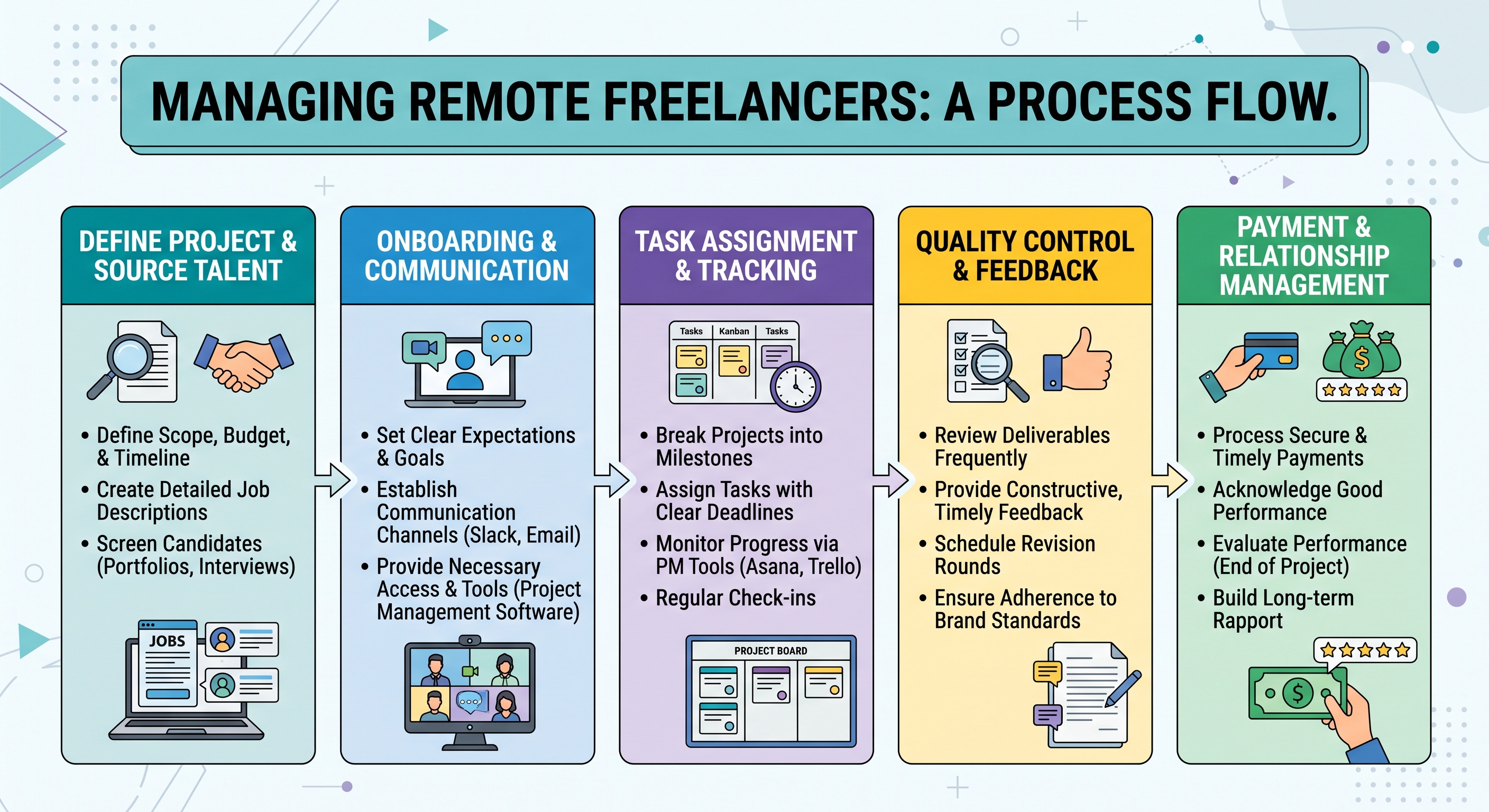
Companies need to create a structure that will allow them not only to accomplish projects, but also to build valuable relationships. This article will talk about creating such a structure.
Effective Onboarding and Integration
The onboarding process sets the pace for the rest of the relationship. It is critical to have an effective welcome kit because it becomes your “single source of truth.” Without this kit, the contractor will be forced to guess. The welcome kit must include all the vital guidelines of the brand, its mission, and its values.
Developing a Comprehensive Freelancer Welcome Packet
Of equal importance is the technical documentation. Instructions for access to the servers, the Content Management System (CMS), and the company’s databases ensure that there is no downtime and that you do not face problems such as “access denied.” It is essential to establish expectations about “Tone of Voice” for content developers. Be it an authoritative and technical tone or a conversational tone, having examples ensures consistency throughout the deliverables.
Establishing the Legal and Administrative Framework
Friction in operations is often due to ambiguous expectations. Before even a line of code is written or a sentence typed, the administrative groundwork needs to be laid solidly. It’s imperative that you streamline MSAs and SOWs. The SOW needs to be detailed down to deliverables, time frames, and billing schedules.
Compliance is yet another important issue to consider while expanding into international territories. Taxation issues and ensuring that remote freelancers from other countries have work permits might be challenging, but using platforms that include features of compliance helps you avoid any legal complications.
It is crucial to protect intellectual property. Strong NDAs and data security regulations help you maintain the confidentiality of your methodology and ensure that your client’s data is protected no matter where your freelancer works.
Mastering Communication in a Borderless Environment
The move towards the distributed work force turns communication into a deliberate process rather than an organic one. Communication in a borderless world is no longer "always on" but depends on your awareness of the way you communicate. It is vital to learn the fine art of synchronization of asynchronous and synchronous processes.
Synchronous vs. Asynchronous Communication Strategies
Observing the “Deep Work” period becomes crucial for remote freelancers who normally work for different clients. As for the knowledge workers, continuous disruptions because of using instant messaging services might lead to decreased productivity and slower output.
It is crucial for the managers to establish the “no-meetings” periods or core hours, which will be synchronized in different time zones.
When communication is necessary, choose the channel strategically:
-
Instant Messaging (Slack/Teams): Hold off using these channels only for questions, status updates, or chit-chatting among teammates. These are not to be used as storage of important documents and feedback related to the project.
-
Video Conferences (Zoom/Google Meet): High bandwidth, high energy consumption meetings. Use these for kick-off meetings and strategic discussions only or building relationships. If an issue can be sorted out through email or instant message, then no need for a meeting.
-
Asynchronous Video (Loom): Game changer in remote management practices. When a designer creates a video of their screen-sharing session of a design, a coding process or a feedback, then there will be no need to have a synchronous meeting anymore. The freelancer can absorb the material at their own pace and time.
Overcoming Cultural and Linguistic Barriers
Miscommunication is another common problem while working with an international freelance talent pool. To solve this, simplify your language. Try to avoid idioms or any other phrases specific to your culture or organization since they might not transfer well into the new environment.
It would be best if you communicated directly and clearly through English instructions only.If you want to communicate complex processes, try visual communication and not email explanations. A screenshot or screen capture of three minutes is worth more than three paragraphs of text in an email.
The remote freelancer will find these visual references very useful and helpful at any time in the process and will save you from unnecessary back and forth due to misunderstandings.
The final tip to consider is the pulse check sessions. These are not to control the freelancer, but just to keep up with their process and problems.
Asking "Do you have any blockers? Have you received all the necessary resources?" instead of focusing only on output will help to maintain partnership relationships and make sure the remote freelancers have all the necessary information for the successful completion of the task.
Creating Specialized Guidelines for Consistent Output
Implementing Comprehensive SEO and Content Guidelines
Consistency of production does not come by luck; it comes from clear and understandable instructions that help to strike a balance between creativity and the requirements of the brand. In case you work with remote freelancers, the best strategy to make sure you get the good end-product is to create a well-structured content frame.
The use of proper headings (H1-H3) and lists becomes crucial not only for search engines but also for users. To start with, it is important for algorithms as it provides them with the semantic structure of the text and makes it clear which topics are more important. Moreover, it helps people avoid the wall of text.
Besides structure, there is the issue of nuances related to keyword optimization. In the current state of affairs, the SEO practice has transcended the days when keywords were simply stuffed within the text to no avail to the reader and to the detriment of search engines that penalized for that practice.
It is better to concentrate efforts on organic placement and relevancy of the keywords to the context. Remote Freelancers should be taught to consider the “flow” of the story and use their primary and secondary keywords where needed.
But technical SEO does not end there; it also includes the optimization of the metadata that dictates how the content is presented on search engine result pages. The process of standardizing the generation of meta tags, titles, and URLs is an essential step in the process.
The page title serves as a digital billboard, while the URL serves as a map for both the bots and the user. By setting the template or minimum requirements in characters for these elements, managers will make sure all content is optimized at indexation time.
Even the most optimized content can suffer if not properly executed. A formal “Review Before Publishing” process must be carried out to ensure that mistakes in grammar and punctuation and lack of coherence in general are addressed before publishing the content.
This step acts as the final filter for quality assurance and ensures that the brand maintains its authority in terms of voice. With such a review process, companies can uphold their professionalism.
Utilizing Checklists for Quality Assurance
Checklists will be the best tool in minimizing the cognitive overload and making sure that there are no mistakes made which could have been avoided in the handoff procedure. Utilizing the "Readiness for Submission" checklist will ensure that the freelancer does the self-inspection before handing off the content to the manager.
Some important checkpoints would be functionality of links, compliance with image alt text standards, and conformation to the style guide. By sorting out the technicalities, the process becomes more efficient for the manager and the freelancer.
To fulfill the requirements of both search algorithms and humans, it is required that it be uniquely and extensively written. With such an abundance of AI generated junk, it is important for the content to provide original information or unique expertise which cannot be obtained anywhere else.
The quality control process will ensure that the content fulfills the needs of the users by answering all their queries related to their search query. Having a well-defined "Definition of Done" is essential in ensuring that everyone's expectations are met concerning the technical and creative aspects of projects.
A project is not "done" just because there is a submission; rather, the project can only be considered "done" when all the requirements in the checklist are satisfied and it is ready for use right away. In this way, the definition of these parameters will remove any confusion about the scope of the project at the start.
Project Management and Collaboration Frameworks
Selecting the Right Tech Stack for Remote Management
The scaling of a distributed workforce demands an advanced digital setup. Using disorganized emails to keep track of all project activities will be disastrous, leading to delays, lost information, and inefficiencies.
Ensure all project management activities take place from a single platform where you can get your "Single Source of Truth". Regarding the management of tasks, select a tool that will fit your workflow. Trello would suffice for a straightforward task management process where you need to use Kanban boards, whereas Asana and Monday.com will provide more features for complex processes.
Documentation should similarly be kept outside of transitory communication platforms. Tools such as Notion and Confluence enable you to create a living knowledge repository in which all SOPs, brand guidelines, and project specs can be found whenever required, thus avoiding the so-called "knowledge silo" issue, which implies keeping vital information in the inbox of one particular employee only.
It is important not to forget about financial integration. The use of tools like Harvest and Clockify will enable you to track your hours directly from the project management board, thus making invoicing more precise and trustful.
Implementing Agile Methodologies for Remote Freelancers
Agile is frequently wrongly used for software engineering alone, yet the essence of Agile lies in the continuous iterative progress and adaptation, both of which make a perfect fit when it comes to contract work.
Dividing a big project into smaller sprints will allow you to keep going and not run into "black box" problems when a freelancer vanishes for several weeks and comes back with unsatisfactory results. In case of part-time or contract teams, adjust the standard practice of two-week sprint by the rhythm of deliverables.
Conduct stand-ups every week or every second week to discuss the current state and remove blockers. Should the schedules be really mismatched, substitute live stand-ups with asynchronous updates using videos or status updates on project boards.
Agile management aids in battling the "Scope Creep" phenomenon that is a hidden danger to the relationship between the client and the freelancer. Ad-hoc approaches lead to budget expansion and broken deadlines.
Having implemented a policy stating that any alteration of the deliverable needs to be accompanied by an SOW update before proceeding with the execution, you will keep control over the scope of your project and appreciate the valuable working time of the freelancer.
This will ensure that the delivered output is in line with the value provided. Through the combination of appropriate technology and Agile practices, you build a perfect link between your own team and outside experts.
The Art of Feedback: Driving Continuous Improvement
Providing Constructive, Actionable Critiques
But despite being a driving force for quality, it is often misunderstood or delayed when giving feedback in a remote setting. Effective managers discard the "sandwich method" of criticism and go for the "Radical Candor."
In it, direct and clear feedback is delivered with sincere concern and warmth. In case of providing feedback on someone's job performance remotely, be specific. Instead of generic suggestions such as "make this more punchy," give specific instructions that will help them edit and develop: "tighten up the sentence structure to accentuate the call to action and employ more active verbs."
Use collaborative and cloud-based software. Instead of sending emails containing your suggestions, utilize Google Docs, Notion, Figma and other similar services to write your comments right onto the document itself. This way, you will ensure that your feedback is contextual and easily verifiable.
Go beyond personal opinion and analyze relevant metrics and KPIs of your employees' performance. From conversion rates for copywriters to code-merge rates for developers.
Cultivating a Sense of Belonging
One misconception about freelancing is the approach to viewing contractors as “disposable” means of production. The latter leads to high turnover rates and poor quality of the service provided. The development of a sense of belonging makes contractors feel like a committed partner.
Include them into the communication process. If a contractor is critical to your project, invite their to the team meetings and briefs about the project’s results or influence on the whole company.
The mentioned actions turn the project for the contractor into something more than a “task to do” – into something that can bring some value. Make sure you appreciate the good performance of a contractor. Even the shout out on Slack and performance bonuses will show that you highly estimate their contribution. As a result, you will have at your disposal a dependable, high-quality source of talents.
Payments and Incentives
The financial side of remote management becomes a key factor in gaining or destroying trust of a freelancer. In the era of globalization, prompt payment becomes a symbol of respect for a profession. If an organization wants to develop and flourish, it needs to get rid of manual invoicing and implement automation of global payments.
Systems like Wise, Payoneer, PayPal provide the appropriate technology to conduct fast and secure cross-border transactions. This approach will ensure timely and regular payments to contractors and make the life of finance departments easier, and also demonstrate your reliability to your team.
Apart from the “how” of the transaction, the timing of such transactions needs to be strategically managed to make sure that corporate cash flow is balanced with retaining the freelancers. The terms of payment such as Net-15 and Net-30 can help to plan ahead. In case of high stakes projects or lengthy projects, payments based on milestones are best.
Since money will be tied to specific and verifiable achievements, you have a quality control system built right into your system, thus reducing the risk of failing the whole project.
Apart from the “how” of the transaction, the timing of such transactions needs to be strategically managed to make sure that corporate cash flow is balanced with retaining the remote freelancers. The terms of payment such as Net-15 and Net-30 can help to plan ahead.
In case of high stakes projects or lengthy projects, payments based on milestones are best. Since money will be tied to specific and verifiable achievements, you have a quality control system built right into your system, thus reducing the risk of failing the whole project.
Scaling Your Business Through Remote Expertise
The integration of remote freelancers requires the existence of three crucial elements: structure, communication, and respect. The presence of a well-designed structure guarantees that all members have been integrated into the culture and standards of the business right from the first moment.
When such structure is accompanied by well thought out methods of communication that incorporate both synchronous and asynchronous elements, businesses are able to overcome the usual difficulties of remote working.
It is respect that creates a significant paradigm shift for businesses when they stop treating freelancers as simple contractors and start valuing them as professionals who deserve respect. Those companies that succeed in combining the internal stability of the company with the flexibility of outside specialists will gain substantial competitive advantages in the growing borderless economy.
By creating the necessary infrastructure and environment for work-at-a-distance personnel, corporate executives will turn their human resources strategy into the source of innovative power of their company.
The shift from using freelancers merely as an auxiliary source of labor to their collaboration as indispensable partners of the firm will determine its long-term success. A managed freelancer is not a resource only but a high-performing partner of the firm.
Frequently Asked Questions (FAQ)
1. What is the biggest hurdle in handling remote freelancers? The main issue would be in creating operational consistency and alignment in work processes without any common physical place where there could be fragmentation in communication and inconsistency in project results.
2. Why is a welcome packet important? The main reason for using such a packet would be in providing contractors with all necessary information related to the "why" behind their work from day one.
3. How do you strike a balance between synchronous and asynchronous communication? Use asynchronous channels for communication when giving any feedback not being urgent and save synchronous communication for strategic discussions and kick-offs.
4. Under what circumstances should video conferencing be used? Use video when relationship building is necessary; use it for strategy sessions involving high bandwidth to make sure that all questions are cleared.
5. How can you address language or cultural challenges? Keep language clear of idiomatic expressions and avoid jargon; use annotated screenshots and/or screen capture videos to clarify your context.
6. In what way do checklists contribute to quality assurance? Checklists help keep your mind free from the burden of checking details, thus helping to eliminate mistakes.
7. How will you manage the feedback process for the remote freelancers? Follow “Radical Candor” by delivering direct, specific, and actionable critique via collaboration tools to guarantee contextual and measurable feedback.
8. What is the advantage of incorporating your freelancers in team meetings? Inclusion helps build a feeling of belonging, which makes their mindset shift from task accomplishment to value creation as valued partners in the company’s journey.
9. How will you ensure punctual payments for the international freelancers? Use automated international payments software and set clear milestones for payment disbursement.
10. What is the definition of a successful remote freelancer relationship? The relationship can be termed as successful if there is respect, structure, and productivity; the freelancer acts as an extension of the core team members.