The Power of AI in Talent Acquisition: A Modern Guide for 2026
The Power of AI in Talent Acquisition: A Modern Guide for 2026
1. Overview
The conventional recruitment scene has flaws. In every industry, there’s a growing problem of inefficiency due to manual sourcing, piles of non-compliant CVs and slow-to-hire processes that sap enterprise energy and irritate hiring managers.
In such a world where only nimble enterprises become leaders, conventional recruitment practices fail to provide talent needed in time.
Human resources used to be all about administration for decades. But in the era of artificial intelligence and machine learning, HR is finally getting what it deserves: its place among the key elements of strategic planning.
Through automation of tedious tasks, prediction of future performance and elimination of bias, AI in talent acquisition allows the workforce to scale as never before.
This is where visionary platforms like Gigmint.ai make the crucial connection between human knowledge and intelligent automation.
Tailored for the needs of contemporary organizations, Gigmint.ai turns hiring into an instrument of sustainable growth rather than a burdensome task.
Throughout this extensive guide, we are going to discuss how AI is reshaping the entire process of recruitment in terms of five essential aspects:
1) Radical Efficiency: Automation of top-of-funnel operations to reduce time-to-hire.
2) High-Quality of Hire: Using analytics to optimize hiring.
3) Uncompromised DEI: Removing cognitive biases to create diverse workplaces.
4) Best Candidate Experience: Providing continuous interaction and transparency.
5) Future Outlook: Balancing technological power and human leadership.
2. The Evolution of Recruitment: From Manual to Intelligent
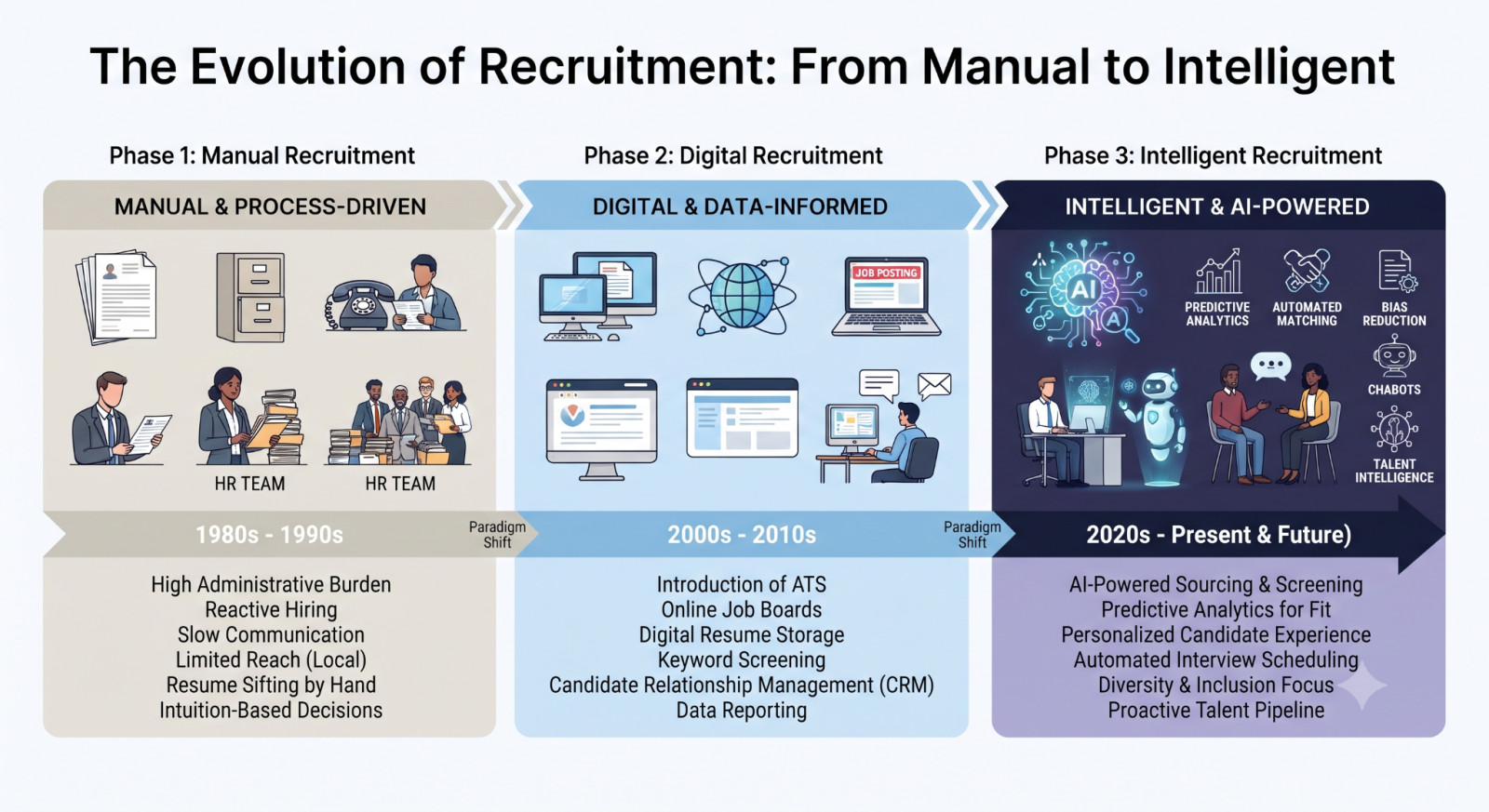
There has been an enormous change in structure within the field of talent acquisition in the past decades. Comprehending this evolution becomes critical when one seeks to understand why artificial intelligence is not just another technological fad, but a paradigm shift in the workforce of enterprises today.
A Quick Recap: From Paper to Basic ATS
It has only been some time since recruitment became a completely analog process. Human Resource Management departments used piles of paper resumes stored in actual file cabinets, index cards, and word-of-mouth connections.
With the rise of the Internet, came online job boards that revolutionized the distribution of positions but led to a disaster of information management by creating a tremendous amount of unstructured data.
In order to manage this wave of information, companies started using the first generation of Applicant Tracking Systems (ATS). Although those were advanced database systems able to store resumes, they remained mere electronic filing cabinets unable to interpret them.
The Bottlenecks of Legacy ATS
As the labor market changed to become a highly dynamic environment, which was characterized by telecommuting, unique skills, and quick job generation, traditional ATS systems started exhibiting considerable structural deficiencies.
The conventional ATS systems depend almost entirely on hard, binary keyword matching. Should a candidate’s resume fail to have an exact combination of the keywords entered by the recruiter, such as “project management” and “program leadership,” the ATS will automatically reject the candidate's application.
Such rigid system design will result in high false-negatives. The right candidates will always be automatically filtered out due to the difference in the phraseology used, but the wrong ones, through keyword stuffing of the resumes, will manage to get past the filtering stage. Legacy ATS systems have no predictive value for the real-life performance of the candidate.
Enter AI and Machine Learning
AI and ML turn traditional candidate screening upside down because while conventional solutions are only capable of doing simple text matching, the most advanced AI algorithms are using NLP techniques and contextual analysis to understand the meaning behind a resume.
AI understands the career path and context, industry jargon, and the skills that could be easily transferred from one field to another regardless of different job titles. With behavioral analysis, sentiment and deep skills adjacency, the AI solution goes beyond the formatting and digs into real capabilities.
Strategic Paradigm Shift
In general, the use of AI means shifting from the administrative task to a strategic solution that will help to build a growth engine out of talent acquisition processes.
Instead of manually filtering through countless resumes and spending weeks on unqualified candidates, the talent acquisition team can become strategic consultants, able to predict their hiring needs, brand their companies and recruit the best candidates ahead of competition.
3. Core Benefits of AI in Talent Acquisition
A. Radically Reducing Time-to-Hire and Cost-per-Hire
The first and most apparent effect of introducing AI to modern recruiting processes is the huge reduction in time-to-hire and, consequently, in cost-per-hire.
Under a conventional talent acquisition system, human recruiters waste 60 percent of their working time on tedious and repetitive administration that includes sorting out hundreds of applicants, who do not even qualify for an interview; composing and sending emails about scheduling interviews, etc.
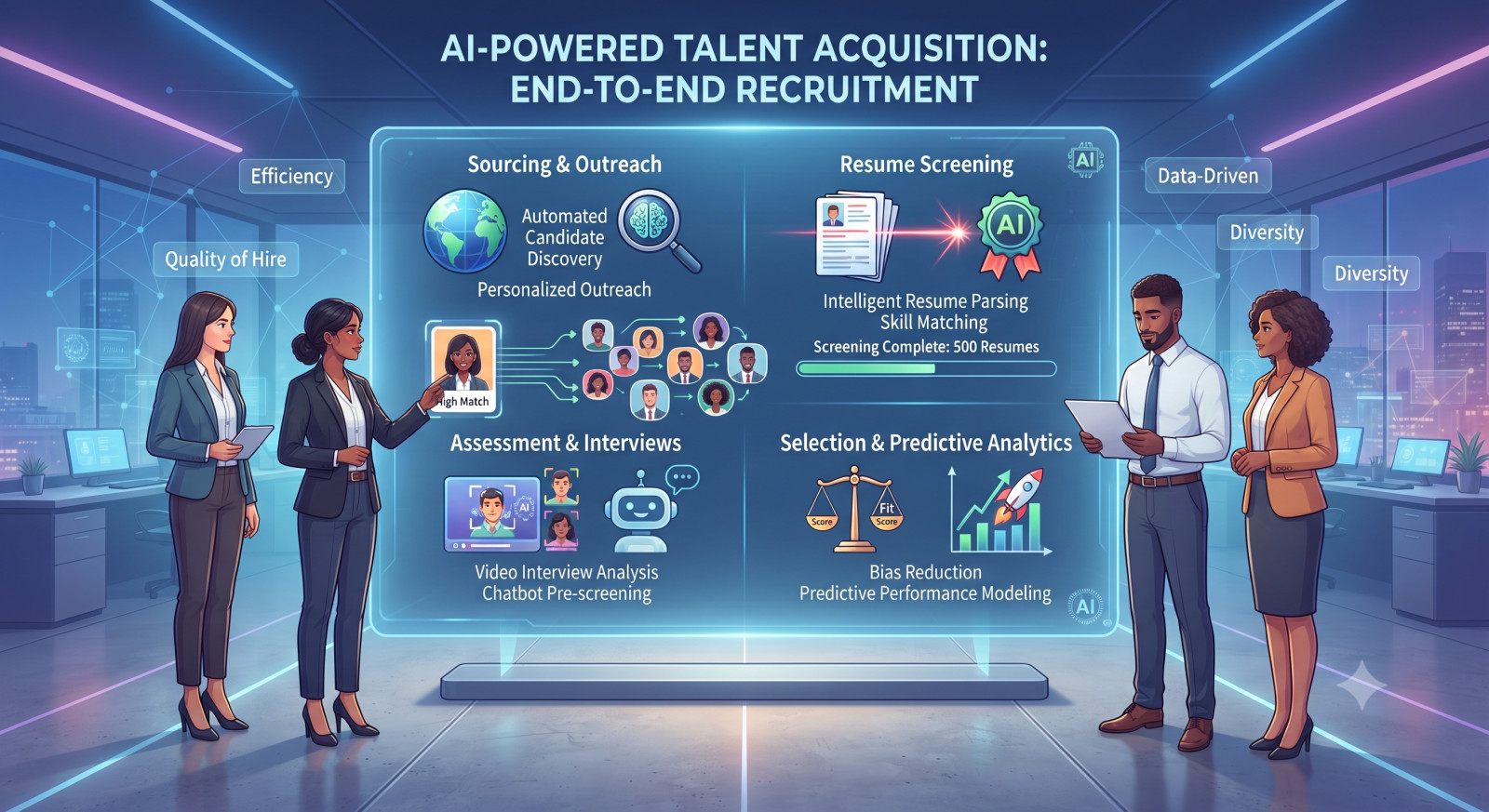
With the help of AI-powered recruiting software, the above-described friction points become automated, thus increasing the speed of the whole process. The automated sourcing systems automatically search for candidates across the globe who are suitable for the required position.
Intelligent resume screening programs assess thousands of applications within seconds instead of weeks, applying natural language processing technology to measure candidate relevance instead of matching simple keywords.
Industry standards and cases have proven that companies with efficient AI-based recruitment technologies get a hiring cycle shortened by up to 50%.
In the absence of bureaucracy, such tools enable recruiters to switch their attention completely to interaction and strategic communication with candidates rather than being bogged down by paperwork.
B. Elevating Quality of Hire through Predictive Analytics
Being able to recruit people quickly is not the whole solution to the problem; the ability to make sure that such hires would be successful and would grow in the company is what makes the difference and brings sustainable value to businesses.
Classical recruitment methods place too much emphasis on gut feelings and intuitions that come out of one-on-one interviews—research has proven that such a method is highly prone to personal biases and lacks predictive validity as well.
With machine learning algorithms, all that changes dramatically because of the use of predictive analytics. Through the examination of an employee's past performance, longevity at work, achievements of training programs, and successful project completion, it is possible to determine which traits and skills are really needed to perform successfully in certain positions within the company.
For this very reason, this approach can be used for finding the talented employees who might not have been found through normal selection owing to their well-respected degree or experience.
C. Eliminating Unconscious Bias and Promoting Diversity, Equity, and Inclusion (DEI)
Human cognitive bias is an intrinsic issue when it comes to conducting manual hiring processes. Inevitably, AI-assisted screening can reduce some forms of human bias, but poorly designed or biased training data can also reproduce or amplify existing disparities, thus reducing the number of potential candidates and creating homogenous workspaces.
Artificial intelligence helps to overcome such biases when ethical measures are employed for algorithm auditing and training of unbiased algorithms.
By following certain protocols of screening, modern hiring tools can ensure anonymous assessment of the candidates by automatically hiding their names, gender, photos, and the names of universities where they studied during the early stages of screening.
This way, the candidate's qualifications are assessed exclusively based on their skills. Moreover, artificial intelligence contributes to the creation of more inclusive and fair work environments based on diverse data sets.
D. Transforming the Candidate Experience
In today’s highly competitive job market, the applicants, especially those in sought-after professions such as software engineers, data scientists, healthcare professionals, or other niche service providers, have options.
Lack of transparency, or poor responsiveness of the hiring process might harm the brand image of the employer and drive away their best applicants.
AI chatbots are instrumental in changing the hiring process from a corporate challenge into a convenient experience for the candidate. The 24/7 availability of the bot allows them to quickly respond to any inquiries of the applicant, schedule an initial interview and lead them through complex application procedures.
What is more, AI can reduce the application black hole by providing candidates with timely updates, automated communication, and clearer feedback throughout the hiring process, by providing instant updates on the progress made by the applicant, clear communication channels and feedback loops.
Seamless and technological application process ensures that the best applicants stay engaged throughout the process and improves the employer's image as well.
4. Deep Dive: Key AI Technologies Reshaping the Hiring Funnel
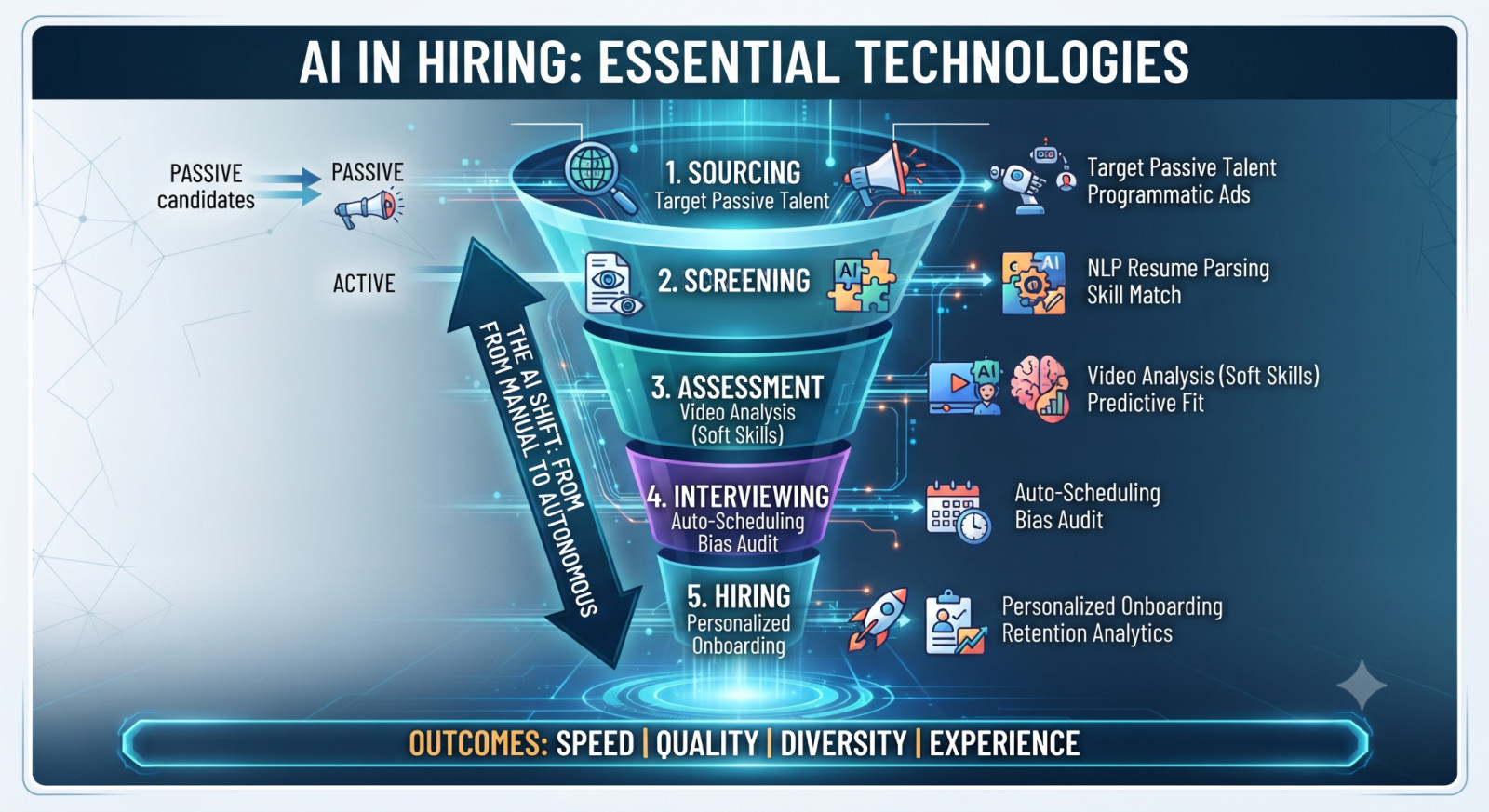
Deep Dive: Key AI Technologies Reshaping the Hiring Funnel
The swift development of artificial intelligence has led to a shift in recruitment from basic automation processes to cutting-edge technologies.
Modern recruitment is based on an array of innovative technological tools that dramatically alter the way in which companies approach the process of attracting, evaluating, and hiring their best employees.
In order to use such technologies effectively as part of the basic hiring process, HR managers have an opportunity to evolve from passive controllers to active strategists. The knowledge about the technology's mechanism is critical for every company utilizing AI-based recruiting.
Natural Language Processing (NLP) in Resume Parsing: Beyond Simple String Matching
Applicant Tracking Systems (ATSs), in their history, utilized simple keyword search engines. In case the keyword "Python programming" did not appear on the candidate's resume, the application would not be further processed.
Even if the person had years of experience working with languages such as Java or C++ and would not find it difficult to move into Python programming. Such systems have caused numerous missed opportunities because of the valuable experience that has been overlooked.
The implementation of Natural Language Processing (NLP) into resume parsing is revolutionary as the system can go beyond the mere counting of words and understand what the candidate means.
One will understand that the person who was leading a project that included the digital transformation of an entire company is skilled in management, strategic planning, and so on.
Another function of NLP is the possibility to see whether the person has been moving forward in his/her career, whether it has been a period of stability in terms of job positions, etc.
Automated Interview Intelligence and Video Analysis
Traditionally, the initial stage of the interviewing process has always been considered one of the most laborious and subjective bottlenecks of the entire recruitment cycle.
It takes several weeks to coordinate schedules among different interviewers, not to mention that human interviewers are highly vulnerable to unconscious bias, exhaustion and loss of focus.
Automation technologies of the interview intelligence and video analysis provide automation of this crucial step due to the structured testing of candidates and intelligent evaluation metrics.
It is based on the analysis of pre-recorded or remote video interviews with regard to verbal responses, semantic competence and structural integrity of speech.
Instead of human subjective evaluation, AI models transcribe the candidate’s answers and provide their analysis with regard to depth of knowledge, rationality and compliance with requirements.
In technical industries, AI-based testing environments are combined with behavioral analysis to estimate problem solving methodology in real time. The assessment is performed according to the standards that take into account both technical knowledge and ability to communicate clearly.
A reliable baseline of evaluation is provided for each candidate, which allows avoiding additional screening calls and selecting best-suited candidates for further interviews.
Candidate Sourcing Bots: Active Outbound Mining of Passive Talent Pools
The best talents are not always actively searching for a job opening. Excellent engineers, niche data scientists, and seasoned executives are usually already gainfully employed, which means that conventional inbound recruitment methods through online job boards can attract only a small percentage of the total market pool.
In order to capture such an illusive market segment, companies must employ a more proactive and data-oriented outbound sourcing strategy.
Sourcing bots are tools that can help talent acquisition teams in the process of finding passive candidates in their targeted industries. They continuously search millions of digital footprints left by potential candidates, including code on GitHub pages, publications in scientific journals, profiles on social media, and portfolios.
While the regular keyword search could generate hundreds of useless profiles, the smart sourcing bot will use machine learning algorithms to determine what is the key of success of an excellent candidate in this particular industry and target the most qualified individuals.
Programmatic Job Advertising: AI-Driven Budget Optimization
Job advertisements on many mass and specialized boards lead to excessive recruitment budgets with very poor efficiency in most cases. Managing bids manually, changing targeting criteria, and tracking conversion ratios in numerous channels are ineffective and susceptible to human mistakes.
Programmatic recruiting solves this problem through the use of machine learning algorithms that enable automation and optimization of ad spends in real time. Instead of posting a job vacancy, programmatic recruiting platforms buy, publish, and optimize recruitment ads on the Internet based on real-time data of supply and demand for talent.
In case when a specific job position needs unique skills, the intelligent algorithm reallocates recruitment budgets to specialized niches. In contrast, if a certain job position attracts too many candidates, the system cuts down the budget to save costs.
Due to constant monitoring of cost per applicant, percentage of applicants' completion, and the quality of hires, programmatic recruiting makes sure that each recruitment budget is used most effectively.
5. Overcoming Challenges and Ethical Considerations in AI Recruitment
Despite the numerous advantages that come from the implementation of artificial intelligence in talent acquisition, such implementation poses difficult challenges that should not be overlooked.
The use of highly sophisticated algorithms in making vital human resource decisions in which people's lives and careers depend can hardly do without close monitoring, ethical considerations, and risk management.
Talent managers have to overcome three major obstacles when trying to apply artificial intelligence in their work safely. These obstacles are the "Black Box" challenge, strict data privacy regulations, and human touch in hiring.
The "Black Box" Problem: The Need for Explainable AI
Another major issue when it comes to recruitment technologies is what's known as the "Black Box" problem. Some of the most sophisticated machine learning algorithms, especially those using deep learning methods, consist of multi-layer neural networks that work according to rules known only to the creator himself. If a certain applicant is not hired or gets a poor compatibility score, the algorithm will not be able to provide a reason.
It's absolutely unacceptable in the case of high-stakes recruitment. Employers should require using Explainable Artificial Intelligence (XAI) systems capable of tracing all algorithmic outputs.
Both recruiters and job applicants should have the opportunity to find out the exact factors – such as competencies, project experience, and certificates – that affected their evaluation. It is the only way to make sure that there is accountability and trust when it comes to job candidates.
Data Privacy and Compliance: Understanding Global Regulations
The data that is collected in recruitment is definitely some of the most sensitive data a company can have.
This data includes past employment records, communication contacts, behavioral analysis, as well as more advanced forms of data in the form of biometric information collected through video interviews. Inevitably, therefore, the use of AI comes with complex layers of global regulation and compliance issues.
Companies have to be very compliant with data protection legislation, such as the General Data Protection Regulation (GDPR) in the European Union, which gives people rights to explanation and informed consent when automated decisions are made.
Regulators have been aggressively going after algorithmic discrimination. In the United States, for example, companies that use recruiting algorithms are strictly liable under the EEOC as well as local AI laws.
Maintaining the Human Element: Augmentation, Not Replacement
What may perhaps be the biggest trap in AI usage could be the urge to automate the entire process of hiring. Algorithms are excellent for analysis and processing of data but are inherently bereft of human traits like emotional intelligence, empathy, and intuition.
Technology needs to be understood only as a tool of augmentation and not replacement of human recruiters.
It can do a fine job of filtering down the pool of candidates and marking out high calibre candidates but the final assessment of whether there is a cultural fit and potential for leadership needs to be done by humans. Human empathy would help ensure that candidates are seen as human beings and not mere statistics.
6. How Gigmint.ai is Pioneering the Future of Talent Acquisition
Now that artificial intelligence has moved on from being a gimmick to becoming an indispensable tool, it is not enough to just have software applications here and there—what is needed is an intelligent system that has been designed to meet the demands of modern times.
This is where Gigmint.ai comes in, as a fully-fledged talent acquisition platform that is built from scratch to combine human skills with advanced machine learning techniques.
Platform Overview: Built for Modern, Agile Teams
The modern business of today, regardless of whether it is a startup or a multinational company, will not stand such inefficiencies within the conventional recruitment software.
The problem lies within the creation of silos in the ATS, as a result of which it becomes difficult to make timely decisions, and recruiters and applicants get annoyed.
Gigmint.ai has been built for organizations operating in today's challenging environment of hybrid workforces, talent gaps, and scale-ups.
The system uses advanced data models to automate the mundane tasks of recruiting without taking away the human component from high-stakes decisions.
Key Features in Action
Gigmint.ai makes modern AI functionalities available for use through the following unique features:
Industry-Specific Intelligent Matching Algorithms: General resume parsing systems tend to miss specific nuances of industry languages. Gigmint.ai incorporates the use of neural networks that are specifically trained for each industry using different professional datasets in order to connect businesses with candidates who have skill sets that fit particular positions.
Irrespective of whether you need a software engineering team or some creative professionals, the tool will identify the best fit.
Compatibility With Current HR Technology Infrastructure: The effectiveness of a tool depends on how compatible it is with your current infrastructure. Gigmint.ai is equipped with strong API integration for popular HRIS, payroll, calendar management tools, and old ATS systems.
Analytics Dashboards Offering Real-Time Workforce Insights: Data-driven recruiting demands continuous visibility. The advanced analytics provided by Gigmint.ai monitor key performance indicators such as time to fill, effectiveness of sourcing channels, recruiter effectiveness, and pipeline conversion in real-time.
Predictive modeling also helps leadership teams predict talent shortages and recruit based on budgets for the future.
Transform Your Recruitment Pipeline
The future of recruitment will belong to those organizations who adopt intelligent automation while not forgetting about the untapped human potential.
With the help of Gigmint.ai, businesses can eliminate administrative bottlenecks and bias in the hiring process and provide an outstanding candidate experience. Gigmint.ai ensures companies' victory in the war for top talent in 2026 and beyond.
Ready to change the way you hire? Contact Gigmint.ai right now and book your free demo.
7. Frequently Asked Questions
1. What is Talent Acquisition AI? Talent Acquisition AI involves the employment of automated recruitment technology that utilizes machine learning, natural language processing, and predictive analytics.
2. In what way can AI improve time-to-hire? Using automated resume parsing and administration of interviewing processes, AI can cut the time required for top-of-funnel screening in half.
3. Can AI reduce bias in hiring? Yes, as AI employs blind screening methods that eliminate the possibility of human cognitive biases by stripping the information about demographic markers from resumes.
4. Will AI replace human recruiters? No, AI automates recruiters’ tasks, whereas the decision-making process is left to humans only.
5. What is predictive analytics in hiring? Predictive analytics involves analysis of the data of past employees’ performance in order to discover the traits of success.
6. How can chatbots enhance the candidate experience? Chatbots offer 24/7 availability, give instant responses to inquiries, and help remove the “application black hole” phenomenon by offering instant status updates.
7. Can AI be used for recruitment without breaching any laws related to data privacy? Top platforms such as Gigmint.ai are always compliant with international regulations like GDPR and EEOC.
8. How is NLP applied in resume parsing? NLP not only uses keywords but also understands semantic information, career trajectories, and skills proximity.
9. Can AI be integrated into existing HR software? Yes, modern AI platforms have API integration capabilities with existing HRIS, payroll systems, and even older ATS.
10. How can I start working with Gigmint.ai? I can visit the website of Gigmint.ai right now to learn about their features and book a demo.
8. Future Outlook
The use of AI technology has assisted organizations to be effective through automating tasks, processing information about candidates, and recruiting processes.
These include AI tools used in resume filtering and candidate sourcing, as well as those that are used for prediction and communication automation.
These AI tools should not substitute human judgment in hiring because some aspects of hiring such as communication skills, ability to contribute culturally and as leaders, and organizational situation cannot be fully captured using algorithmic tools.
The best way forward would then be the human and AI recruitment approach, where AI is used to manage the high volume and repetitive processes, whereas the human recruits are responsible for oversight and decision making.
Systems like Gigmint.ai showcase how this strategy could be implemented by integrating AI-enabled recruitment into a consolidated process.
As talent acquisition keeps on evolving, those who are able to leverage technology in a responsible way will be better at finding the right candidates and creating stronger teams.
The future of recruiting is not just about automating the human processes with AI; it is about using AI to enhance the recruiting decision-making process.