Top AI Recruiting Platforms Compared: Features, Pros, and Cons
Top AI Recruiting Platforms Compared: Features, Pros, and Cons
I. Overview
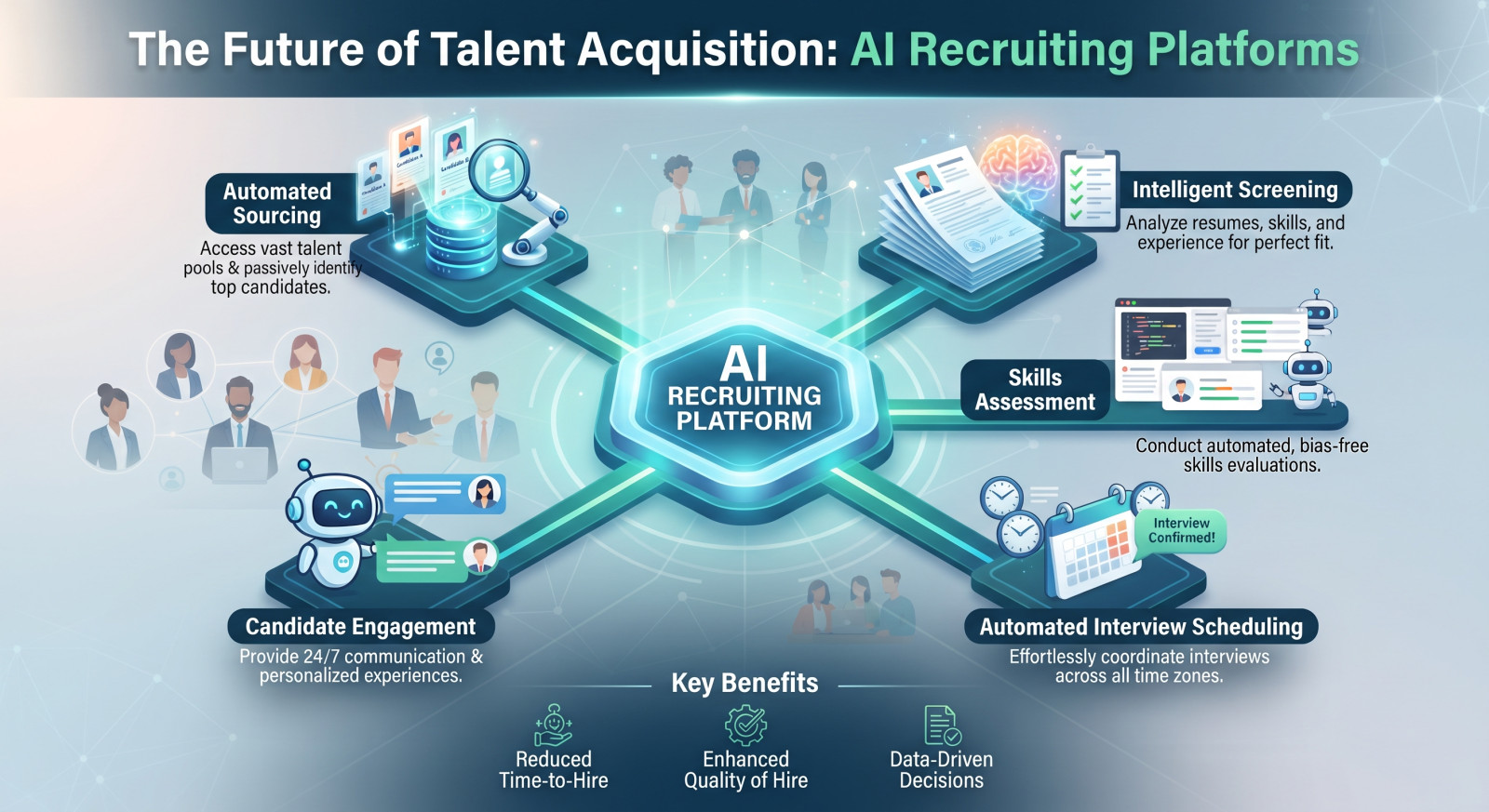
AI recruiting platforms have become popular among modern recruiting solutions. Recruiting teams are able to use AI technology in order to conduct some aspects of their work rather than performing all processes manually, including resume screening, keyword search, reaching out to candidates, and scheduling interviews.
The functionality varies considerably between platforms. Some of them concentrate on candidate sourcing or skills matching, while others specialize in screening, candidate communication, internal mobility, recruiting automation or ATS integration.
AI recruiting technology may make use of such technologies as machine learning, natural language processing (NLP), semantic matching, data analysis, in order to help recruiters evaluate candidates. Still, the level of functionality and automation of these platforms varies from one vendor to another and there is no replacement for human judgment during the process of hiring decision-making.
When choosing an AI recruiting technology, the most important question is not whether a certain platform uses AI. The main question to consider is whether this platform is right for your company in terms of its volume of hires, recruiting process flow, technological stack, budget constraints, compliance and candidate experience.
In this article, leading AI recruiting platforms are compared to each other in order to highlight their features, advantages, disadvantages, integration opportunities, scalability and possible applications. This information will help recruiting teams understand how the platforms differ and select the right type of solution.
For GigMint.ai, this information is especially valuable since technical hiring is a much more complex process than matching candidates to jobs or keywords.
II. Why AI is No Longer Optional
Traditional recruiting workflows can become difficult to manage as hiring volume and process complexity increase. Recruiters would go through numerous manual processes for several decades, such as putting the job postings on fragmented boards, scanning for keyword matches in resumes and scheduling issues in countless iterations. This not only reduces the process of hiring but also makes the organization lose top talent.
Traditional Recruitment vs AI-Driven Recruiting
Bottlenecks in Manual Approach: The human recruiters are extremely limited by their capabilities while going through numerous irrelevant resumes, keyword matches and calendar scheduling.
Bottleneck in AI Approach: Predictive analytics, Natural Language Processing (NLP) and automated workflows in modern hiring software are making the entire hiring process easy and smooth.
Key Capabilities Defining Modern Platforms
In order to compete, modern talent teams need certain AI-based capabilities:
AI Sourcing & Talent Pools: Actively discovers passive candidates online and reactivates silver-medal candidates from previous hiring rounds.
Automated Screening & Semantic Matching: Screens for candidates according to skills, context and potential instead of relying on linear titles and keyword screening.
Chatbot Communication: Offers round-the-clock communication with candidates, instant FAQ answering, and automated interviews scheduling.
Bias Elimination & Diversity Analytics: Strips candidates’ resumes from any demographic data and analyzes job descriptions for inclusive language..
The Business Impact
Incorporating AI technology in the entire recruitment process brings tangible benefits for your business. With the help of these tools, companies manage to see the decrease in cost-per-hire, thanks to the elimination of administration and avoiding recruiter fatigue. Automation and instant communication bring fast results and give an opportunity to get the best candidates before any other companies do.
Such efficiency does not impact the quality of services in a negative way. Thanks to the lack of routine activities, recruiters can concentrate more on building relationships, thus, ensuring an improved candidate experience.
III. Criteria for Evaluating AI Recruiting Platforms
In order to navigate through AI recruitment software, a systematic and thorough evaluation process becomes crucial. In order to ensure that the talent acquisition professionals can differentiate between real innovations and buzzwords,This comparison evaluates the platforms across five criteria: AI and matching capabilities, integration and usability, candidate experience, compliance considerations, and pricing and scalability
Matching Algorithm & AI Capability: While most vendors promise advanced matching capabilities,The comparison gives particular attention to platforms that use semantic matching, skills-based analysis, machine learning, or contextual candidate evaluation in addition to keyword search
Integration & Usability: As the saying goes, the usefulness of a tool depends on how many people actually use it. We paid much attention to ease of integration with ATS systems and intuitiveness of the UI for recruiters and hiring managers.
Candidate Experience: Given that the candidates are consumers of the services, we reviewed such parameters as the response time, communication, and accessibility of interactions with the tool.
Compliance & Ethics: With ever-growing regulatory requirements, the software was checked for the presence of the bias reduction mechanism, the transparency of decisions made by the algorithm and compliance with privacy requirements like GDPR.
Pricing & Scalability: We also checked how scalable and financially sustainable is the tool for both startups, mid-market organizations, and enterprises.
Methodology: The above-discussed platforms are compared based on publicly accessible product information, functionality, ability to integrate, pricing where applicable, and the use case statements provided. The capabilities and prices may vary over time; hence, organizations should verify the same with the service providers before making any purchase decisions.
IV. Top AI Recruiting Platforms
In the talent acquisition environment, we can now talk about AI-powered systems that source, screen, engage, and retain top talent. In order to help talent executives maneuver through this competitive space, here is an analysis of some of the top AI recruitment platforms.
1. Eightfold.ai (Focus on Talent Intelligence & Enterprise Scale)
Overview
Eightfold.ai is an excellent talent intelligence platform, equipped with an advanced deep-learning neural network. Instead of using basic keyword search or Boolean strings, Eightfold creates a unique "talent graph" which tracks millions of careers, skills, and job positions across the globe. Eightfold acquires talent from the perspective of lifecycle, bringing together talent sourcing, talent acquisition, internal mobility, and career planning into one system.
Key Features
Talent Graph: Continuously updated semantic layer linking internal employees, applicants, alumni, and potential hires based on the inferred skills and not job positions.
Internal Mobility Matching: Offers internal employees for open positions, promotions or any project-based jobs by considering the development of the employees' skills, reducing employee turnover.
Career Planning Based on Skills: Gives employees the opportunity to see what career paths exist in their enterprise, offering recommended learning modules.
Bias-Reduction Features: Removes all demographic attributes during the initial screening process and focuses on only capability, potential, and experience.
Pros
Superior Scalability: Able to process millions of candidate records simultaneously without loss of speed, thus making it an designed for enterprise-scale recruiting workflows
Strong Internal Mobility Platform: Brings out the best in internal resources by maximizing talent potential, leading to reduced cost per hire and time for onboarding.
Data Security: Fully compliant with international standards of safety and privacy (SOC 2, GDPR, CCPA).
Drawbacks
Sloping Learning Curve: Needs to have significant preparation in terms of data cleaning, change management, and IT cooperation to be integrated with existing ERP software.
Expensive: Pricing models make it inaccessible for mid-market and small companies due to high costs of recruiting.
Best For
Big international enterprises, holding companies, and multinational corporations in need of comprehensive talent life cycle management, with focus on internal mobility and skills transparency.
2. SeekOut (Focus on Advanced Sourcing & Diversity Talent Acquisition)
Overview
SeekOut is an advanced candidate sourcing and diversity recruitment platform, powered by AI technology. The main purpose of the platform is to help recruiters find hard-to-find candidates.
While regular job boards focus on job-seekers, SeekOut stands out in the sense that it gathers and analyzes data from open resources, professional networks, and developer communities. Its distinguishing feature is engineering and diversity filters.
Key Features
Niche Developer Integrations: Indexes GitHub, StackOverflow, academic citation systems, and patent databases in great depth for unmatched insights into technical professionals.
Different Filters for Different Candidates: Special AI-based filters that allow recruiting teams to actively search for underrepresented groups without affecting recruiting equality.
Contact Information Augmentation: Collects verified emails, phone numbers, and social media connections of passive candidates.
Recruiting Email Creation by AI: Uses language models to create personalized outreach emails with much higher response rates.
Pros
Unrivaled Developer Sourcing: Best-in-class software developer and data scientist talent identification tool, designed to locate software engineers who don't visit job boards regularly.
GitHub Deep Analysis: Rates code quality, participation in projects, and skills proficiency, rather than relying on what is stated on resumes.
Easy to Learn Interface: Very little training needed to learn how to make complex and multilayered search queries.
Cons
Post-Sourcing Process Limited: Works mostly as a funnel top sourcing and enrichment tool, not as an all-in-one ATS.
Niche Nature of the Tool: Not as good at sourcing for large volume operations hiring and other kinds of corporate positions.
Best For
Tech-focused recruiting teams, specialty engineering recruiters, and tech businesses looking for diverse and technical hires.
3. Paradox (Focus on Conversational AI & High-Volume Automation)
Overview
The approach to recruitment takes on a new meaning in terms of candidate experience and immediate engagement. This approach revolves around the conversational AI assistant “Olivia” that makes it possible to eliminate the administrative burden of high-volume, hourly, and operational recruiting. With Paradox, screening, scheduling, and candidate messaging via text or chat is automated to avoid scheduling ping-pong effects.
Key Features
"Olivia" Conversational Assistant: A smart AI chatbot that responds to candidates’ questions, screens candidates, and answers FAQs all day and night 24/7 in several languages.
Instant Interview Scheduling: Seamlessly works with the scheduling calendar of hiring managers and books interviews right away in seconds via chat.
SMS-First Communication: Reaches candidates wherever they are on their mobile devices to get instant replies instead of waiting for emails.
Offer & Onboarding Automations: Automatically coordinates the background checks and document gathering after the interview.
Pros
Greatly Decreases Time to Hire: Shortens the time to hire from days and even weeks to just hours for mass recruitment cases, providing an enormous advantage.
Excellent Candidate Engagement Rate: Excellent completion rate because of frictionless mobile communication.
Manager Adoption: Needs almost no training as hiring managers receive interview requests for pre-screened candidates.
Cons
Doesn’t Emphasize Skill Matching: Isn’t designed for complex executive searches, skill mapping, and long-term career development of candidates.
Integration Complexity: Works best if you use it within your core HR systems such as Workday and SAP SuccessFactors.
Best Fit
For large-scale recruitment in the retail, hospitality, healthcare, logistics industries, etc.
4. Contemporary Challenger Platforms (such as Greenhouse/Lever with Artificial Intelligence and Agile Systems)
Overview
With the changing landscape of the modern workforce moving towards hybrid, remote, and blended worker models of contractors and employees, modern challenger ecosystems (in the form of artificial intelligence-powered iterations of the existing agile applicant tracking system tools such as Greenhouse and Lever, along with new ecosystem orchestrators) are at the forefront of flexibility.
Key Features
Smart Pipeline Management: Predictive AI to spot dormant candidates, suggest rubric modifications, and serve reminders about feedback from the interviewer.
Feedback Loop Automation: AI capturing of interview notes by converting voice to text in order to create structured scorecards immediately to hasten consensus meeting process.
Blended Workforce Management: One system that is capable of managing the recruitment for traditional W2 employees and also contractors through a modular ecosystem.
Developer Focused APIs: Good webhook integration and API support that enables emerging technology companies to integrate their AI microservices.
Strengths
Extremely Flexible & Customizable: Easily customized for your specific workflow, rapid changes to organizational structure and specialized hiring rubrics.
Hybrid/Remote Recruiting Friendly: Natively developed with distributed recruiting collaboration tools, asynchronous video screenings, and compliance checking.
Efficient Recruiter Workflow: Streamlines the daily tasks of recruiters while not being tied to cumbersome enterprise workflows.
Weaknesses
Limited Feature Set: Does not provide hyper-advanced proprietary deep learning neural nets or legacy intelligence from years of enterprise use.
Dependence on Ecosystem: Usually needs to cobble together various best of breed point solutions rather than getting all from one box.
Best Suited To
Tech firms with growth, digital agencies, startups, and companies with innovative approaches to their workforce and technology stack.
V. Feature-by-Feature Comparison Matrix
|
Platform / Example |
Primary Focus |
Best Suited For |
Matching Technology |
Typical Setup Time |
Price |
|
Talent Intelligence (e.g., Eightfold.ai) |
Full lifecycle & internal mobility |
Enterprise (5,000+ employees) |
Deep learning & unified talent graph |
3–6+ months |
$$$$ |
|
Sourcing & Diversity (e.g., SeekOut) |
Active & passive sourcing |
Mid-market to enterprise |
NLP & multi-repository indexing |
2–4 weeks |
$$ |
|
Conversational AI (e.g., Paradox) |
High-volume screening & scheduling |
Enterprise / high-volume hiring |
Conversational NLP & rule-based AI |
2–6 weeks |
$$ |
VI. Key Challenges and Ethical Considerations in AI Recruiting
With the increasing prevalence of artificial intelligence in the recruitment process, talent managers have to consider several key challenges in the realm of ethics, law, and operations.
Algorithmic Bias: AI systems are trained on past data about recruiting and therefore might be affected by human biases concerning gender, race, and other characteristics. This issue should be addressed through regular audits of algorithms, stripping all personal identifiers from the initial screening stage, and using explainable AI ($XAI$).
Privacy and Compliance Issues: With the complexity of the legal environment, there is a need to follow certain guidelines like GDPR in Europe, EEOC regulations in the United States, or more restrictive state laws concerning AI in hiring like NYC Local Law 144 requiring bias audits for automated employment decision tools. Compliance has become a requirement of the system.
Human Element: Over-automation of the hiring process may lead to dehumanization and damage to an employer's reputation. The ideal solution is one that combines the employment of AI to automate the administrative processes (such as scheduling and initial screening) with the preservation of the human element in interviewing and other levels of interaction.
VII. How to Select the AI Solution for Your Organization
Selecting the AI recruitment solution does not involve acquiring the most advanced technology, but rather selecting the appropriate software functionality tailored to the specific friction points in your organization. The following are the four considerations for evaluating AI technology in recruiting:
Step 1: Auditing your current bottlenecks. Assessing the metrics of your talent funnel. Do you have bottlenecks at the bottom of the funnel where conversion and scheduling become a problem or at the top of the funnel where sourcing and passive candidates are an issue? Your vendor hunt must be focused on solving your weakest point.
Step 2: Evaluating your technology stack. Checking what tools do you currently use – ATS and HRIS. Will the prospective AI system have integrations or will it create yet another silo of data which will drive your recruiting team nuts?
Step 3: Setting your budget and ROI targets. Assessing the cost of recruiters' efforts wasted on the manual work versus software subscription fees. Creating clear ROI targets, such as 30% decrease in time-to-hire, before paying the enterprise-level pricing.
Step 4: Conducting pilot with your power recruiters. Never deploy an AI hiring solution throughout the entire organization before piloting it. Testing 30 days with a few recruiters as a pilot group is a mandatory step before going to production.
VIII. The Future of Work
The AI recruiting platforms can facilitate various stages of the recruiting process, including the talent sourcing and matching on skills, as well as screening, communication, scheduling and other processes related to talent management. The solutions are not interchangeable, and the most suitable one will depend on the recruiting priorities and the technological environment of an organization.
The enterprise organizations will pay attention to talent intelligence, internal talent mobility, large scale data management and integration. The companies recruiting technical talent will be interested in the capabilities related to the specialized sourcing and skills-based matching. For the high-volume employers, the solution will be more helpful if the candidate engagement and recruiting automation is included.
The evaluation of an AI recruiting platforms should not start from checking whether the solution includes the necessary AI technology or not. Important criteria for evaluation include the quality of matching and search capabilities, compatibility with existing recruiting systems, the candidate experience, privacy and compliance, the requirements for implementation, scalability and cost.
AI can significantly minimize the amount of routine tasks related to the recruiting process and facilitate processing information; it will not replace the need for human judgment when making hiring decisions.
The organizations need to take into account how the AI recruiting software will handle the potential bias, the transparency of its decision-making and candidate data, and the recommendations generated by it.
For the organizations creating their technical teams, the most suitable AI recruiting platforms will make the identification of necessary skills and experience easier and will fit into the organization's recruiting workflow. GigMint.ai is one such solution.
IX. Frequently Asked Questions
Definition of AI recruiting platforms. The AI recruiting platforms is one that uses machine learning, natural language processing, and analytics to enhance the process of resume screening, recruitment, and even scheduling of interviews.
How can AI help reduce bias in recruiting? Some AI recruitment platforms even have elements in their designs which enable a greater amount of consistency when evaluating candidates, for example, through standardized evaluation processes or filters which minimize the use of specific traits from the candidates. AI recruitment is still not free from bias.
Are AI hiring tools compliant with laws such as NYC Local Law 144? Enterprise AI recruiting platforms have third-party audits and compliance documents necessary for AEDT laws.
Will AI take away the job of a human recruiter? No, since AI will automate the administrative tasks and assist with sourcing big data, while allowing the recruiter to do relationship management.
How much time is required to implement the AI recruitment system? It is different for different tools. Deployment may take as little as a few days in case of API-based recruiting solutions to 3-6 months for enterprise-level talent intelligence platforms.
Can small businesses use AI recruiting software? Yes, although enterprise giants need huge budgets, there are many flexible modular platforms that fit small business perfectly.
What is the difference between an ATS and an AI recruiting platforms? ATS is a system of records tracking candidates' application statuses, while an AI platform helps in source, match, engage, and analyze candidates more effectively.
How can AI bots assist in candidate engagement? For example, the chatbot akin to the “Olivia” of Paradox is readily available 24x7 and can answer questions of the candidate as well as arrange for an interview via SMS within a few minutes.
What key performance indicators should we look at? Time to Fill, Cost per Hire, recruiter’s time saved, Candidate NPS and First Year Retention Rate.
How do I get started on picking my AI recruiting software? Begin with auditing of recruiting challenges, defining budget, mapping out technology stack and running a targeted pilot with the recruiting team.