Why Companies Are Investing in AI Talent Acquisition Solutions

Why Companies Are Investing in AI Talent Acquisition Solutions
The Modern Enterprise Hiring Crucible
Hiring teams are managing growing application volumes, skills shortages, and increasing pressure to fill roles efficiently
Firms in many different sectors, including growing technology startups, financial institutions, health care providers, manufacturing firms, and logistics firms, face an operational landscape characterized by increased volume of applications, skill shortages, and intense competition for high-level executives and IT personnel, all of which occurs in an environment where company management operates under tight and highly monitored budgets.
For all the advances in digital technology that have been achieved, Traditional hiring processes can become difficult to manage as application volumes increase and recruiting teams are expected to respond more quickly
When a firm's human resources department is forced to work with outdated technology, it brings down the entire business with inefficiency, low-quality hires, and higher cost of recruitment. In a time when market timing equals human capital agility, traditional hiring kills innovation.
In order to stay ahead of the competition amid the tough economic environment of today's world, corporate heads have been turning to artificial intelligence for the purpose of recruiting.
Rather than opting for its application to cut costs of administration or recruiting fees for agencies, organizations of all scales resort to employing AI talent acquisition technologies in an effort to recruit better employees, avoid any kind of unconscious bias, and plan their workforce strategies for the future.
Gigmint is designed to help businesses connect with talent through a more streamlined AI talent acquisition process
In evaluating the use of artificial intelligence in recruiting, this guide takes into account aspects of the recruitment process as well as business considerations, covering everything from sourcing to privacy concerns, bias, implementation, and ROI. It is important to keep in mind employment laws and platform capabilities.
1. The Current Crisis in AI Talent Acquisition
The Volume Paradox in Modern Sourcing
Online job ads today easily receive hundreds and in enterprise settings, thousands, of applicants within a matter of hours since their release. This trend is strongly fueled by one-click application options on major job platforms including LinkedIn, Indeed, and other career-specific sites.
Yet, TA executives are confronted with a harsh volume dilemma whereby the quantity of applicants skyrockets to record numbers but the portion of actually qualified candidates stays disappointingly small.
The signal-to-noise ratio is immensely strong here. Recruiters spend hours going through unqualified candidate profiles that have been submitted automatically with the help of mass application software, whereas truly qualified people get buried underneath the mountain of irrelevant data.
At the same time, top-tier candidates often fall off the radar owing to the sluggishness of response times from the recruiting team. In today's hypercompetitive economic environment, highly sought-after candidates may have multiple opportunities available, making timely communication and decision-making important during the hiring process of becoming available, a month-long consideration process means an automatic loss of the best candidates for your company to more nimble rivals.
Recruiting teams can spend substantial time reviewing applications and handling repetitive administrative tasks, leaving less time for candidate engagement and strategic workforce planning
The Hidden Cost of Delay
With every day that an essential organizational position is not filled, significant costs of both financial and operational nature accrue. "Time-to-Fill" and "Cost-per-Hire" metrics shoot up when there is a vacancy in any specialized technical, operations, or executive management track.
Apart from recruitment advertising costs and fees paid to external executive search agencies, there are hidden losses in terms of underutilized productivity, increased workload on existing staff, and missed opportunities, all of which reduce the company's income.
To estimate this problem, one can use the example of a mid-to-large scale enterprise where the position of senior software engineer or data scientist has been left open for 90 days. Apart from salary differences, there are expenses connected with delayed release of new features, loss of customers, and technical debt created by employees still working in the team.
When it comes to the fast-paced industry sector, vacancies have a direct negative impact on the roadmap, customer service delivery, and company's quarterly results. In the traditional recruiting environment, the hiring process is seen as a slow and linear task instead of a fast logistics problem. Open positions affect the employees who are responsible for covering extra workload and suffer secondary burnout.
Human Burnout Across HR and TA Teams
Recruiters, sourcers, and hiring managers are facing an overwhelming amount of burnout in corporate America and globally. Administrative work of handling hundreds of resumes line by line, verifying simple qualifications on a static scorecard, and coordinating the logistical details of Scheduling, resume review, candidate communication, and other administrative activities can consume significant recruiter time
All this administrative burden leaves absolutely no space for creating relationships and headhunting on their own initiative. The result is the burnout of recruiters, turnover in the internal HR department, and a terrible experience of candidates, who are left unanswered and not heard from with automated rejection emails. The overloaded internal recruitment department means a poor-quality hire.
The Legacy ATS Trap
The traditional applicant tracking systems were created decades ago mainly as an electronic filing system. The data is stored in an unstructured manner instead of optimizing and analyzing data to make predictions about the candidate’s performance in future.
Such legacy applicant tracking systems depend a lot on simple keyword matching techniques that often block very talented candidates whose way of writing skills, past projects or professional history differ from those exact terms used in a job description.
The traditional applicant tracking systems do not possess the necessary behavioral intelligence to measure cultural fit and predict retention.
2. What Are AI Talent Acquisition Solutions?
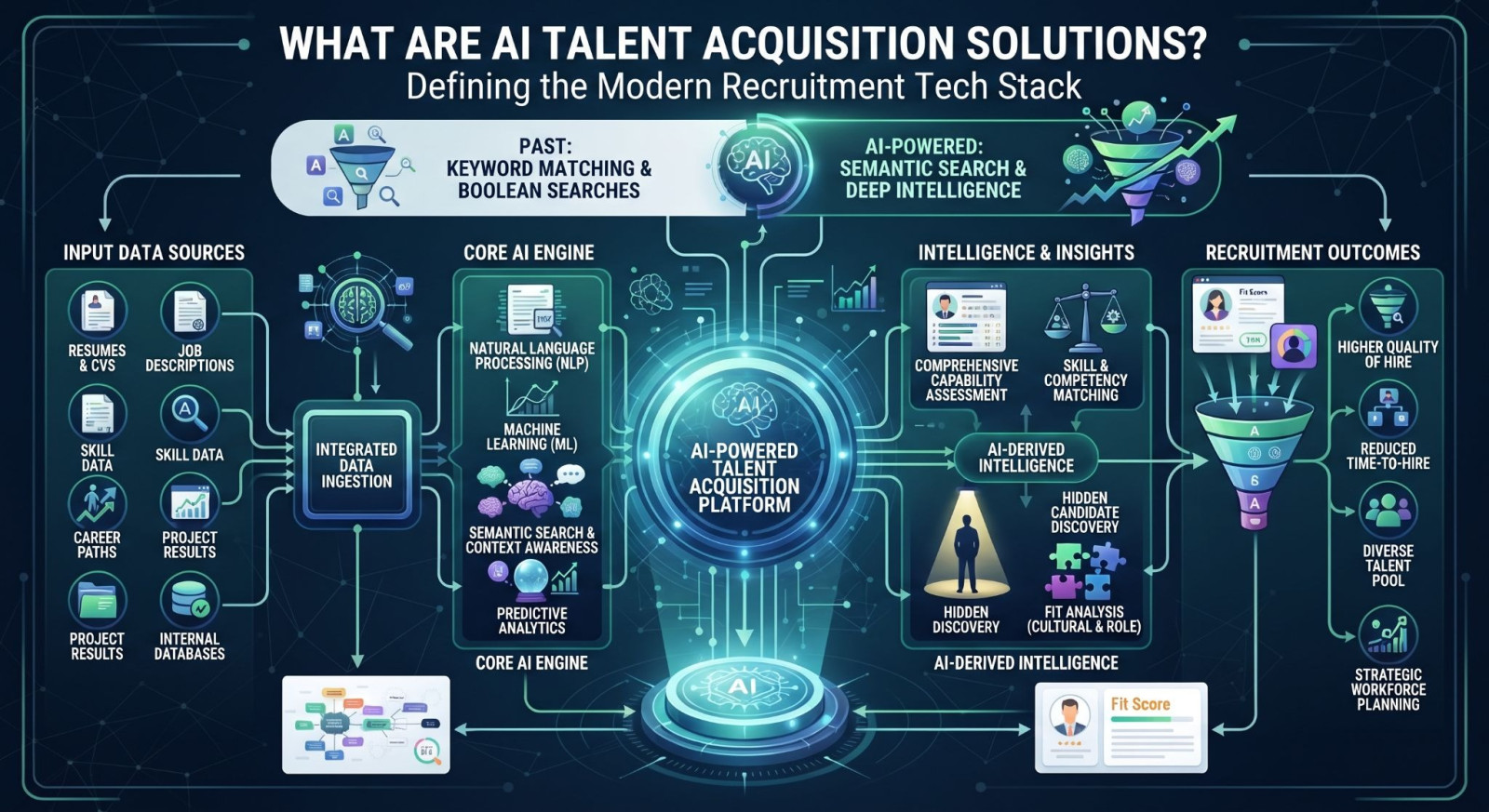
Defining the Modern Recruitment Tech Stack
Today's AI talent acquisition technology is a huge paradigm shift from the past of enterprise applications. Going well beyond just simple keyword matches and boolean string searches, today's talent acquisition technology platform leverages semantic search, machine learning, NLP, and predictive analytics to comprehend the context, competency, and fit.
Rather than just searching for a job title match, today's systems leverage the analysis of skills and career path data in order to discover hidden candidates both internally in an existing database of candidates and externally in the talent pool.
Through analysis of the semantic connections between various skills and technologies and how those are applied to various project results, today's AI engine provides a comprehensive assessment of the individual's capabilities.
Key Capabilities of Modern AI Platforms
Automated Sourcing & Candidate Matching: Utilizing deep learning algorithms and With transformer-based embedding models for searching through internal candidate databases and external professional networks, the system can help identify active and passive candidates whose skills and experience align with defined role requirements. Unstructured resumes, social media accounts, GitHub and portfolio pages will be processed with amazing precision.
AI-enabled Conversational Tools & Chatbots: These intelligent bots will work around the clock across various channels and interact with the candidates immediately after submission of their applications to do an immediate pre-screening of the candidates to answer their common questions about the role and the organization’s culture and schedule interviews whenever the recruiter or hiring managers are available. This may facilitate the process of candidate communications and save time for recruiting teams to follow up with candidates
Predictive Performance Modeling: These tools leverage the historical data on recruitment and the workforce to produce insights that could help with the evaluation of candidates and workforce planning. The output of these tools is to be considered decision-support information.
When choosing an application for recruitment, it is important for businesses not to concentrate only on the inclusion of AI features. Some factors worth considering are the level of matching, compatibility with other recruitment tools, privacy and security, explainability, human control, reporting tools, and ease of implementation into the workflow of a recruiter.
The Gigmint Difference
Intelligent discovery-based platforms are reshaping the concept of efficiency for contemporary teams. Making the process from job postings to candidate placements more streamlined, platforms such as Gigmint make sure that organizations can access talented people quickly without any barriers inherent to the traditional recruitment processes. With help of the matching algorithms, Gigmint makes sure that the gap between organizational needs and today's talent is bridged.
3. Key Benefits Driving Enterprise Investment
Benefit 1: Reducing Time-to-Hire and Recruitment Costs
The automation of the preliminary filtering, ranking and contacting stages increases candidate processing speed. Weeks of labor-intensive sorting are replaced with quick procedures. The dramatic time-saving cuts down the cost-per-hire through saving on advertising costs and minimizing use of outside recruitment services.
It releases hundreds of recruiter's work hours which can be devoted to other activities of greater value such as candidate contact, brand building and strategic workforce planning.
Benefit 2: Increasing the Level of Candidate's Quality and Fit
Intuitive hiring approach is known to be highly vulnerable to errors, biases and unrealistic expectations. Predictive platform-based hiring allows organizations to shift from intuitive to data-based approach to competency mapping.
Through analyzing huge amounts of data on previous successful hires, such a system detects signs of success which might escape the attention of a tired human eye due to subjective perceptions.
Benefit 3: Scaling Candidate Experience (CX)
AI talent acquisition systems revolutionize the candidate experience by sending instant application confirmation, live status updates, and effective communication to the candidates.
The process of being proactive and respectful of the candidates safeguards the company’s reputation as a brand in the competitive labor market space, such that even if the candidates do not get hired, they leave with a good impression of the company.
Benefit 4: Improving Diversity, Equity, and Inclusion (DEI)
Human unconscious bias is one of the biggest problems in traditional resume screening, when the names, education, or gaps in work experience create a certain set of prejudiced ideas about the candidate. With AI talent acquisition solutions, it is possible to overcome this problem with anonymized data processing and skill-based algorithms.
4. Key Benefits Driving Enterprise Investment
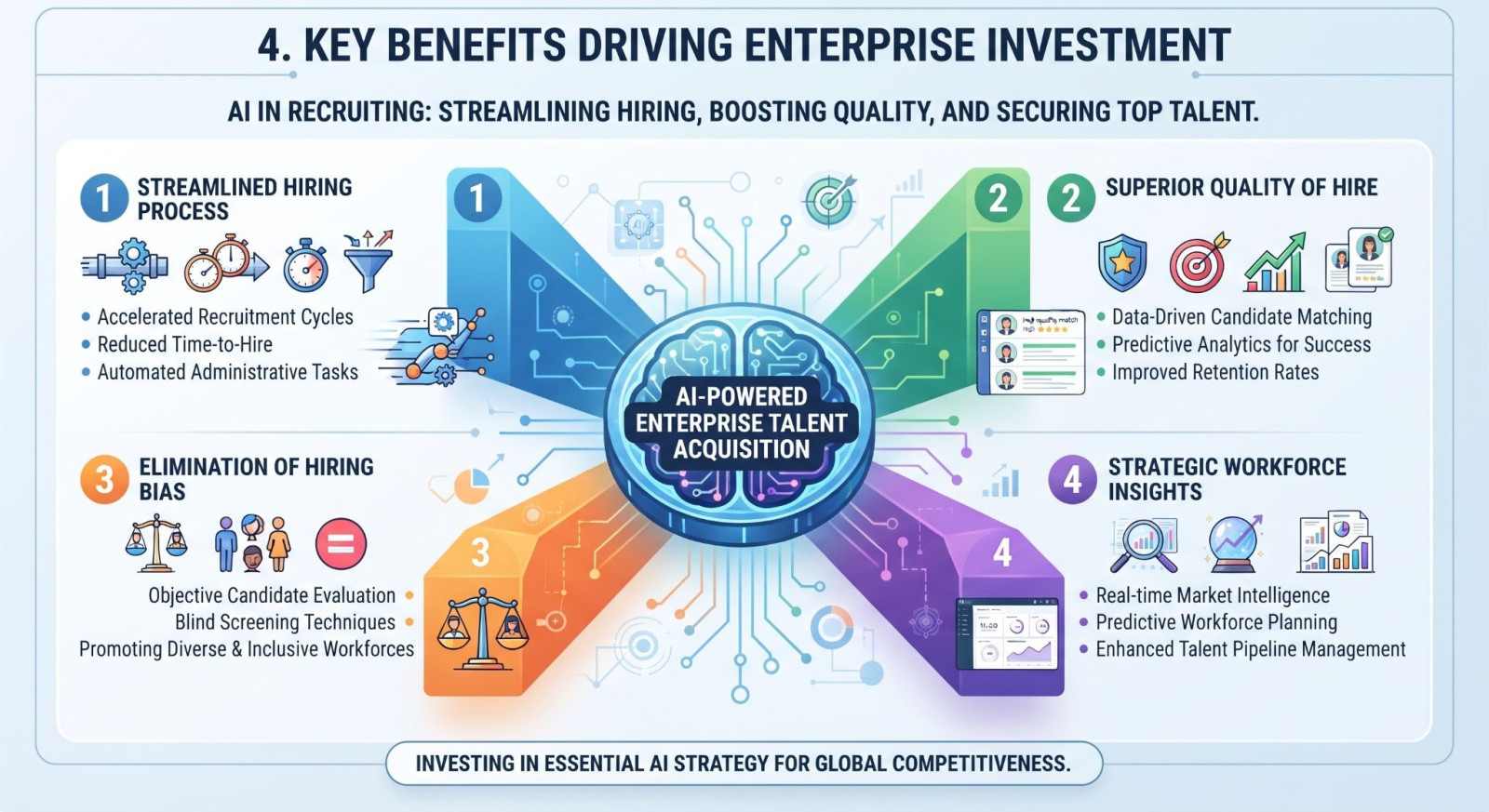
With the intensifying competition in the global talent market, it is imperative for enterprise organizations to streamline their hiring process in such a way that they do not lose out on the quality of their hires.
Inclusion of Artificial Intelligence technology in recruiting is no longer considered a trial process but an essential strategy. Enterprise companies have invested large sums of money in these processes due to their benefits in four key operational pillars.
1: Radical Reduction in Time-to-Hire and Cost-per-Hire
AI-based recruiting systems can automate or support parts of this process significantly AI-assisted screening can help automate parts of the initial candidate review process, potentially reducing the amount of manual work involved
While AI systems can process large volumes of candidate information more quickly than some manual review processes, categorizing them based on skills for job descriptions, performing the initial qualification steps, the whole pipeline becomes more efficient. More importantly, such efficiency implies the reallocation of labor resources.
The removal of redundant activities enables organizations to effectively redeploy recruiters from administrative to relationship-related efforts. Thus, recruiters get an opportunity to shift their attention from administrative tasks to stakeholder management and top candidates' communication, reducing the cost-per-hire and increasing productivity at the same time.
2: Elevating Candidate Quality and Predictive Fit
The previous hiring process relied heavily on hunches, informal unstructured interviews, and superficial credentials like the reputation of the school one went to. The subjectivity of such an approach has often added noise and volatility to the process of hiring. AI adds rigour and objectivity to the process of hiring by shifting the focus from intuition-based hiring to data-driven competency mapping.
The latest enterprise-level hiring systems assess candidates in terms of their overall behavior and skills and also performance history. By comparing the pre-hire assessment information to metrics of future success, organizations can gain valuable insight.
Both theoretical and empirical metrics indicate that competency matching through data leads to an observable boost in the 1-year retention rate. Matching the candidates to not only the technical requirements of the position, but also the rhythm of work at the organization, reduces turnover significantly.
3: Scaling Candidate Experience (CX)
The candidate experience has been turned into a warfront in terms of employer brand reputation. In cases of limited availability of talent, lengthy black holes in terms of communication and processes are the common causes of candidate ghosting, meaning that the highly-valued candidates suddenly stop communicating due to their dissatisfaction.
AI-powered solutions enhance candidate experience by preventing any applicant from being sent to a black hole.
Feedback can be done through the AI tools instantaneously, as this would help in giving the current status, scheduling the interviews without sending back and forth emails and giving feedback to all candidates, including those who have been turned down somewhere along the line.
4: Enhancing Diversity, Equity, and Inclusion (DEI)
This technology is very effective in dealing with unconscious human bias because of its built-in structural standardization. With anonymized data processing and skills first approach, hiring systems used in enterprises can remove any identifiers of the applicant’s demographics—like names, age, gender, and educational institutions—during the first stage of assessment.
The only thing that matters is the proven competence, capability, and potential of performance. As a result, the enterprises are able to develop a more diverse talent pipeline and become more innovative due to cognitive diversity.
5. How to Build a Business Case for AI Talent Acquisition
Even as the prospects of artificial intelligence in the field of enterprise talent acquisition are promising, implementation is impossible without proper oversight and management.
The dangers that come with uncontrolled automation are grave enough that ignoring them can ruin a firm's reputation, bring legal charges and lawsuits, and alienate the very workforce that is being targeted by such measures. In order to enjoy the benefits of intelligent recruiting practices, enterprises have to address a number of important issues.
Algorithmic Bias and Historical Data
The first challenge in using AI for the purposes of hiring and recruitment lies in the potential problem of perpetrating historical issues. The very nature of machine learning means that an algorithm will learn from the patterns present in historical data.
As a result, an algorithm trained on decades worth of biased hiring at a corporation will learn to reproduce these patterns. For example, if an enterprise has a historically unbalanced workforce, then the algorithm may learn that certain demographic features are requirements for success.
Transparency and Explainability: Demanding "White-Box" Solutions
Compliance and trust within the enterprise are doomed by an approach that operates through black-box technology, where there is no rationale offered for the choice of an algorithm to recommend a potential candidate.
It is advisable for recruiters and managers to choose systems where they will get adequate explanations on how recommendation decisions were made and which data about candidates was taken into account.
The explainability of the system makes it easier to check the decision and identify possible faults. Should the system recommend or reject a candidate, it must be easy to understand which qualifications, certificates, or tests influenced that decision.
Data Privacy and Compliance Considerations
The recruitment data is among the most sensitive information that a company can obtain. Compliance involves adhering to a maze of international rules, laws, and directives, which include the EU's General Data Protection Regulation (GDPR), the rigorous standards of the U.S.'s EEOC, and even groundbreaking local legislation like New York City's Local Law 144 that regulates the use of AI-powered recruitment tools. In all cases, compliance calls for third-party audit of any form of bias, informed consent, data encryption, and sound retention policies.
Human in the Loop Principle: Enhancing But Not Replacing Decision-Making Ability
In any case, technology should not be used to replace our capacity to empathize, to think morally and strategically. Human in the loop is at the center of ethical enterprise AI implementation.
Technology and algorithms are good at handling big data and providing predictions and insights based on it; the decision-maker on whether or not an individual gets hired always has to be a person. When HR personnel are assured that AI tools are meant to augment their skills and decision-making, it helps in fostering a collaborative environment.
6. What’s Next for AI in Recruitment?
The key to acquiring enterprise investment for the AI Talent Technology lies in moving away from vague arguments for "innovation" and developing a strong financial and logical business case.
Auditing Your Existing Tech Ecosystem
Prior to going to the executive management with your ask for funding, talent executives should conduct a full audit of their current recruitment tech stack. It is crucial to understand where the existing process leaks in terms of both time and money.
Are the candidate data stored in different ATS and spreadsheets? How much time does it take to schedule candidate interviews manually? Finding these points of friction allows you to measure how the AI solution will help close the gaps.
Calculating ROI for Leadership
The CFO and other members of the leadership team need concrete numbers. This means that the business case should involve translating the advantages of using AI into numbers:
Time Savings: Multiply total time saved per recruiter with the fully burdened cost of an hour of labor.
Decreased Turnover: Compute the money saved from having higher one-year retention rates, taking into account the savings from not needing to re-recruit and retrain employees.
Additional Recruiter Productivity: Compute the ability to process more hires without the need for more people in the talent acquisition department, resulting in lower cost-per-hire.
Pilot Programs and Change Management
Most technology deployments fall flat because of resistance from the user side and over-hasty deployment. The intelligent business case should have an implementation strategy that starts with piloting the tool in one particular department or location. It would minimize the disturbance and allow for testing of the technology in the live environment, along with collecting initial success stories.
With a well-devised change management strategy with a good communication strategy and training programs, this would assure the internal recruiters that the tool is built to help rather than intimidate them.
7. Call to Action
With the current speed at which corporations operate, AI talent solutions are becoming an area of interest for organizations looking to improve the efficiency and scalability of their recruitment processes, experimental, or luxurious for future implementation, but as crucial components of competitive businesses.
By cutting time-to-hire, enhancing fit prediction, creating scalable candidate experiences, and fostering diverse hiring approaches, artificial intelligence makes contemporary businesses ready to compete more effectively for qualified talent
Through such intelligent hiring platforms, businesses will be able to work around the constraints that they have faced so far and build a very agile and resilient team. Would you like to innovate your hiring process? Learn how Gigmint does things differently in the intelligent talent solutions market through Gigmint.
8. Frequently Asked Questions
1. Can AI recruiting systems substitute human recruiters?
No. AI recruitment systems are usually designed to assist recruiters in various tasks related to candidate sourcing, screening, scheduling, and communication. The role of human recruiters remains unchanged.
2. What are the advantages of using AI recruiting systems in fostering diversity, equity, and inclusion?
Such systems can be useful in creating standardized procedures and criteria for screening. Such systems cannot automatically guarantee that there will be no bias. If a system was taught with biased or incomplete data, it is likely that biases or inconsistencies will be reproduced or enhanced by it. It is essential to monitor such systems for potential biases and to exercise proper control over their application.
3. Can AI recruiting systems ensure compliance with employment laws?
No. Such systems do not automatically ensure compliance. Their compliance with applicable employment laws is conditional on the nature of the particular system, its use, the organization's policies, and the applicable laws.
4. Can AI be used to predict employee retention?
Yes, some AI tools can analyze the historical data of a workforce in order to find any pattern related to retention or turnover. The results should be considered to be estimates that will assist in workforce planning.
5. What aspects should the company pay attention to in its implementation of AI talent acquisition solutions?
It should pay attention to the following: matching candidates, integration with other HR software, data privacy and security measures, reporting, bias detection, human in the loop, implementation, and business results.
6. How can a company calculate ROI for the implementation of AI recruiting technology?
The company can assess recruitment metrics before and after the process implementation. This largely depends on the situation; some metrics could be recruiter administration, time to hire, cost per hire, candidate response rate, scheduling interviews time, applications to interview ratio.
7. Is the final hiring decision supposed to be made by AI?
The organizations must think carefully about the right amount of human supervision to apply in their hiring process. The recommendations of AI should not be accepted as the right decisions but analyzed in the context of recruitment policy of the organization.