15 Best AI Talent Acquisition Tools for Recruiters
15 Best AI Talent Acquisition Tools for Recruiters
The contemporary world of recruiting seems to be going at an incredibly fast pace, making conventional recruiting mechanisms struggle to catch up. Human resources departments had been using their old-fashioned applicant tracking systems (ATS) and resume screening processes, which are becoming unable to cope with thousands of applications due to the enormous load from the flood of applications.
With the average corporate vacancy receiving more than 250 applications in just two days, out of which 75 percent turn out to be completely unqualified, human recruiters drown in piles of paperwork instead of having talks with the best human candidates.
This particular operational roadblock has led to a massive technological revolution within global human resource management. The application of artificial intelligence (AI) is revolutionizing talent acquisition from a reactionary, cumbersome process to a proactive and highly strategic one, based on data analysis.
State-of-the-art talent eco-systems, as well as modern hubs, such as gigmint.ai, are at the epicenter of this transformation, applying advanced machine learning, predictive analytics, and matching technologies to connect visionary companies with top global talent.
In this in-depth article, we will analyze the current state of artificial intelligence within recruitment processes, introduce our comprehensive multi-pillar rating system, and consider 15 of the best AI talent acquisition tools.
II. The Evolution of Recruitment: Why AI is No Longer Optional
For decades now, hiring within corporations has been done using antiquated ATS software that was nothing but fancy filing cabinets rather than intelligent matching software.
Hours were spent cross-referencing keywords, scheduling interviews amid conflicting schedules, and sending out impersonal rejections, hurting companies' reputations. Nowadays, that process of hiring is not just inefficient, but it is actually counterproductive to the growth of business.
The Problem with Legacy Hiring
The weaknesses in traditional recruiting structure are evident in the following key operational challenges:
Extended Time-to-Fill: The lengthy process leaves vital positions in engineering, sales, and management empty for months. The result is costly inefficiency, pressure on budgetary departments, and overwhelming current employees.
Human Error & Exhaustion: Human error caused by unconscious and exhaustion-induced bias makes recruiters miss outstanding candidates in the database queue because of fatigue or reject excellent resumes just due to the slightest formatting issues.
Resumes' Screening Exhaustion: Screening of irrelevant resumes consumes valuable time of the recruiters, leaving no space for the proper interaction with candidates, employer branding, or workforce planning.
Bad Candidate Experience: The slow reaction, no feedback, or "ghosting" from recruiters harms the employer brand in the highly competitive labor market by making talented individuals work for competitors.
How AI Transforms the Funnel
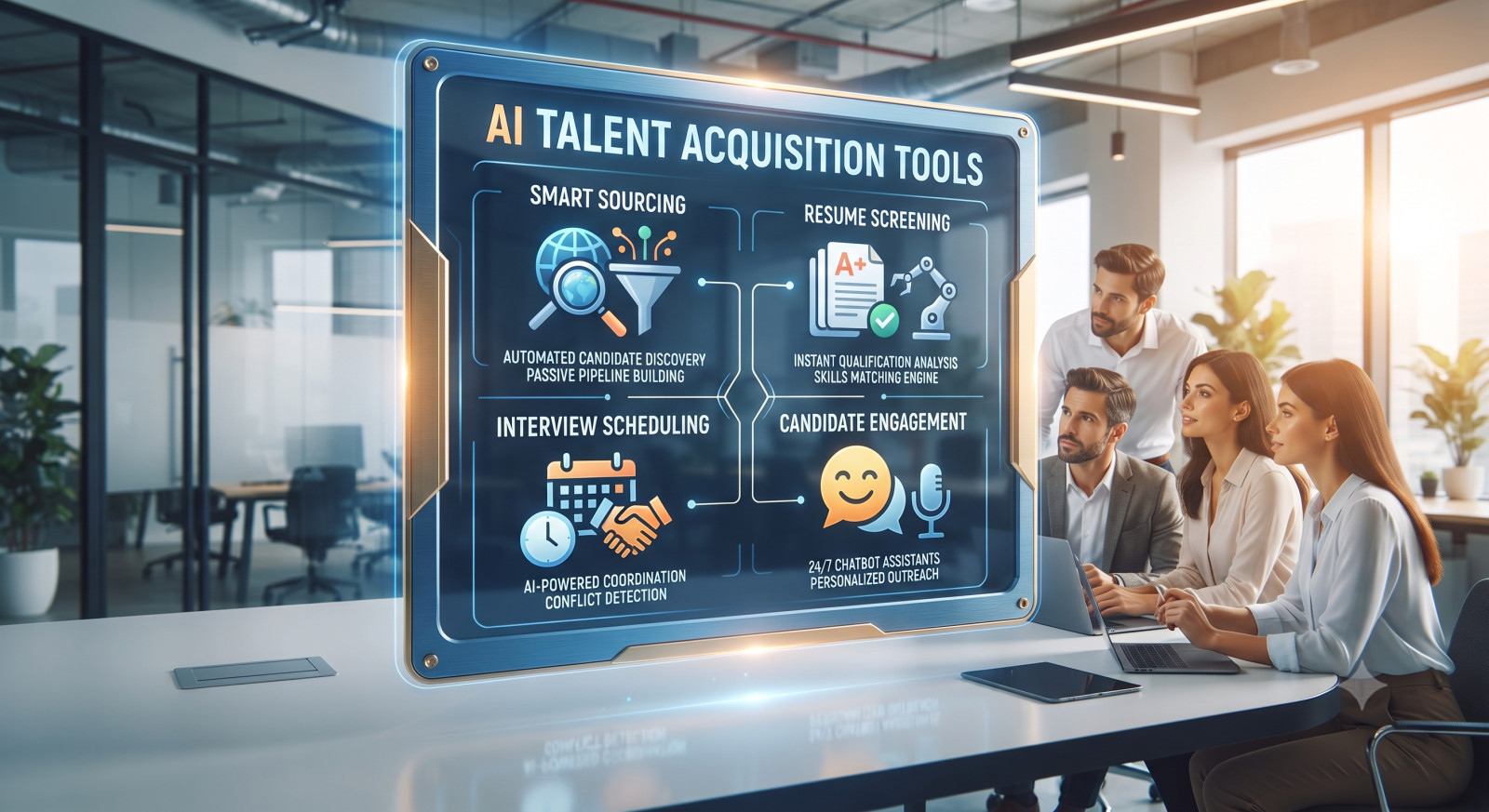
The role of artificial intelligence in recruitment is to transform, optimize, and make intelligent each stage of the recruiting process:
Sourcing: Using advanced algorithms, the process of searching for professionals from the external professional networks, code bases, niche communities, and even passive talent pools is made proactive and finds hard-to-find skill matches.
Screening: Rather than using the keyword approach, machine learning models analyze context-based competencies and skills of each candidate objectively.
Engagement: Chatbot with conversational AI answers candidates' questions 24/7, does an initial conversational prescreen, and sends highly personalized follow-up emails.
Interviewing: Scheduling tools based on automation completely remove calendar ping-pong while video assessment analyzes behavior, sentiment, and clarity of communication.
The Return on Investment of AI in HR
There is no doubt that hard data shows how artificial intelligence provides excellent financial and operational returns on investment. Organizations adopting AI-based hiring processes achieve up to 50% improvement in time-to-fill, 30% reduction in cost-per-hire, and spikes in retention rates due to better initial placements and cultural fit.
III. How We Chose the Best AI Recruiting Tools
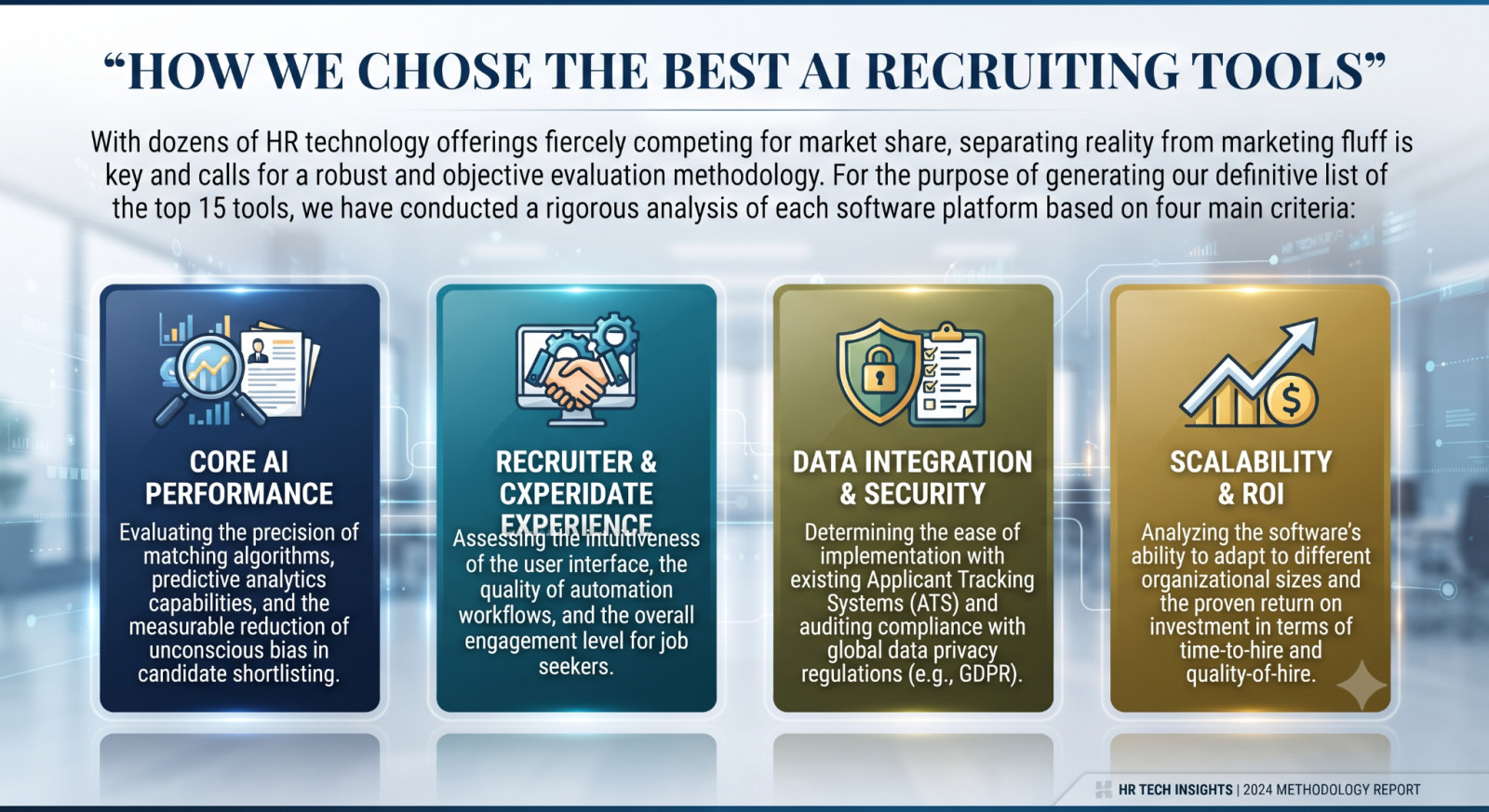
With dozens of HR technology offerings fiercely competing for market share, separating reality from marketing fluff is key and calls for a robust and objective evaluation methodology. For the purpose of generating our definitive list of the top 15 tools, we have conducted a rigorous analysis of each software platform based on four main criteria:
Matching & Accuracy: Is this platform employing advanced algorithms and contextual machine learning or is just a sophisticated keyword matching tool?
Integration Ability: Is it possible to integrate this platform seamlessly into your existing systems like Workday, Greenhouse, Lever, gigmint.ai and other talent platforms?
Compliance & Bias: Is the platform compliant with evolving regulations like GDPR and EEOC anti-discrimination laws as well as ethical AI audit criteria?
User Experience (UX): Is the dashboard designed in such a way that provides a seamless experience for busy recruiters while still offering engaging mobile experience for candidates?
IV. The 15 Best AI Talent Acquisition Tools for Recruiters
In order to enable you to understand and traverse the vast world of HR technology, we have compiled a list of the best 15 talent acquisition technologies powered by AI. Be it your search for specialized engineering talent, high-volume hiring in retail companies, or creation of talent mobility pipelines within organizations, these technologies embody the zenith of recruitment technology.
1. Fetcher
Best For: Recruiting automation for candidate sourcing and highly targeted diversity recruitment.
Deep Dive: Fetcher takes care of your top-of-funnel sourcing needs by becoming a natural extension of your recruitment team. While other tools will merely scrape LinkedIn, Fetcher works through a novel “human-in-the-loop” model which sources the right profiles using advanced AI algorithms according to your criteria, and then has a dedicated team of human data experts validate these candidates' profiles before sending them to you. Thus, recruiters do not have to waste any time considering irrelevant profiles.
Key Features: Has an automated email sequence feature, allowing recruiters to conduct multi-touch drip campaigns. Also comes with detailed diversity recruitment analytics in order to ensure the DEI (Diversity, Equity, and Inclusion) compliance of your pipeline from the very first contact point.
Pros & Cons: The greatest benefit of Fetcher is its extremely high accuracy and number of saved hours per source per week. One disadvantage is that recruitment teams have to be consistent in creating and A/B testing their message templates because fully automated emails may lack personalized “brand voice.”
2. SeekOut
Best For: Engineering, technical, healthcare, and any type of hard-to-find specialists.
Deep Dive: If conventional platforms aren't enough to find specialized talent, SeekOut will do the trick. It is called the best platform for tech recruiting because it does way more than what ordinary social networks can offer. SeekOut creates full-profiles of experts from big unstructured data pools, such as GitHub repositories, StackOverflow projects, global patents, and whitepapers.
Key Features: It has an extremely advanced Boolean search engine with artificial intelligence support, providing incredible precision in searches. The filters allow searching for candidates with security clearances, certain coding skills, and belonging to underrepresented minorities. The "Clone" feature lets recruiters put there the profile of a best performer of theirs and receive exact matches in external talent pools.
Pros & Cons: SeekOut offers unparalleled detail that is necessary when searching for specialists for competitive technical positions. However, the difficulty in using SeekOut's interface and all the search modifiers is that of a steep learning curve for junior non-technical recruiters.
3. Eightfold.ai
Best For: Holistic talent intelligence, succession planning, and internal mobility on a massive scale in an organization.
Deep Dive: Based on a proprietary deep-learning neural network, Eightfold.ai is a monolithic enterprise software built to see the full picture of the talent. It analyzes billions of data points across the globe to find out about possible career paths, adjacent skills, and future possibilities of each individual. Instead of matching candidates for a job opening, Eightfold predicts the possible future of a candidate in three years.
Key Features: Provides a holistic Talent Intelligence Platform which takes care of all aspects of talent management including bias-free and anonymous resume screening at the very beginning of the hiring process and continuous internal career planning and upskilling of existing employees. It works as an intelligent layer on top of your current ATS/HRIS.
Pros & Cons: The software is a revolutionary, highly scalable solution that radically changes the way of managing human capital in global enterprises (Fortune 500 companies). On the other hand, the prohibitively expensive enterprise price point coupled with a complex multi-month implementation and change management period makes it highly inaccessible for startups and mid-size companies.
4. Paradox (Olivia)
Best For: Recruiting through conversation, large-scale hiring for frontline staff, and scheduling automation.
Deep Dive: Paradox came out with an extremely popular AI recruiting assistant named "Olivia" that operates where the candidates already spend their time: in their mobile phones. Olivia totally changes the conventional way of applying for jobs since now the applicants can apply for a position via SMS text message, WhatsApp messages, or web chat.
It's really efficient for recruiting in retail, hospitality, and healthcare industries when candidates won't have access to a computer with a PDF version of their resume.
Features: Olivia immediately performs candidate screening using pre-qualifying questions in a conversational style. In case the candidate gets through this stage, Olivia instantly checks the hiring manager's schedule and arranges an interview. Olivia takes care of the automated rescheduling of interviews, answering frequently asked questions about the benefits package and onboarding documentation.
Pros & Cons: Paradox produces astonishing results in terms of candidate engagement, having an almost instantaneous response time and minimal drop-offs. But because it uses text messaging exclusively as the mode of communication, it isn't really effective for high-touch executive search and corporate hires requiring nuanced cultural assessments.
5. HireVue
Best For: Asynchronous video interviews, structured coding tests, and pre-employment cognitive assessments.
Deep Dive: HireVue has been the leader in the field of video interviews and has kept up to date by building upon its interviews with layers of extremely sophisticated AI and machine learning analytics. It enables companies to make the first round of their interviewing process scalable worldwide as candidates record asynchronous videos in response to a set of questions. These interviews are rated not only by human recruiters but also by AI.
Features: Offers highly structured interview questions, game-based psychometric and cognitive evaluations, and automated coding tasks for software engineers. It uses AI technology to evaluate the skills of candidates in terms of their communication abilities, approaches to solving problems, and technical expertise using IO psychology models.
Advantages & Disadvantages: HireVue creates a highly standardized, extremely repeatable and objective evaluation system where the role of human biases during the interview is minimal. However, many candidates feel "camera anxiety" and nervousness about automated video interviews.
6. Leena AI
Best For: Automation of HR Helpdesks, Internal Employee Experience, Post-Hiring Lifecycle Management.
Deep Dive: Whereas many solutions concentrate only on attracting candidates, Leena AI is an autonomous and generative AI technology that is solely oriented towards the employee experience after being hired.
This system operates as an intelligent HR digital business partner whose main purpose is to answer thousands of frequently asked questions by people who work in human resources departments: from “How many PTO days I have left?” to “How to fill out my tax form?”
Key Features: Seamless integration into Slack, Microsoft Teams, HRIS. It serves as an intelligent HR ticketing system, as well as performs pulse surveys to check the level of engagement of employees, and manages extremely complex and multidepartmental onboarding processes.
Pros & Cons: Leena AI is absolutely great at deflection of IT and HR tickets; it helps corporate departments to save thousands of working hours per year. Nevertheless, from the point of view of talent acquisition, it is less oriented towards attracting candidates from outside the company.
7. Beamery
Good For: Full spectrum talent lifecycle management and pipeline building with CRM.
Deep Dive: At its core, Beamery runs on the principle that recruiting needs to be just like modern marketing and sales. It is an incredibly sophisticated Talent CRM (Customer Relationship Management) tool that enables big companies to create relationships with potential hires years in advance of a job becoming available.
Unique Selling Proposition: The one-of-a-kind selling proposition of the tool is the AI-driven "Talent Rediscovery" functionality, where Beamery constantly scours through the dead ATS database of the company looking for the silver-medal talents that have become a good match for the newly opened positions. It also offers GDPR automation and predictive pipeline analytics for workforce planning.
Pros and Cons: Beamery comes with the best-in-class, enterprise-level CRM that is necessary for any proactive pipeline management and talent pools. The only thing about the tool is that it is necessary to put in a lot of effort to configure the tool properly in order to maximize its ROI.
8. Manatal
Best for: Growing boutique recruiting firms, executive search firms, and fast-paced mid-market small to medium businesses (SMBs).
In Depth: Manatal is an online application tracking system (ATS) and CRM that is incredibly fast and lightweight. It gets rid of the bulkiness of traditional systems and incorporates useful artificial intelligence.
Key Features: Manatal comes with an inbuilt AI-powered recommendation engine that instantly scores and ranks candidates based on the job description. It also comes with a great social media data enrichment feature which automatically adds the latest LinkedIn or web data about a candidate to their profile. The visual pipeline with Kanban style makes candidate management easy.
Pros & Cons: Manatal is extremely cost effective and has one of the quickest onboarding processes in the market—companies can get up and running within days. However, it is important to note that although it does have great reporting features and predictive analytics, these are relatively basic compared to the giant enterprises in the market.
9. Greenhouse (with Predictive Analytics and Ecosystem AI Integrations)
Best For: Hiring models that are tightly structured alongside intelligent workflow customization.
In-Depth Analysis: While Greenhouse is fundamentally an applicant tracking system, Greenhouse gets on this list due to the uniqueness of their structured hiring approach and their AI integration marketplace that is enormous.
Greenhouse is not developing its own artificial intelligence technology which would eventually get outdated, rather it serves as a reliable portal for integrating dozens of state-of-the-art AI systems.
Features: It offers a backbone which ensures that structured interviewing rubrics are followed by all hiring managers objectively. The platform comes with an extensive API ecosystem which allows the users to add AI screening plugins, scheduling bots and predictive analytics dashboards effortlessly.
Pros & Cons: Greenhouse offers world-class industry standard reliability, compliance and user interface. Nevertheless, the problem with the most advanced AI features of Greenhouse is that they depend on third-party marketplace integrations, thus, the costs skyrocket easily.
10. Lever (LeverTRM)
Best For: Talent acquisition in relation-heavy environments and collaborative hiring processes.
Deep Dive: Lever was one of the first players in the market who introduced the notion of TRM platform (Talent Relationship Management) that seamlessly combines CRM capabilities with ATS tracking into one integrated database. It is designed for companies whose culture considers talent acquisition as a collaborative effort, rather than HR department activity.
Features: "Fast Resume Review" tool on Lever platform utilizes machine learning capabilities to find the most suitable candidates automatically. It has sophisticated email nurture campaigns to keep passive candidates warm during months or even years. Lever platform is extremely intuitive and encourages hiring managers and executives to log in and leave their feedback.
Pros & Cons: Lever provides excellent collaboration tools for recruiting and hiring managers throughout the entire funnel. The only disadvantage is that their advanced predictive reports and automation tools require you to purchase one of their enterprise packages.
11. Gloat
Best For: Talent marketplace inside the organization, flexibility of the workforce, and upskilling in enterprises.
Deeper Look: In today’s world, your best candidates will usually be the employees who already work for you. Gloat is an innovative platform that uses AI technology to establish a live gig economy within the organization’s walls. It destroys departmental silos by matching internal employees to various part-time projects, mentorships, and internal full-time transfers based on their skill sets.
Features: It uses the engine of AI to match the ambitions of the employees and their skill sets against the needs of the organization. It offers automated mentorship programs, fractional bidding for project assignments, and real-time skills-gap detection for CHROs.
Pros & Cons: Gloat is an amazing tool for increasing internal employee retention rate, destroying corporate bureaucracy, and upskilling. But it is completely irrelevant for smaller businesses because it only works when there are lots of people internally mobile.
12. Phenom
Best for: Omnichannel candidate experience, hyper-personalization of recruitment marketing efforts, and career site CMS.
Deep Dive: According to Phenom, it is a Talent Experience Management (TXM) platform. It utilizes AI to personalize the candidate experience, so that looking for a job becomes similar to shopping on Amazon or watching Netflix, in which AI recommends the best content depending on users' locations, browsing history, and preferences.
Once the candidate comes to the website powered by Phenom, the AI changes what is being displayed for the candidate taking into consideration their geographic location, browsing history, and uploaded resume.
Key Features: Provides an extremely powerful career site CMS, advanced chatbots using conversational AI for quick problem solving, automated internal employee referral programs, and extremely detailed recruitment marketing campaign analytics.
Pros and Cons: Phenom is an enormous ecosystem suite, which allows getting rid of 6 different HR tools. The downside is that the tool is so big that it becomes extremely hard to set up and configure and the system becomes quite bloated for small HR departments without recruitment marketing specialists.
13. Arya by Leoforce
Best For: Quick multi-channel sourcing and deep web talent identification.
Deep Dive: Arya is an AI recruiting tool that aims to throw a wide net within a very short period of time. It gathers data from a variety of sources, such as internal recruitment systems (ATS databases), external recruitment websites (Dice, Monster, and CareerBuilder, to name just a few), and even from social media sites, providing you with a consolidated ranking of candidates for any particular job opening.
Features: Multi-dimensional predictive matching technology used by the tool allows analyzing candidates based on 70+ criteria and making predictions about how likely a candidate is to move to another job position. The tool offers deep and seamless integration with more than 50 popular applicant tracking systems.
Pros & Cons: Arya works wonders when it comes to delivering very quick and efficient multi-channel results across a wide range of recruitment websites and databases. The only disadvantage of the tool lies in the user interface being sometimes messy, overloaded with information, and even somewhat outdated.
14. iCIMS Talent Cloud
Best For: Enterprise-level recruiting automation, massive hiring at an hourly level, and global compliance.
Deep Dive: iCIMS is a leader in its industry, offering a very complete and robust talent cloud, able to handle enormous volumes of applicants. It is used extensively by very large retail and manufacturing enterprises as well as multinational corporations that require hiring of tens of thousands of applicants a year, while still maintaining very rigorous global standards of compliance and reporting.
Features: Talent Cloud includes native conversational AI through text messages, robust recruiting marketing automation capabilities, extremely customizable offer management system, and very strong integrations with global HRIS platforms such as SAP SuccessFactors and Oracle.
Pros and Cons: iCIMS offers very robust and bulletproof enterprise-level solutions that won't fail when presented with enormous, global applicant volume. The downside of this very robustness is that the product has a very long onboarding and implementation process and it requires significant investments upfront.
15. Hired
Best For: Technology, software engineering, sales and marketing reverse-marketplace hiring.
In Depth: Hired is essentially a complete reversal of conventional recruitment methods. Rather than having recruiters cold contact potential employees via LinkedIn, Hired uses an extremely curated “reverse marketplace,” where candidates (in the fields of tech and commercial employment) apply to join the service, are pre-screened through Hired’s algorithms, and are then contacted by companies with salaries offered from the get-go.
Key Features: The algorithmic matching of Hired makes sure companies only have access to candidates that have demonstrated extremely high intentions to switch jobs and have the precise tech stack necessary.
Hired’s services include built-in salary transparency functions, strong bias reduction capabilities (such as hiding names and profile pictures at the stage of initial screening), as well as automated interview scheduling.
Pros & Cons: Hired gives companies an extremely high-intent candidate pool with response rates above 95%, thus decreasing dramatically the time needed to hire competitively. But the usefulness of Hired is confined to software engineering, data science, tech sales and commercial marketing positions.
V. Key Benefits of Implementing AI in Your Hiring Workflow
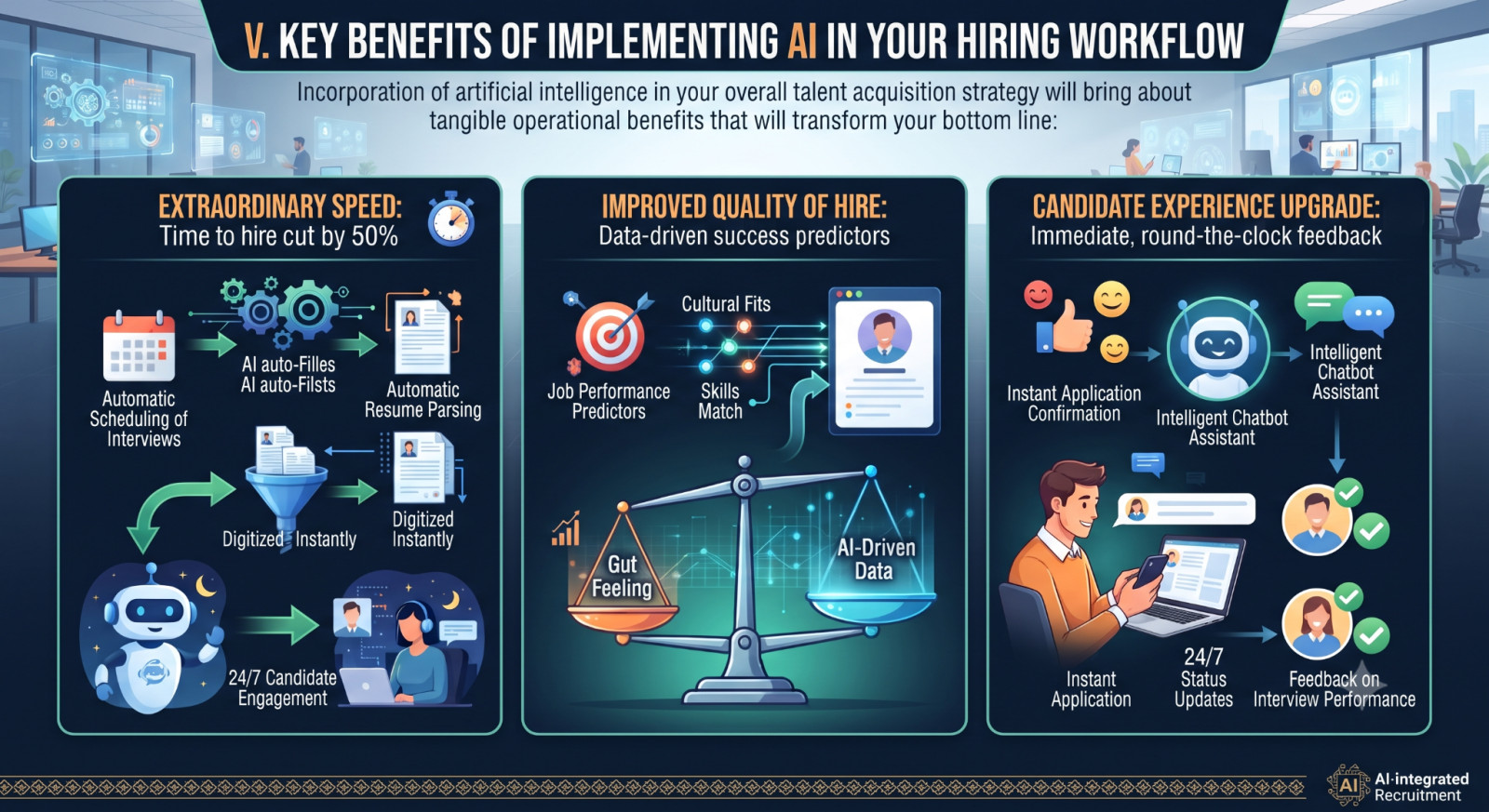
Incorporation of artificial intelligence in your overall talent acquisition strategy will bring about tangible operational benefits that will transform your bottom line:
Extraordinary Speed: Time to hire cut by up to 50% due to automatic scheduling of interviews, automatic resume parsing, and 24/7 candidate engagement.
Improved Quality of Hire: Shifting from intuition-driven "gut feelings" and cognitive biases towards data-driven success predictors which are directly related to future job performance.
Candidate Experience Upgrade: Giving immediate and round-the-clock feedback to candidates using intelligent chatbots, thereby eliminating the dreaded "black hole" associated with traditional applications.
VI. Best Practices of AI Implementation While Maintaining the Human Element
Even though modern technologies and machine learning are capable of accelerating the hiring process substantially, the very process of recruiting is, in fact, inherently human. Technology should augment the abilities of the recruiter, but not substitute human empathy and interpersonal skills.
There are several strategic considerations that need to be taken into account in order to ensure successful implementation without alienating candidates and changing the corporate culture.
Primarily, the human element must always be present in the process. Although the advanced algorithms might quickly analyze and sort out thousands of resumes, the human recruiter will always have the final say in who to hire, especially when dealing with the cultural fit interview and offer negotiation process.
Companies need to pledge themselves to regular and thorough algorithm audits. AI models can be biased just like any human being, and therefore, conducting audits will be necessary to verify whether there are any biases, skews, or demographically induced errors in your technology suite that may work against a perfectly suitable candidate.
VII. Frequently Asked Questions (FAQ)
1. What are AI Talent Acquisition Tools?
They are pieces of software which make use of artificial intelligence, machine learning and natural language processing to aid in automating various stages of the recruitment funnel such as sourcing, CV screening, candidate communication and scheduling interviews.
2. How do AI resume screeners work?
Instead of looking at keywords in the way that conventional ATS systems do, AI screeners evaluate contextual information, meaning, and real skills of a person, which helps to avoid false negatives and finds high potential candidates.
3. Will AI replace human recruiters?
No. AI is supposed to deal with repetitive tasks and administrative burden, as well as filter out candidates at the beginning of the process, but human recruiters are needed for their empathic and cultural assessment abilities and relationship building.
4. How do AI tools enhance workplace diversity?
AI recruiting tools often have blind screening feature when during the first review names, gender information, and education background are hidden, while only objective skill information is evaluated.
5. How much is the average ROI of introducing AI into recruitment?
With the help of artificial intelligence for recruitment, companies can achieve a reduction in time-to-fill of up to 50%, cost-per-hire reduction of up to 30%, and better employee retention because of good initial match.
6. Can AI recruitment be used in accordance with data protection regulations?
Best AI recruitment solutions include a set of compliance mechanisms, meeting international standards of GDPR, EEOC anti-discrimination policies, and new algorithmic fairness rules.
7. How do AI-based applications contact passive candidates?
Next-gen platforms explore external sources of information such as professional social networks, publicly available open-source code bases, academic articles and patents in order to find and reach out to top candidates who do not seek new job opportunities.
8. Can small companies take advantage of AI hiring apps?
Absolutely. While big corporations deploy full-fledged solutions like Eightfold or iCIMS, small companies and SMBs can rely on agile and affordable platforms like Manatal or Fetcher.
9. How can gigmint.ai be relevant in today's world of AI-powered hiring?
Modern hiring hubs such as gigmint.ai incorporate advanced matching technologies in order to provide forward-looking companies with access to outstanding global talent.
VII. Next Steps with gigmint.ai
AI is a catalyst, not a substitute for empathy, culture analysis, and a leader's intuition of human beings. With the right AI-powered talent sourcing technology, today’s recruiters will be able to remove all administrative obstacles and concentrate on what really counts – establishing meaningful connections with talented individuals.
Do you want to revolutionize your hiring process? Find out how today’s advanced technologies, such as gigmint.ai, utilize smart matching technologies to bring progressive companies and extraordinary global talent together.