How AI Is Transforming Talent Acquisition in 2026: The Age of Intelligent Orchestration
How AI Is Transforming Talent Acquisition in 2026: The Age of Intelligent Orchestration
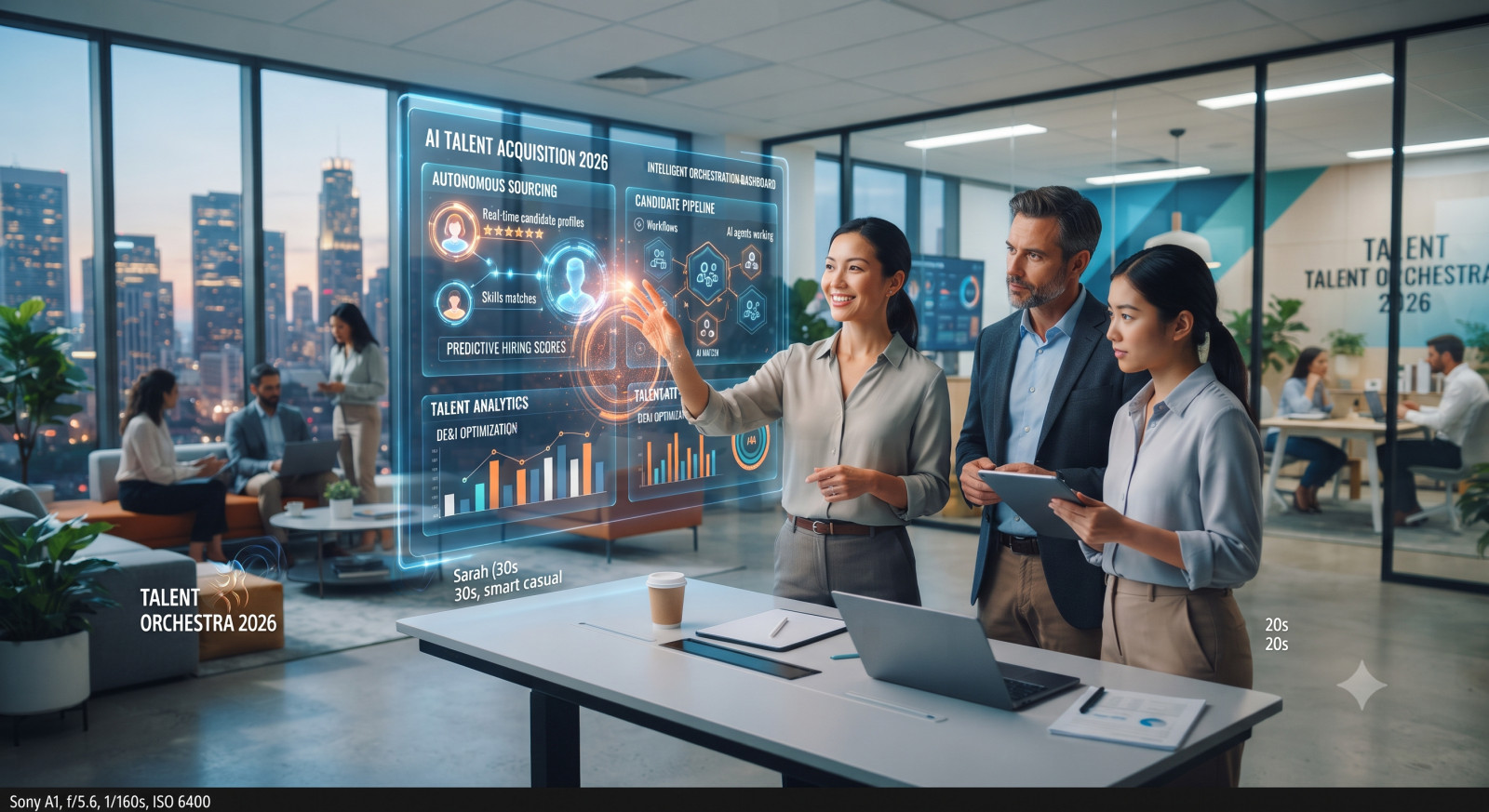
In the last ten years, "AI-enabled" was the golden ticket in recruiting – a set of separate technologies aimed at executing various manual jobs such as resume sorting or scheduling meetings. Now, as we approach the middle of 2026, everything is changing radically.
We've progressed beyond the realm of simple enablement and entered the new age of "AI-orchestrated" recruiting. No longer does it boil down to pure automation, but involves the introduction of fully autonomous systems able to reason, make decisions, and navigate the whole talent lifecycle independently.
2026 is the moment of truth for HR professionals. The period of initial testing of artificial intelligence is over. Nowadays, TA leaders are facing a requirement that goes far beyond just efficiency – they have to show business value in an extremely competitive environment of global skills economy. Current tools allow making the jump from reactionary recruiting to proactive workforce planning.
One challenge that comes with this process is whether AI would replace the recruiter in the process. In no doubt, AI will change the recruitment process significantly but will definitely not replace recruiters at all as recruiters will evolve into "Talent Strategists".
By delegating complex and autonomous processes to intelligent agents, recruiters will finally be liberated from "administrative grind" and will be able to engage in important negotiations, emotional engagements and long-term talent development.
This article will reveal the truth about the new reality. By discussing such emerging concepts like "Agentic AI" that is responsible for end-to-end pipeline management and skills-first hiring becoming a requirement, this paper will tell you how to design a talent acquisition process that is highly efficient and human-centric. We will also discuss the importance of good governance in order to be able to navigate AI ethics and human-in-the-loop practices.
II. The Great Shift: From Automation to "Agentic" Recruiting
For a long time, recruitment process automation consisted of "bolt-on" solutions. We treated AI technology as a digital intern whose tasks include analyzing the CV, sending a generic e-mail message or booking an appointment.
Those "point-solutions" left recruiters juggling between the tabs of ATS, CRM and LinkedIn Recruiter subscription. The previous model of automation could be described as an array of triggers that, once a user clicks "apply," results in sending a confirmation. While effective, it lacked the essence.
In 2026, we have evolved beyond binary interactions into the concept of "Agentic Recruiting." In contrast to earlier versions, agentic AI is marked by autonomy, reason and context-awareness. Instead of running an automated command, an agentic AI agent evaluates a task and determines the optimal way to complete it.
When it is required to "shortlist three software engineers with edge computing experience," the agentic AI agent does not simply look for certain keywords. It crawls through internal databases, analyzes open-source code repositories, studies the present-day sentiment in the marketplace and contacts potential passive candidates with targeted messaging prior to the recruiters' morning coffee break.
That’s what I call the "24/7 Pipeline." Previously, the recruitment pipeline had its limitations due to the boundaries of the working day. But now, your agentic AI is in a constant loop. While you sleep, they source from the global talent pools, screen against the current business needs and overcome complex scheduling conflicts between various time zones.
They don't just "do" the work. They move the recruiting pipeline forward and make sure that those candidates who have a high intent are never put in a "pending" list for 48 hours.
But there is one more innovation and that's what we call "Orchestration." Automation links two points. Orchestration connects the whole ecosystem. Your agentic AI is the glue that connects the different pieces of your fractured software stack.
They pull information from your CRM system, update scheduling in the ATS and communicate with the results of the interviews on the communication platform. And that's all without any manual data input. By becoming the central nervous system of your talent stack, these AI agents eliminate the friction of "administrative debt."
III. Precision Recruiting: Quality Over Volume
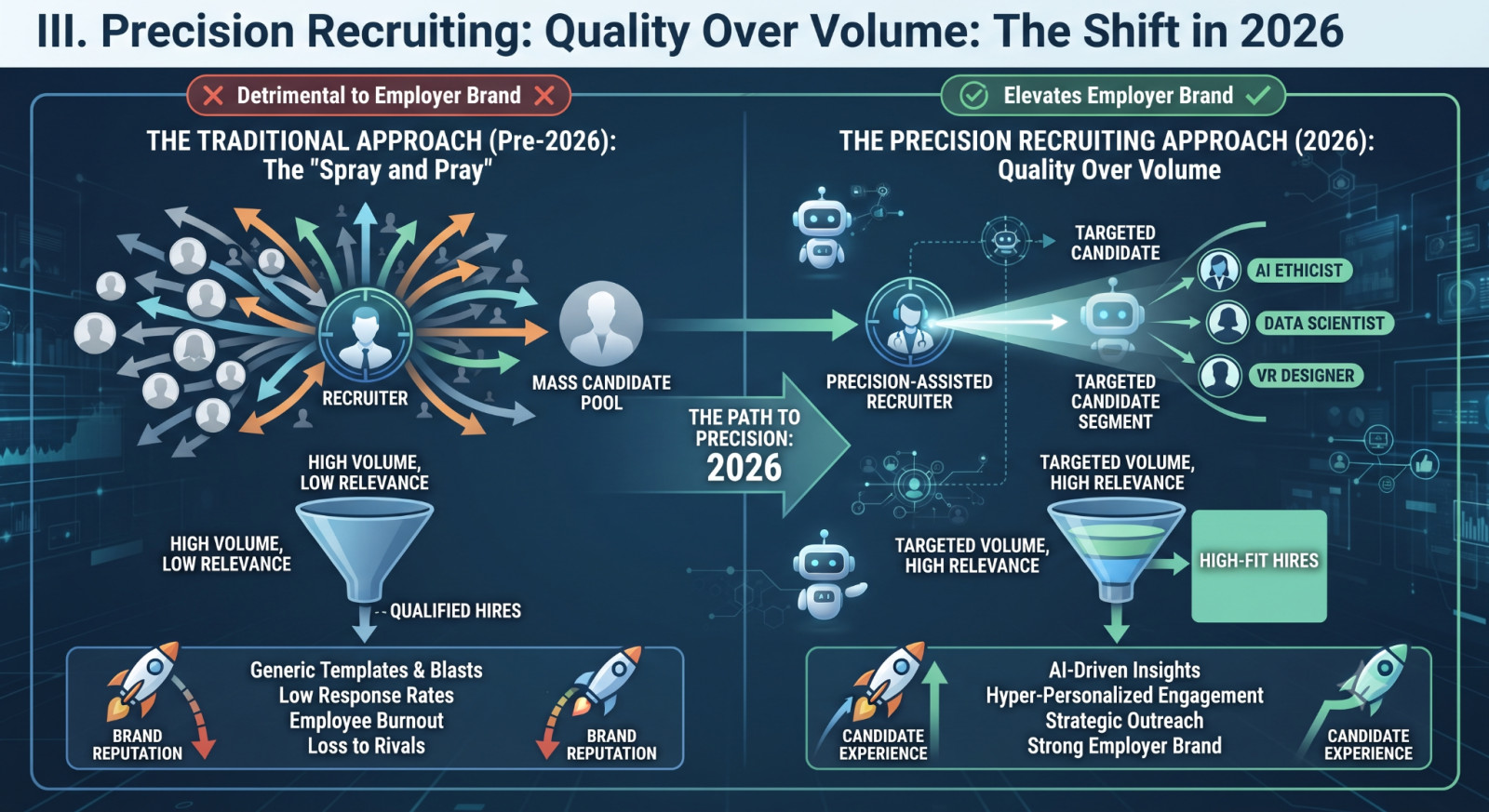
For far too long, the recruiting field suffered from the syndrome of the “spray and pray.” The logic was quite straightforward: try to contact as many people as you can, hope that some of them have necessary skills, and burn out your employees while trying to sift out those who do not.
In 2026, such an attitude to recruitment is no longer only inefficient, but detrimental to your employer’s brand. In an environment in which the most talented candidates receive numerous requests, sending them generic templates and blasts is the quickest way to ruin your image and lose them to your rivals.
“Precision Recruiting” of 2026 has been shaped by the Predictive Talent Intelligence. As opposed to the old practice of posting a vacancy as soon as it appears, advanced software solutions allow for analyzing past performance, growth of the company, and changing market trends to predict future vacancies even before they appear. This makes it possible for TA teams to establish relationships with promising candidates ahead of time, creating talent pools “in waiting.”
In this case, the technical transition is from “filtering” to “ranking.” Traditional ATS technology used Boolean logic searches with keyword matching, which is a crude way of identifying great candidates because they simply didn’t meet the ATS’s requirements even though they had all the necessary skills and knowledge, but simply were not written in terms that the system could recognize.
Modern AI agents apply semantic comprehension to make behavioral and skill matching rankings, examining the specific experience of a candidate, how his specific projects align with the key competencies needed for the position.
Take, for example, the latest development at a mid-level manufacturing business. With the help of an AI-driven shortlisting tool, they have done away with their manual process of screening candidates for senior engineers. The tool didn't merely use keyword matching but rather took into consideration their work experience, the soft skills demonstrated during the preliminary round of assessment, and their career progression path.
In effect, the time taken to reach "productive hires" came down by 30% since they no longer looked to pursue the quantity of candidates but only those with the most chances of succeeding.
This is what precision looks like: by cutting through the noise associated with volume, companies can actually get to know the person behind the candidate and guarantee themselves a productive engagement each time.
IV. The Human-Centric Advantage
As the technology assumes control of the administrative burden of the recruitment process, the question remains: what happens if the machine sources, screens, and schedules the talent? Well, there is much left that actually matters, which is everything else.
By 2026, the best recruiters will be those who embrace their humanity and capitalize on qualitative and nuanced aspects of talent acquisition not replicable via any algorithm.
"Recruiter-as-Advisor" is the definition of this transition. As AI agents assume control over 70% of recruiter's time currently spent on administrative tasks, this time will become available for performing high-impact strategy.
In effect, the recruiter transforms from "process runner" to a talent consultant and collaborates with hiring managers in developing long-term workforce strategies. This means working out challenging negotiations, solving difficult questions of cultural fit, and cultivating strong, high-trust relationships with a candidate that has plenty of opportunities elsewhere. AI may locate the talent, but it cannot convince a top talent to become a part of your vision - only a person who fully understands the company's mission can do that.
We can observe the emergence of "Augmented Interviewing." As opposed to replacing interviewing with technology, AI acts as an invisible colleague, offering its intelligence to make the dialogue better.
AI-powered tools now offer the real-time summarization of candidate's answers, sentiment analysis to measure engagement levels and objective skill assessment which highlights a person's potential, not his/her past achievements. Augmented interviewing is crucial to fight unconscious bias.
With the help of AI-powered algorithms, the assessment of soft skills becomes standardized and consistency of interviews is tracked, which allows a recruiter to solely concentrate on a person's personality and values.
This is the symbiotic future of human resources management. The machine offers data-driven context, and the human interprets it. No longer will the recruiter spend a day searching through different platforms trying to find "the right candidate".
Now he/she concentrates only on making sure that the candidate sees and hears him/her and shares excitement about the future of the company. AI takes care of the precision, while humans determine the purpose of things. With the help of emotional intelligence and strategic orientation, today's recruiters make sure that the candidates hired by them are really engaged in the company's success.
V. Skills-First Hiring: The New Global Standard
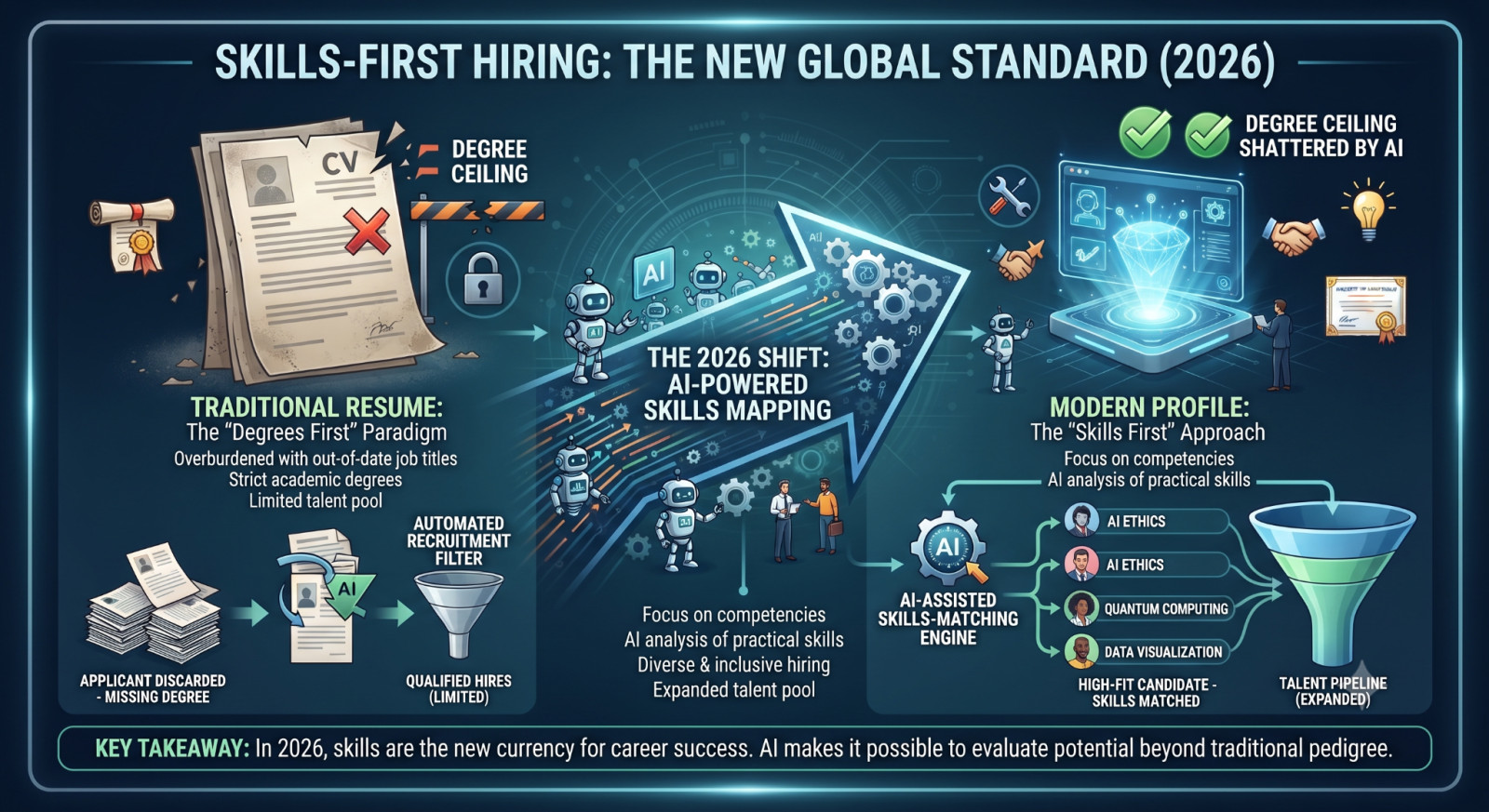
The traditional resume—the type of CV that tends to be overburdened with out-of-date job titles and strict academic degrees—is not a sufficient measure for success anymore. The 2026 world has definitely moved past "Degrees First" hiring towards the global "Skills First" hiring policy. This transition is not just about preference, but necessity caused by fast-paced development of technology and shortage of skilled professionals.
The greatest benefit of artificial intelligence in the process is that AI allows it to shatter the "Degree Ceiling." For years, the automated recruitment filters have been throwing away promising applicants without certain qualifications even though the candidate possesses all the necessary skills needed for the position.
The current generation of AI tools uses semantic algorithms to discover the potential skills of the candidates without proper qualifications. Through the analysis of portfolios, GitHub accounts, micro-certificate, and previous achievements, these tools are capable of discovering "hidden gems," which cannot be found using conventional Boolean searches.
To external recruitment, AI has made a major shift in what has been termed "Dynamic Skill Mapping". Instead of merely recruiting individuals for the existing job descriptions, organizations are now aligning their skills internally to the upcoming business goals.
Through continuous data input from project management systems and performance evaluations, an organization's skill set is mapped on a heat map that provides real-time analysis of their skills. If an organization switches to a different area of expertise altogether, the question of whether the necessary expertise exists internally arises immediately.
This is what drives internal mobility optimization. The past has seen people leaving an organization because they were not able to "see" their future within the firm. Artificial intelligence turns the situation around as it suggests projects or jobs within the firm that help the employee grow in his/her career by leveraging the fact that internal hiring will become an internal talent marketplace.
This way, organizations will benefit from retaining talent, saving money on hiring, and nurturing a culture of continuous learning. The organizations that will thrive in 2026 will be those which see an employee not as a static title in the organizational structure but rather as a growing set of skills.
VI. Addressing the "Ready-to-Deploy" Gap
By 2026, the gap between AI hype and successful execution continues to be the major choke point for HR departments. Companies have started off the year with lightning-fast adoption plans and have hit a brick wall due to operational friction. This "Ready-to-Deploy" gap does not come from technology issues but from issues of process readiness.
To begin the process of bridging this gap, organizations need to do an AI Readiness Audit. This includes evaluating an organization's data hygiene, technical compatibility, but most importantly, the level of digital literacy in the organization's talent teams. Hype about transformation through AI cannot cover up messy, disorganized data. In absence of the foundation of good quality actionable data, AI agents can scale inefficiency.
While operational considerations are important, Data Governance & Ethics is the most crucial issue. The risks associated with AI "hallucinations," where an agent may falsely certify someone, create skills matches, or misread the sentiments can cause hiring disasters and open an organization up to liabilities. From our experience in 2026, organizations have learned some very tough lessons from AI agents that were left to run unsupervised and have caused bias in candidate pipelines.
An ethical framework needs to be developed as a necessary feature. It implies transparency when setting limits to training and auditing of AI models. To make sure of successful adoption of the framework, support of the C-suite is needed to take the solution out of the experimental stage. The framework should make sure that even though an AI agent makes recommendations, its decision needs to be validated by a human recruiter.
To prevent hallucinations and bias, companies start implementing "Sandboxed Implementation." This approach allows them to test the AI agents in a safe environment, for example, an internal mobility platform, prior to moving the solution to external hiring and see whether the agent's reasoning holds.
VII. The Future: Preparing for the 2027 Talent Landscape
The technology infrastructure built in 2026—agentic workflows and skills-first foundation—will become the core of a whole new level of predictive and highly personalized recruiting.
The most promising trend to watch out for is going to be the rise of the "AI Twin." Picture an AI assistant for each recruiter that is designed to mimic his or her own way of work not by following general best practices but through individual learning based on successful placements made by that particular recruiter, his or her way of communicating with people and intuition in terms of cultural fit.
By 2027, this assistant will actually work as a kind of force multiplier: handling routine low-level interactions and at the same time preserving the voice of the recruiter. It would be the next level of Recruiter as Advisor concept.
Such a high degree of personalization will completely change the recruitment experience. We will move to what can be called "Hyper-Personalization" whereby the recruitment process won't be a cookie-cutter application anymore. The entire journey will be tailored for each individual candidate by the AI-driven system.
From the content, which talks about their career aspirations, through interview preparations, which cater to their specific learning styles, the entire recruitment experience will add value to your employer brand.
Finally, the recruitment industry will shift from point-in-time recruitment where the clock resets every time there is a new position open to continuous talent acquisition loops based on data. By 2027, the distinctions between an "applicant," "employee" and "alumni" will merge into a single dynamic talent pool.
The AI system will continuously monitor the internal performance data and the changes in the market and will keep talent pools "warm." This means constant preparedness for the organization in identifying and attracting the right talent without any need for any position opening.
VIII. Conclusion: The Path Forward
This paradigm shift that we have been experiencing during the year 2026 is certainly no less than a revolution. We have seen how the world is no longer filled with the fragmented tools of "AI-enabled," but the world is now defined by the concept of "Intelligent Orchestration." The emergence of agentic AI, predictive intelligence, and skills-based hiring is no longer just about technology; it is all about how organizations recruit and retain talent.
The path to 2027 requires more than simply investing in software; it calls for changing the mindset of leadership itself. The “experimental” nature of AI, which is defined by fast wins and disjointed pilot programs, must be replaced by “intentional” AI design. Intentional AI design involves creating architecture in which AI acts as a force multiplier for human recruiters, where data management is seen as a strategic asset, and the “human-in-the-loop” concept becomes a design tenet.
While considering your company’s journey to 2027, there is one critical thing that needs to be understood: Technology is merely the enabler of your strategy when it comes to talentAI has the capability of analyzing, predicting, and executing at an unprecedented rate, but it does not have the discretion to make decisions about cultural fit or the skill of persuasion in
FAQ - The Future of AI in Talent Acquisition
1. Will AI replace human recruiters by 2027? No, AI will evolve the role of a recruiter to that of a "Talent Strategist". It eliminates all the tedious administrative aspects of scheduling and screening candidates, leaving humans to concentrate on negotiating, matching cultures, and providing strategic counsel.
2. What do we mean by "Agentic AI" within the recruitment space? Agentic AI is the kind of autonomous system which is able to reason, learn, and execute end-to-end workflow processes (such as the full sourcing pipeline).
3. How can we make sure our AI will not add biases to our recruitment process? By maintaining human in the loop oversight and conducting periodic AI readiness audits. Your training data needs to be diverse and the AI recommendations should be reviewed by human recruiters.
4. What is the most difficult part in applying AI to HR? “Ready to Deploy” problem – the friction between the availability of the technology and availability of the clean data and the corporate culture that would allow using it properly.
5. In what ways does "Skills First" hiring differ from the usual hiring process? The fact that Skills First hiring focuses on evaluating a candidate's abilities ("latent skills"), instead of strict academic qualifications and job titles.
6. What is an "AI Twin"? A new notion that appeared in 2027 – an AI personal assistant of the recruiter, which has learned all his methods and ways of communicating and working, becoming a multiplying factor.
7. Can AI really improve the experience of the candidate? Yes, because AI can be applied to hyper-personalization of the recruiting process.
8. How can we prevent our AI from having “hallucinations”? Use "Sandboxed Implementation". Allow agents to be tested in a low-risk internal setting, and always draw the line between ethics and AI involvement when dealing with high-risk hiring decisions.
9. Can AI really predict hiring needs? Yes. Using predictive talent intelligence, AI is able to analyze changes in the market and data within organizations to predict future hiring needs before they become vacancies.
10. Where does a TA leader start on their AI journey? Conduct an AI Readiness Audit to check data hygiene and digital skills among your people, and focus on “intentional” design over experimentation.