5 Red Flags to Watch Out for When Hiring on Open Marketplaces
5 Red Flags to Watch Out for When Hiring on Open Marketplaces
The New Frontier of Talent Acquisition
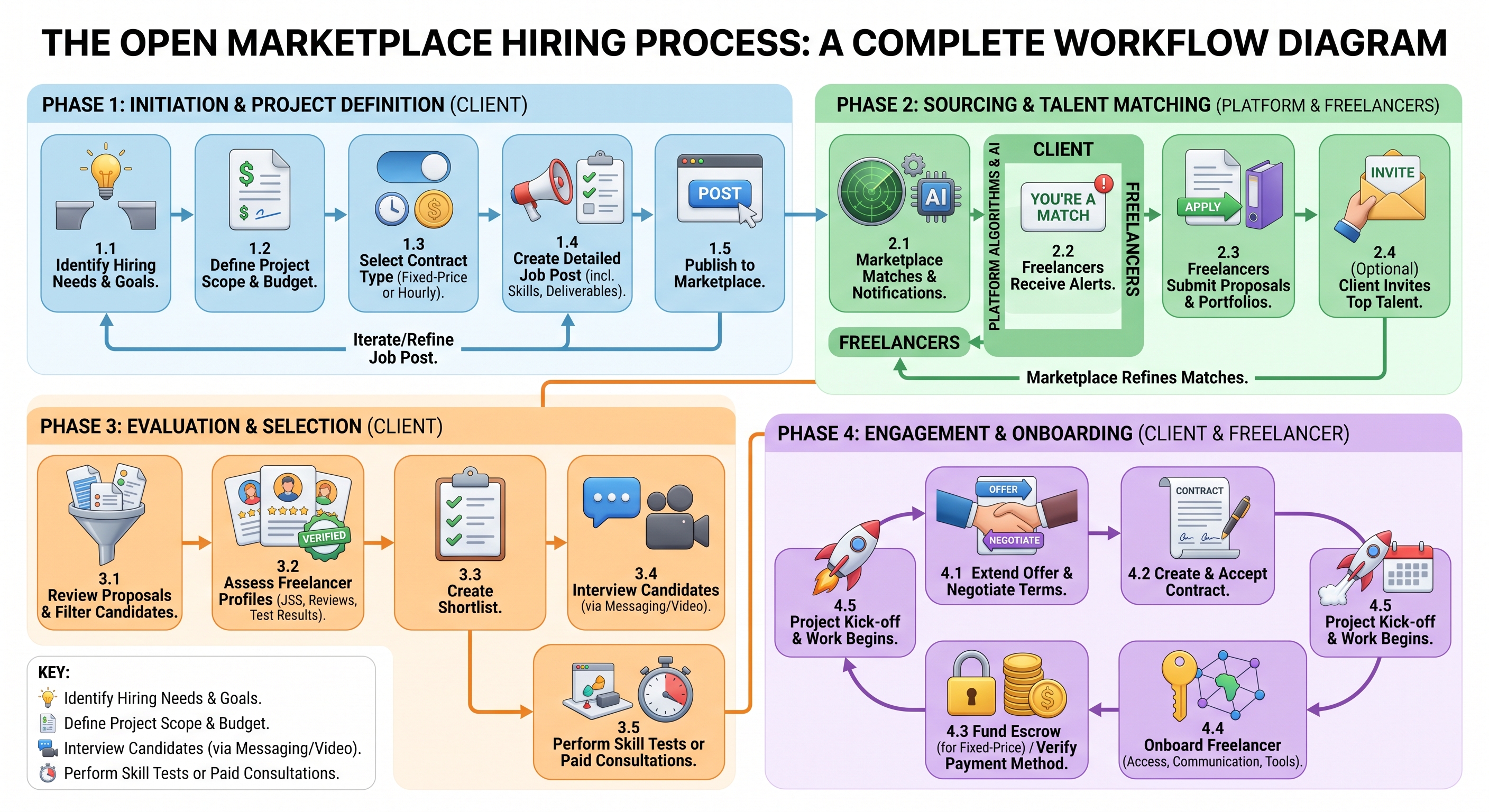
Hiring on open marketplaces has become the dominant approach used by organizations that seek to expand their activities in a flexible manner. Businesses increasingly rely on an open marketplace to find skilled freelancers quickly and affordably . While these platforms offer access to global talent , they also make it easier to hire the wrong person if you don't have a proper vetting process
The idea sounds very attractive since one gets the possibility to employ the services of world-class specialists in an instant manner and ensure quick project completion. Such an approach always comes with a risk factor.
In the rush to hire the necessary personnel, organizations usually forget about the crucial stage of freelance vetting. The lack of attention to the process described above becomes the main source of project failure since as a result, one experiences problems with delays, low quality of services delivered, and serious security risks that could threaten the reputation of one's business.
At GigMint.ai, our approach implies making a radical step forward in contrast to the typical race to the bottom which usually takes place in the field of quantity-based bidding. The present paper becomes your guide in the world of GigMint.ai hiring.
The Landscape of Modern Hiring
This quick shift towards gig economy and Hiring on open marketplaces has changed the business environment entirely. Platforms like Upwork, Fiverr, and others have made it possible to easily gain access to skilled people, making it easy for companies to create top-class teams from diverse time zones in just hours.
This system is highly flexible for both startup firms and corporations, but it has its own challenges, which are unique to the gig economy.
Its ease of use has created a false sense of security because when you get numerous offers, hiring freelancers can create a false sense of security because when you get numerous offers in your inbox, it is easy to believe that the more offers you receive, the better you can perform.
But in the absence of such stringent measures, it might cause an outburst of “template” applications which do not cater to your objectives. Without a proper format and strategy in place, the entire recruitment exercise becomes more reactive than proactive.
To be able to hire the right kind of talent in today’s times of transition, this requires a certain level of discipline in filtering the applicants and being able to identify early red flags along with maintaining high standards of communication. The focus needs to be on structured and considered evaluation as opposed to hurried hiring which ensures that each engagement is valuable for your organization. It is now time to move away from the distractions of the open market.
The 5 Red Flags
1. Vague or Generic Communication: The "Copy-Paste" Bid
If you advertise a job in an open market, Hiring on open marketplaces means you are opening yourself up to receiving thousands of offers, many of which are simply generated by bots that spam the offer out to hundreds of other clients. The initial interaction can actually be the best determinant of how good the freelancer really is because if they can't bother to make it personalized, neither will they with your work.
The Lack of Project Specificity
The most frequent warning sign is a proposal that sounds like a typical sales brochure. Is the bidder mentioning your firm's name? Are they addressing the particular issues your firm faced according to your job description? If you receive a proposal full of buzzwords and completely unaware of your needs and the difficulties of your industry, you are most likely facing "template fatigue."
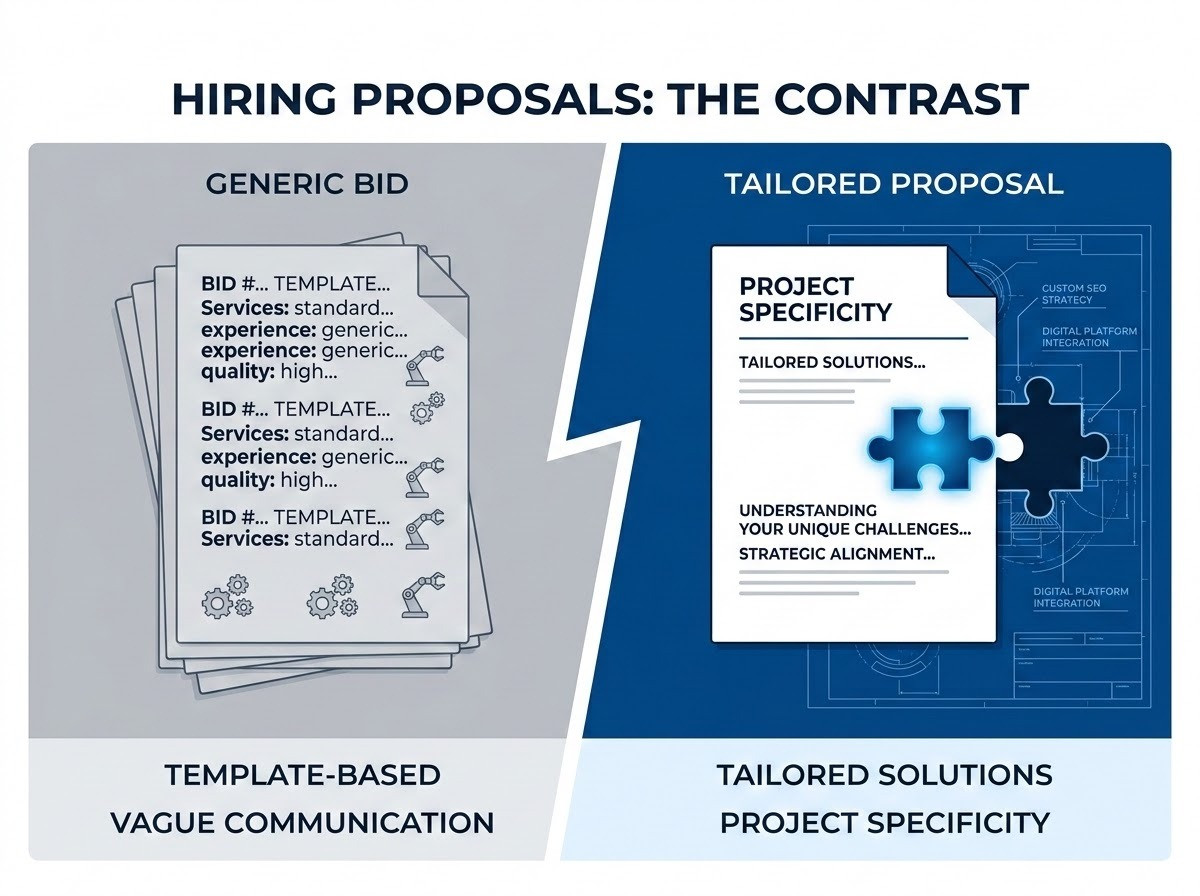
Such candidates are playing a numbers game, not a matching skills game. The more they pitch the better for them as long as they hope to eventually land a deal through sheer quantity. By not taking into consideration industry specifics, they show their inability to customize their offer, which is important for a specific project. If such candidates cannot be bothered to adjust their offers in the crucial introductory stage, they are unlikely to go beyond minimal efforts once they get the contract.
Ignoring Explicit Instructions
For the prevention of bots or automated spam, most experienced HR managers utilize Easter Egg instructions in the job post. For example, you can place in your request the following phrase: “Use the word ‘Blue’ at the start of your bid if you want me to know that you’ve read all the description.” A proposal without a specific word gives you the objective evidence that the candidate did not read your instructions carefully.
It’s a great tool since the person who does not bother to follow simple instructions in the application process will definitely overlook your requirements in the project completion process. In case of important hiring, you should have partners who are able to be careful enough to understand complicated briefs and not those who try to find keywords as quickly as possible.
Language Barriers vs. Effort
It is important to understand the difference between real language barriers and the absence of professional effort. After all, we work in an international environment, and non-native speaking ability is never the sole reason for refusal. But it makes a big difference whether the candidate submits a well-thought-out and well-structured proposal that might not have proper grammar, or whether he or she sends you a slovenly and chaotic correspondence.
When there are lots of typos, when formatting conventions are disregarded, when compliments sound mechanical and do not match your request—there is no question about language barriers. A true professional always guarantees the clarity of his message independently of his native language.
You should evaluate the candidate’s intention and professional attitude towards your particular request. The candidate who fails to demonstrate effort in the very beginning will most probably fail during the whole period of work.
2. Inconsistent or Stock Portfolios: Authenticity Checks
The "Frankenstein" Portfolio
One of the most alarming red flags is a "Frankenstein" portfolio – a portfolio with works that have wildly different design approaches, skill levels, and aesthetic value. If a portfolio contains works that switch from amateurish low-res graphics to professional level UI design, then it's clear that these works do not come from one person.
To prove the portfolio is authentic, use objective methods.
Use a reverse image search of the portfolio works through services such as Google Images or TinEye and see if these assets are present on other sites and/or under the name of other authors. Check for any signs of metadata or branding that would indicate these works belong to this author. An actual professional has a coherent "voice" throughout all his works.
Heavy Reliance on Stock Imagery
An additional warning sign is a portfolio made up mainly of stock images. When a “creative” individual depends mainly on stock photography, generic templates, and pre-built user interface kits, they are not doing creative work; they are assembling it
Proficiency comes from being able to address unique problems through a tailor-made solution.
When an applicant’s portfolio contains no original ideas and instead depends mainly on “drag and drop” resources, they have not yet acquired the basic skill set needed to create a tailor-made solution for your business. When considering candidates, it is important to consider only those portfolios which contain original ideas.
Requesting Live Proof of Concept
Static PDFs can be edited at will, and frequently lack the most important aspect of the effort – the process itself. A high-end individual will have no qualms about presenting a live link, an active GitHub repository, or even a full-fledged case study on the “before and after” of their project.
A failure by the potential heir to do this might indicate that the project has been left unfinished, that it is owned by somebody else, or that it doesn’t exist altogether. Ask for tangible proof of their effort. An expert will not simply demonstrate a picture of the site they have worked on; they will direct you to the actual website, and tell you how they affected its metrics and the process behind the creative decision-making.
3. Suspiciously Low Bids vs. Unrealistic Premiums
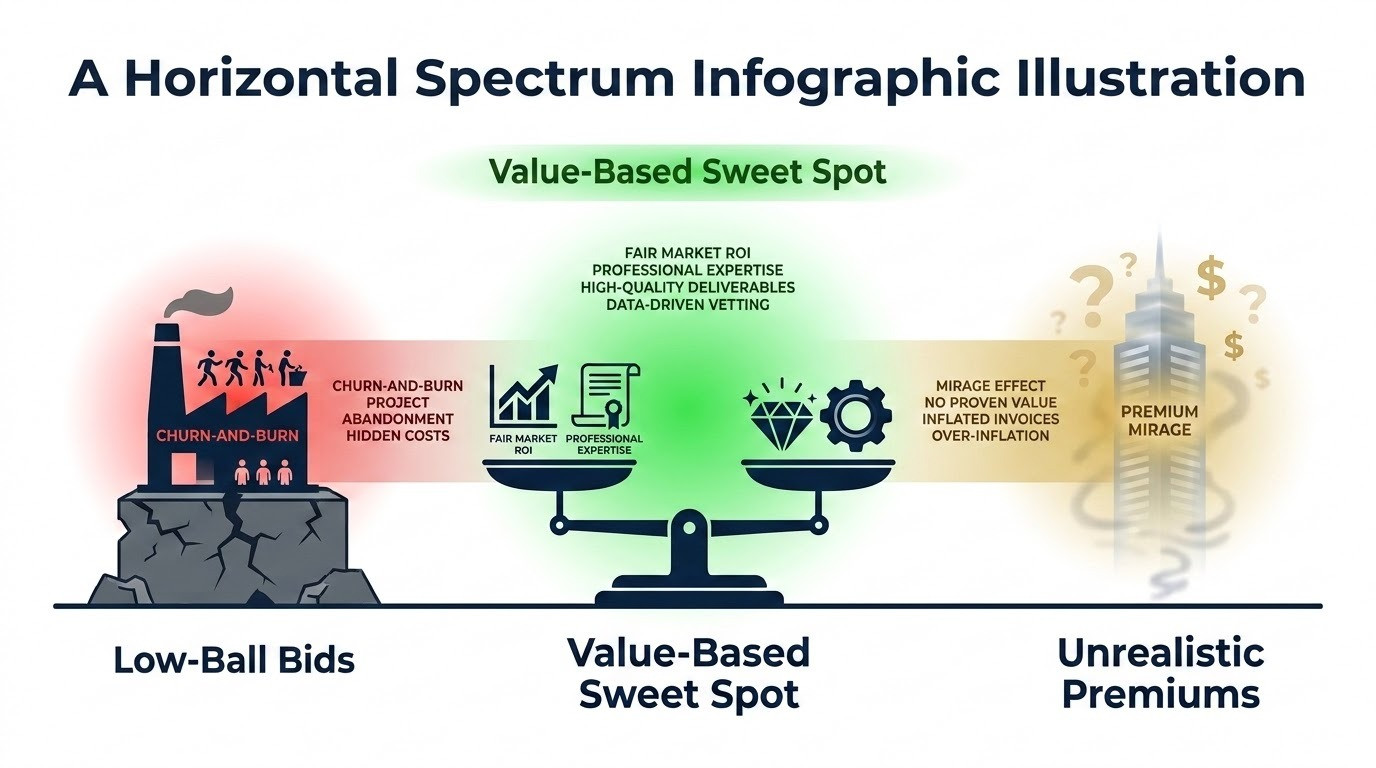
In terms of reviewing proposals posted in open marketplaces, hiring on open marketplaces requires careful examination by hiring managers. Treating freelancers' prices as just commodity prices is one of the biggest strategic mistakes. Hiring freelancers often leads to discrepancies—either too low or too high—are generally the best indications of a freelancer's business sophistication and professionalism.
The Underlying Price of "Too Good to Be True"
It might be tempting to hire a person with a low offer, but in case an offer is priced below average market rates, Hiring on open marketplaces will never become "a steal." On the contrary, low-priced offers will more likely be the sign of the upcoming project abandonment.
Low-bidders usually use the "high volume/low effort" strategy, basically "churning" clients and making money off outsourcing projects to the unskilled labor force or doing only the minimum amount of work to get paid. These projects put you into a "review loop"—a situation where the freelancer provides you with a sub-standard result and forces you to write a 5-star review for him to keep up his profile ranking. Talented people know how much their work costs; if someone lowballs you, you should definitely avoid hiring them.
Over-Inflation without Rationale
Pricing should never be haphazard. Although top-notch specialists do charge more for their services, you need to look out for a "premium" service provider who does not have any obvious track record that justifies their steep prices. When a bidder tries to brand himself/herself as a high-end consultant, but fails to prove their value to you with some solid facts, then there is a good chance that he/she is a "premium mirage".
Such individuals usually take advantage of the human tendency to associate high price with high quality and hope that you would conclude that their services are top-notch based only on their invoices. A real premium service provider always justifies their high prices with the tangible benefits.
Value-Based Pricing Models
The best approach to take in regard to marketplace pricing is to change your point of view and engage through value. Rather than looking for low hourly rates, search for those professionals who price their services in accordance with the impact and ROI generated by the project.
Professional freelancers offer tiered pricing packages in order to show you how deep is their expertise in regard to the services they provide and to demonstrate what you actually pay for (either it is professional strategic planning, fast response time, or implementation of the technical skills).
Understanding the realistic market rates of your particular industry becomes critical; knowing how much should be invested in skilled professionals, you will be able to distinguish all the noise from the truth.
4. Feedback Auditing
For the marketplace economy, hiring on open marketplaces does not represent anything other than social currency and not performance metrics. The majority of clients tend to either fear some kind of backlash or prefer avoiding it at all costs, which results in “reciprocate fluff” or a generic set of praises that give no clue regarding the skill level of the person being rated.
While conducting the audit of a prospective candidate’s work record, one should disregard the number of stars. What really counts is the detailed feedback on the freelancer. Has he managed to overcome any technical challenge successfully? Had he coped with a difficult deadline? Was he proactive in communication during the period of the crisis? In case all the reviews are short and vague phrases such as “Great job” or “Fast delivery,” they have to be disregarded as they are not a sign of professionalism.
The "Ghosting" Pattern
The marketplace reviews are a goldmine of behavioral information for those who know where to look for them. It’s not enough to browse through the portfolio of a freelancer – make sure to use filters for such words as “deadline,” “responsiveness,” “communication,” and “unavailable.”
Even a mere mention of “communication blackout” or “missed milestone” is worth taking into consideration and viewing as an alarming signal. The reliability of a worker in the freelance sector is equally important as his or her skills. In the pressure points of your own project, you simply do not have the time to chase a contractor.
Look for contractors who have a reputation for maintaining good communication channels throughout their projects. If one of their past clients had to struggle to find out any information, you probably will, too. Do not risk hoping that this freelancer can suddenly "turn over a new leaf."
Analyzing Gaps in Work History
The history of a freelance worker should logically reflect how they have progressed through their career. It is impossible to miss the periods when there was no activity—usually, those periods were healthy since they allowed time for deep work or development.
It is crucial for you to differentiate these natural pauses from "churn-and-burn" cycles. The warning sign is an account with cycles of intense activity that come one after another and are immediately followed by a period of complete absence. These patterns usually indicate a problem with sustainability and inability to maintain the balance between workload and rest.
Steadiness in velocity is what you need to look for. A person who has been able to combine long-term projects and occasional short-term work can be said to manage their capacity correctly. If the pattern of activities is chaotic and resembles several bursts of intensity, think twice. You want to have a stable partner who would have enough energy and time for your project.
5. The "Yes-Man" Syndrome: Lack of Critical Project Questions
Getting a freelancer who agrees with everything you have proposed sounds great, but in the realm of high-stakes talent acquisition, hiring on open marketplaces is usually quite the opposite. The Yes Man syndrome happens when the candidate wants to secure the contract so badly that he or she fails to comprehend the reality of the project. It is tempting to see this flexibility as such, but it is normally just a sign of an “order taker.”
Passive Engagement as a Risk Factor
In case you provide a complicated job description, a real professional would try to understand all details related to your objectives, limitations and plans for the future. If a candidate is only ready to say "I can do that" or "I'm ready to begin" without any clarifying questions at all, it means that he or she is not involved enough.
A passive approach shows that he or she does not think critically about the situation in which you have found yourself. If you are doing most of the intellectual work on your own, you are not saving time; on the contrary, you are increasing the burden on yourself as a manager twice.
Over-Promising on Impossible Deadlines
The most prevalent form of "Yes-Man" behavior is unrealistic turnaround time. Hiring on open marketplaces often involves accepting a deadline that looks suspiciously short, they don’t display their speed – they display the lack of professional boundaries. They place their need to win the contract above the reality of the work.
That means that sooner or later there will be a speed trap – compromises on quality, skipping QA, or releasing something that was never finished just because some date was chosen. Quality cannot be rushed – architecture, testing, fine-tuning take time. If a candidate agrees to your deadline without discussion of the scope, milestones, and potential roadblocks, you should expect problems with quality.
The Value of Constructive Pushback
Great freelancers work as consultants rather than as mere workers. They will argue in case the concept proposed lacks technical validity, the deadlines set are unrealistic, or the path recommended by you will eventually create technical debts. It is through this kind of friction that the value is generated.
It shows that they have taken time to analyze your problems and are concerned enough about the fate of your project to point out its weak spots. They come into the project with the intent of utilizing their expertise in order to keep you from doing something that may cost you a lot of money. Top talent wants not only to "get the job done" but to deliver real value to your business.
Building a Foolproof Interview Process
Recognizing these flags is only half the solution; the actual answer is in crafting an effective, scalable interviewing process. In order to scale Hiring on open marketplaces, you have to standardize your evaluation. Relying on reactive hiring processes means testing capability and not just claims.
The Technical Deep Dive
Don’t use resumes as a basis for assessing problem-solving capability because these are basically marketing brochures aimed at flattering. For understanding whether people are really experts in problem solving, you have to get down to the technical deep dive.
Challenge them to describe a previous project, but pay attention to the moment when things start going badly. How do they cope with this situation? What technical steps did they take and why? The genuine professional will give you a detailed description of their reasoning process. Otherwise, most probably he is not an author of the project he’s bragging about.
Paid Test Projects
The most effective way of vetting someone is through the use of "Trial Run". Always ensure you do not sign an agreement with anyone without giving him/her an opportunity to prove themselves first by engaging him/her in a small paid milestone. This should always be a miniature version of what you will be expecting from them—this could be a particular feature, a blog or just a particular graphic. By doing so, not only do you remove the problem of asking for free work, but you get an opportunity to see their process first hand.
Video Consultations
Communication via text messages can be deceptive. For a video call, you get the most authentic "vibe check" to see whether your applicant has the right soft skills and cultural fit. Instead of questioning the candidate about their experience, you should try to imitate the process of actual work. Tell your applicant that your team is stuck in a small issue, and see how they respond to the challenge. Can they demonstrate their active listening? Or, do they speak without any purpose?.
Reference Checks
It is quite hard to check references on marketplace sites, but you should still try. Ask for contacts of your candidates' previous clients, or look for common friends. If you manage to find the old clients, don't ask whether your candidates did a good job. Try instead to ask such questions as "Would you give them a one million dollar project?", or "What was the hardest thing about working with them?". You need to hear the truth from the clients, not only compliments. Candidates who can't provide any references should be avoided since they have no established business relations.
Reviewing for Flow and Clarity
Last but not least, evaluate the candidate’s production in terms of structure. Good writing is an indicator of good thinking. Whether it is a software developer, a graphic designer, or a writer, the quality of their professional emails—and their results—should be marked by high standards in structure. You should see writing in which things are clearly stated in short paragraphs and simple sentences. If their pitches or outputs from tests are complex and full of technical jargon, then they will find it hard to make complicated concepts come to fruition.
Quality Over Speed
The dynamic environment of the digital economy, Hiring on open marketplaces makes recruiting on the basis of speed tempting, which could turn out to be detrimental for a business in the long run.
The problem that we have highlighted in our discussion about the “vetting gap” in open marketplaces, Hiring on open marketplaces is an operational risk that will result in inconsistency in quality, potential threats to security, and unnecessary cost implications.
Disregarding the warning signals, such as generic bid offers, inconsistent portfolio presentations, unusual price quotations, and passiveness in communication, is too risky a strategy for your brand image.
GigMint Advantage consists of transforming the hiring process from one of purely transactional "race-to-the-bottom" approach to the vetted partnership model. With the use of The 1% Standard and our AI Task Pipeline, we transform the noise and risk of open marketplaces into efficient and secure hiring systems based on the data.
You stop functioning as a recruiter and begin working as a leader, creating your own bench of experts who will share your vision of your company.
In essence, content and development projects become the fuel for your growth. Making the hiring process a central component of your business activity and paying attention to depth, vetting and alignment of interests is the only way to ensure your brand is organically visible and credible. It is time to get out of the turmoil of Hiring on open marketplaces. It is time to elevate your hiring process by choosing the partner who shares your values of quality.
Ready to build your team out of the 1% of the vetted experts? Visit GigMint.ai and post your first project now!
.