AI Agent Development Explained: How Autonomous AI Systems Work

AI Agent Development Explained: How Autonomous AI Systems Work
1. Overview
For the last two years, the business industry has become mesmerized by the capabilities of reactive AI. It has become commonplace to ask queries to chatbots and wait for a response – a "question-answer" process which is quite amazing, but which nevertheless requires considerable human effort to turn data into actions.
Now we are seeing a paradigm shift: from reactive chatbots that only offer answers to proactive, self-directed "AI Agents" who not only answer our queries but get things done.
The Next Step: Defining AI Agency
An Autonomous AI Agent is a machine that can perceive its surroundings, reason about a goal and take a series of actions to reach this goal with minimal human involvement. This is what is called an "Agency". An Autonomous AI Agent, unlike regular LLMs which only respond to prompts, is autonomous enough to take the initiative, manage its workflow and iteratively improve itself depending on the result.
The Value Proposition: From Efficiency to Scalability
In the business context, the adoption of automation is no longer just nice to have—rather, it has become imperative for competitiveness. Using agents, companies will be able to work around the clock, distributing tasks that are routine and involve multiple steps of cognition currently hindering humans. Whether it is dealing with full customer resolution processes or coordinating sophisticated data flows, agents bring an order of magnitude in scaling beyond linear headcount increases.
Guide to Agentic Architecture
In this guide, we will uncover what agentic architecture means. We will review the "Perceive, Reason, Act, Learn" cycle, discuss the elements that make up a good tech stack, and present a full-fledged development plan. We will tackle the issue of governance and reliability, arming you with all the knowledge needed to take your pilot project from concept to reality at Gigmint.ai.
2. What Exactly is an Autonomous AI Agent?
The difference between standard AI and Agentic AI can be explained by comparing a consultant and an employee. While the former one acts like a consultant, answering the requests and giving suggestions, the latter acts like a proficient employee, taking responsibility for completing the task from beginning to end.
Standard AI vs. Agentic AI
In general, most users know what "reactive" AI is: you give a prompt and get a text response back from the model. The process is transactional and linear. Agentic AI is non-linear and iterative. It doesn’t respond to the prompt; it knows the reasons for the task and completes it.
The Key Characteristics of Agency
In order for an agent to advance from merely generating texts, it must have the following four essential traits:
Goal-Directed Autonomy: Unlike a chatbot that is instructed how to perform, an agent is provided with a target. It knows what needs to be achieved, and it can devise its own way to overcome any obstacles on the way without any human input.
Perception and Reasoning: The agent has to understand the surrounding world – whether it is a database, a dynamic website, or an email thread – and think rationally about the actions needed to achieve the goal.
Tool Usage and Integration: The agent’s efficiency depends on how well it can interact with the world around it. By connecting to databases via API integration, executing code via a code interpreter, and accessing websites via browser integration, the agent connects its cognitive abilities to the real world.
Learning and Adaptation: An advanced agent unlike one with a set of scripts learns from its behavior. If something does not work, the agent identifies the problem and looks for alternative ways to solve it.
The "Loop": Perceive, Reason, Act, Learn
It is the cycle of an agent that makes it magical. It does not stay at the stage of "response." Rather, it is involved in a repetitive cycle that includes:
Perception: The agent collects data from its surroundings or inputs by a user.
Reasoning: It splits up the goal into sub-tasks and chooses the tools for accomplishing those tasks.
Action: It accomplishes the task (for example, sends an API request or writes a program).
Learning: It analyses the result, updates its context, and goes back to step one until the goal is accomplished.
This cycle is the basis of productivity, which helps turn a lonely AI model into a true digital assistant.
3. The Architecture of an AI Agent
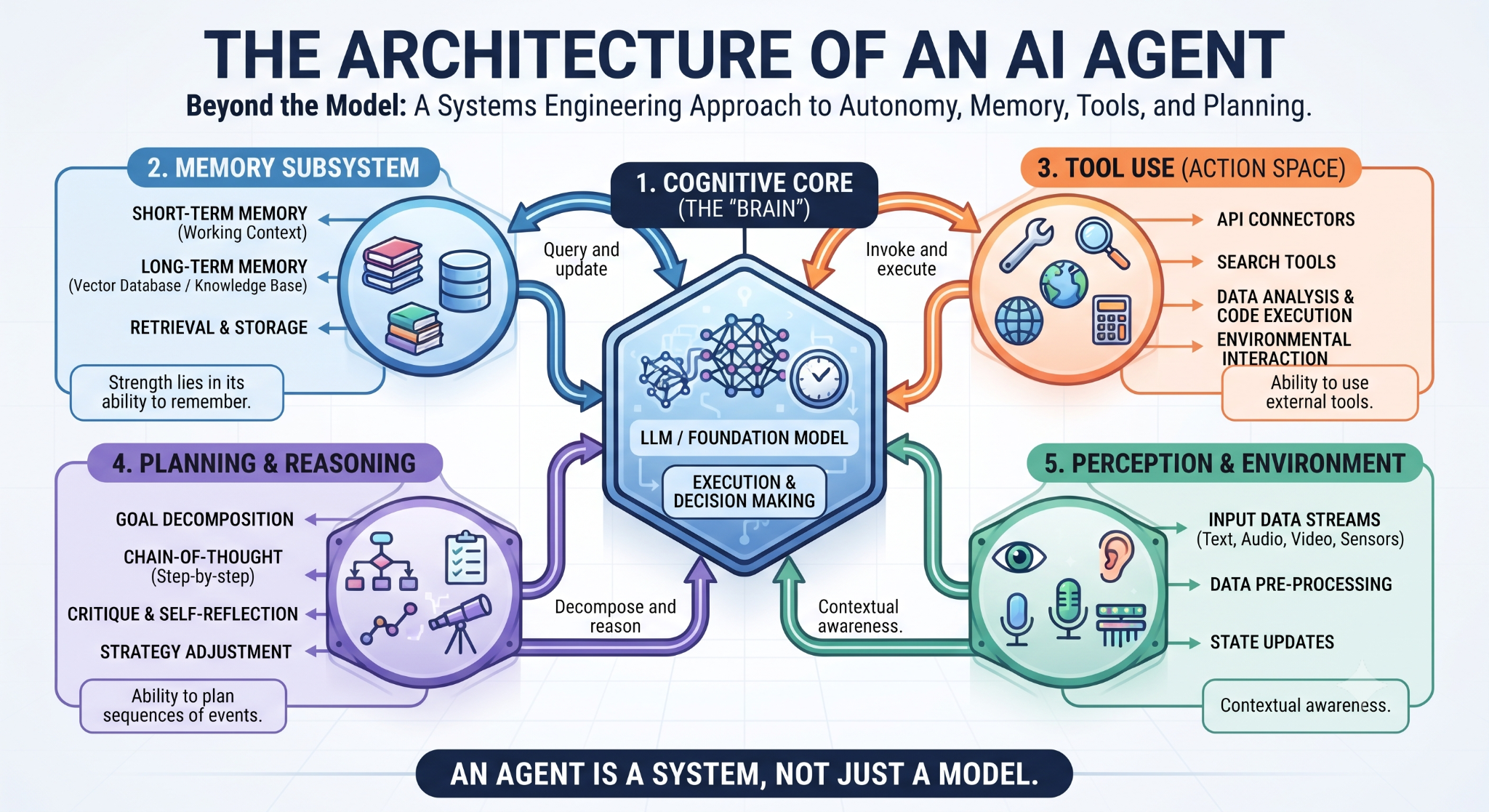
Developing an autonomous agent is not merely the selection of a model but an exercise in systems engineering. Although the brain is important, the strength of the agent is in its ability to remember things, use tools, and plan sequences of events. In order to understand agents, we have to dissect the four main architectural pillars that define them.
The Brain: The Reasoning Engine
The core of any agent is either a Large Language Model (LLM) or Large Multimodal Model (LMM). This model serves as a reasoning engine. While the model of a chatbot is used to predict the next token, in the case of an agent, the model is used for predicting the next step in the workflow.
Reasoning models like GPT-4o, Claude 3.5 Sonnet or other models that are specifically designed for reasoning are very important in this case, as they should be capable of translating business goals into actionable instructions.
Memory: Short-term vs. Long-term
Agents need both short-term memory and long-term memory for context preservation and improvement.
Short-term Memory: This is the context window of the agent. It contains the progress of the ongoing task and user inputs, temporary state variables.
Long-term Memory: To operate effectively, agents should have access to their history. This can be provided through Vector Databases like Pinecone, Milvus, or Weaviate. Using the Retrieval-Augmented Generation (RAG) principle, the agent can "ask" about their history, documents of the company, previous task results and will not commit the same mistakes twice while staying grounded in the domain of your organization.
Tool/Action Layer: Linking Reasoning and Reality
The brain without hands cannot do anything. The Tool/Action layer is the link between the agent’s reasoning and the real world. This layer allows the agent to communicate with various APIs, run Python code, navigate on the Internet, activate enterprise applications (CRM updates, sending emails, etc.). This way, developers are able to provide the agent with the exact "toolkit" depending on the task – from debugging the production code to fixing a spreadsheet.
Planning and Orchestration: The ReAct Pattern
The last architectural element is the orchestrator. The agents do not usually complete a task at once. They apply such patterns as Chain-of-Thought (CoT) or ReAct (Reason + Act).
Chain-of-Thought encourages an agent to "think out loud" and split the complex task into a sequence of logical steps.
ReAct extends the idea of Chain-of-Thought, encouraging the agent to reason about the task, take an action, observe the results and revise the reasoning. It is this type of orchestration which allows an agent to debug itself.
4. How to Build an Ai Agent: A Developmental Roadmap
Developing an agentic system is a process of designing and engineering. Though the architecture creates the necessary structure, the development process will determine the usefulness of the agent. Take the following five steps for developing a full-fledged autonomous system.
Step 1: Setting Goals and Scope
The first thing you need to do is to identify the “agentic scope” before coding even starts. You should not attempt to develop an all-around “Swiss-army” agent. Identify the processes of high friction, repetitiveness (e.g., lead qualification, support tickets routing, cross-platform data reconciliation), where there is a lot of manual oversight involved and the logic behind the process is mostly rule- and data-based.
Identify how your success will be measured: the time spent completing a particular task, reduction in human intervention, or automated data synthesis accuracy? Narrow down the scope of the agent’s capabilities to a specific area. Create an MVP version of the agent. Define the minimum subset of tasks that the agent should execute flawlessly to prove its usefulness within your technology stack.
Step 2: Selecting a Sophisticated Tech Stack
The foundation of your agent determines its limitations.
LLM Selection: Your decision will be based on the tradeoff between the cost of reasoning, latency, and capability. State-of-the-art models like GPT-4o and Claude 3.5 Sonnet are currently better in multi-step reasoning and tool-calling.
If you want to optimize on cost and need high volume, then you can consider open-source models like Llama 3 which perform well when self-hosted. This is particularly useful because self-hosting provides data privacy.
Orchestration Frameworks: Don’t try to invent the wheel. LangChain is still the best framework if you want to build complex and customizable chains of logic. But for the purpose of creating a multi-agent system, CrewAI and Microsoft AutoGen should be considered. These frameworks help you create "teams" of different agents such as a "Researcher", "Writer" and "QA" that communicate through passing context and output among each other.
Step 3: Designing the "System Prompt" (The Agent Constitution)
The System Prompt is the "constitution" of the agent. It sets out the definition of persona, scope, and instructions. Some principles of successful prompting are:
Setting Guardrails: Set clear restrictions ("You are not allowed to delete the entries in the database.")
Persona Setting: Set the persona ("You are a senior DevOps engineer...") to provide a background for the style of reasoning and professionalism.
Priority List of Objectives: Set the priorities for the tasks.
Few-Shot Prompting: Provide a list of examples of the input-output pair to let the agent act in a uniform way in any situation, even in case of an input that is outside the training set.
Step 4: Secure Tool Integration
An un-equipped agent is a smart chatbot. You need to make the agent interact with the enterprise ecosystem using APIs.
Primitive Actions: The first step is to understand the primitive actions that the agent can perform: querying the SQL database, fetching data from the S3 bucket, or performing any action on Slack or Jira.
Security Measures: It is essential to use OAuth 2.0 and scope-based API keys in order to make sure that the agent has limited access to the resources.
Human-in-the-Loop (HITL) Gates: In cases of high-value actions, the HITL Gate must be used. The agent creates the email or transaction and halts its process until there is a human “go-ahead.”
Step 5: Testing, Evaluation, and Resilience
The non-deterministic nature of agentic systems makes testing a non-traditional endeavor. It's essential to use "traditional" unit testing, but it won't be enough. We must create "Agent Benchmarking":
Artificial Test Sets: Prepare a list of various inputs and outputs for the test of reasonability.
Hallucination Control: Create some automated "critics," "verifiers." The secondary model of much smaller capacity than the LLM can check the facts and output of the agent prior to the final decision-making.
Error Handling Logic: Design for failure! In case of a 500 API error or any other error like malformatted LLM output, the agent must have a fail-safes for handling such errors: alert a human, perform an exponential backoff or notify a user about hitting a dead end.
5. From Theory to Reality
It is at the stage where architecture becomes practical that the real potential of Agentic AI is realized. With the departure from just being a means to generate content, these automated systems are increasingly becoming highly useful digital coworkers in different functions within companies.
Customer Support: Automated Problem Solving
Customer support AI was used as an advanced router, where tickets would be routed to the appropriate humans based on keyword matching. Automated agents have taken this approach a step further by solving problems rather than routing tickets.
An automated agent, when correctly configured, can do everything that a customer needs it to do. It can log into the customer's account, check the status of their order, issue a refund according to the company's policy, and solve technical problems.
Software Development: The "Engineer-in-the-Loop"
In software engineering, the role of agentic workflows is changing the SDLC process of creating new software. The coding agents have become increasingly adept at more than just writing small bits of code - they can traverse codebases, find bugs, write unit tests to fix the problem and even initiate the deployment pipeline processes automatically.
With the help of the agents, you can make sure that your repository stays healthy and you keep addressing technical debt without slowing down the process by being constantly on top of it manually. The human is left to take care of the bigger picture.
Operations & Finance: Precision Automation
Both Operations and Finance depend on precision and consistency in their work. Autonomous agents shine in those circumstances. For instance, you can use autonomous agents for cross-platform data reconciliation.
In such cases, where human errors in manual operations or spreadsheet analysis are quite common, the agent can constantly audit your financial logs, spot any discrepancies and create compliance reports.
Marketing: End-to-End Campaign Management
Agility is an essential quality of modern marketing. Agents have become autonomous entities that are now in charge of conducting end-to-end marketing campaigns from start to finish, right down from developing content and optimizing ad spend.
They can track the performance metrics of a campaign across various channels, optimize bidding depending on conversion rate and improve the message for the target audiences. In treating a marketing campaign as a dynamic objective, the agent optimizes its performance constantly.
6. Navigating Challenges in Ai Agent Development
The possibilities are huge, but the path to go from concept to production is fraught with many technical and logistical challenges. From creating a working prototype to developing a highly reliable production-ready system necessitates a robust strategy to address the challenges posed by the agentic workflow.
Reliability and Hallucinations
Agentic systems have intrinsic uncertainty, making them non-deterministic and prone to producing different output for the same input. The agentic system runs the risk of hallucination, in which the agent makes an erroneous decision or provides wrong information with absolute certainty.
Ensuring reliability needs to come from architectural restrictions. Developers can impose probabilistic guardrails and input/output validations on the system to make the agent work within a specific logical sandbox.
Security & Governance
By enabling agents to run code and interact with internal APIs, you are increasing your attack surface. Security is no longer about securing the LLM but is rather about securing the tools that agents interact with.
Enterprise-grade solutions require strict RBAC where the agent has minimum capabilities and works on the "principle of least privilege." The agent should never be allowed to hard-code sensitive API keys and credentials. These need to be provisioned via ephemeral secret-management services and their access needs to be rotated accordingly.
Cost Management
An agentic workflow, especially when it involves multi-agents orchestration, is going to consume a lot of tokens. To balance utility and cost, it becomes necessary to cache the results of past reasoning processes and use smaller and more economical models like Llama 3 or GPT-4o-mini for performing simpler sub-tasks.
The "Human-in-the-Loop" Balance
Autonomy is the aim of an agent but excessive autonomy could lead to dangers especially in risky situations. The best possible agents have what is known as Human-in-the-Loop (HITL). Through the clever positioning of "confirmation gates" in key locations, for instance money transfers or database erasing, you are still in complete control. What is required is that the gates should not interrupt the process, making the agent do the grunt work while the human makes the key decision.
7. The Future of Autonomous AI
Currently, we stand at the cusp of moving from task-specific, individual agents to a much more advanced system called Multi-Agent Systems (MAS). Whereas current agents do extremely well at performing specific tasks, the future will lie in agents collaborating and working together in order to solve higher order problems in the enterprise environment.
The Emergence of Multi-Agent Systems (MAS)
The future step in the development of AI architectures will be the move from "silo" agents to collaborative agents. In a Multi-Agent System, each of the agents has its own persona, toolbox and set of knowledge.
Think of how a "Project Manager" type of agent could delegate tasks to an "Engineer" who then works with a "Researcher". Through exchanging states and outputs between the agents, such systems would be capable of solving multi-faceted projects beyond the reach of a single agent.
From Task-Specific to General-Purpose Digital Coworkers
The current generation of agents are designed to address only one task, such as handling tickets and coding linters. Nevertheless, with the development of reasoning techniques and increase of the size of the context window, it is possible to develop "General-Purpose Digital Coworkers." These agents will have a profound understanding of the company's culture and history of projects, as well as their strategic goals..
Predictions for the Next 2-3 Years
In the coming 24 to 36 months, three key changes should occur:
Agent-to-Agent Economies: Standardized agent protocols across companies should be developed that enable secure interactions between agents and facilitate automated supply chain negotiations and enterprise-wide data exchange.
Higher Efficiency of Models: There should be a transition from large monolithic models to more specialized "small language models" (SLMs), which provide higher efficiency cost-wise in agentic use cases.
Human-Agent Collaboration Everywhere: “Human in the Loop” should transform from being a necessity to a norm, where human intuition helps develop strategic decisions, and the agents execute all operations in full.
8. Conclusion
This transition is not only about technology but, rather, is fundamentally changing our views on work, productivity, and organizational design. As mentioned above, the capabilities provided by advanced reasoning engines, tool integration, and planning cycles allow enterprises to go way beyond mere information search and achieve operational autonomy.
With some obstacles still present (reliability, security, costs), there is more clarity than ever regarding how to build robust, enterprise-class agents. Specialized deployment of agents for customer resolution, software engineering, data reconciliation, etc., is quickly becoming a must-have for competitive companies. Agentic workflows are going to take over, and the companies that will start their experiments today will establish the best practices for tomorrow's autonomous enterprise.
The future of your company does not consist in the implementation of AI alone; rather, it lies in your ability to augment your teams with agentic digital coworkers that will help you meet your ambitions. You have your vision, and there is no better time than now to implement it with our technology.
Are you ready for the first agentic pilot? Discover the endless possibilities right here at Gigmint.ai.
Frequently Asked Questions
1. How does an AI Agent differ from the regular chatbot? In contrast to the reactive nature of a chatbot, an AI Agent is proactive and aims at accomplishing some task or reaching a certain objective. It can reason, use tools, perform multi-step actions independently.
2. Do I need to be a coding guru to develop an AI agent? Although the process requires technical expertise to some extent, such frameworks as LangChain and CrewAI have made it much easier to create efficient agents through modular code blocks.
3. Which component is most important in an AI agent? The "Brain," which is usually a sophisticated language model (e.g., GPT-4o, Claude 3.5), is essential for reasoning, while the "Orchestrator" component is equally important to accomplish decomposition of the task.
4. How do I avoid the AI agent hallucinations? I should apply architectural guardrails, validate the input and output information rigorously, and use RAG (Retrieval-Augmented Generation).
5. How expensive is it to operate an autonomous agent? Expenses depend on the type of model and the number of reasoning cycles required. You can control expenses through the caching of reasoning paths and by using small and efficient models for routine sub-tasks.
6. Is my company's data safe when operated by AI agents? Yes, if you put in place proper Role-Based Access Control (RBAC) and ensure secure secret-management service for API keys. No hardcoding of credentials.
7. What is "Human in the Loop" (HITL)? "Human in the Loop" (HITL) is a framework that involves human verification in case of any decision involving finances or data erasure to ensure safety without losing autonomy in low-risk situations.
8. What is meant by Multi-Agent Systems (MAS)? The MAS consists of multiple agents who are specialists in their fields, such as a researcher, a coder, and a manager, working together to accomplish complicated projects which cannot be accomplished by an individual agent.
9. Do autonomous agents intend to substitute workers? No; autonomous agents are supposed to be “digital coworkers” to perform repetitive, voluminous tasks and leave more time for strategic planning for you and your team.
10. How can I begin my first agentic pilot project? Now you have an opportunity to try your first autonomous pilot project and build your digital workforce at Gigmint.ai.