AI Software Development Lifecycle: From Planning to Production
AI Software Development Lifecycle: From Planning to Production
I.Overview
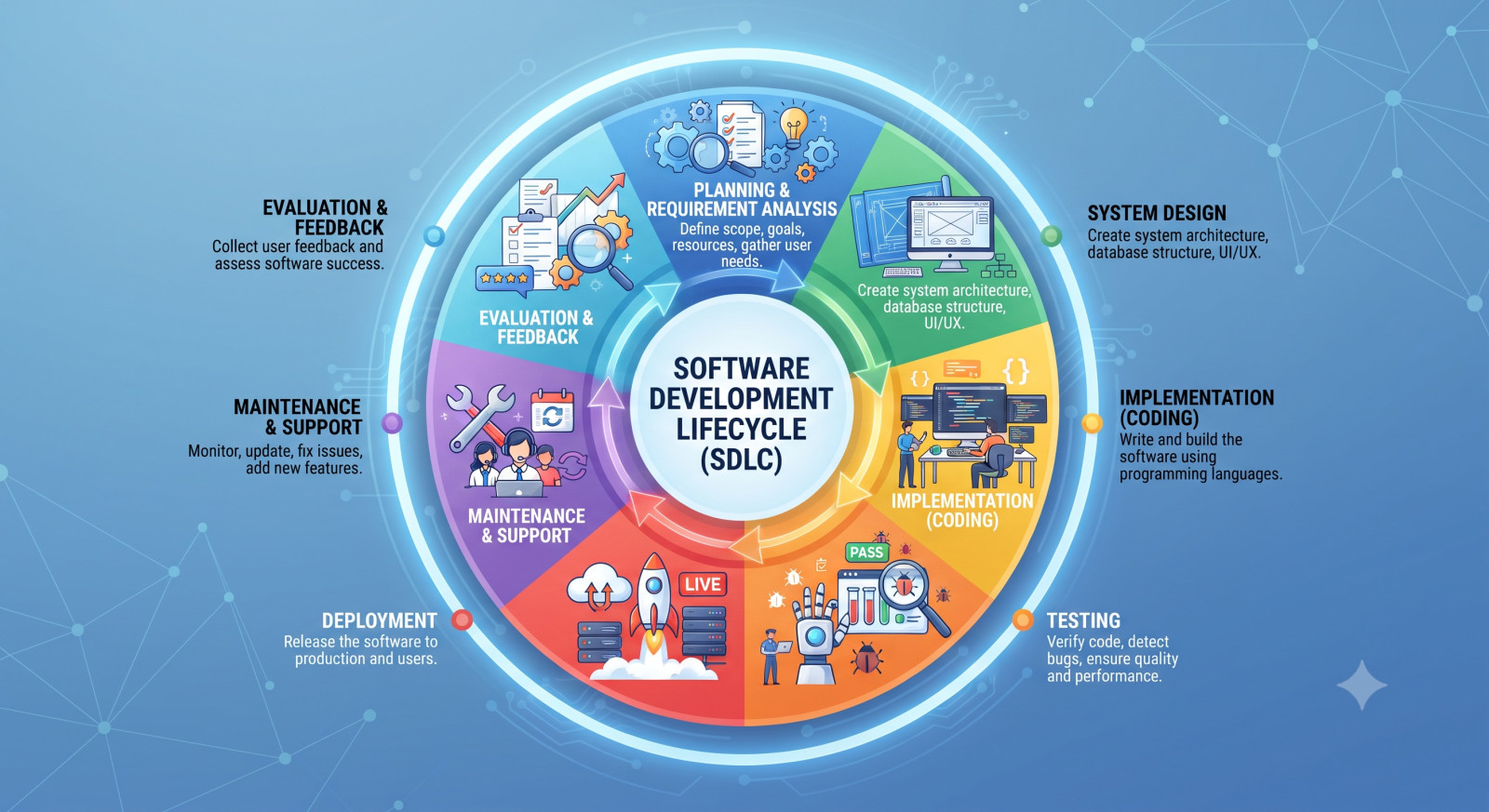
For decades, the classic Software Development Lifecycle (SDLC) has served as the backbone of all our innovations in the realm of information technology. We have been developing systems based on the premise that if a user performs this action, the system will react in a certain way.
We set out the rules, and the software followed them to perfection. Yet now, standing at the brink of the AI revolution, we can see how this classical approach to software development faces its limitations.
Classic SDLC models, which are often linear or influenced by the waterfall approach, cannot be used for AI products because they do not take into account the probabilistic character of machine learning.
Unlike in classic software development when logic was written by developers, in the case of AI systems, the logic is being formed by itself during the process of learning from data. As such, any changes in data will lead to changes in the software.
In order for organizations to survive in this era, they have to be able to embrace the AI Software Development Lifecycle (AI SDLC). This is not an absolute plan to complete a certain project, but a process that needs continuous iteration. This is a process that takes into consideration the business need for rapid time-to-market and the unyielding necessity of system reliability and governance.
This article explores the AI SDLC, starting from the planning stages all the way through to production monitoring. No matter whether your organization is at the early stage of developing its first model or already has an enterprise level pipeline of AI, the AI SDLC should be your priority.
II. Why AI Systems Require a Different Lifecycle
Whereas traditional software engineering involves development by the programmer of logic, we write code, create compilers, and specify how a system will respond to any possible input. Deterministic programming where action A leads to the execution of function B. It is deterministic, predictable, testable, and inherently static.
Once an application feature is created and tested, it becomes immutable until a programmer modifies the code.
AI-native development moves away from deterministic programming into probabilistic programming. Here, instead of executing a predetermined sequence of actions, the program utilizes a large dataset to make predictions or decisions about the best course of action.
As such, instead of being a programmer who writes “what the computer should do”, we become designers of architecture which allows computers to figure out what to do.
This change brings two major differences which disrupt the traditional software development life cycle (SDLC):
Static Logic versus Evolving Dependencies: Unlike in conventional software, the logic and the data are decoupled in AI. The logic of an AI model depends upon the statistical distribution of its training data and is, therefore, susceptible to "data drift." If the real-life data the model encounters differs from the training data, the model fails – even when the code itself doesn't contain any bugs.
Data is the Primary Resource: Whereas the data is viewed as an input by traditional software, AI treats data as the main resource that determines the features of its product. That means we should make a drastic shift in our approach towards the way we version, manage, and monitor the systems.
It is exactly the reason behind the rise of the MLOps (Machine Learning Operations) movement. In the classical development flow, "deployment" is the point of completion. In the AI SDLC, however, deployment is just the start of the most important stage. Since AI models do not exist in a static form, they should be continuously monitored and automatically retrained in order to retain their quality and relevance.
III. Phase 1: Planning, Discovery, and Business Alignment
No code gets written or models get trained before the very first crucial step of the AI SDLC occurs: strategic alignment. Many AI initiatives fail, not due to poor engineering, but because of the misalignment between the capabilities of the AI and the real business challenge.
"Identifying the 'Why'"
The process starts by aligning business challenges with particular capabilities of AI. Don't fall into the "AI-first" pitfall, where a company creates a product just because of its desire to use new technologies.
Consider whether you have a probabilistic challenge: if you can solve it via a simple deterministic script, you probably don't need to apply AI at all; it will only be a heavy and unreliable piece of software. AI shines in cases where there are too complex patterns to write human-coded rules—for example, image recognition, NLU, and forecasting.
Feasibility: Data Audit
In the AI SDLC, feasibility revolves around your data. Without data, there is no intelligence. In this stage, you have to make a comprehensive data audit:
Availability: Do you have the data needed for training the model?
Accessibility: Is the data siloed, or can your engineering team clean and access it?
Quality: Is your data labeled, representative,
Establishing Success Metrics
Defining "success" in AI is particularly challenging since one has to create a connection between business goals and technical performance. It is important to have two levels of metrics:
Business KPIs: What is our ROI? (such as reduction in churn, quicker ticket handling times, higher conversion rate).
Model-specific Metrics: How can we evaluate the model's performance? Depending on the problem, there may be accuracy, precision, recall, or even $F1$-score. This level of metric needs to be defined prior to model training as the development team will know what to optimize.
Creating a Cross-Functional Team
Bear in mind that AI is not an individual venture for a data scientist. A successful project requires a cross-functional team. Specifically, you need Data Scientists for mathematical expertise, ML Engineers who will create the infrastructure to run the model in production, and Domain Experts who will give meaning to the model's output. Without domain experts, you risk creating an excellent but irrelevant model.
IV. Phase 2: Data Engineering – The Foundation
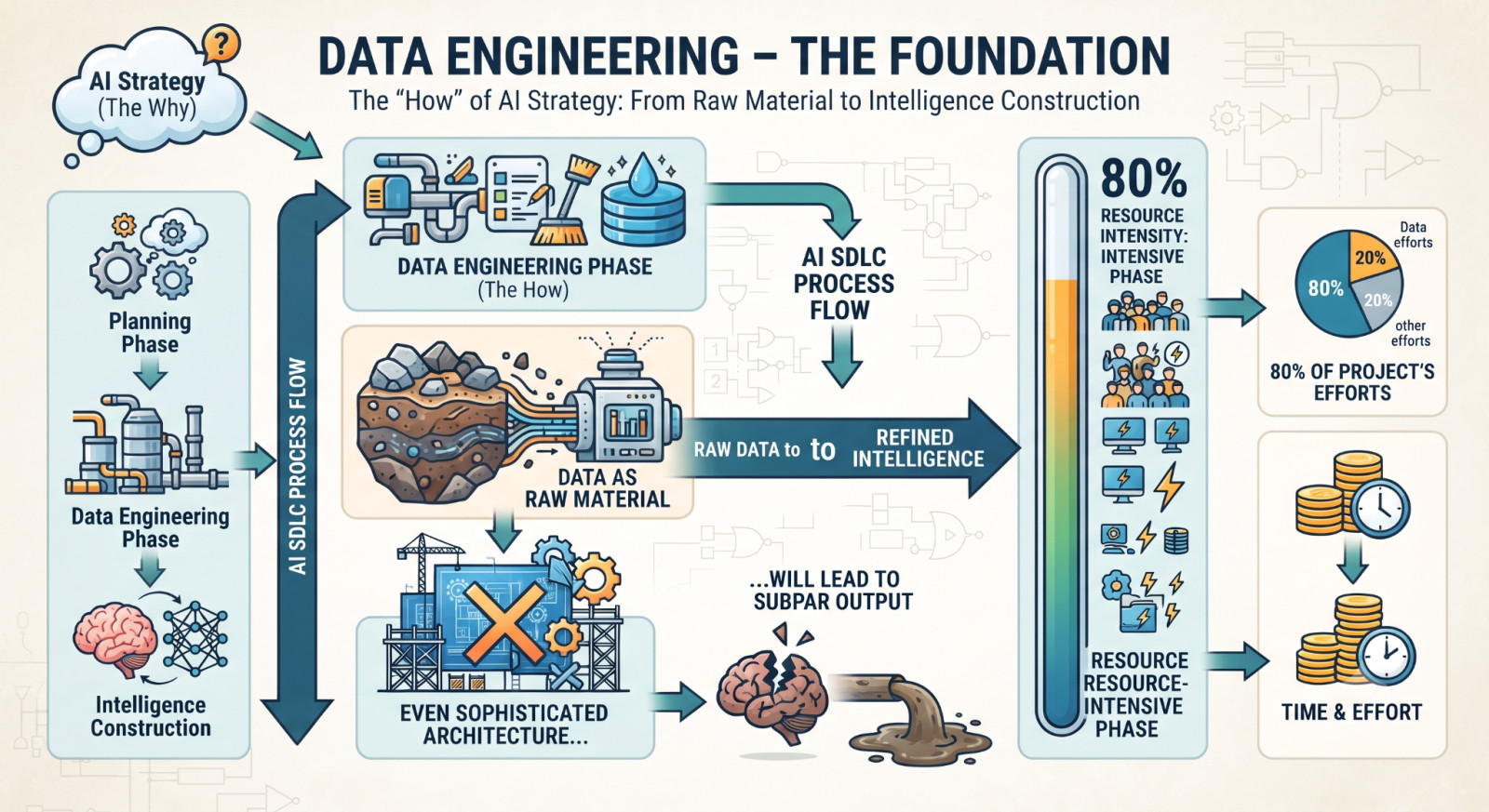
While the planning phase gives your AI strategy its "why," the Data Engineering phase gives your project its "how." As mentioned, within the AI SDLC process, the data you collect is not just a piece of the puzzle but is actually used as raw material for your intelligence to be constructed.
Even if the architecture of your project is highly sophisticated, subpar data will lead to subpar output. This stage is usually the most resource intensive and can use up 80% of the project's efforts.
Data Acquisition: Privacy and Integrity
The data acquisition phase does not just involve the collection of logs; rather, it involves setting up an appropriate pipeline. Businesses need to find a balance between the need for huge amounts of data and privacy restrictions like GDPR and CCPA. In addition, at this point in time, you need to perform a "bias audit." Any bias found in the training data, whether socioeconomic or gender, will be absorbed by your model and amplified.
The 80/20 Rule: Data Preparation
Rule "80/20" for AI Development states that 80% of scientists' work time goes to cleaning, normalization, and tagging data, and just 20% goes to modeling. But it doesn't mean that it's inefficient; this is a key step.. "Noisy" or "dirty" data leads to fragile models. Whatever method you apply, be it some automatic pipeline for preprocessing data or manual labeling of it, make sure that it is reflective of the world in which the model will operate. This consistency is the line between research experiment and product.
Data Versioning: Beyond Code
In software development, we use version control systems like Git to track our source code changes. In AI development, it is not enough to just track the code. You have to introduce Data Versioning, which implies having backups of your datasets and code that produced it. In case of any issues with the model performance in production, you should be able to trace what data was used for training of the particular version of the model and fix the problem.
Managing Data Drift from Day One
Fourthly, it is important for engineers to design for "drift." Drift in data means that there have been changes in the statistical properties of the input data, thus making the original training assumptions no longer valid. The ability to detect this through the instrumentation of data pipelines provides warning signals at an early stage. This will give you a chance to automate the re-training pipeline to ensure that the system does not become unstable.
V. Phase 3: Model Architecture and Training
With a clean, validated data set, it's time to move into the “engine room” of the AI lifecycle: Model Architecture and Training. This is the phase in which theoretical goals of your business become practical intelligence. This process involves a careful balance of technical experimentation and control, which must be approached with discipline to ensure that your model not only works but is also safe and scalable.
Choosing the Correct Architecture
One of the pitfalls of contemporary AI development is known as “architecture inflation.” There is a tendency to employ large language models while in some cases, a small supervised model can work perfectly well and will cost you less money and effort in maintaining. You have to choose an architecture that corresponds to your needs: do you need a model capable of general reasoning or high-speed small architecture that performs better?
Hyperparameter Tuning and Experimentation
The training of AI models usually is not one-shot; it is a process of trial and error. It is necessary to use hyperparameters tuning, i.e., the manipulation of the variables which control the learning process, to bring the model to production.
At this stage, make use of automated experiment tracking and record all training runs – configuration, hyperparameters, and results. The history of these experiments is very important because it helps not to redo the unsuccessful experiments and to reproduce the successful ones.
Training Loops and Environment Management
The training should be reproducible and isolated. The use of containers and orchestrated workflows protects you from the problem called “it works on my machine.” The infrastructure of training should be treated as code, and this way, any developer working at your company will be able to create a training environment, fetch the newest version of the data, and get predictable results.
Guardrails: Ethics, Fairness, and Safety
The crucial thing to remember about the modern day AI training stage is the necessity to include "guardrails." Fairness and safety should not be an afterthought anymore; instead, they need to be part of the training process. Specifically, stress-testing needs to take place in order to ensure that any sort of output toxicity is identified, that there is no discrimination against any protected groups, and that there are hard limits on the response from the model. This way, you will be able to avoid deploying a model that may cause any damage either to your reputation or legally.
VI. Phase 4: Evaluation, Validation, and Testing
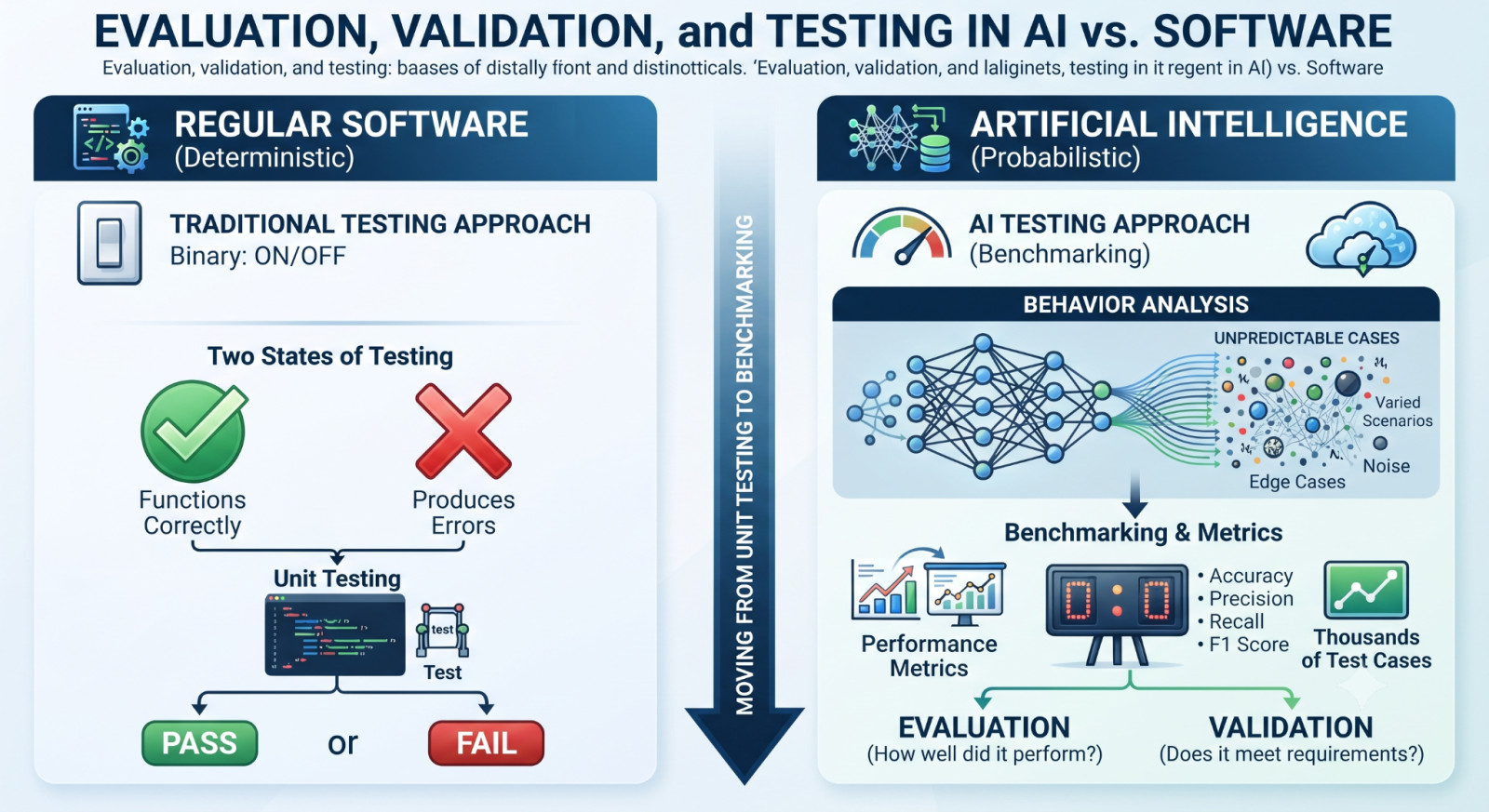
In regular software, testing involves two states: The software either functions correctly or produces errors. In the realm of artificial intelligence, "testing" has a different meaning: Instead of testing whether a certain functionality was achieved, you are testing a probabilistic model. You are therefore looking into the behavior of the model in a huge number of unpredictable cases. In that context, testing should move from unit testing to benchmarking.
Why "Testing" Is Different in AI
Existing CI/CD flows cannot cover the essence of AI models. An AI model may pass through all unit tests: it may execute, consume input and produce output. But the model still can be "wrong". Testing here does not mean checking the accuracy score on the test dataset; it should include evaluation of the model on different slices of data to check whether the model will function correctly for any user group and any rare cases.
Red Teaming and Adversarial Testing
In order to create resilient AI, you have to try breaking it. Red Teaming is the process of exposing your model to adversarial examples and seeing how your model behaves and reacts to these attacks. It could be prompt injection in case of LLMs, or perturbations of data in case of a classifier. Adversarial testing helps discover weaknesses in the model that regular validation datasets will fail to detect.
Creating "Golden Datasets" for Benchmarking
Another essential part of the validation process is creating "golden datasets." It means that you will be creating an immutable set of the best possible samples, which are essential for your model's performance. This is what your benchmark should look like. You need to compare your model on those golden datasets every time you retrain or fine-tune the model to see whether its performance has improved.
Stakeholder Acceptance Testing (SAT)
Technical metrics are not all that you need to gauge the success of a model. Stakeholder Acceptance Testing (SAT) connects performance to value. The model needs to be tested by the domain experts who will use its predictions. Does the prediction help in solving the business problem? If the model is 99% correct, yet gives results that cannot be utilized by your operations people, then the model is not doing what it is supposed to do.
VII. Phase 5: Deployment and Integration
In regular software, deployment marks the endpoint of the entire development lifecycle. However, in the context of AI SDLC, deployment represents a transition stage from a carefully supervised training environment to the actual working ecosystem. At that, the deployment stage should not be regarded as "just shipping the code," but as management of the infrastructure, delivery mechanisms, and version control necessary to deliver probabilistic predictions.
From CI/CD to CT (Continuous Training)
The classic CI/CD pipeline is a good basis, but it does not fit into the requirements for AI. What we need is to add CT—Continuous Training. Continuous retraining of the model is a must for any production-level AI system, and thus, your deployment pipeline should be connected with your monitoring systems, and the loop where you continuously ingest new data, retrain the model, evaluate it, and deploy again.
Deployment Patterns: Batch vs. Real-time
Selecting an appropriate deployment strategy is completely based on your latency needs.
Batch Processing: Best suited for tasks that do not have latency requirements such as generating daily predictive maintenance reports or bulk customer segmentation operations. This approach is affordable, more manageable, and offers complete pre-processing.
Real-time API Inference: Must-have when dealing with end-user applications such as recommendations systems, chatbots, or fraud detection systems. This calls for high availability infrastructure capable of handling variable amounts of requests at the same time with response times less than a millisecond.
Infrastructure: Scaling with GPU-heavy Models
AI models, especially those utilizing deep learning or large language architecture, are heavy consumers of resources. The infrastructure design should take into account that in order to scale inference, you need the infrastructure to scale horizontally with the increase in traffic. This is not only about achieving better performance but about managing costs to avoid the common issue of 'cloud bill shock' when scaling high-performance model inference.
Managing Model Versions in Production
Updating a model does not just entail uploading new code but a whole intelligence engine. A robust “Model Registry” needs to be set up. A model registry ensures that you have a record of your model lineage that links your particular version of the model to the dataset used, the hyperparameters used, and performance metrics of that model. It will be possible for you to perform rolling upgrades, A/B tests on different models, and even rollbacks in case there happen to be any unforeseen issues with the model.
VIII. Phase 6: Monitoring, Maintenance, and Retraining
Traditional software, when deployed and stabilized, may face a significant reduction in maintenance efforts. AI systems, however, are deployed into an entirely new reality—into what can be called "the real world." The nature of models makes them vulnerable to performance deterioration due to the ever-changing environment.
The Post-Production Reality: Concept Drift
An AI model expects the future to be similar to the past. Whenever the above-mentioned assumption is broken, we deal with "concept drift"—when the statistical relationship between the input and output variables changes.
To give an example, a fraud detection algorithm built on the pre-pandemic consumer behavior patterns may suddenly label legal transactions as fraudulent just because consumers' habits have changed. You will never notice the change in your model's performance.
Automated Monitoring Dashboards
Proactive visibility is necessary for efficient maintenance. It is imperative to create automated monitoring dashboards which will measure two parallel metrics:
System Health: Measuring classic IT infrastructure parameters such as latency, throughput, and error rate.
Model Performance: Monitoring important AI parameters such as predictions' distribution, confidence scores, and real business KPIs. If any of these metrics deviate from predefined limits, your system needs to notify your engineering team about it in order to avoid "silent failures" when the model is operational but does not provide good results.
Feedback Loop Automation: How to Retrain
The goal of the mature AI SDLC is to automate the retraining process. You should establish "triggers" of the retraining, i.e., certain thresholds or periods of time when a new training cycle starts automatically. The trigger may be either deterioration of the model's precision or accumulation of the critical mass of "golden" data.
The Human-in-the-Loop Oversight
Although we strive toward automation, the AI system must always be monitored at least periodically. “Human-in-the-loop” monitoring is the ultimate safeguard. Experts must audit the output generated by the algorithm on an ongoing basis to ensure that its logic continues to make sense within both a business context and an ethical one. Human intervention does more than simply monitor compliance. It provides feedback to refine future models.
IX. Building a Culture of AI Excellence
The AI Software Development Lifecycle is a mindset, not a process to follow. It is evident from our discussion above that adopting the SDLC framework in the era of artificial intelligence involves shedding the 'Ship and Forget' approach and embracing an attitude of continuous iteration, stringent data governance, and monitoring.
Building an AI team that can be future-proof involves training engineers on handling probabilistic systems, focusing on the maturity of MLOps and keeping human oversight at the center of any form of automation strategy. Responsible adoption of AI should involve not only the avoidance of potential risks but also development of robust and ethical systems.
Transitioning into AI-native software engineering is indeed very tough, but it is the biggest revolution of digital transformation in our era. Gigmint.ai has experience of bridging the gap between AI capabilities and business outcomes. Are you ready to move your AI projects to production-quality systems? Contact Gigmint.ai today!
Frequently Asked Questions: Navigating the AI SDLC
1. How does AI SDLC differ from traditional Agile methodology? While Agile is all about iterative code development, AI SDLC requires an additional step of “data iteration.” In addition to making updates to existing features, you are continuously improving the intelligence of the model as data patterns change.
2. What is the most common mistake made by development teams in AI SDLC? The most common mistake is “shipping and forgetting.” Unlike regular software, AI degrades over time. If you have no plan of how to monitor and retrain your model, it will eventually become useless.
3. Do we need Data Scientists for every AI project? Yes, we do. Despite the fact that there are many APIs available for different jobs, data scientists are important because they will help you tune your model and eliminate any potential bias.
4. Define "Data Drift" and explain its significance. Data drift refers to the situation where the actual world data fed into the production model becomes different from your training data. Data drift is the number one reason for silent degradation in AI.
5. How much time should you spend on preparing your data? It is said that in the industry, the 80/20 rule applies; 80 percent of your time would be dedicated to data preparation while 20 percent of your time would be spent on modeling.
6. Explain what Guardrails mean when it comes to AI training. Guardrails are protocols that automatically prevent models from producing toxic content or any other kind of dangerous content.
7. When do we need Batch vs Real-time inference?
Batch for non-urgent use-cases such as reporting and bulk classification.
Real-time API for applications that interact with users such as chatbots or fraud detection systems.
8. What is "Golden Dataset"?
A highly curated "truth" data set used to test your model’s performance after each retrain to make sure you did not introduce regressions.
9. How do we measure AI Return on Investment?
By measuring both technical KPIs (F1-Score) and business metrics (reduced customer service tickets, more conversions etc.)
10. How Gigmint.ai can help my team?
Gigmint.ai brings experience to fill the gap between untapped AI potential and production excellence.