Top AI Development Trends in 2026: The Year of Operational Maturity
Top AI Development Trends in 2026: The Year of Operational Maturity
The age of "AI experimentation" – when it was all about copying prompts and using API wrapper – is finally over. In 2026, we are witnessing the software industry to reach a new threshold, which is referred to as "AI operational maturity".
While for developers and technical leaders the joy of building a simple chatbot is long gone, there comes a strict requirement to develop solutions that are both secure and autonomous.
The difference is already tangible. Companies are not anymore inquiring about their capacity to utilize AI but about ways to manage it in a reliable way and avoid any technical and security risks. While 2024 and 2025 were all about discovery, 2026 is definitely the year of architecture.
Building an AI solution is not anymore a trump card; it has become an obligation. It is now crucial to be able to move from experimental AI solutions to something that works as reliably as traditional software engineering.
In order to be relevant in this scenario, programmers need to evolve beyond the superficial ease of generic API calls. The modern world of development demands more than ever before, in terms of proficiency in multi-agent systems, advanced RAG systems, and AI governance mechanisms. This is not only a transition on a technical level; it is an evolution from a programmer to an AI operator.
Having seen such developments within Gigmint ourselves, and assisted high-performing teams to integrate the use of scalable AI systems in line with their business objectives, we will explore all the important trends of 2026 in this guide.
Trend 1: From Chatbots to Agentic AI
The age of the "reactive chatbot", where the user inputs a prompt and receives one static response, is officially over. The industry standard for 2026 is set by autonomous agentic AIs. Unlike conversation-oriented systems that try to predict the next token based on the user prompt, agents complete multi-step workflows with little-to-no human involvement in order to perform their high-level tasks.
Architecture Change: Plan-and-Execute vs. LLM-only
Developers used a very simple, LLM-only approach to develop their chatbots – they would pipe user prompts through the model and hope for an accurate response. Such an approach lacks the level of reasoning required for real-world enterprise-grade solutions. The architecture preferred for 2026 developments is called "Plan-and-Execute".
In this architecture, the primary LLM is considered a "brain" of the agent – it takes a high-level prompt and breaks it down into a series of sub-tasks. Agent then chooses the required tool (whether an API, database or even a sandboxed code environment) to perform each of those subtasks. Iterative loop of reflection, planning and execution is what makes an ordinary chatbot a true digital employee.
Developer Takeaway: Designing for Human-in-the-Loop
Despite the fact that agentic AI is supposed to be autonomous in nature, enterprise software development calls for thorough supervision. At the moment, the most efficient systems have Human-in-the-Loop (HITL) checkpoints included.
Checkpointing: Build mandatory checkpoints when an agent is supposed to provide its "reasoning path" to perform some important operations, like updating a production database or performing an external financial transaction.
State Management: Provide state persistence along multiple steps execution chains. If an agent fails in completing task N + 1, it should be able to start from step N which is known to be correct rather than restart the whole chain.
Feedback Loops: Analyze telemetry to understand what kind of deviations from the "planned" path the agents make. Analysis of these deviations is necessary for further tuning of system prompts and tools used.
In other words, for teams that work on creation of autonomous AI agents, the task is not only prompt engineering anymore. It is the design of the system itself which includes the agent.
Trend 2: The New Engineering Discipline
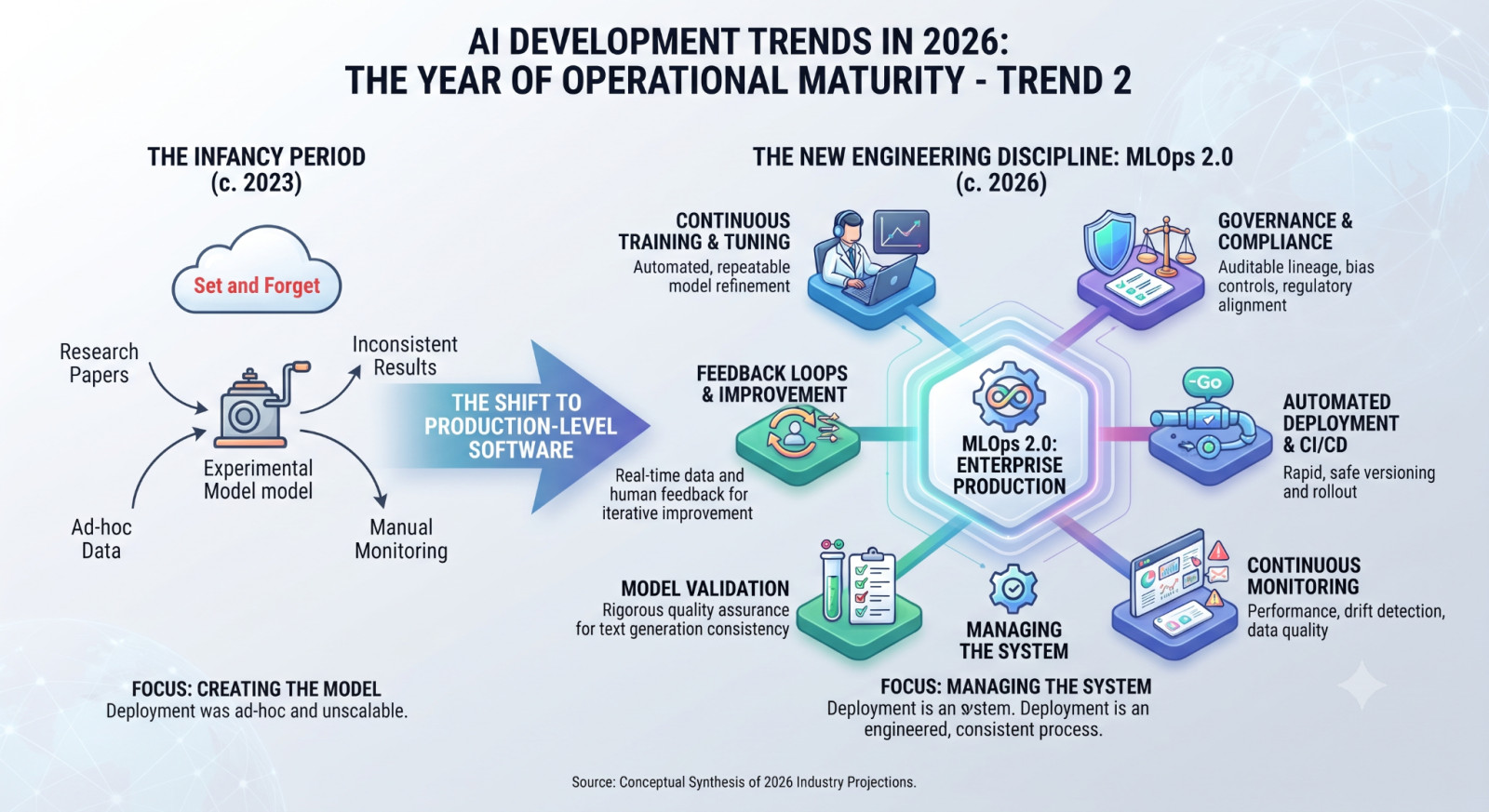
During the infancy period of Generative AI, the deployment strategy was usually “set and forget.” This is not the case today. As 2026 progresses, the shift from experiments based on research to enterprise production-level software has made MLOps 2.0 the engineering field of the year. The problem is not only how the model generates text anymore; the real problem is how the model performs consistently.
The Problem: From Research to Robust Production
Today, the majority of companies are already experiencing the "production gap". The model which works perfectly on paper will deteriorate when subjected to variations of real-world data and/or the high load of concurrent production traffic.
To make the system for machine learning well versioned, tested, and monitored, it is important to implement MLOps pipeline correctly. Any artificial intelligence component will become a black box that can not be analyzed, debugged, or scaled.
The Trend: Observability and Automated Guardrails
The MLOps 2.0 implies an evolution in the direction of pro-active infrastructure. The key trends in that respect include the following:
Automated Drift Detection: modern MLOps pipelines allow to continuously monitor the deviation from the baseline distribution of model inputs such as user queries or external data feed, thus preventing "model rot".
Observability: apart from simple latencies, we are witnessing the trend towards semantic observability – not just the fact that the model worked, but also the quality, sentiment, and safety of the reasoning chain.
Canary testing: before introducing a new model version to all users, it is deployed to a smaller, isolated population of users, and in case of any increase in hallucination rate or latency, the
Developer Takeaway: Treating Models as Immutable Artifacts
The first and foremost transformation in thinking about your development process in 2026 will be the idea of treating models as code. Every new version of the model has to be an immutable artifact. It’s not appropriate to execute the training script again in production. Instead, the versioned, packaged model with all necessary weights, metadata, and configuration files is fetched from the registry.
Through standardizing the deployment processes by using tools that provide the ability to have a version-controlled registry of models, you get rid of the “it worked on my machine” syndrome. In order to scale up the use of AI for your company, MLOps is no longer an option—it’s the base of stability for the system. With the understanding that your model needs to be updated, tested, and monitored, you move from simple scripting to proper software engineering.
Trend 3: Multimodal as the Baseline
As far as the year 2026 goes, the concept of "LLM" is gradually becoming obsolete. The field has surpassed the limitations of being "text only," which defined earlier stages of development of generative AI, transitioning to natively multimodal systems.
We no longer see audio, image, and video as distinct objects, which should be transcribed or labeled; we process everything through models able to understand the input on the sensory level. Welcome to the world of "Context-to-Insight" beyond "Text-to-Everything."
The Shift: Transcription vs. Native Reasoning
Multimodal processing was achieved by chaining models together, with ASR (Automatic Speech Recognition) used for audio, computer vision model processing the frames, and LLM processing everything else.
Such an approach introduced additional latency and complexity, but, what is even more critical, lossy reasoning. The problem with that approach was that, if some information was not correctly interpreted by the vision model, LLM did not have access to the raw data to fix its mistake.
Unlike that, modern multimodal models are natively trained on various data modalities.
High-Impact Use Cases
Native multimodality is propelling change in areas where text alone proves inadequate as a descriptor:
Vision-Based Retail Inventory System: Rather than barcodes and metadata, an autonomous system continuously analyzes shelf video streams to recognize inventory stock, misplaced products, and any damage present.
Instantaneous Safety Monitoring: In dangerous working areas such as factories and construction sites, native multimodal systems analyze sensor and video data from the site to recognize safety violations almost instantaneously, significantly faster than any human operator could point out a potential issue.
Retrieval of Multimodal Data: Knowledge management will undergo revolutionary change. Consider how RAG systems work if developers could retrieve the exact video segments, from millions of hours of video data, based on queries involving text, speech snippets, and even sketches.
Developer Takeaway: Choosing the Right Engine
In choosing models for multimodal tasks, it is important for the developer to consider cross-modal alignment more than parameter counts. Choose models that perform well in multimodal benchmark tests such as $VQA$ (Visual Question Answering) and audio to text semantic accuracy.
Design systems that accommodate asynchronous multimodal input. Ensure that your system can buffer various modalities without interfering with the inference engine. It allows enough time for the model to interpret sensory inputs. The competitive edge for AI-powered solutions in 2026 is the ability to derive any meaning from noisy and complex sensory signals.
Trend 4: RAG Architectures & Domain-Specific LLMs
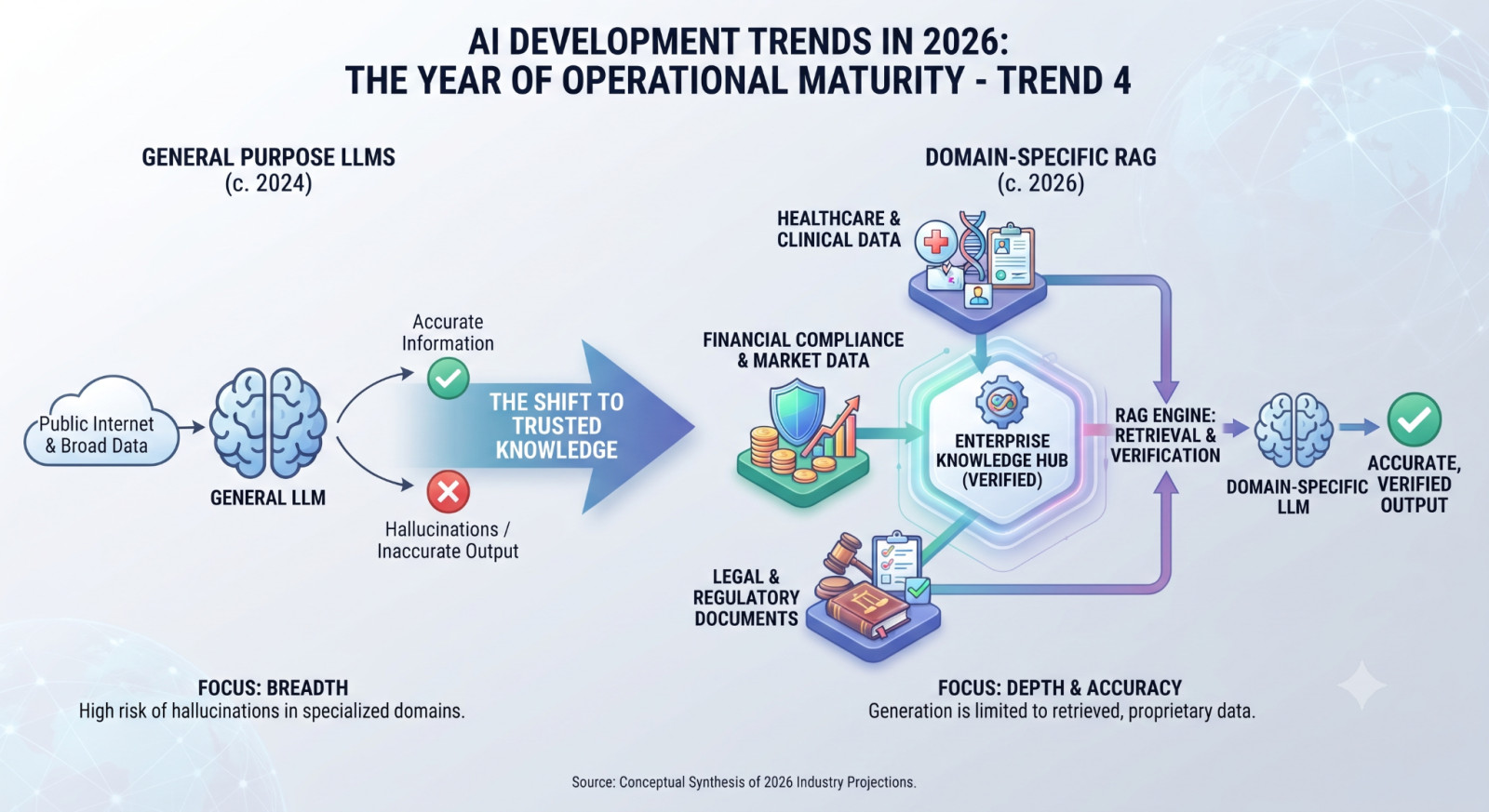
As enterprises adopt AI technology more widely, dependency on general purpose models has increasingly become a limitation. High stakes industries demand accuracy that off-the-shelf LLMs that are susceptible to hallucination simply cannot deliver without being trained on domain-specific knowledge bases. The trend is shifting towards domain-specific RAG (Retrieval-Augmented Generation) – where the generation process is limited to verified, proprietary knowledge bases.
The Implementation Challenge
Implementing RAG technology in its current form is not about retrieval but rather about the governance layer. Compliance requires building pipelines which will strictly adhere to data residency (data location) and access control (access rights). Therefore, the retrieval process should also be aware of the user's access level and filter out information accordingly before passing it onto the LLM.
Integrating fine grained Access Control List (ACL) checks directly in your vector database query ensures that the LLM generates insights only from the data which is accessible to the user.
Developer Takeaway: Preventing Hallucination
In order to avoid hallucinations, your RAG framework needs to consider the retrieved context as the source of truth that overrides the internal biases of the model. Practices such as query decomposition (the practice of splitting large user queries into multiple sub-queries to check their validity), and citations-first response (where the model is required to provide a citation for each statement it makes), have become quite common practice. The agent should be designed in such a way that if the data does not exist in the vector store, the agent should admit it.
Trend 5: Edge AI and Low-Latency Deployment
While cloud computing has played a major role in advancing the development of AI up until now, 2026 will be the year when the AI revolution is going to move in the direction of the Edge due to the needs for sub-millisecond response times and strict data privacy laws (like GDPR and others).
The Driver: Cloud Independence and Predictability
In the context of industrial and mission-critical applications, cloud computing is a significant vulnerability due to the requirement for reliable internet access. Whether it is a robot in the warehouse, an application running diagnostics on-device in a hospital, or a system providing for the safety of a vehicle, the data has to be processed locally in order to maintain reliability. The mathematically common relation is:
In cloud architectures, $L_{network}$ is the largest and most unpredictable part of this equation. Moving computation to the Edge means eliminating $L_{network}$ completely, making systems very predictable and responsive. This is especially important for scenarios where there is a safety aspect and the price of waiting for the network is not just inconvenient but potentially catastrophic – in terms of physical damage or even human safety.
Developer Takeaway: Strategies for Optimization and Maintenance
In order to utilize AI at the edge efficiently, one has to learn to apply techniques which minimize the model's size without losing much of its ability to reason. Among the techniques are:
Model Quantization and Pruning: Moving from high-precision float-point weights to lower-precision types greatly minimizes memory consumption and time of inference. Adding this to the process of pruning helps to make complex models work on hardware-constrained machines like NPUs (Neural Processing Units).
"Federated Learning": In low-connectivity or very distributed environments apply the "federated learning" strategy. Edge devices do all the work of making local inference and collecting data and send only anonymized high-level information or updates to model's gradient to the central point. You still get the advantage of cross-site analysis not requiring high-bandwidth constant connectivity.
Architecture of Predictive Maintenance: When working with remote machinery, put lightweight failure-detection agents straight to the hardware. With the help of analyzing vibration, temperature, and acoustic signals, such agents will be able to detect future failures. This agent sends the alerts or high-level telemetry when needed in order to reduce bandwidth usage.
Thus, by changing the paradigm from "all in the cloud" to "just computing where you need", you are creating
Trend 6: AI-Native Security and Governance
AI agents, now moving beyond passive helpers into the role of actual participants in business workflows, have been afforded access to production databases, internal APIs, and important customer data. Increased autonomy opens up more potential areas of vulnerability.
By 2026, the need for cybersecurity is not an auxiliary concern, but a critical element of the process. The threats that used to be hypothetical, including adversarial prompt injection, shadow AI, and training data poisoning, have become fully formed and persistent threats with potentially catastrophic consequences in terms of data exfiltration or service interruption.
The New Threats
The first problem with AI native security threats in 2026 is that the conventional perimeter-based security model, based on firewalls and identity management systems, is simply not designed for dealing with these threats. Prompt injection threat involves malicious manipulations of an AI agent into ignoring its system's instructions, so it can leak out sensitive information or carry out some unwanted action.
At the same time, shadow AI, when employees use third-party AI solutions in their work, creates a hidden point of risk and allows for data exfiltration, violating GDPR and other privacy regulations worldwide.
Strategy: Preemptive Cybersecurity (PCS) and Sandboxing
The security of the solution must be "baked in" from the very beginning, during the design stage. In order to address these concerns, the developers should introduce a Preemptive Cybersecurity (PCS) method.
The difference between this strategy and previous solutions lies in the shift of attention from post hoc fixing to preemptive monitoring. Every agent should run within an isolated AI sandbox—an execution environment with the least-privilege policy.
Within such an environment, the so-called "guardian" approach should be used—namely, a separate, dedicated LLM should act as a security filter for the main agent. Every request and every response from the main agent should be evaluated by the guardian.
If the instructions include any attempt at prompt injection or if the result contains any critical information, the transaction will be blocked even before reaching either a user or the target system.
Minimum Viable Governance Checklist
For the sake of enterprise reliability and compliance, every business should adopt the following governance controls:
Model Provenance Registry: It is essential to have a single registry containing information about all of the models used within the enterprise. Information about their origin and training data sources is critical to prevent attacks coming from the supply chain.
Red-Teaming: Schedule automated red-teaming events. Leverage specialized agents for testing of your system for vulnerabilities in order to prevent prompt injection and API abuse.
Reasoning Log: Any agent's process of reaching a decision should be logged immutably for future investigation and auditing.
Granular ACLs: Adopt fine-grained Access Control List (ACL) mechanism to control an agent's access to external systems depending on the user's authorization level.
HITL Gateway: In case of critical operations such as performing transactions and manipulating database records, require a manual verification step performed by the agent.
Trend 7: AI-Native Development Platforms
The last frontiers of 2026 will be the development environments themselves. We are quickly moving from the "AI-assisted coding" model of providing suggestions within a conventional IDE to the AI-Native Development Platform.
With such an environment, natural language prompts do not complete syntax anymore; instead, they control the entire process of development, creating complex integrations of APIs, database schemas, and IaC templates based on the high-level technical requirements.
The Architectural Shift
In the AI-native development environment, LLM becomes an integral part of the kernel of an IDE. Due to the knowledge about the state of the entire application and its internal dependency graph, the platform generates a boilerplate-free code that follows architectural patterns rigorously.
This way, the "syntax barrier" gets bypassed, and developers get freed from writing the same functions again and again. They become capable of defining the interactions within the system and business logic.
The Impact on Agile Teams
For agile development teams, this is transformational. The time-to-market for feature releases is greatly accelerated because the “grunt work”—such as creating JSON schemas, implementing RESTful endpoints, or configuring containers—is no longer something that engineers have to do themselves. Rather, the work is handled by the platform itself.
But, in turn, this change requires a different skillset from software engineers. The critical skill set that will define an engineer in 2026 is not the ability to memorize documentation for libraries or syntaxes but rather Architectural Synthesis, where developers need enough knowledge about systems design to be able to guide the AI, debug the generated logic, and make sure that all the parts of code generated by AI will come together to create a secure and effective system.
Offloading the mechanical elements of writing code allows the team to focus on doing what is important—building better user experience and creating modular architectures. In this new age, the role of the developer shifts into becoming a “System Architect” who will make sure that the automated build pipeline creates better code than ever before.
Conclusion & The Road Ahead
Looking ahead to the rest of 2026 and beyond, there is no question that the era of the "AI Gold Rush" has been transformed forever into the age of "AI Engineering." The era of rapid coding has evolved into a more rigorous and disciplined practice.
Within this landscape, the winning developers will not necessarily be the ones that know the most prompts; instead, they will be the ones that combine their technical intuitions with an overall understanding of the architecture of AI.
Complex as these systems can be, from agent orchestration through multimodal edge computing, the way to become an expert is not through attempting to learn all the trends at once. Our recommendation is that you either begin by integrating your current projects with solid MLOps methodologies or begin to test a single, high-impact agent architecture.
As you design the future of intelligent software, keep in mind that the aim is not only about developing the AI but doing so in a way that produces robust, secure, and performant solutions to practical problems.
Get ready to create the future of AI? At Gigmint, we work with engineering teams to get the transition from AI development to production done. Contact us for more information about how we can help with your next project or sign up for our technical newsletter to receive information about high performance AI integration.
Frequently Asked Questions: AI Security & Governance
1. What is the biggest risk for AI agents in 2026? The biggest risk is data exfiltration through prompt injection. As agents become autonomous enough to talk to APIs, perimeter security is not enough anymore – you have to use granular sandboxing.
2. How can I prevent LLM hallucinations in serious situations? Base your answers on proprietary data through RAG (Retrieval-Augmented Generation) and force "Citations-First" type of answers that will require references to exact document chunks.
3. Difference between MLOps 1.0 and MLOps 2.0: The focus was on faster deployment in MLOps 1.0, but the main features of MLOps 2.0 are monitoring, automated drift detection, and immutability of the models.
4. Why is the term “Edge AI” gaining popularity? “Edge AI” reduces latency (as per the formula $Latency \approx L_{network} + L_{compute}$) as it works on local computations without transferring data through the network.
5. What makes a multi-agent system different from a simple chatbot? The chatbot is reactive, and the multi-agent system is proactive. Multi-agent systems make use of the "Plan-and-Execute" architecture that involves breaking down complex tasks into smaller sub-tasks which are assigned to different sub-agents.
6. What are "immutable artifacts" in artificial intelligence development? Models must be considered to be compiled programs, meaning that when you train the models and give a version number to them, they become immutable artifacts to make sure there is consistency during testing and production.
7. Are native multimodal models capable of replacing specialized models? Yes. Native multimodal models are able to achieve greater reasoning fidelity by tokenizing text, images, and audio inputs in the same embedding space.
8. What does "Human-in-the-Loop" (HITL) checkpoint mean? A safety gate in which the agent needs to show its "reasoning path" manually verified before performing crucial actions, such as writing into a database or any external transactions.
9. How can I make sure my data stays resident during RAG? By implementing Access Control List (ACL) mechanisms within the vector database queries so that the LLM only pulls information based on the permissions of the user.
10. What is Preemptive Cybersecurity (PCS)? PCS is about utilizing a second "guardian" model that will check the output of the agent in real time to filter out any malicious instructions.