The Complete Guide to AI Development in 2026: Tools, Frameworks, and Best Practices
The Complete Guide to AI Development in 2026: Tools, Frameworks, and Best Practices
Overview
The age of “chat-based” passive artificial intelligence is definitely in the past. We have successfully transitioned from the period of prompt-based experiments to the period of autonomous agent-based workflows.
The leading companies use AI not only to create texts but also to build complicated systems where AI agents negotiate, analyze and do multi-step actions to solve important business tasks independently.
It takes a great deal of effort to navigate in such a fast-changing environment. The speed of evolution of frameworks, models, and tools can sometimes make even experienced technical teams feel overwhelmed. This guide provides all the needed information for developers, CTOs, and technical leads to separate the latest trends from those technologies that will make the future of AI.
The Core-and-Orbit philosophy is the backbone of this manual. Far too often do companies think about AI development in terms of integrations of other parties' applications programming interfaces and their own subsequent transformation.
Our recommendation is to base AI on your organization's intellectual property: your proprietary data, your workflow processes, and your expertise. In this case, your unique logic becomes the "core," while agents and tools make up the "orbit" around it. Focusing on the core, you will be able to keep your AI proprietary rather than a commodity solution for your business to prosper amidst increasing automation.
1. The 2026 AI Development Landscape
The era of “one-size-fits-all” artificial intelligence is coming to an end. Navigating the technical space of 2026, the objective of developers and enterprises is no longer to get access to the biggest possible parameters but to design intelligent and specialized models.
The victory no longer lies in the possession of the model with the largest amount of parameters, but in the accuracy, efficiency, and precision of the result provided for a particular business domain.
SLMs Instead of Monoliths
Although LLMs have been the basis of AI, the year 2026 is characterized by an explosion of SLMs and domain-based architectures. SLMs offer a unique benefit – they are faster, cheaper to use, and much more private.
Thanks to the training or fine-tuning of models based on proprietary and high-quality data of a certain business domain, companies have achieved “human-level” expertise in various niche domains – legal analysis, biomedical research, financial auditing, etc.
From Prompt Engineering to Agentic Orchestration
"Prompt engineering" was considered a craft art to get more out of static interfaces. This era is effectively over. Welcome to 2026 – the age of Agentic Orchestration. We are no longer developing prompts but creating autonomous flows when AI agents interact, debate and perform tasks by using different systems.
An agentic system is not just an answer provider – it sends queries to databases, communicates with APIs, checks its results and performs the code execution in cycles until a business goal is achieved.
Building From The Core: A Sustainable Strategy
The only sustainable strategy in this environment is "Building From the Core". Many businesses fell in the trap of "Tool First" development – implemented a third-party LLM and waited for the results. Instead, the key to success nowadays is building out from your core – from your organization's intelligence. When you prioritize your internal data flows, governance and business-specific logic first, you can be sure your implementation will remain a proprietary asset.
2. The Essential AI Development Stack in 2026
For creating robust AI systems in 2026, you need more than an API key. You need an integrated stack that combines rapid iteration and stability necessary for deploying the systems in enterprise-level settings. In this part, the reader can learn more about the most important tools and frameworks in the contemporary world of AI development.
Programming Languages: The Balance Between Performance and Flexibility
Python remains the dominant language of choice when it comes to AI due to the unique flexibility and rich ecosystem of tools ($PyTorch$, $TensorFlow$, and $Scikit-learn$). The requirements towards latency and increasing compute prices are forcing the industry to change its course of action.
Python (the foundation): It remains the core programming language used in AI due to its unique capacity to perform the complex data science workflow.
Mojo and Rust (high-performance layer): For developers who work with computationally-heavy tasks such as custom kernel development, high-frequency inference, or data ingestion, $Mojo$ becomes a great solution. This framework allows using the performance of C++ combined with the convenience of the Python syntax.
$Rust$ becomes the dominant tool for building high-concurrency, memory-safe backend services to interface with AI models.
Frameworks & Orchestration
While LLMs represent the "brain," orchestration represents the "nervous system." As we advanced from basic text generation, we developed frameworks to cope with the complexities involved in multiple logical steps.
Evolution of RAG: $LangChain$ and $LlamaIndex$ are not just "connectors" anymore. They have evolved past that point. The term that applies to them in 2026 is “Adaptive RAG”: picking out dynamic data sources, re-ranking, and handling multi-hop queries in an attempt to avoid hallucinations.
Multi-Agent Systems: $AutoGen$ and $CrewAI$ changed the way we deal with workflows. We stopped thinking about one prompt and started building "teams" of agents where one would be the researcher, another one would be the reviewer, and the last one would execute the task.
The Rise of AI-Assisted Development
The rate at which ai development happens is highly influenced by the capabilities of the tools in your IDE. Intelligent coding tools such as $GitHub$ $Copilot$, $Cursor$, and $Codeium$ are now non-optional. They are parts of the development pipeline.
By doing away with the boilerplate code, suggesting architectural changes, and helping in debugging complicated issues, these tools help developers concentrate on the "Core-and-Orbit" architecture without being bothered about syntax errors.
Vector Databases: The Memory of the Enterprise
RAG is based on semantic searches. Selecting the correct vector database is one of the key decisions that will determine performance and scalability.
Pinecone: It still remains a clear winner in case your teams are looking for a managed, serverless, and scalable solution. This is usually the go-to tool for most enterprises looking to reduce maintenance burden.
Milvus & Weaviate: These are the preferred choices for high-performance or on-premise solutions. Their powerful functionalities include filtering and hybrid searching options.
3. Best Practices for Modern AI Architecture
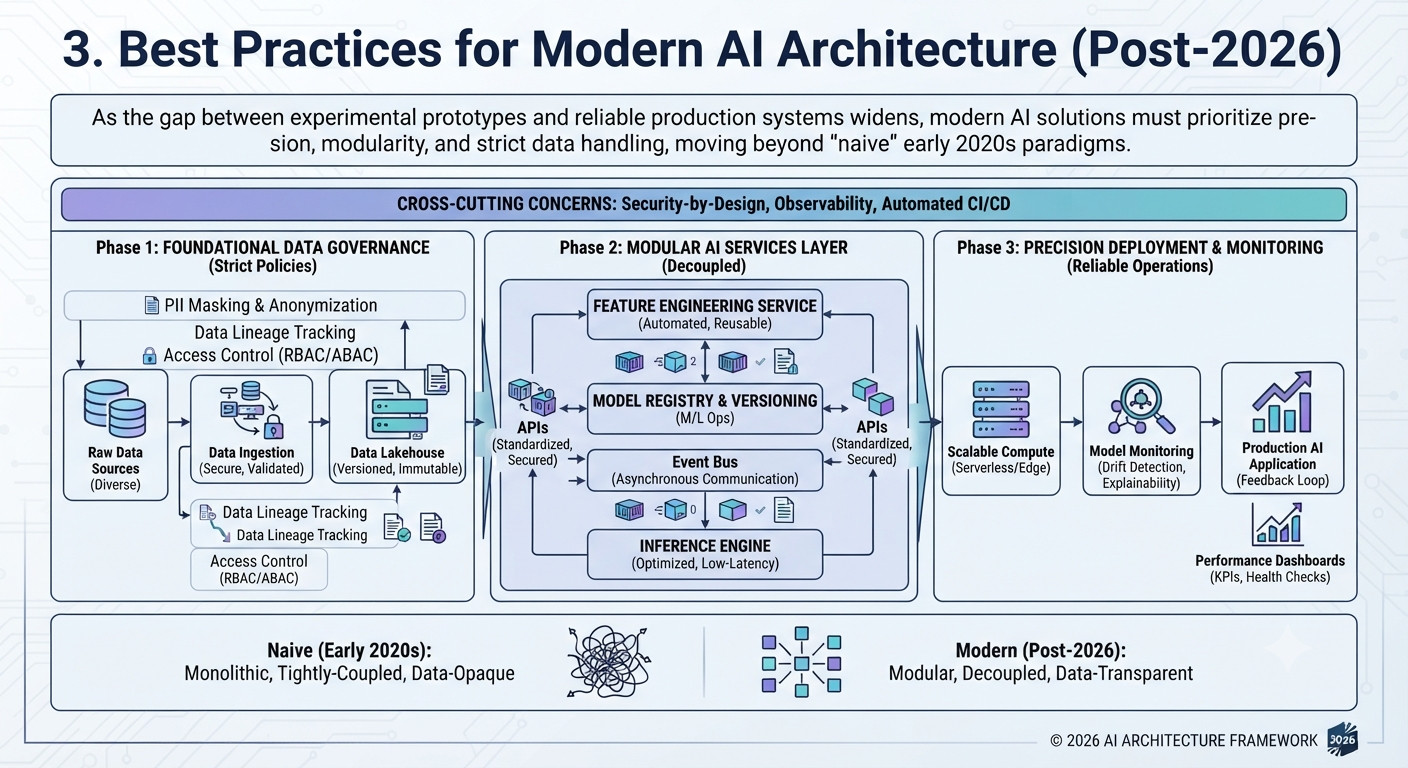
As we move into the latter half of 2026, the gap between experimental AI prototypes and production systems is now considerably greater. To deliver reliable, scalable, and efficient AI solutions, we have to go beyond the "naive" architectural paradigms of the early 2020s. The architecture of a modern AI development solution is characterized by its precision, modularity, and strict data handling policies.
Data Engineering for AI: Taking "Garbage In, Garbage Out" to a Whole New Level
"The Garbage In, Garbage Out" (GIGO) principle still underpins any effective solution; in 2026, we need a much more sophisticated approach. Data engineering for AI is no longer about making the initial dataset clean; it is about generating "Context-Ready" data pipelines.
Semantic Integrity: Beyond deduplication, you will need to make sure that your data is properly labeled with a specific context. Sometimes, the plain raw data such as PDF files and logs are not enough. Modern data pipelines have to include the automatic classification, PII masking, and semantic chunking procedures so that the data processed by RAG is correct and searchable.
The Feedback Loop: Your data pipeline is cyclic. In 2026, a successful architecture treats the system's errors as data. In case the agent
Model Selection Strategy: The "Buy-to-Build" Sequence
The option of choosing to create a new model, purchase an API from a commercial supplier, or fine-tuning an open weight model does not have to be a one-time decision; rather, it is a process that should be carefully orchestrated:
Purchase (validation phase): Begin your journey by using commercial APIs, as this will enable you to test the viability of your case and your users’ need for this product/service in just 3–9 months, without the high cost of training or maintenance.
Fine-Tune (differentiation phase): Once the business case proves to be valuable, move to fine-tuning your own open-weight models (Llama 3 or other SLMs). This way, you will have models that have been tailored to your specific domain.
Build (competitive advantage phase): Create your own custom model only if the model becomes the differentiator of your offering or if there are regulatory or security reasons (on-premise sovereignty, etc.). Build only what is valuable and provides real competitive advantages.
Implementing RAG 2.0: Beyond Semantic Search
We are currently evolving from "naive" RAG 1.0 (basic vector similarity) into "RAG 2.0," where retrieval can be seen as a multi-step reasoning process.
Graph-Augmented RAG: Basic vector databases do not capture the "why" of the data. RAG 2.0 makes use of Knowledge Graphs to identify the relationships that exist between entities ("Customer A" is connected to "Contract B" and "Project C"). This enables the agent to navigate through the relationships and not just match keywords, thus substantially addressing the "middle lost in the middle" issue.
Active Retrieval: RAG 1.0 was a one-directional "ask-then-retrieve" process, but RAG 2.0 applies agentic orchestration to rephrase the question, perform a search in multiple types of databases (Vector, SQL, and Graph) and even ask the user questions if required by the retrieval process.
Latency and Cost Optimization
Compute spend in 2026 will be vanity metrics; Throughput/latency-per-dollar is what matters in terms of architectural soundness.
Inference Engines: Modern high-performance architectures do not rely on standard pipeline() functions and instead use advanced inference engines such as vLLM and SGLang. Such engines allow one to perform continuous batch inference and PagedAttention, maximizing the use of GPUs.
Speculative Decoding: In order to decrease latency without acquiring expensive new hardware, modern architectures use speculative decoding, where smaller "draft" models predict the next few tokens, and a bigger model verifies their predictions. It allows achieving both the performance of smaller models and accuracy of larger ones.
Quantization: If we consider the case of a production deployment, quantization (model conversion from float16 to 4-bit/8-bit) is simply inevitable. It significantly decreases VRAM consumption, giving one an ability to run very powerful models on cheaper hardware without affecting the output in any noticeable way.
With these best practices in mind, you will turn "AI-powered applications" into "smart systems."
4. Governance, Safety, and Ethical AI
By 2026, AI governance is not a "check-the-box" exercise but a competitive imperative for business. With AI progressing from fixed-text generators to intelligent entities able to perform workflows, the potential threats of data leaks, hallucinations, and unpermitted actions have multiplied significantly. Modern businesses should consider security and ethics as the core requirements for any successful deployment of AI.
AI Governance Is No Longer Negotiable
When speaking of AI governance in 2026, there is no choice but "Governance-as-Code." It means that businesses cannot afford to rely on routine manual audits anymore and should incorporate control mechanisms into the agentic cycle from the very beginning. The most effective way is to include an automatic verification process where the actions performed by one agent will be verified by another, a "critic" agent.
Managing the Shadow AI Crisis
One of the biggest problems for CTOs is the rise of "Shadow AI," where the employees are using third-party AI tools to execute work tasks. Though these tools enhance the productivity of an individual, they pose significant security risks since they expose the proprietary code, financial details, and customers' personal data to public training datasets.
In 2026, the approach should not involve prohibition but rather centralization and empowerment. The organizations need to give their employees sanctioned, secure ways of working with AI, such as having LLMs hosted inside the organization.
Also, they will have to introduce some monitoring tools that detect unauthorized usage of third-party AI tools. Having figured out why people are using Shadow AI (mostly because of its speed and convenience), the organization can build such capabilities into their own architecture.
Observability for Autonomous Agents
Classic logging is ineffective when it comes to monitoring the activities of agents. In case an agent performs a complex task, the process of debugging becomes extremely hard. In 2026, to achieve effective observability, you have to trace the "thought process" of the agent. The tools should help you to visualize the path of the tool calls, API interaction, and re-rankings
Privacy-First Development
For businesses that handle sensitive information, the safest course of action would be on-premise or private cloud hosting. Hosting models such as the Llama 3, or any other fine-tuned version within your own VPC ensures that your sensitive data stays inside your perimeter for processing.
When it comes to using public models, there will always be a need for data masking and PII redaction pipelines to filter sensitive information upstream. The objective in 2026 is to design a system where the usefulness of AI development is ensured while the sensitivity of the data is minimized.
5. Building for Scalability and ROI
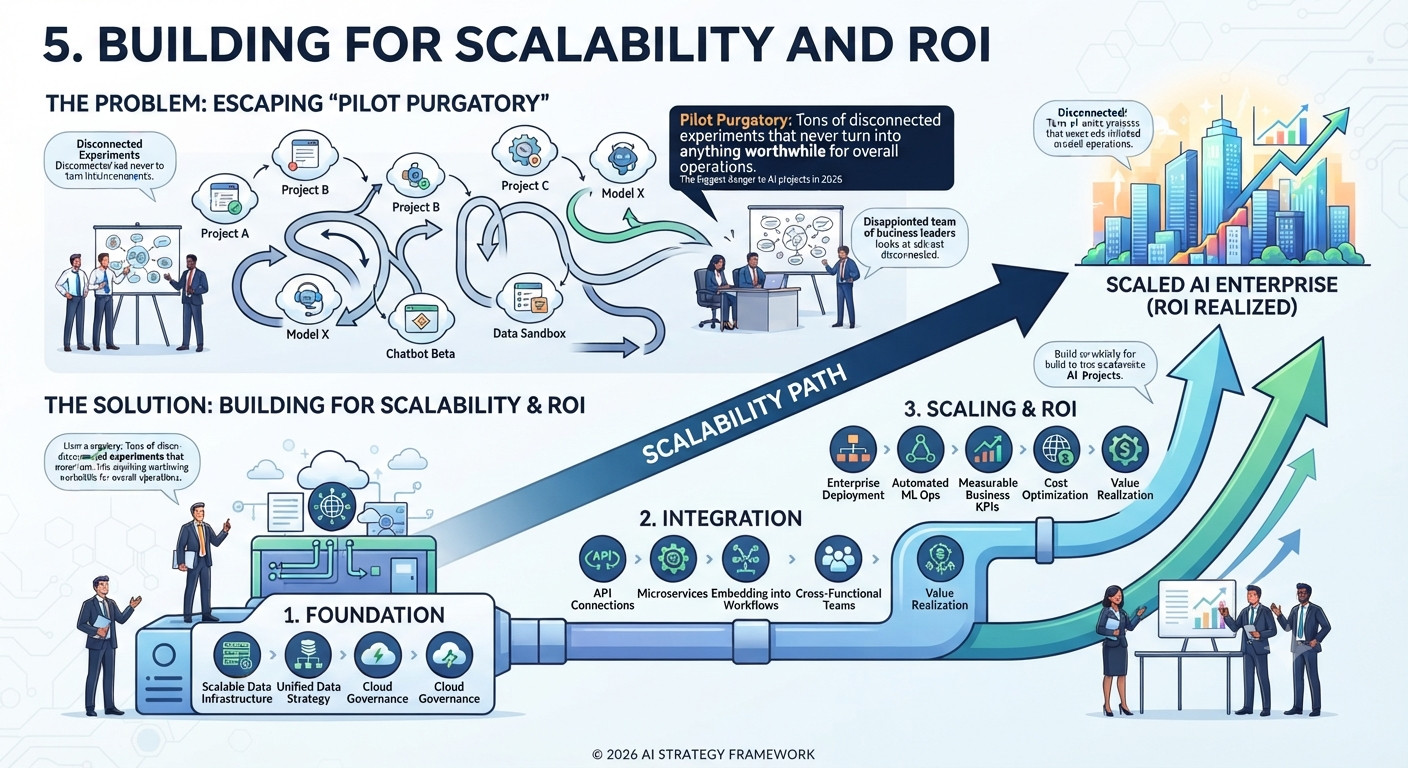
Pilot purgatory—not failed technology—is the biggest danger to AI projects in 2026. It's where you run tons of disconnected experiments that never turn into anything worthwhile for your organization's overall operations.
Transformation Cycle of 90 Days
In order to keep moving forward, we suggest implementing the Transformation Cycle of 90 days. The cycle breaks down the process into well-defined quarters to keep the energy going and ensure prioritization.
Day 1 - Day 30 (Discovery & Core Alignment): Find a process that adds significant value to your company and follows the principle of "Core-and-Orbit". Don't choose anything insignificant; only those processes where the uniqueness of your data will give you an advantage.
Day 31 - Day 60 (Development & Agentic Logic): Develop your MVP, emphasizing full automation and not just a chat tool. Introduce RAG and observability hooks at once.
Day 61 - Day 90 (Validation & Feedback): Assess the results based on real-world data and feedback. Decide to either kill the process, pivot or scale.
Measuring Impact: The Five Pillars of ROI
If you are assessing AI based on "developer speed" alone, then you are missing the bigger picture entirely. Here are the five essential pillars that should be considered for a successful AI deployment in 2026:
Effectiveness – is the AI achieving the intended outcome with greater accuracy compared to a non-AI process?
Quality – is the level of errors, hallucinations or inconsistencies in the acceptable range?
Time – what is the cycle-time improvement for a specific end-to-end process?
Revenue – is the automation enabling revenue growth by improving customer experience or time-to-market?
Cost – what is the net reduction in human capital costs or overheads, including cost of inference and compute?
Scaling from Assistant to Automation
Scaling is not about becoming "smarter" with your AI, but making your infrastructure smarter. As you scale your business from using an assistant to full automation, you need to move beyond ad-hoc scripting and towards orchestration.
That requires establishing standardized data pipelines, a single API gateway for all your agentic operations, and setting up security guardrails in place across the entire company. It’s about transitioning from managing multiple individual AI development solutions to managing your "intelligence layer."
6. Future Trends: What’s Next Beyond 2026?
Looking beyond 2026 into the future of artificial intelligence, we can expect nothing less than a major change due to the emergence of digital intelligence as it converges with physical intelligence.
The Emergence of Embodied AI and Digital Agents
Most certainly, the greatest development in the making will be the convergence of digital agentic workflows with that of embodied artificial intelligence, which is a system that allows physical action.
As digital agents evolve and acquire the capability to control hardware systems, the next leap would move from automation to autonomous execution, as seen in logistics, manufacturing, and healthcare. For developers, this calls for the inclusion of robotics and sensor fusion data within the "Core-and-Orbit" architecture..
Multimodal Reasoning as the Standard
Although the year of 2026 belongs to agentic orchestration, the immediate future belongs to native multimodal reasoning. No longer will there be models able to handle text, images, and audio in isolation – the key will be to develop the ability to reason about the environment holistically via real-time synthesis of multimodal information.
Preparation for Computation-Intensive Waves
With the advent of models capable of reasoning and physical manipulation, the demand for computers will increase dramatically. The coming wave of AI development will not only need to scale but scale in an extreme burst-oriented way. Now is the time to start preparing data centers and cloud approaches to cope with greater densities of GPUs and the inclusion of AI-accelerated hardware at the edge.
Next Steps
The landscape of 2026 is marked by an absolute transformation in that AI has ceased to be a side experiment and has become the main driver of organizational intelligence. As we have seen in the course of this manual, the way to ensure sustainability of success will not be the pursuit of some latest vendor tool but rather the application of the "Core-and-Orbit" approach.
The quick development of agentic frameworks, specialized SLMs and computationally expensive architectures may seem daunting but keep in mind that technical perfection is a constant process. The key for success in this era lies in retaining curiosity, developing systems with scalability and security as basic requirements and being ready for the next leap towards multimodal and embodied intelligence.
Ready to accelerate your AI maturity?
Here at Gigmint.ai, we excel in assisting companies to overcome the hurdle of transitioning from pilot purgatory into fully autonomous processes across the enterprise. If you require personalized consulting to optimize your artificial intelligence infrastructure, assistance in picking the appropriate vector database for your scale, or if you want to be part of a community of innovators that are shaping the future, then look no further!
[Get a strategy consultation from Gigmint.ai] or become a member of our community forums to build the intelligence layer of tomorrow today.
Frequently Asked Questions (FAQ)
1. Is "Core-and-Orbit" architecture appropriate for startups? Yes, indeed. As a startup, your priority will be focused on your own proprietary data, thus avoiding "vendor lock-in" and creating a defensible, intellectual property-focused architecture.
2. Why is the popularity of SLMs growing? These models provide low latency, lower cost of operations, and increased precision for domain-specific tasks. This makes them perfect for enterprise-specific workflows.
3. What lies the main distinction between RAG 1.0 and RAG 2.0? While the former utilizes basic semantic search, RAG 2.0 utilizes graph-augmented retrieval in order to grasp the connections between the data points, thus minimizing hallucinations.
4. How do I detect Shadow AI within my company? You need to track the network traffic in order to discover any unauthorized API endpoints and perform regular audits of developers' workstations in your company.
5. What is the "90-Day Transformation Cycle"? This is a methodology to avoid "pilot purgatory" and time-box Discovery, Development, and Validation stages to ensure ROI within one quarter for AI initiatives.
6. Is Python still king in 2026? Yes, in development and data science, but there is a "high-performance tier" of applications that use Mojo and Rust to deal with compute-intensive magnetic logic.
7. How should I calculate ROI for an AI Agent? Do not limit yourself to the developer's velocity. Evaluate it along the Five Pillars: Effectiveness, Quality, Time-to-complete, Revenue and Cost of Ownership.
8. What is "Agentic Orchestration"? It is the art of designing multi-agent systems where AI agents automatically plan, execute and verify their tasks in different toolchains and systems.
9. Why is on-premise hosting the best option for enterprise? Total control over your proprietary data and no exposure of any sensitive information outside your secure perimeter for public training sets.
10. How can Gigmint.ai help me to improve my AI maturity? We assist you in crossing the boundary from pilots to enterprise-wide agentic workflows via our architectural consulting and community expertise.