AI Talent Acquisition vs Traditional Hiring: What’s the Difference?
AI Talent Acquisition vs Traditional Hiring: What’s the Difference?
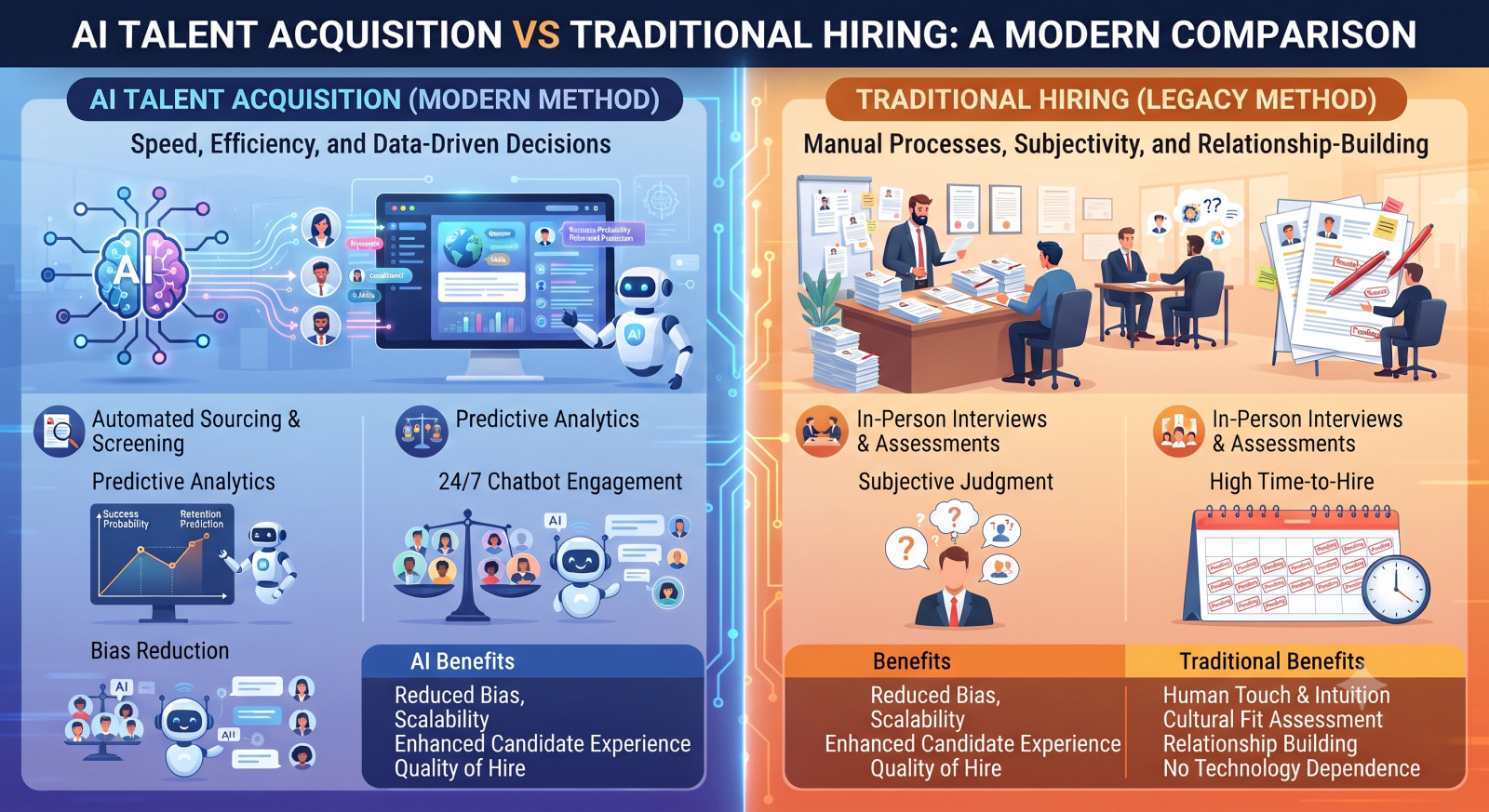
The recruiting industry is experiencing rapid transformation as companies utilize artificial intelligence (AI) to optimize the process of attracting, evaluating and employing people. Traditional recruiting typically uses manual resume screening, job portals, telephone interviews, etc., and this process might become lengthy as hundreds or even thousands of resumes are received by an organization.
Recruiting with the use of technologies such as machine learning, natural language processing (NLP) and predictive analysis represents a more automated recruiting process. Such techniques may assist recruiters to find appropriate skills, match candidates to available positions and automate recruitment activities.
Yet, this process cannot be fully automated since the human factor still plays an essential role in the assessment of candidate communication skills, leadership qualities and other aspects that cannot be easily determined using algorithms.
The paper provides a comprehensive analysis comparing the two strategies and highlights their fundamental aspects including benefits, limitations, costs and implementations. Comparing the two strategies, this paper focuses on the ultimate collaboration, which is the hybrid approach.
Through the integration of smart computing for matching processes coupled with human supervision, it becomes possible to create a robust, flexible and effective team ready to work in volatile environments.
It all starts with strategic brand positioning using GigMint AI platform. In the contemporary world, AI-powered platforms integrate AI matching algorithms into work ecosystems. As such, they automate laborious processes of sourcing and validating candidate skills, while providing useful insights to the hiring managers about candidates.
Defining the Contenders
What is Traditional Hiring?
Traditional hiring is the term used for the traditional procedures that are normally adopted during human resource management and which rely largely on human judgment and decision making.
Traditional hiring includes manual recruiting, posting on job boards like LinkedIn and Indeed, resume screening by human beings, and using either unstructured or semi-structured interviews. The key element of the traditional recruitment process lies in subjective assessments, which involve recruiting personnel judging candidates' pedigree, education, and work experience.
The traditional process flow is characterized by sequential steps:
Sourcing: Posting positions on online job boards and receiving applications or manually scanning professional social networks.
Screening: Recruiters going through piles of resumes in search of possible candidates based on their past job titles and companies.
Interviewing: Holding several phone screens, peer interviews, and an interview with the executive team in order to evaluate technical skill and culture fit.
Offer: Making an offer, negotiating salary, and onboarding a candidate through manual processes.
Even though this process flow is familiar and proven, it is known to be very time-consuming, often lasting from weeks to months.
What is AI Talent Acquisition?
The acquisition of talent via artificial intelligence is a significant change in the recruitment process, which involves the use of Artificial Intelligence, Machine Learning, NLP, and predictive analysis. Rather than having to oversee every single administrative issue manually, an AI system consumes large amounts of recruitment data.
Capabilities today in this area are quite advanced and revolutionary:
Automated Parsing: Using NLP, the algorithm analyzes the unstructured resumes automatically and derives key skills, certificates, and projects other than the mere keywords.
Candidate Matching Algorithms: These machine learning algorithms assess the candidate’s skills based on the job description with high statistical accuracy.
Chatbots: The automated assistants engage the candidate and schedule for initial interviews and screening.
Predictive Analytics: The system evaluates past performance to predict future success, risks of turnover, and fitment into the culture.
The Key Paradigm Shift
The most important change in the course of this evolution is moving away from the match between the keyword in the resume and pedigree towards matching based on skills and performance backed by data.
The traditional approach to hiring eliminates highly talented individuals who do not have an education from an elite university or a prestigious employer on their resumes. Matching based on AI talent acquisition considers only skills and competencies.
Head-to-Head Comparison: Core Evaluation Metrics
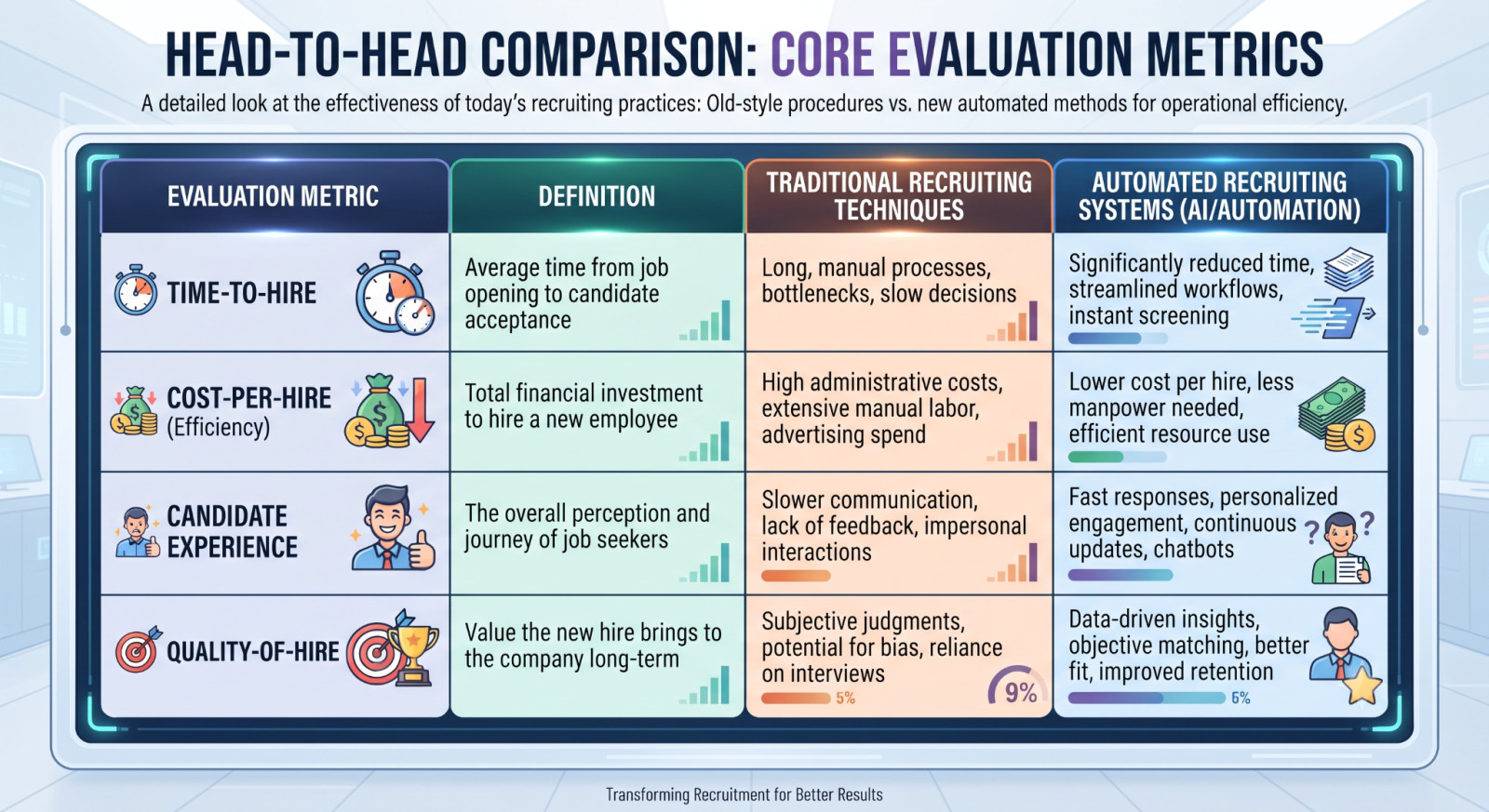
To understand the effectiveness of today’s recruiting practices, it becomes imperative to compare old-style procedures with new automated methods in terms of operational efficiency.
This table highlights the comparison between traditional recruiting techniques and automated recruiting systems on four important parameters of success.
Metric 1: Speed and Efficiency (Time-to-Hire)
-
Traditional Approach: Traditional recruiting suffers from inherent bottlenecks. Human recruiters need weeks, even months of time, to sift through countless resumes of unqualified applicants, trying to get in touch for an interview, and coordinating schedules of busy executives. Such a time-consuming process usually leads to the best candidates accepting other offers before an interview round even begins.
-
AI-Based Approach: AI-powered recruiting speeds up the timeline up to minutes. Applications get instant parsing, while machine learning algorithms rank candidates according to the criteria of the position on-the-go. Interview scheduling gets automated, cutting out all email communication completely.
-
Industry Insights: Benchmarks within the industry constantly prove that implementation of intelligent automation reduces overall time-to-hire by 50% to 70%. This way, organizations acquire their best talent without having to put them on the open market.
Metric 2: Quality of Hire & Predictive Success
-
Traditional Hiring Process: Traditional hiring process can be defined as a process that relies a lot on human instincts and judgments. Interviewers often fall prey to confirmation bias where they favor candidates who attended a certain university or worked at a famous company, which doesn’t necessarily translate to their job performance.
-
AI-Based Hiring Process: AI-based hiring emphasizes competency over pedigree through the use of granular skill set matrices, data about previous performance, and behavioral data. Algorithms then pick out candidates that have the exact competencies needed for sustained success.
-
Data Insights: With the help of data-driven matching, the retention rate in the first year improves significantly and increases the speed of employee productivity due to matching of skill sets with the demands of the project.
Metric 3: Cost Efficiency (Cost-per-Hire)
-
Traditional Process: Manual recruiting is incredibly costly due to high overhead costs. Companies allocate large amounts of money in the form of manpower in order to sift through the noise, costly hiring website postings, agency retainer fees, and hidden costs involved with vacancies causing disruptions in company output.
-
AI Process: Artificial intelligence technology reduces operational costs through automation of tedious administrative tasks. Rather than allocating human labor to sift through hundreds of CVs that may not even be relevant, recruiters can use algorithms to sort through the data while recruiters concentrate on their candidates.
-
Data Point: Cutting down on administrative time and the allocation of agency retainer fees reduces the cost per hire by up to 40%.
Metric 4: Candidate Experience & Engagement
-
Conventional methodology: Due to this problem of bandwidth, the conventional way of recruitment leads to something that is popularly referred to as “Black Hole Syndrome,” whereby literally hundreds of applicants become ghosts without even knowing anything about their applications.
-
AI-Based Methodology: Thanks to AI, not a single applicant is missed. Conversations that never cease, along with intelligent chatbots, provide instant answers to the queries raised by candidates, give instant updates about their status, and ensure a continuous feedback loop system.
-
Insight into Data: An effective, transparent experience for candidates contributes to improved Employer Net Promoter Scores (eNPS) and helps recruit higher-quality passive candidates.
The Dark Side: Challenges and Pitfalls of Both Approaches
Whereas conventional recruitment and AI-based recruitment have their strengths in connecting companies with great people, each one is also capable of bringing out its share of dark aspects which may end up compromising corporate ethics and efficiency.
Pitfalls of Traditional Hiring
Over the years, the human-centric approach to recruitment has come under the scanner for inherent flaws that stem from cognitive exhaustion and lack of structure:
Human Prejudice: Human biases like affinity bias (tendency to prefer individuals with similar traits), halo/horns effect (whereby a candidate’s evaluation is completely skewed by one single trait), and confirmation bias are common pitfalls of an unstructured interview panel process.
Recruitment Exhaustion: In-house recruiters dealing with repetitive functions have extremely high burnout levels. Sifting through tons of unorganized paperwork leaves little scope for engaging with any candidate.
Missing Passive Talent: Old-school inbound recruiting models depend on active candidates only. Outstanding passive candidates who do not refresh their jobs boards often get overlooked using traditional recruiting approaches.
Pitfalls of AI Talent Acquisition
Although the use of automation offers solutions to speed and scalability issues, the adoption of technology without proper guardrails creates several potential risks :
Algorithmic Discrimination: An AI model trained on data sets that show the previous demographics will have its biases, making it discriminate against individuals from different backgrounds, thus screening out the eligible candidates.
Loss of Empathy: When everything is fully automated, then empathy can be lost. Jobs that are more collaborative or leadership-related require some human element and emotions which are difficult to measure using algorithms.
Concerns for Data Privacy: When dealing with sensitive candidate data, then it is imperative to follow all the guidelines related to the global data protection acts like the EU AI Act, GDPR, and CCPA.
The Ethical Imperative: Transparency and Oversight
Given the risks involved, the current laws, which classify employment AI as risky under the AI Act of EU, require transparency, regular bias checks, and human oversight to be an absolute necessity.
AI should aid the decision-making process of humans, but never relieve the human of their ethical obligations. Employers are able to leverage the speed of technology while protecting fairness and integrity by ensuring there is an audit trail and human professional decision-makers at all times.
The Rise of Skill-Based and Gig Economies: Why Traditional Models Are Changing
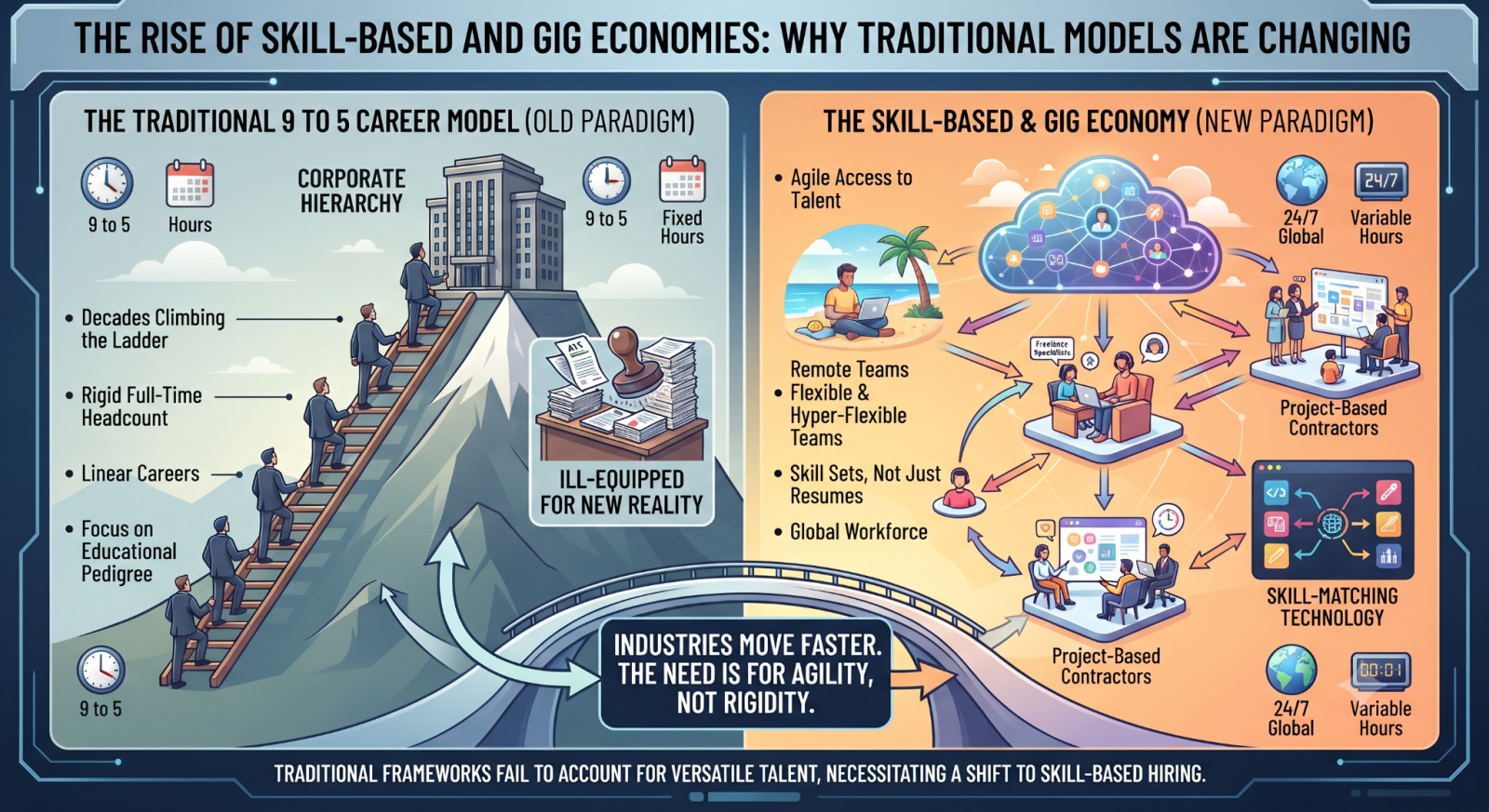
The traditional 9 to 5 career model—which entailed decades of climbing up the corporate ladder—is quickly becoming a thing of the past. In its wake has come the rapid rise of freelance specialists, project-based contractors, and hyper-flexible remote teams within the global workforce.
With industries moving at ever-greater speeds, there is no longer a need to maintain a rigid headcount of full-time employees for every specialized endeavor but, rather, a need for agile access to exceptional talent.
This traditional hiring framework is entirely ill-equipped to handle this new reality. Job listings and applicant tracking software (ATS), which are designed to sift applicants by their linear resumes and educational pedigree, fail to account for the highly versatile skill sets possessed by today’s workers. If a company needs a specialized technical project done immediately, going through a three month recruitment pipeline would be an absolute death sentence.
The GigMint AI Advantage
Here, modern platforms are redefining the ecosystem. GigMint AI creates a solution to the structural mismatch by combining a smart matchmaking algorithm with the right working environment.
Instead of depending on old-fashioned hurdles, GigMint AI allows agile professionals to be matched with demand-based businesses seamlessly. Instead of focusing on titles, which may not always reflect true competencies, GigMint AI helps businesses scale their specialized teams instantly, while at the same time, providing qualified talent with flexibility.
The Verdict: Which is Better, and When?
The argument that is still raging between conventional recruitment and recruitment via artificial intelligence always seems to pose a false dilemma. There is no denying the fact that artificial intelligence has not come to replace human recruiters but to free them from administrative chores and allow them to think strategically.
The Winning Formula (The Hybrid Model)
The most successful organizations of today use a high-impact combination of the two – a hybrid approach that makes use of the strengths of both approaches :
Where AI is the Leader (Top of Funnel): Automated intelligent systems perform high-volume administrative functions such as instant resume scanning, skill matching, continuous candidate engagement through chatbots, and interview scheduling.
Orbis HR Solutions
Where Humans Are the Leaders (Bottom of Funnel): Human talent management professionals get involved to conduct high-touch interviews, align cultures and psychologies, negotiate complex compensation packages, and make executive decisions.
With the combination of speed from computation and genuine human empathy, businesses will be able to form highly responsive and innovative teams that can rule the growing skills-based economy
The recruitment industry has reached a period of rapid change . While traditional recruiting provides the important human element of empathy, it often falls apart under the weight of administrative hassles, expense, and human biases.
Purely automated systems offer speed and efficiency in data analysis, but need to have strict ethics controls to preserve their credibility. In the future of work, there is room only for intelligent systems—perfect synthesis of computation and human wisdom.
Now, when businesses have to operate within the increasingly dynamic and skill-based world economy, they have no choice but to embrace the intelligent technology to remain competitive.
No matter whether you run a fast-growing business or are looking for flexible projects, the smart modernized talent acquisition process is the key to sustainable success.
Looking to revolutionize your recruitment process and secure sought-after projects? Learn how GigMint AI is using intelligent talent acquisition with AI to successfully connect talented individuals with progressive companies.
Frequently Asked Questions
1. How is AI-based recruitment distinct from the traditional resume screening process that involves keywords?
The traditional ATS system uses simple keyword matching technology, which usually excludes suitable candidates owing to small differences in wording or absence of exact keywords.
The technology of AI talent acquisition is based on the analysis of context using NLP and machine learning to determine skills and competence.
2. Is there any chance that AI-based recruitment will make the process absolutely objective?
The technology of AI is able to diminish cognitive biases such as affinity and confirmation biases through the assessment of objective indicators, but it is unable to eliminate the problem by itself. In case the algorithm is taught with prejudiced data, it will carry the same problems.
3. In what ways can GigMint AI keep the "human touch" element while employing automation?
The GigMint AI automates the tedious administrative process of sourcing, initial parsing, and scheduling. The recruiters and the managers have the chance to work on only high-touch engagements, cultural fit assessment, empathic interviewing and relationship management.
4. How much cost saving is possible through the use of AI-driven hiring solutions?
With AI-driven hiring solutions, companies can save up to 40% of their cost per hire. This is because of the reduction of the costs associated with retainers for external agencies, posting costs on job boards, and the cost of internal time spent on manually filtering out the inappropriate applications.
5. How can the use of AI help candidates have a better experience during the recruitment process?
Through automation, the problem of "black hole syndrome" can be eliminated because it offers round-the-clock conversational support, confirmation of applications, immediate feedback and status reports, and a feedback loop system.
6. Are there data privacy issues associated with AI talent acquisition in accordance with GDPR and CCPA?
No, most reliable AI recruitment platforms follow very strict data governance rules. They comply with all data privacy policies worldwide such as GDPR and CCPA.
7. What is the practical application of the hybrid recruiting model?
In this case, computational power and human intelligence merge into one process where AI deals with top-of-funnel processes such as fast sourcing, skills matching, and initial screening whereas human specialists will be responsible for bottom-of-funnel interviews, negotiations, and hiring itself.
8. What makes traditional recruitment pipelines fail in the modern gig economy?
The fact that traditional recruitment relies on a linear approach to careers where employees have to work in full-time 9-to-5 jobs while the modern gig economy involves a lot of specialized freelancers and contract workers.
9. Which KPIs should HR executives monitor to assess the effectiveness of artificial intelligence for recruitment purposes?
KPIs such as time-to-hire speed, cost-per-hire savings, one-year retention rates, quality-of-hire assessments, and candidates’ Net Promoter Score (eNPS) can be used to determine how efficiently and effectively the hiring process works.
10. How can firms use GigMint AI?
It is quite easy to begin. Companies may simply connect to the GigMint AI solution to get access to talented and vetted professionals through project-based team collaboration.