Beyond the Hype: A CEO’s Step-by-Step Strategy for Enterprise AI Integration
Beyond the Hype: A CEO’s Step-by-Step Strategy for Enterprise AI Integration
Artificial intelligence has evolved from being a novel technology to a core business strategy. But for CEO’s, the issue is not whether AI is important, but how to leverage AI as part of the organizational strategy so as to deliver business value through AI without adding unnecessary complexity, risk, cost and piecemeal technology programs.
The Enterprise AI integration does not just involve providing employees with access to AI applications, but leveraging the AI applications with business objectives, data, technology, processes, governance and people so that the technology complements the operations of the organization.
In this regard, the best course of action for CEO’s would be deliberate rather than reactive. This means that organizations do not need to implement AI applications simply because they have become more popular, but through identifying business challenges, preparing for implementation, selecting viable use cases, governance, testing in safe environments, measuring outcomes and scaling success.
What Enterprise AI Integration Really Means
Enterprise AI integration is the embedding of AI within an organization’s business operations, technological landscape, data infrastructure, and decision workflows.
This can include generative AI, machine learning, predictive analytics, intelligent automation, AI-powered applications, or other varieties of AI.
The key difference is that enterprise AI integration is not just about buying an AI application.
An individual’s use of an AI application to summarize a document is very different from a company’s enterprise-level integration of an AI-powered document processing workflow into the company’s overall operating process.
In the former, the use of AI might be an individual productivity function. In the latter, there is technology, data, access control, workflow management, governance, training, measurement, and measurable business impact.
From a CEO’s perspective, enterprise AI should be viewed as a business capability and not an experimental technology.
The essential question to ask then is:
In what area will AI solve a critical business issue, and what changes are needed for the organization to utilize it properly?
Step 1: Define the Business Outcomes Before Choosing AI
An enterprise AI strategy requires specifying the business goal.
If you begin your planning process by focusing on certain AI technologies, it will cause organizations to find problems that they can solve with those technologies. However, a better way is to start with what you want to achieve and see if you can accomplish that with AI.
An organization may have a goal of streamlining administrative processes, increasing accessibility to internal information, processing documents faster, helping customer service teams, enhancing decision making, or automating a process.
It must be something measurable.
For instance, instead of stating, “Our business goal is to utilize AI for increased productivity,” your management team can formulate a business goal like reducing the time of a specific workflow while ensuring quality control.
Establish a Baseline
In advance of any deployment of AI, describe the process currently in place.
Think about time, manpower, cost of operation, error rate, effects on the customer, existing technologies, and anything else pertinent.
The benchmark will be important later because any assessment of the performance of the AI system should be done relative to the old process.
Connect AI to Business Priorities
There must be a connection between an AI project and some priority in the business.
Step 2: Assess Your Organization's AI Readiness
Organizations might not be in a able to implement enterprise AI. It is important that before embarking on an AI project, the CEOs assess whether their organizations have what it takes to sustain the same.
Assess Data Readiness
Data serves as food for AI.
Therefore, it’s critical for the CEO to understand which data there is, where it is located, who owns it, who has access to it, and whether it is appropriate for its purpose.
Disorganized, obsolete, incomplete, and inaccessible data will complicate the process of implementing AI significantly.
Assess Technology Readiness
Analyze the current technology environment.
Take into consideration applications, databases, APIs, infrastructure, identity management systems, security control, and integration.
It’s not always necessary to rebuild the current technology environment from scratch.
Quite often, its successful implementation relies on integration of AI with systems that are currently used by your company.
Assess Workforce Readiness
Employees play a key role in AI implementation.
It is important for management to find out whether employees are aware about reasons for AI implementation, changes in their processes, tasks that need to be done by employees themselves, and training.
Assess Governance Readiness
In addition, organizations should assess their readiness regarding the existence of policies for AI usage, data access, privacy and security, human involvement, responsibility, and risks.
This assessment gives the true picture of capabilities of the organization.
Step 3: Identify and Prioritize the Right AI Use Cases
The goal of using enterprise AI is not to implement as many AI applications as possible. The goal of enterprise AI is to find those use cases which solve real business problems and provide real value.
Find repetitive, information-intensive, time-consuming, or decision-making processes where AI applications may provide helpful assistance.
Examples may include document management, internal knowledge search, customer service, work flow assistance, analytics, reporting, forecasting, content creation, software development, and process automation.
However, identifying potential areas of AI application is just a first step.
Prioritize Each Use Case
An example of effective framework for prioritization includes the following criteria:
Value
What valuable result could be achieved?
Feasibility
Is it realistic to implement the solution?
Information
Is the required information available and available?
Risk
What bad things can happen in case of an incorrect or inadequate solution?
Integration
How difficult is it to integrate the solution into current processes?
Measurement
Can the business measure whether the initiative was successful or not?
Start With Manageable Opportunities
There is a need for an initial AI project to be well-defined.
A bounded process with quantifiable goals will offer valuable lessons on data, governance, employee acceptance, technology and evaluation before the business ventures further into AI.
Step 4: Build the Enterprise AI Business Case
After selecting an example of a potentially profitable business use of AI, the next task is to evaluate the potential profitability of the venture.
Enterprise AI deployment requires spending money not only on AI solutions.
Costs to be considered may include software expenses, hardware, systems integration, data prep, security measures, staff training, engineering services, maintenance, monitoring, and project management.
This list should be kept in mind by the company's leadership when evaluating an initiative.
Calculate the Expected Value
Value may derive from several sources.
An AI-based process might help save manual effort, time, provide access to information, assist employees, ensure consistency, and even create something that was impossible before.
The actual value derived will be different for each process.
That is why CEOs need to be careful not to base their decisions on generic arguments about AI benefits. The question is whether a certain solution is expected to bring sufficient value.
Make the Investment Decision
The business case should address four issues:
What Problem Are We Trying to Solve?
State clearly the particular business problem which the AI program is meant to solve.
What Does It Take to Implement?
Consider the technological, data, people, security, integration, training, and any other necessary elements.
How Do We Measure Success?
Define the outcome and evaluation criteria before implementation.
When Do We Need to Scale or Shutdown?
Understand what makes further investment justified and when to stop the project.
This is going to provide the base for implementing AI programs in enterprises.
Step 5: Implement AI Governance Before Scaling
AI Governance is also an essential element in implementing AI at the enterprise level because AI technology will affect business process, data, people, customers, and decision making. Good governance necessitates creating proper roles and controls without hampering the adoption of AI technology.
Define Ownership
It is necessary for an organization to define who will take care of AI strategy, technology, data, security, risk management, compliance, and business results.
Clear ownership of an AI project will help avoid any problems related to deploying the AI solution without defining who will be responsible for the result.
Set Rules for Using AI
Such policies can include guidelines regarding handling sensitive information, personal information, sensitive business information, information produced by AI algorithms, external AI programs, permissions, and human involvement. It is essential to realize what type of information can be processed using AI systems and what type cannot.
Maintain Human Oversight
AI outputs should never be considered correct by default.
Depending on the use scenario, employees can have to validate, check, approve, or reject AI outputs.
The extent of human involvement must depend on the severity of potential mistakes and the type of business process involved.
Conduct an AI Risk Assessment
The risk assessment will include risks related to privacy, security, wrong outputs, misuse, security breaches, disruption of operations, and others.
The governance model has to adapt as new AI solutions and business applications become available.
Step 6: Prepare Data and Infrastructure for AI
Information is among the pillars of AI implementation within enterprises.
Organizations must consider what information the AI solution requires before they implement the same.
Identify Required Information
One should start by defining the use case of the solution.
This will help identify the required data sources, their owners, locations, and the people who need to have access to the data.
Organizations avoid having to revamp all enterprise information for each new AI solution that arises in the company.
Improve Information Quality
Any problems relating to duplication of records, missing information, obsolete information, poor formatting, and poor management should be sorted out first.
The quality of information provided to an AI system affects its results.
Connect AI With Existing Systems
Enterprise AI is hardly ever used in isolation.
It depends upon the use case as to whether integration involves enterprise applications, database, API, knowledge base, authentication and workflow platforms.
The architecture for integration needs to be developed considering the business process, not later after choosing the AI platform.
Build Security Into the Architecture
Security must take into account access control, authentication, permissions, data protection, logging and monitoring.
AI must work within the larger security architecture of the company.
Step 7: Choose the Right AI Technology and Architecture
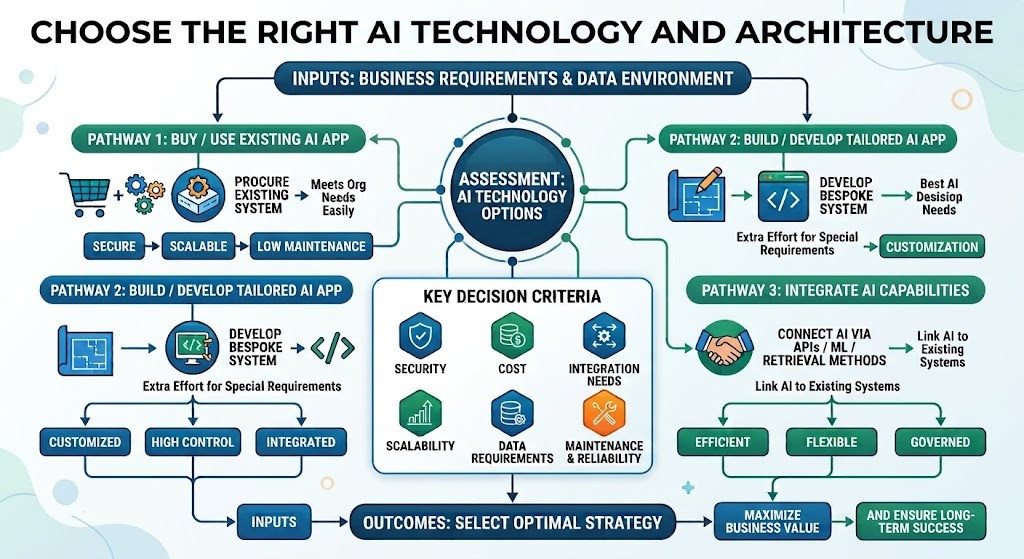
Once the business requirements and data environment are known, leadership can assess the various technology options available to them.
Technology solutions will vary according to need.
The firm has various options to consider, including using an existing AI-based app, integrating AI capabilities through APIs, developing an application tailored for the firm, using a retrieval method, using machine learning, or all the above.
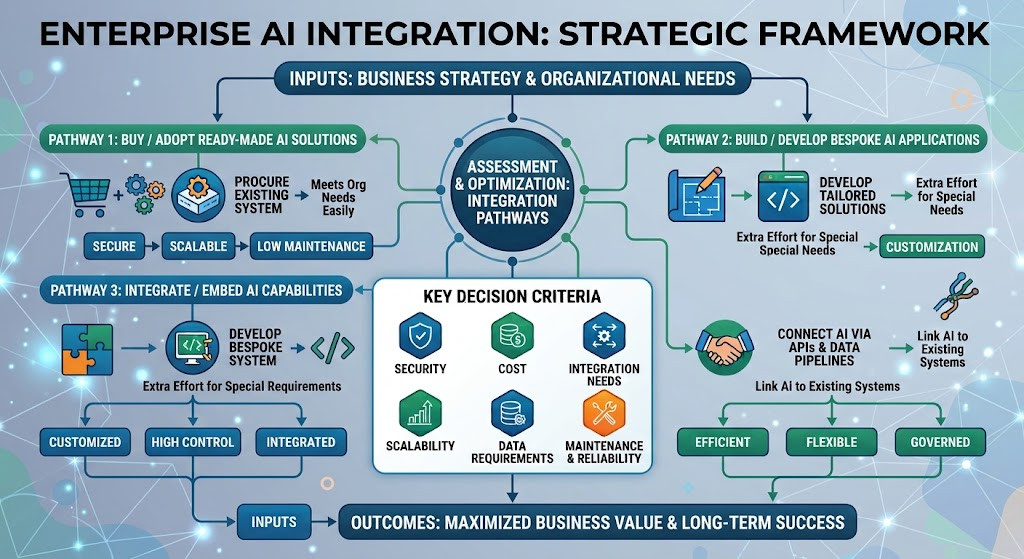
Consider Build, Buy, or Integrate
Procuring an existing system becomes easy when it meets the organization’s needs.
Development of a bespoke system becomes easy if there are special requirements that need extra effort to fulfill.
Integration makes the connection between AI capabilities and the existing enterprise application systems.
Not all of these strategies are necessarily better than others.
The choice must be made taking into account security, cost, integration needs, scalability, data requirements, maintenance, reliability, and governance.
Select Technology Based on Requirements
Do not choose technology because it is trendy.
The correct technology is one that suits the business needs and environment of the organization.
Step 8: Start With a Controlled AI Pilot
A controlled pilot enables an organization to validate its hypotheses prior to a full enterprise AI solution roll-out.
Pilot requirements include having a specific set of users, a specific workflow, clear goals, evaluation metrics, and an owner for the project.
Test the Solution in a Workflow Context
Do not only assess whether the technology works on a technical level.
Also measure the quality of the output, its reliability, the user experience, impact on the workflow, security considerations, employee buy-in, and human intervention needed.
The AI technology may behave very differently when it is integrated in an actual workflow rather than when presented in a demo.
Take Learning From a Pilot Project
A pilot may show that the use case is valid but there is a need to improve data quality.
There could be a need to solve an integration issue, provide some training, adjust the workflow, or establish new governance.
Step 9: Prepare Employees for AI Adoption
AI technology alone cannot bring success in enterprise integration of the technology.
Employees have to be aware of how the technology will be incorporated into their work and what their remaining responsibilities are.
Explain the Aim
The purpose behind adopting AI needs to be clear for employees including the problem the technology is expected to solve and how the workflow will be altered.
Communication can help in making things clearer for the employees regarding the new technology.
Provide Training on Using the Technology
Training will include the use of AI, output review, sensitive data management, error identification, adherence to organization policy, and escalation.
It should be made clear to employees that AI can help in performing certain tasks but will not take away professional judgment from the employees.
Establish a Feedback Mechanism
There should be a process through which users can feed back regarding incorrect output, workflow issues, security, usability, and further improvements in AI.
Step 10: Measure AI Performance and Business Impact
It is necessary for each AI initiative in the company to have specific metrics relating to its goals. This will assist the management in making informed decisions on how to proceed with a particular AI project.
Measure Business Metrics
Depending on the use case, appropriate metrics might be processing time, cost, productivity, quality, customer outcomes, and other metrics that make sense for the business.
Measure Operational Metrics
Organizations can measure workflow completion time, error rate, throughput, reliability, and system availability.
Measure User Adoption Metrics
Employee adoption is important since an effective technical solution will have little impact if the targeted users are unable to utilize it efficiently.
Metrics can include usage, user feedback, satisfaction, training completion, and adoption of the workflow.
Measure Risk Metrics
Appropriate risk metrics can include security incidents, violations of policies, incorrect results, escalations, and other failures depending on the particular application.
Compare Results With the Baseline
The most informative way to measure is by comparing the new process enhanced by the AI technology to the old process.
Leadership is able to make a decision about scaling or stopping the initiative.
Step 11: Scale Enterprise AI Without Losing Control
A successful pilot is not the endpoint of integrating enterprise AI. Scaling will bring a whole new set of challenges.
As more departments embrace AI, there could be cases of duplication of tools, inconsistent policies, scattered data flows, cost escalation, and lack of clear ownership.
Standardize What Works
Successful integrations could be used as guidelines in security, governance, evaluation, training, and technical integration.
Standardization could make future projects easier while still having proper control measures in place.
Prevent AI Sprawl
Individuals may independently utilize AI technologies to address existing issues.
Experimentation could be beneficial; however, without any control, it could raise questions about data security, access, costs, compliance, and accountability.
Organizations will thus need to find a way to combine responsible experimentation with enterprise management.
Build an AI Operating Model
Enterprise AI operating models could link strategy, technology, data, governance, business units, and workforce development.
The goal here is to ensure that AI adoption is coherent but does not depend on any one central team for innovations.
Common Enterprise AI Integration Mistakes CEOs Should Avoid
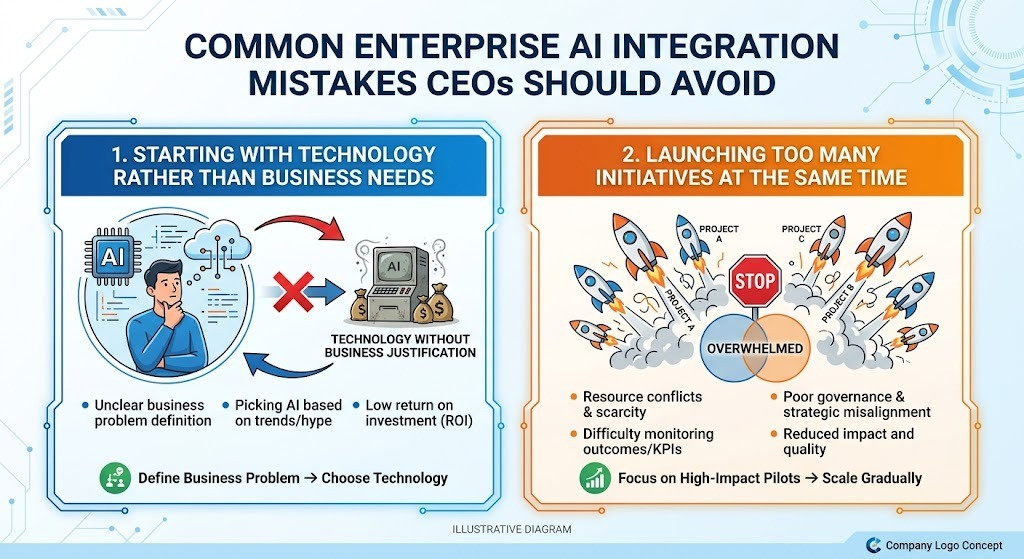
Starting With Technology Rather Than Business Needs
The decision to pick an AI technology without knowing about the business problem may lead to technology without any business justification.
Launching Too Many Initiatives at the Same Time
Initiating many independent initiatives will make it harder for resource allocation, monitoring outcomes, and governing initiatives.
Neglecting Data Quality
Data is the base for any AI technology. Poor quality of data infrastructure may ruin any implementation of AI technology.
Approaching Governance as an Afterthought
Questions about security, privacy, accessibility, accountability, and control should be taken into account in planning but not when deploying.
Evaluating Engagement Rather Than Impact
A lot of activity in using a technology does not necessarily mean that it is creating any business value.
Underestimating Change Management
Employees will require communication, training, assistance, and a chance to express their views.
Scaling Without Proper Pilot Testing
Scaling the technology without proper assessment of its impacts may increase the challenges rather than business value.
Believing That All AI Outputs Are Reliable
Each piece of AI output should be assessed according to the needs of each particular use case.
A Practical Enterprise AI Integration Roadmap
The eight stages of AI implementation for an organization by the CEO could include:
Stage 1: Strategy
Clarification of the business problem and expected results.
Stage 2: Readiness
Checking of data, technology, personnel, and governance.
Stage 3: Prioritization
Identification of application areas of AI depending on the value, feasibility, risk, and measurability.
Stage 4: Design
Technology selection, architecture, integration, control, and ownership design.
Stage 5: Pilot
Implementation of the solution in a controlled workflow.
Stage 6: Adoption
Employee training and feedback implementation.
Stage 7: Measurement
Comparison of the results with the initial benchmark and analysis of business impact.
Stage 8: Scaling
Scaling up successful projects with governance, security, and measurements.
Questions CEOs Should Ask Before Integrating AI
What Does Enterprise AI Integration Mean?
It refers to embedding AI within a firm’s business processes, technology environment, data environment, and workflows.
How Does a Firm Begin the Implementation of AI?
The firm needs to start with defining a clear business problem. Following that, it can assess its preparedness, find out its use cases, set up governance, select technologies, and test the solution via implementation.
What Would Make for a Good Enterprise AI Use Case?
It should be grounded in a sound business objective, proper data, reasonable technological complexity, acceptable risks, and measurable results.
How Can a CEO Measure AI ROI?
The AI ROI needs to be measured relative to the costs and outcomes of the implementation itself. It can be related to time, costs, efficiency, quality, adoption rates, or whatever goal was set prior to implementation.
What Are the Biggest Risks of Enterprise AI Adoption?
Some of the risks include the misuse of data, security risks, incorrect outputs, lack of human intervention, lack of governance, inability to integrate and uncontrollable adoption.
Should Companies Make or Buy AI Products?
This will depend on various factors such as business needs, technical challenges, security needs, costs, integration, customization and maintenance.
What Role Does AI Governance Play?
It plays an important role in ensuring that there is accountability, proper use of data, control of data, security considerations, human involvement, and risk management processes.
Move From AI Hype to Deliberate Execution
Integration of AI into an Enterprise does not mean CEOs need to chase all available AI applications. Instead, it means following a structured process for aligning technology with measurable business objectives.
The first thing that is needed is having a measurable business challenge or goal. After this, the leaders can assess their organizational readiness, prioritize viable cases of using the technology, ready data and necessary infrastructures, put in place the right governance, pick the right technology according to their business objectives, and validate the entire process through a pilot project.
The next thing to do would be preparing employees, measuring the outcome against the initial baseline, and scaling up the initiatives that have proven valuable.
The true benefit of enterprise AI therefore is not the additional AI tools but an organization capable of adopting, governing, measuring, and scaling up AI initiatives based on evolving business objectives.