Business Consultant: The Value of an Outside Perspective
Business Consultant: The Value of an Outside Perspective
The Paradox of Professional Proximity
Today's B2B leaders operate in a fast moving business environment where daily operations often demand their full attention . While this focus keeps businesses running , it can also make it difficult to recognize inefficiencies, emerging risks , and new opportunities over time , even experienced teams can lose the objective perspective needed to make strategic decisions.
For the intense operational focus on operations. As they find themselves immersed in the intricacies of the day-to-day—the quarterly races, budgeting exercises, and internal political maneuverings—it becomes almost inevitable that they will lose the perspective necessary for sound strategy. This immersion leads to an insidious and widespread “ losing sight of the bigger picture" mentality whereby internal teams, for all their commitment, fail to see inefficiencies in plain sight.
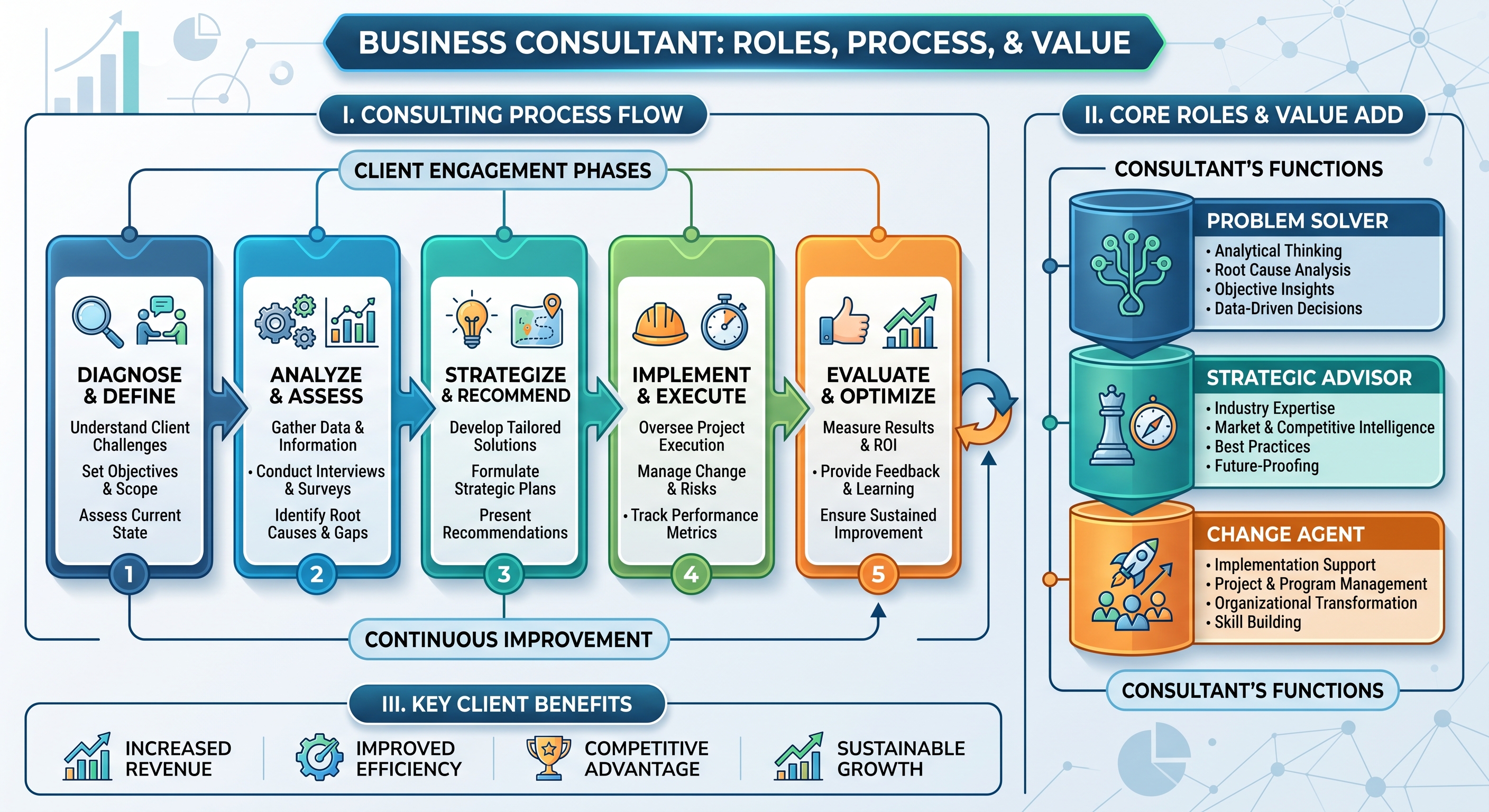
This introduction clearly defines that getting another perspective is neither a sign of weakness nor a privilege to be enjoyed when everything fails. By changing the perception of business consultants, we are no longer dealing with clichés of temporary employees or auditors; rather, we are talking about vital "strategic partners." An experienced business consultant offers more than a fresh perspective .
They bring industry knowledge , objective analysis and practical recommendations that help businesses identify blind spots and make informed decisions. We also consider the “Agility Mandate.” In today’s world, where markets turn within weeks not years, inertia will bring death. An external business consultant brings objective insights that internal teams may struggle to see.
This perspective enables organisations to respond more quickly to changing markets and make informed strategic decisions without being constrained by established routine, the capacity to make quick and objective turns that are impossible for internal-only restructuring due to being biased by culture and experience. Thus, incorporating such a force into the system allows organizations not only to overcome problems but also to ensure future readiness to avoid inertia.
Why Internal Solutions Often Stall

Each organization will have its own unique internal pulse, or standard operating procedure that, after some time, becomes unquestionable as a way of things. While it is important for growth to maintain consistency, it also results in creating a cocoon-like environment where all criticism is stifled and creativity inadvertently squelched. This internal atmosphere may well make leaders oblivious to changing times, which results in organizations failing even if good people work hard.
Institutional Inertia: One of the greatest barriers to organizational growth is institutional inertia: the tendency to continue using familiar methods even when they are no longer effective. Practices that once drove success can eventually limit innovation and slow progress. You can say in a business context "we've always done it this way."
Institutional inertia operates as an anchor holding your organization back by anchoring you to methods that might have been very effective five years ago but now actively stand in your way. When the people within your organization have been working in the context of the history of successes at your company, they are not going to see how those same successes have become liabilities. It takes an outside influence to overcome institutional inertia.
Emotional Attachment: Founders or long-serving managers will be subject to the "sunk cost fallacy." By having put years of effort and investment and emotion into various projects, divisions, or products, their personal psychological barriers make it impossible to take a step back and realize the need to do so. They aren't trying to save their project; they are trying to save their own career legacy.
The Neutrality Advantage: Herein lies the value of the outside business consultant. Because he or she is not tainted by office politics, organizational politics, and fears of being ostracized, the consultant offers the “neutrality advantage.” The business consultant serves as the objective data mirror for showing the unpalatable truths that the internal personnel might be afraid to speak out about because of political fears. Through the provision of objective data, strategic planning decisions can be made based on the latest information available.
5 Critical Signs It’s Time to Hire a Business Consultant
Acknowledging a need for help is the first step in optimization. Below are certain quantifiable signs indicating that a business has run into a wall of its own capacity.
1. Flat Income Even with Great Efforts
Whenever the "more of the same" strategy does not yield results, it means that the strategy is out of tune with the market. In other words, even if the operating machine is working well, the machine itself drives the wrong way. The business consultant provides external market knowledge needed to figure out what the problem lies: whether the issue is related to product-market fit, wrong pricing or changing the demographic of customers, which the internal staff may be too close to the project to detect.
2. Fast Growth Causing Outgrowing the Infrastructure

Success can be as damaging as failure when your infrastructure cannot accommodate it. At some point of time, the processes that have been working at one million dollars in revenue will fail at ten million dollars. Consultants are experts at professionalizing the processes of scaling – implementing an enterprise CRM system, optimizing the supply chain management, standardizing the workflow – without killing the company's culture
3. Critical Knowledge or Technical Gaps
Some projects like entering into a new international market, digital transformation, or deploying AI technology need unique skills which are very costly to hire on a permanent basis. "Up-skilling" employees in order to take care of a one time high-risk project will always lead to unnecessary delays. The business consultants will offer you the battle-tested playbook that will help you to skip the learning phase and get straight to implementation.
4. High-Risk Strategic Changes
Before investing millions of dollars into something new, an external audit will help you to verify your assumptions and find possible risks associated with the change. The internal team may have some biases about the current projects or "sunk cost" effect because of which it will be very difficult for them to give an objective opinion about the project.
5. Internal Conflict or Lack of Clarity
When there is a split between the leadership members, there is a "stalemate of perspectives" because no decisions can be made. The consultant, in such conditions, plays the role of the neutral arbitrator, who brings external criteria and good examples from the industry in order to eliminate the personal interests and politics of the group.
ROI vs. Overhead
Most business owners encounter a brief dilemma while going through the consultant's proposal—sticker shock may be an appropriate description of their reaction to the high hourly rates or even the rate for the entire project. The idea of treating the professional service as merely "costs" is one of the worst strategic mistakes a company can make.
It will be important to change the perspective and conduct a thorough cost-benefit analysis on the Return on Investment. The classic overhead of the full-time employee is considerable—it includes not only the base salary but also benefits, payroll taxes, and the implicit costs of training and possible turnover.
In case of hiring an internal generalist for some specific initiative, you essentially spend 2,000 hours of effort for something which requires just 100 hours of highly qualified expert's work. Business Consultant provides you with the surgical effect—they charge you not for the onboarding and learning process but for the output of the experienced professional.
One must also consider the hidden costs of trial and error. If you decide to have your internal team try out a complicated task, which is not in their field of expertise, they will end up spending time trying to learn along the way. Consultants will help to save you on this front by offering their battle-tested “playbook”.
It’s not just that you pay for their time – you pay to prevent the mistakes which they have already made elsewhere and save themselves the trouble of making again.You need to consider the cost of delays. In today’s business-to-business environment, fast turnaround is one of the key factors in determining the valuation.
The money that you can make simply by launching your important project three months sooner due to proper consulting will more than justify the price of the consultant. Under this perspective, high-end professional services stop being costly and become investments at a very high rate of return.
Overcoming the "Expert Search" Friction
While in today's world of consulting the difficulty lies not in realizing when one needs help, but in going through the difficult and risky process of finding an expert business consultant. For many executives, the hunt for talent from outside has turned into a "Major obstacle".
While the traditional network approach is limited by geography and confirmation bias, public job websites do not offer the best specialists in consulting who could perform strategic expertise. Friction converts a strategically important step into operational challenges.
Vetting Nightmare: The main problem with this approach is that traditional resumes are simply static documents which serve as a record of the historical employment, not the present consultation skills. It is easy to find out what company a person used to work in, but hard to know whether he or she can effectively solve complex unstructured problems.
This is why traditional resumes result in the "vetting nightmare" where a manager spends weeks on interviewing a candidate, but realizes afterwards that despite all of the qualifications the candidate lacks practical experience in consulting and is unable to make a quick strategy shift.
The Trust Gap: To further add to this operational challenge is what I term the "Trust Gap." Inviting a business consultant into the business environment necessarily entails sharing proprietary information, intellectual property, and confidential financial information. With the growing risks associated with cybersecurity, entrusting the exchange of confidential information with an unknown freelancer represents a risk.
The executives' concern lies in the fact that the marketplace does not provide the right level of security infrastructure for protecting the business secrets. This insecurity pushes organizations to use conventional and safer but less innovative options, or even to eschew outside consultancy entirely.
The Modern Gateway to Elite Consulting