Content Strategy for the AI Era: Finding Freelancers Who Understand Your Niche
Content Strategy for the AI Era: Finding Freelancers Who Understand Your Niche
The Paradox of Plenty
Businesses have never had easier access to content creation, yet producing more content no longer guarantees better visibility or conversions, we have definitely entered the "Content Deluge" age. In the age of digital marketing, whoever managed to generate the highest quantity of high-quality content won the battle.
The situation changed dramatically. Being able to produce content in bulk has stopped being an advantage since it has become something ordinary and even mundane because Ai has significantly reduced the time and the cost required to produce large volumes of content making high-volume publishing accessible to businesses of all sizes.
It has led us to the point when it is hard to compete anymore because of the excessive amount of perfectly average AI-generated content that flooded search engines and social media feeds. Even though the generated text will be technically accurate and grammatically impeccable, it lacks something – it does not have the human touch.
It does not contain a personal experience and point of view of the author. And, consequently, users learn to filter out such content and scroll past it.
It presents a unique opportunity for something we call "the Human Premium". Since AI will lower the bar of content creation and make information widely available, unique expertise, insights and authority of human beings are setting the high bar in return. Being different in the age of sameness, a unique and authoritative voice of your company can provide what readers want—unique and "unfair" knowledge which can be delivered only by an experienced professional in his field.
The purpose of this article is to prove that the high-quality B2B content in 2026 must incorporate the "Human-Plus" content strategy. It does not imply rejection of any technological advancements, rather it implies the application of AI to achieve unparalleled efficiency in scaffolding and research and dependence on the top 1% of the subject matter experts for content's soul, authority and strategic value.
The "Content Deluge": Why Generic AI Fails to Rank and Convert
Why Google is Penalizing "Ghost Content"
Search engines have changed. Algorithm changes used to be all about spotting any keyword stuffing or link building schemes. Currently, the war is on something called "Ghost Content" - content which is grammatically correct and structurally sound, yet not based on any experience or human insight.
The new Google updates highlight E-E-A-T (Experience, Expertise, Authoritativeness, and Trustworthiness), with an additional letter "E" for Experience determining the outcome.
Generic AI algorithms crawl the internet and collect existing knowledge. They can't be on-site with their clients and see the failure of the deployed software product themselves.
Nor can they understand the office politics which may come into play when trying to sell a product via B2B. When AI creates content, it does it by reusing the existing information. The algorithms of Google are becoming increasingly efficient at spotting that this information lacks original, personal experience.
Also the problem of "hallucinations."
Generic AI solutions often misstate facts, come up with fake studies or misunderstand difficult ideas in technical or specialized niches. If you run a B2B business, one hallucination in your whitepaper or tech blog post will be more than a mere SEO mistake – it will destroy your company's reputation. When your prospects see a wrong fact based on an algorithm's assumption, their trust is gone. And in the era of information abundance, trust is the most important currency.
The Conversion Gap
The problem with generic AI lies in conversion. B2B sales processes are lengthy, costly, and based on complex reasoning. The prospect doesn't need a summary of general information about the business environment because he can obtain that from any source, and probably already has it. What he needs is someone who can speak his language – understand the specifics of the prospect's reality.
AI can simulate the language of a professional, AI can imitate professional language, but it cannot replace the practical experience, industry judgement, and nuanced decision-making that experienced professionals bring to content creation but it can't simulate the intuition of a professional. It lacks the capability to synthesize unique experience, such as a unique workaround to a typical engineering problem or an alternative opinion about a conventional way of acting in the industry.
When a potential customer goes through a generic article, he feels that he is going through a book. When he goes through an article written by a niche subject matter expert, he feels as if he is talking to his peer.
It is this intellectual and emotional resonance that drives the process forward. If you don't have any unique "unfair knowledge," your content doesn't have a chance of making an impression in 2026.
The Importance of Subject Matter Authority
Moving Beyond Keywords to Topic Clusters
SEO used to mean keyword volume—locating the keyword with high traffic and then writing an article that corresponds with it. That is no longer working. With an AI-era search engine, such keywords-driven content is considered as commodity content.
To remain relevant, you should now pivot your content creation approach to "Topic Clusters." Topic clusters entail having a very comprehensive analysis of one main topic while taking into account other relevant sub-topics associated with the main topic. Such an approach will show search engine algorithms that you are a definite authority on that particular topic.
This is where “semantic gaps” become extremely important. By nature, AI models tend to go for the “mean” of whatever information there is – they sum up what is usually known and available about any particular subject matter. This leads to them ignoring “semantic gaps” – places of nuance, complexity, or difficult specifics which are too granular or “off-beat” for AI models to comprehend.
This is where your edge comes from. With an audit of your field, you are able to determine semantic gaps, and use that information to develop a content strategy that can not be replicated by AI models.
The Value of "Unfair Knowledge"
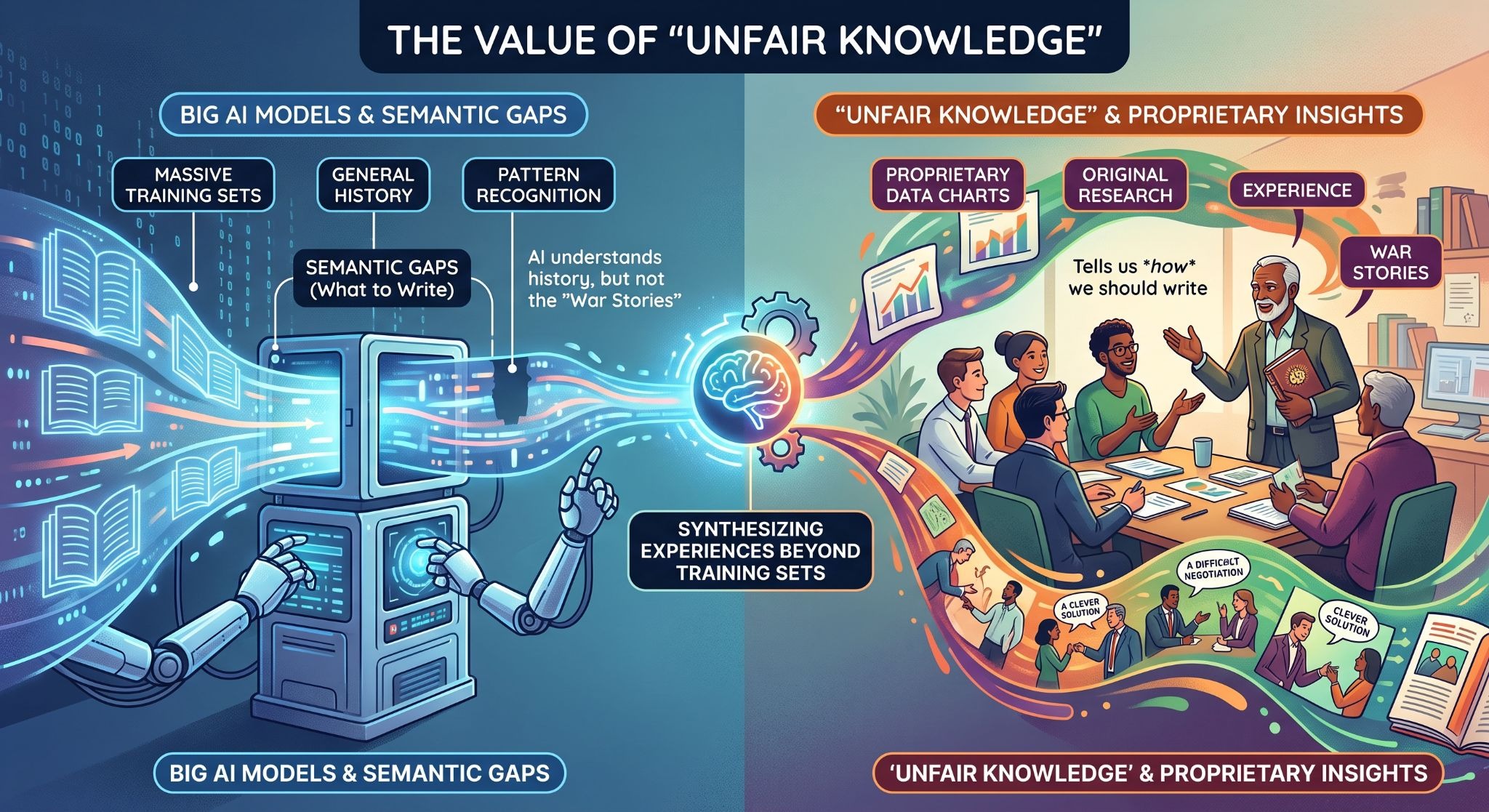
Whereas semantic gaps tell us what we should write about, “Unfair Knowledge” tells us how we should be writing. This refers to proprietary insights, original data, and experience which lie beyond the reach of training sets of big AI models. While artificial intelligence can understand the history of your industry, it cannot synthesize its “war stories.”
The niche expert will be your gateway to that unfair knowledge. In employing a freelancer who has experienced firsthand the reality of working in that particular vertical – whether it is a software engineer who debugged legacy code or a financial analyst who dealt with particular regulatory barriers – you ensure that the quality of content created immediately changes for the better.
Contrarian perspectives that break down industry dogma, case studies showing implementation in practice, original data which hasn’t been spun a thousand different ways – all these will only come from a true industry insider. AI copies; the niche expert creates. It is through focusing on such intellectual capital that you move from being merely a content publisher to an industry thought leader.
Identifying Freelancers Who "Get" Your Industry
Spotting the Difference Between a Writer and an Expert
With so many "content creators" in the market, the key challenge for B2B decision-makers is differentiating between someone with solid writing skills and a genuine subject matter expert. Conventional screening techniques are based on vanity stats—such as years of experience or number of completed projects—that have lost their significance in the age of artificial intelligence.
A freelance writer who boasts of a decade of experience in general copywriting is likely to create "ghost content" that is not technical enough to rank well for high-intent keywords.
Identifying the cream of the crop calls for an evaluation that puts greater emphasis on portfolio depth and original thought leadership. You should be looking for freelance professionals who have made an impact by actively participating in the discussion in your niche, showing what we term as "Unfair Knowledge"—knowledge gained not through a quick Google search but through practical experience. The existence of this expertise can be determined through the "vibe check" method, which evaluates fluency in the relevant industry lingo and understanding of client problems.
It's one thing to define a problem, but an expert defines a problem by describing the messy process of solving it in a way that speaks to someone on the same level. It isn't just about explaining how to solve something—it's like writing the problem out yourself as if you are the one who has to fix it.
To find the 1% of truly amazing talent, you need to evaluate based on the depth of their portfolio and the ability to prove original thought leadership in your particular area. You should look for freelancers who have actually helped drive the conversation in your particular industry with their Unfair Knowledge—their understanding of things that comes from real-world experience, not from Googling the answer. This is done through the "vibe check" of knowing the language in your particular industry and understanding the complex problems facing customers.
The Challenge of Scale
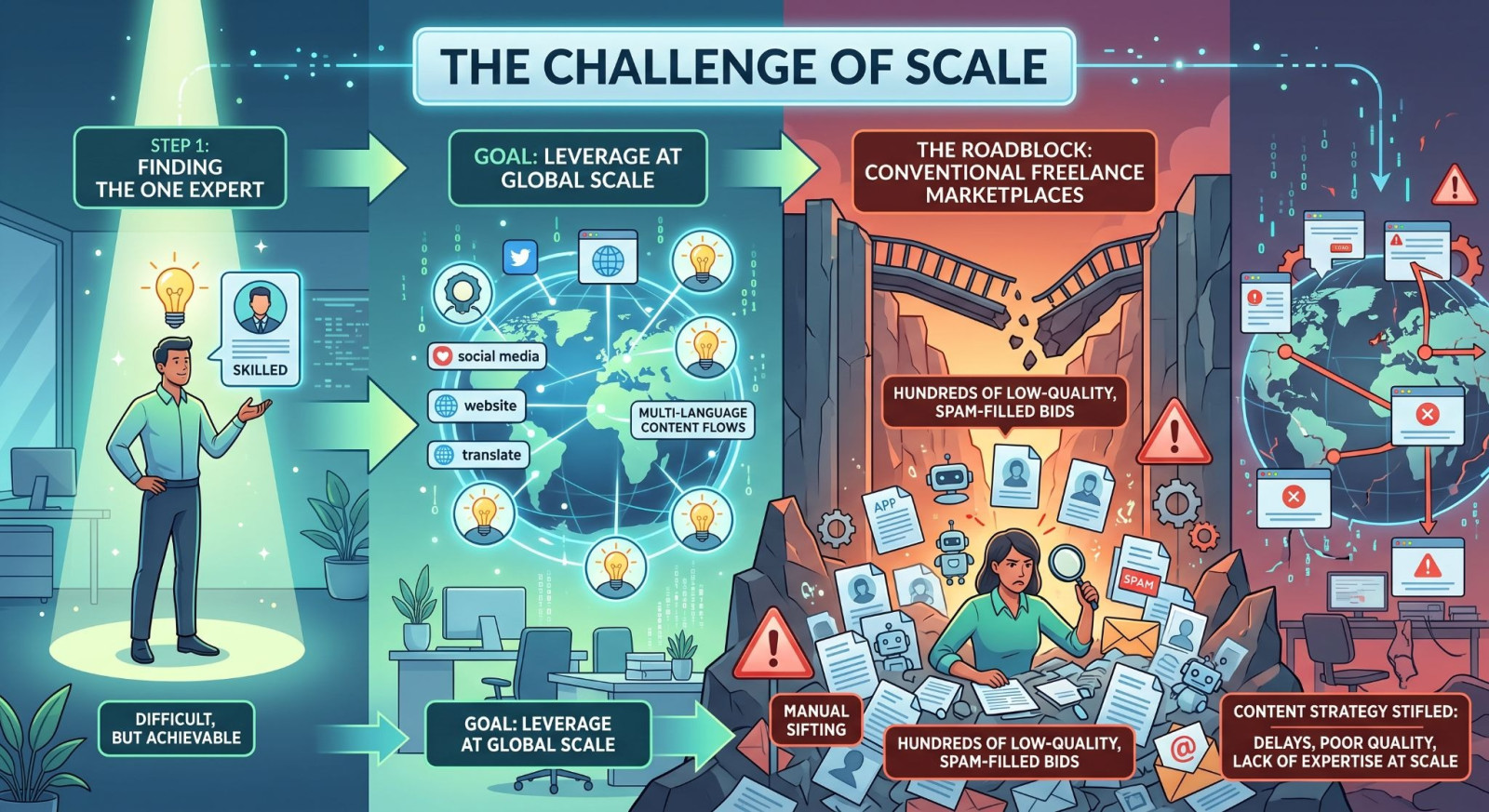
As difficult as it may be to find one expert, leveraging that expertise at scale in a global
content strategy can prove a substantial roadblock. The conventional freelance marketplaces are typically burdened by “manual friction,” wherein one has to sift through hundreds of low quality, spam-filled bids.
It becomes increasingly difficult to locate an expert who comprehends the nuances of something like SaaS architecture, for instance. The layer of administration involved in coordinating a team of independent contractors with varying processes, communication, and payment methods does not make the business scalable. The creation of a "bench" of specialists demands a shift away from such labor-intensive and transactional recruitment models.
In order to achieve the needed brand uniformity and consistency, companies have to switch to an automated, AI-driven process of recruitment that will eliminate any administrative barriers and ensure a certain level of technical skills for the entire workforce. Otherwise, any efforts to achieve scale in production of high-authority content will fail due to inherent inefficiency of the approach.
Inefficiencies of managing numerous independent contractors with their separate ways of working, modes of communication, and methods of billing, which do not allow for scalability, it is essential to recognize that the creation of the “bench” of experts necessitates a shift away from these inefficient processes.
For the sake of maintaining continuity of the company’s identity and progress, an AI-driven solution without any managerial hassles and the guarantee of technical skill level among all available resources is needed.
Using GigMint to Bridge the Gap
Efficiency Meets Nuance
"The briefing gap" between a high-level vision of the business problem and the actual task list needed by the expert is the largest point of friction when trying to scale expert-led content. Entrepreneurs and marketing managers often face difficulties when describing their needs in a way that fully empowers an expert.
In order to overcome this problem, GigMint uses the "AI Task Pipeline," our unique engine that serves as a technical translator of sorts. Taking in your business objectives in an unfiltered form ("increase organic authority of our ML product" or "describe technical specifics of our new CRM integration"), it does all of the heavy lifting in terms of structuring your project.
It creates detailed briefs with KPIs defined, technical stack described, and all of the tasks divided into milestone-driven units. This process allows us to use the "Human-Plus" approach. We are using AI as a "scaffolding" of the entire content creation process: conducting preliminary data collection, performing high-level research, and creating structured outlines.
This offers the efficiency of an automated process. But the "soul" of the content—its flow, its industry knowledge, its contrarian positions, and its authority—are left exclusively for the human experts. With the help of AI, you can eliminate the operational clutter, allowing your SMEs to devote all their attention to injecting their "unfair knowledge" into the story. In other words, you get a content creation factory that works as fast as software, yet has the expertise of a seasoned industry professional.
Instant Global Reach
The traditional freelance approach makes it difficult to source the right specialist due to the limitations of geography and “bidding wars” markets. If your particular niche happens to be obscure, such as advanced cybersecurity in fintech or medical compliance in software, you may find your perfect fit in London, whereas you are in New York.
This traditional approach will not work in such obscure niches, resulting in lost time and reduced output. GigMint removes all barriers here. Your business will get connected to an online community of more than 10,000 specialists in our system regardless of how rare or obscure your niche is.
Being an integrated platform within the financial ecosystem globally like Stripe, we save you from the hassle of payroll and tax processing related to cross-border payments, foreign currencies, and so on. Our global footprint will enable you to create an "Agile Creative Team" that fits right into your business content strategy.
Regardless of whether you require one single analyst or need specialized writers across the globe, GigMint gives you immediate, compliant access to global talent and makes your content strategy work for you.
Ensuring Reliability
The Top 1% Standard
In an environment where “freelancer” sometimes translates to “a roll of dice for quality,” GigMint sets up an entirely new level of reliability. Our "1% Standard" is a series of comprehensive, multistage tests and checks, where only one out of one hundred candidates pass. This is not about sorting resumes. It is an all-encompassing approach to ensure that your company’s image remains intact.
Technical skills are assessed using deep-stack tests, problem-solving abilities are confirmed by practical cases, communication skills are checked, and most importantly, portfolio verification is a requirement. By assessing past metrics of success, we make sure that every expert in our database has the proven ability to create truly impressive results.
Security and Financial Protection
Apart from the quality of talents, a modern business-to-business content operation needs to be resilient to systemic risks. Dealing with external specialists creates risks related to intellectual property and data security. GigMint ensures these risks don't materialize because it operates with SOC 2 compliance, which means that your confidential information and internal research stay safe and protected via banking-level security protocols.
Money security is also a critical aspect. The classical freelance "pay and pray" approach is outdated since it leaves companies vulnerable to failure to deliver or deliver low-quality work. We offer our clients a much more secure alternative through the use of an escrow service. All of the payments made by the client for each milestone get transferred into an independent, transparent account. They are kept aside until the deliverable is approved by the client.
This structure will guarantee that your budget becomes completely aligned with tangible results. With our integration of Stripe for payments around the world, we take care of the difficulties associated with cross-border compliance, taxation, and currency exchange. This system makes it possible for you to concentrate on content dominance and growth while being assured of your financial and intellectual safety within a highly trusted business framework.
Building a Bench of Niche Experts
From Transactions to Partnerships
At the early stage of content strategy development, using freelancers can seem like a process of making separate deals. You hire someone, give him/her something to do, and go on to the next person. Real influence is never based only on such individual meetings.
To get things done in an efficient way, you need to switch from “hiring” to “partnering.” With the help of creating a recurring team of specialists in a particular niche that understands your company’s style, your industry’s challenges, and knows your content strategy inside out, you will get rid of the trouble of briefing every single time.
Importantly, this model is not only based on human interaction, but operational scalability as well. Coordinating work with independent contractors around the globe is administratively difficult, entailing complicated aspects such as local tax regulations and currency exchange rates.
Using GigMint as a platform will enable you to take advantage of integrated finance systems, for example, Stripe, which will enable you to make payments in more than 90 countries without any difficulties. You are no longer dependent on the "payroll bottleneck."
Future-Proofing Your Brand
Developing a bench ensures that you have the flexibility needed to future-proof your brand. The internet does not stand still; search algorithms evolve, and new industry trends appear seemingly out of nowhere. If you don't embrace evolution, you lose to those who do.
Regular "Content Audits" will allow you to keep your expert-written content up-to-date with regards to changes in search algorithms. With a bench of experts, you get an early detection mechanism because they understand what's happening within the industry and can detect when search intent changes or the need arises to update a particular pillar topic to keep its position in search results.
Why GigMint is the Solution
AI is a means of gaining efficiency, but human expertise is an undisputed means of gaining leadership. While the automation of your content creation process will help you stay up-to-date with the algorithm, it won't allow you to create the kind of brand authority that will make you rule your niche. In order to scale in the age of AI, you should reconcile efficiency and intuition.
And here comes GigMint to help you with your scaling content strategy. We solve the problem of the expert content by giving you access to the top 1% of rigorously vetted niche experts. The AI-powered Task Pipeline removes any operational overhead related to briefing and matching while the pool of verified talent makes sure each piece of content created for you has the necessary authority, insight, and "unfair knowledge."
Don't think of your content as something to be created in bulk quantities. Instead, treat your content as a strategic resource to be developed. Whatever type of expert content you require, whether in-depth technical whitepapers, contrarian thought leadership pieces, or simply an ongoing bench of niche experts, GigMint will give you the scalable high-authority content infrastructure.
Looking to change your content strategy from "output" to "leadership"? Sign up to be in the elite 1% of brands leveraging GigMint for organic growth. Check out GigMint.ai and start your first project now!