Generative AI : Technologies, Use Cases, and Best Practices
Generative AI Development: A Comprehensive Guide to Technologies, Use Cases, and Best Practices
I. The New Foundational Layer of Enterprise Architecture
Generative AI has been largely in the domain of research papers and prototype demos, fascinating, but often at the margins of business. All of that is now firmly in the past. It's time to move from the age of AI as an "extra feature" to Generative AI as a base layer of modern software architecture. It is not a matter of integrating AI into your business anymore for the CTOs and technical leaders – it is a matter of architecting and scaling it.
And the "why now" lies in the particularity of the current technological landscape – we can see three major pillars converging into one unprecedented combination: the existence of computing power large enough to train frontier models; development of advanced Transformer architectures with emergent reasoning capabilities; availability of those models via powerful and user-friendly APIs. The barriers for engineering teams are now so low that the problem is no longer about access to the technology, but about the application of it in real-life environments.
This piece delves deeply into the technical details associated with the actual creation, integration, and management of Generative AI. We'll step outside of the hype cycle, concentrating instead on the technical discipline required in order to deploy LLMs, diffusion models, and agentic processes into production environments.
The aim is to provide your engineering culture with the tools it needs to take action, from implementing Retrieval Augmented Generation (RAG) processes and selecting the proper weighting of models, through setting up governance structures that minimize risk while increasing performance. Whether you're re-engineering existing processes or building "AI-first" applications from scratch, the following pages outline the technical path ahead.
II. The Technical Foundation: How GenAI Works
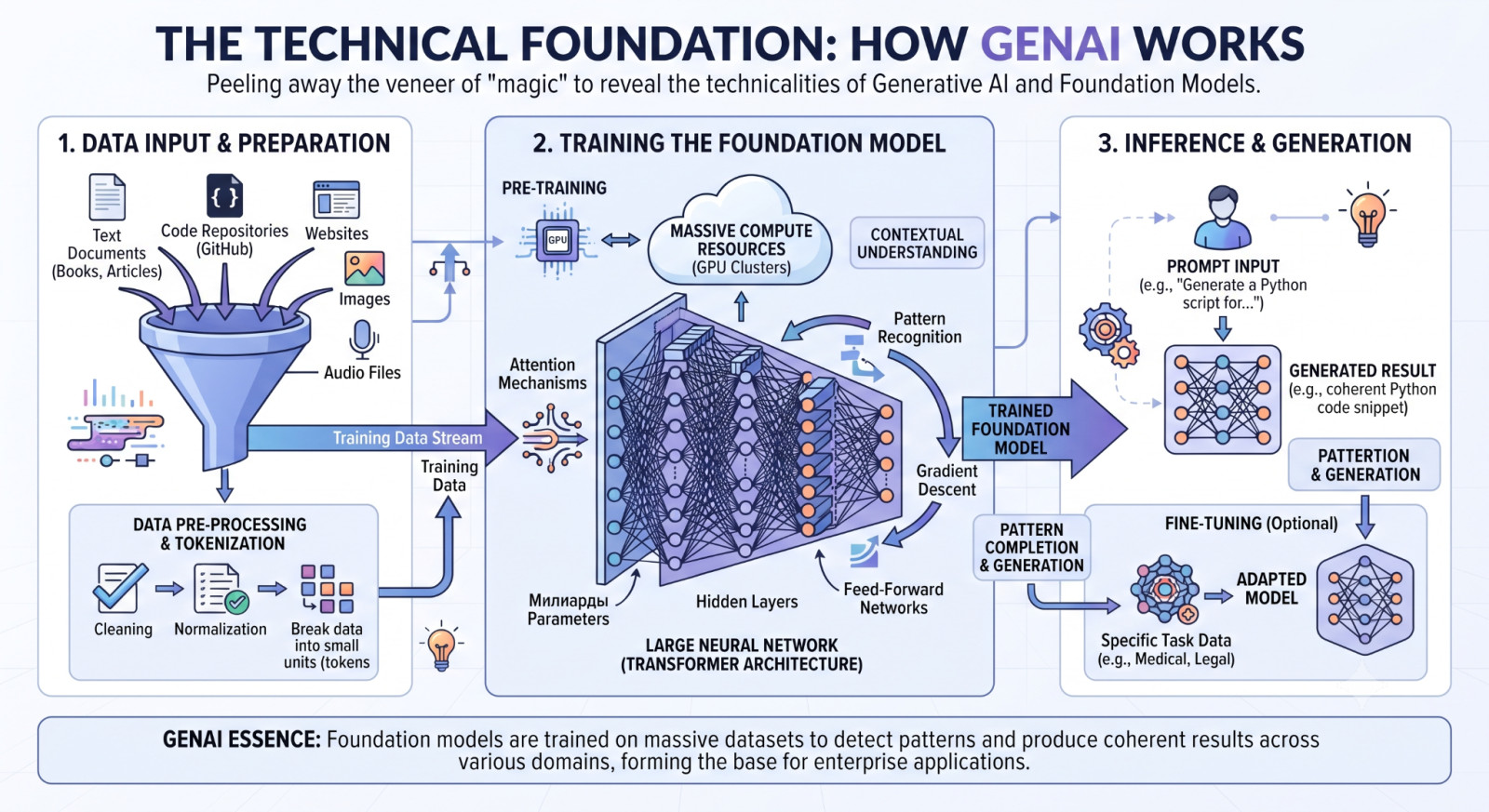
In order to develop robust enterprise applications, it is necessary to peel away the veneer of "magic" associated with Generative AI and explore the technicalities behind it. In essence, Generative AI is based on foundation models, which are large neural networks trained on huge amounts of data that can detect patterns and produce coherent results.
Foundation Models Overview
The ability to differentiate between models is the key to efficient architecture design:
Large Language Models (LLMs): Designed primarily for sequence prediction, LLMs are excellent at processing text, reasoning and code generation.
Diffusion Models: As their name suggests, these models are adept at learning the process of removing noise from data and are currently the main generators of images, videos, and audio content.
Multimodal Models: The future has arrived! Such models (e.g., GPT-4o or Gemini) are intended to work on text, images, and audio at the same time.
The Architecture: Transformer Primers
The Transformer architecture is at the core of many LLMs. Its key breakthrough is called the Attention Mechanism or "Self-Attention." Unlike previous recurrent neural networks that used sequential processing, Transformers consider the weight of each word in the sequence at once, independent of its location. It allows Transformers to keep track of the context in long documents and to use sophisticated reasoning that we can observe now.
The Development Lifecycle
AI application development is a multi-layer lifecycle rather than a single training experience:
-
Pre-training: The pre-training phase requires vast amounts of data (terabytes) and numerous graphics processors (thousands). For us, developers of enterprise products, pre-training is mostly invisible since we access such models using APIs or open weights checkpoints.
-
Fine-Tuning (SFT): SFT is the process of adjusting a pre-trained model on domain-specific data. It is needed when you want to train a model on a certain way of communicating or technical terminology. However, in most cases, it is excessive.
-
Retrieval-Augmented Generation (RAG): RAG is the killer feature for the enterprise. The model queries your databases with the current information in addition to the static training data before creating an answer.
The Modern Tech Stack
To build a production-ready stack, specific tooling is needed:
Vector Databases: Pinecone, Milvus, and Weaviate are essential for handling embeddings ("long-term memory"), which are the high-dimensional representations of your data.
Orchestration Tools: LangChain and LlamaIndex help coordinate a series of prompts, tool invocations, and other retrieval processes.
Models Serving: In the case of latency-sensitive applications, hosting your own vLLM or TGI (Text Generation Inference) instances will give you more flexibility and savings compared to managed APIs.
III. Strategic Use Cases Across Industries
The real power of Generative AI is not in "chatting" but in automation of complex knowledge-intensive workflows. Transitioning from user interfaces to agents, the enterprise value of AI skyrockets.
Software Development (SDLC)
Generative AI has completely redefined the experience of development. In addition to auto-completion of code, we have seen the following developments:
Automated Testing: The ability to create unit, integration, and regression testing based on the pattern of the existing code base helps greatly in saving the technical debt.
Legacy Refactoring: LLMs are very good at refactoring monolithic legacy codebases written in languages like COBOL and old versions of Java into modern architectures.
Architecture Documentation: The AI technologies were capable of processing large collections of code and creating architecture documentation autonomously.
Customer Experience (CX)
The age of the "scripted chatbot" has passed. The modern CX experience is all about Agentic Workflows, where the agents can do the following:
Multi-Step Transaction: An agent can authenticate the user's credentials, troubleshoot a problem with their bill and make an API call to initiate a refund, all in one go.
Sentiment and Intent Analysis: The analysis of customers' interactions in real time enables preemptive action even before any support ticket is escalated to a human operator.
Financial & Legal Services
Accuracy is key in high-risk sectors. Generative AI acts as a great multiplier for:
Compliance Monitoring: The AI platform consumes all changes in global regulations and compares these with internal policies, spotting any possible discrepancies.
Risk Analysis: Through the synthesis of unstructured data (like news, social media trends, and past reports) and financial indicators, predictions can be made on market changes and credit risk.
Contract Lifecycle Management: Automated summaries and analysis of contracts' clauses will enable legal departments to go through thousands of pages of material in just seconds.
Creative & Marketing
Large-scale personalization is the end result being sought here.
Synthetic Media Production: Today's generation models are capable of producing tailored imagery, sound and localized video, which allows for fully personalized global marketing campaigns.
Dynamic Content Production: Instead of working with a static template, marketers are developing systems that alter tone, style, and imagery based on user behavior.
The "Agentic" Shift: From Chatbots to Agents
This is the most pivotal point for CTOs of the modern age.
Passive versus Active: A chatbot works in a reactive manner; it requires a cue from the user. Agents work in an autonomous fashion and are driven by goals. It has agency that involves using tools like search engines and calculators in order to accomplish a predefined goal.
Process Involved: When there is an agentic system in place, then you can have your high-level goal set ("Analyze the Q3 financials and write a summary email to the board of directors"). Then the agent creates tasks based on the goal and achieves it in iterations.
IV. Best Practices for Generative AI Development
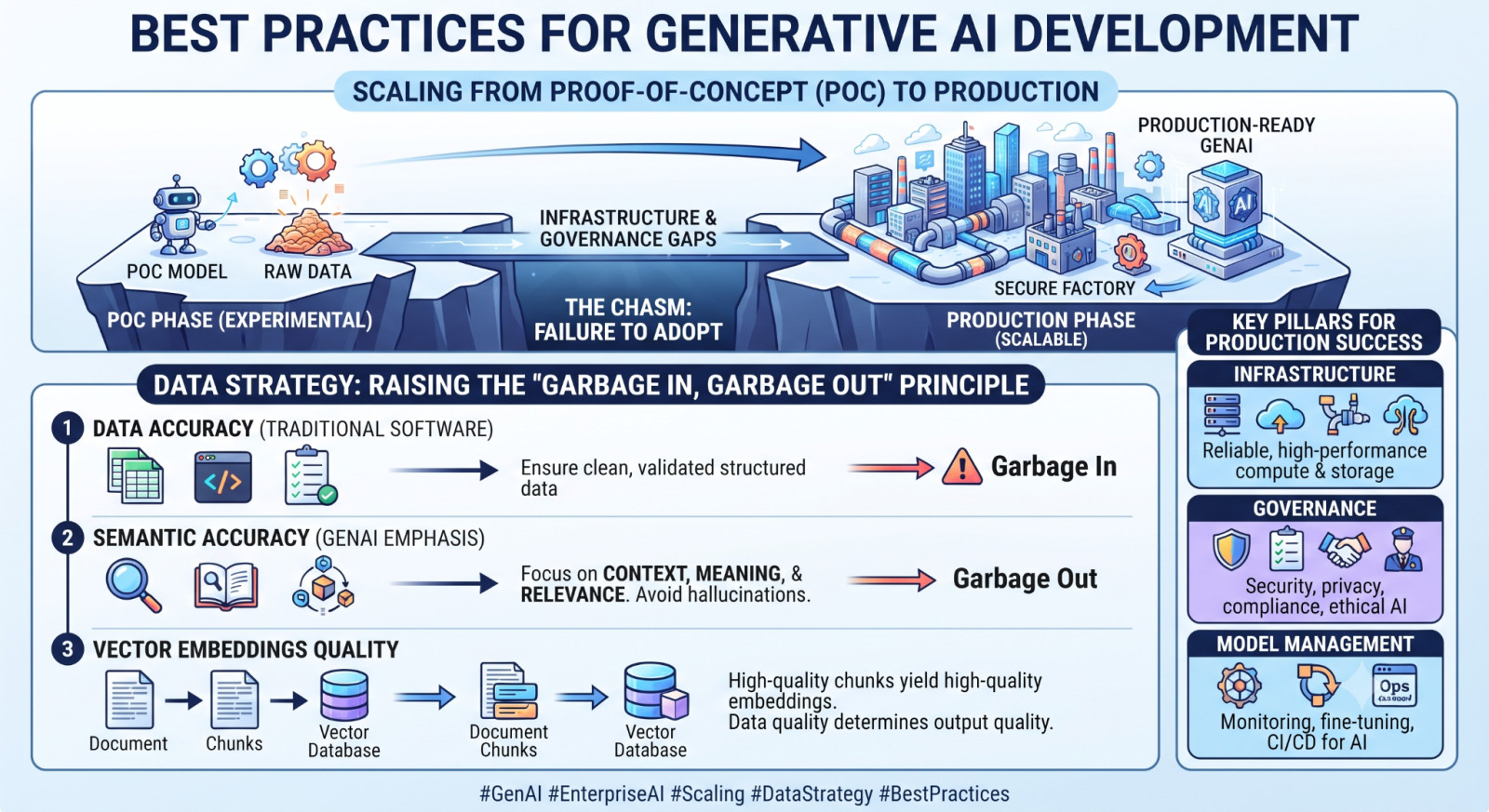
Scaling from proof-of-concept to production is the "chasm" stage, where many enterprise projects fall short in adopting GenAI. Success in this stage does not lie simply in the level of intelligence of your model, but in the strength of your infrastructure and governance.
Data Strategy: Raising the "Garbage In, Garbage Out" Principle
In traditional software, we have to make sure our data is accurate. In GenAI, we have to be even more worried about the semantic accuracy of our data. The quality of your vector embeddings depends on the chunks of data that they represent.
Contextual Chunks: Do not rely on length as the basis of your chunking system. Perform semantic chunking based on document borders to ensure that your model processes a whole "thought" instead of fragments.
Metadata Enrichment: Use your vector store as a database. Include additional information into your embeddings such as timestamps, source ID, type of document to filter out before retrieval.
Embedding Life Cycle: The Vector Store is not static. Whenever there are changes in the source documents, the embeddings should be refreshed to ensure the "long-term memory" of the system is updated.
Model Selection: The Proprietary vs. Open-Weights Calculus
The decision about the use of proprietary models such as Gemini/GPT-4o and open-weights such as Llama 3 or Mistral should be based on three key metrics: Capability, Compliance, and Cost.
Proprietary Models: If you need high-reasoning capabilities and use the “frontier” capability, choose proprietary models. Also, if you are okay with letting the vendor manage your infrastructure, then proprietary models will suit you just fine.
Open Weights Models: Essential for enterprise-level organizations that have very strict data sovereignty policies. Self-hosting allows you to keep your data in the VPC and not let anything out.
Hybrid Architecture: Employ a hybrid approach that will help in splitting your application code from the model provider. Utilize an abstraction layer to swap the models such as GPT-4 and Llama 3 without any need to rearchitect everything.
Evaluation & Observability: Closing the Feedback Loop
You cannot get better at something that you can't measure. There is a need for shifting Production AI from "eyeballing it" to proper measurement.
LLM-as-a-Judge: Put into place a pipeline where a superior model (e.g. Gemini 1.5 Pro) would evaluate responses of your production model against a ground truth dataset. It will help you to keep track of performance drift in an automated fashion.
Metrics of Observability: Move from simple logging to monitoring:
Latency: Time-to-first-token (TTFT) is more important in terms of user experience than total execution time.
Cost per request: Compute it on a per user, per feature or per model version basis
.
Hallucination rate: Measure semantic consistency in responses to repeated queries.
Prompt Management: Version Control of the AI Logic
Manually "prompt hacking" is a debt-creation machine. Think of your prompts as of code:
Prompt templates: Make use of a templating engine to standardize your prompts. System instructions should never be hardcoded in your app logic.
Version control: Put all your prompt templates in a git repo. Each change made to a prompt should go through peer review, and testing in the form of "evals".
Dynamic prompting: Separation of instruction (version controlled) and data context (dynamically provided)
V. Governance, Security, and Responsible AI
With Generative AI at the heart of enterprise business operations, a new and difficult attack surface emerges. The security paradigm in the AI era is not limited to firewalls and encryption, but must focus on securing the logic and context behind your models.
Navigating the New Security Landscape
Transition from static code to a probabilistic AI model brings some particular vulnerabilities which should be addressed by CTOs:
Prompt Injection: This threat is similar to the classic one (SQL injection). However, in this case, you trick the model into ignoring the guardrails it was set up with. The mitigation strategy involves the "defense-in-depth" approach when output filtering, structuring user input, and separating it from the system's instruction by employing a message format, and adding gatekeepers based on LLM are used.
Data Leakage: If you are using RAG, you might have some threat of leaking sensitive data from the vector database. ACLs should be implemented in your vector database on the document level in order to guarantee that users have access only to the information that you authorize them to obtain.
Supply Chain Attacks: In case you use open-weight models or third-party libraries like LangChain agents, you are exposing yourself to all their dependencies' threats. You always should get models from trusted and audited sources and audit your orchestration.
Privacy and Regulatory Compliance
GenAI's "hunger for data" directly puts it at odds with the global privacy standards such as GDPR and EU AI Act.
PII Masking: When the data is loaded into your embedding pipeline, it must first be thoroughly de-identified. This can be done via automation of PII masking to eliminate personally identifying data such as name, Social Security number, and other identifiable information.
The "Right to be Forgotten": In case the user asks that his/her data be erased from your databases, this will not suffice; you must also make sure that the model's memory is erased. This could depend on how the system architecture was developed – whether it means re-indexing the vector store or forgetting protocols applied when retrieving the information.
Compliance: The EU AI Act classifies AI systems according to the risk they present. It requires maintaining detailed documentation known as "Model Cards" or "System Cards."
Operationalizing Responsible AI
Red Team Testing: Prior to implementation, carry out red team testing on your model by having internal teams try to generate output that is biased, toxic, or even just wrong.
Guardrails: Implement software-based guardrails, such as Guardrails AI or NeMo Guardrails, which serve as an intermediary layer between the model and the user. These systems help to intercept any outputs that are problematic and enforce company-wide standards of tone, accuracy, and safety.
Explainability: Even though some advanced models are black boxes, when it comes to important decision-making, you need to be able to explain your model. Use strategies like citation-based responses in RAG pipelines to ensure the model cites its source.
VI. What CTOs Need to Plan For
Beyond the first wave of “generative” enthusiasm, the technology world is quickly turning towards efficiency, independence, and deep logic. For the CTOs, the future lies in three big changes that will set the foundation of competitive advantages for the long run.
The Era of Small Language Models (SLMs)
“Bigger is better” time of the LLMs is reaching the phase of diminishing marginal gains for many enterprises' applications. We are entering the Small Language Models era—models optimized for performance, domain-focused and capable of bringing huge amounts of intelligence into a small amount of parameters.
SLMs make possible edge inference, allowing companies to perform inference of the AI directly on their premises either locally or in a restricted VPC network. It's a big gain in terms of costs and data control, as well as tradeoff of the generic “knowledge” for specialization.
The Evolution of Multi-Agent Systems
The move from single-model solutions to a collaborative approach of multi-agent architectures represents the future of automation. Rather than working with a single "master" model, the enterprise architecture is now developing into an ecosystem where specific agents—with their own toolkits, knowledge base, and different prompts—are working together in harmony.
By coordinating a team of AI agents, one can solve complex end-to-end workflows which require cross-functional reasoning, like a procurement workflow requiring a legal evaluation, checking the inventory, and accounting.
The Move Towards Reasoning Engines
We are shifting away from models that are capable of acting as sophisticated probability-based text predictors towards solutions that act as problem-solving machines. The new generation of models is increasingly becoming trained in "reasoning," i.e., solving complex multi-step problems, checking their reasoning and iterating over it before providing the final result.
This shift towards reasoning engines will redefine the way we approach our mission-critical processes, as the ability of "showing our work" and logic behind the reasoning becomes as essential as the output.
VII. Strategic Roadmap
Becoming an AI-driven company is a continuous activity rather than a one-time activity. In the case of a CTO, there remains the same principle of "build or buy" where a firm needs to "build" if there is a need for differentiation or data sovereignty, while everything else can be bought or partnered with.
In the end, the most successful engineering organizations are going to be those who think about AI as an ongoing part of their engineering lifecycle. It's not enough to just plug some APIs in; it is important to shift the culture to become an iteratively experimental organization with excellent observability capabilities and strong focus on data quality. The age of the "AI-augmented" business is here.
Frequently Asked Questions
1. What is the greatest challenge in going from a prototype to production? The biggest problem here is the issue of reliability. Going from a "chatty" demo to a reliable and evaluable system involves creating robust data pipelines, observability, and comprehensive automation testing (Evals).
2. Do we need to make our own LLMs? Almost never. Instead, try to fine-tune or use RAG on top of existing models. Develop your own models only if you have large and proprietary datasets along with dedicated compute hardware to make the ROI work.
3. How can we avoid hallucinations in RAG pipelines? Ground the model through retrieval. Apply "Chain of Thought" prompting and ensure citation is done wherever necessary (i.e., where the model needs to reference the particular source).
4. What effect does RAG have on data privacy? RAG creates a centralized data aggregation node. Make sure that your vector database has per-document access control and that any PII is removed prior to generating embeddings.
5. Why is the advantage of the Open-Weights models? They provide you with data sovereignty and cost-efficiency. They can be hosted in your own VPC, with no data ever leaving your secure environment.
6. What are "agentic" workflows? The agents are able to independently utilize various tools such as web search and APIs to perform multi-step objectives, while standard chatbots just react to user input passively.
7. How should I gauge the quality of the AI response? Apply "LLM-as-a-Judge" approach and use a high-capability language model to evaluate the responses generated by your production LLM using specific criteria.
8. What is the biggest security issue with GenAI? The greatest threat is prompt injection. You should always clean the inputs from the users, and regard prompts as untrusted.
9. Why are Small Language Models (SLMs) becoming popular? SLMs offer fast inference times, are less expensive, and have the potential of being deployed on the edge.
10. How do I begin an “AI-first” culture? Identify internal workflows which have high value but low risks, and are candidates for automation.