Here is How to Brief Your Freelance Designer For a Website redesign
Here is How to Brief Your Freelance Designer For a Website redesign
Executive Content Summary
This guide explains how to create a clear website redesign brief that aligns your business goals with your freelance designer's work. You will learn how to define project objectives ,avoid costly misunderstandings and build a website that improves user experience , search visibility and conversations.
The High Cost of a Vague Brief
-
Most failed website redesigns die an early death in the initial brief or requirements document. Many design projects fail because the initial brief lacks clear goals, measurable outcomes, and detailed requirements. As a result, businesses often face repeated revisions, high costs , and websites that fail to deliver results.
The reason for this is usually down to ambiguity in the initial request and the designer reading too much into the brief. This is particularly difficult for the designer as even experienced designers can struggle to read minds and it is not part of their remit to try to.
-
A good redesign is 20% design and 80% preparation for the redesign. The quality of the outcome is directly dependent on the quality of the input. As mentioned before, instead of asking for a set of design requirements that express your vibe for the new website, you should attempt to set up a solid document that outlines the required outcome for the designer.
-
Here is a website redesign guide that helps create a professional freelance designer brief. This guide will aid you in designing a clear and concise brief to a freelance web designer for your next website redesign. Using a solid website redesign brief is key to creating a great website. As the client, you have to establish a solid groundwork and preparation for your freelance web designer.
By developing a clear and effective freelance designer brief, the freelance web designer will have all the necessary information to take to task in creating a first class website to serve as a storefront for your online business. In short, a good website redesign is 20% design and 80% preparation for the web designer prior to the initial design concept, created from your initial request to the freelance designer.
Phase 1: Internal Discovery and Goal Alignment
Identifying Your "Why"
Before you email a freelance designer to redesign your site it is worth looking at the current site to understand the problems it currently has. A redesign is not a cosmetic operation – it is a strategic business decision. So what is your ‘Why’ for a website redesign? Perhaps you just need a new look for your brand. Your design goals should be specific and measurable . For example , you may want to
Increase lead generation, improve conversion rates, reduce bounce rates, improve mobile usability or strengthen your brand identity. Or maybe you have some serious technical debt that is harming your website.
By not defining your goals and objectives for the redesign of your website, you risk creating a stunning but valueless website. If you decide to redesign your website, it is essential to first list and specify all the problems that your current site is causing.
Are the analytics on your current site horrible (like an extremely high percentage of bounce rates on key landing pages)? Is your current site not doing well with regard to mobile sites and Google’s mobile-first indexing? If your current mobile site is ugly or does not work, then that is an example of technical debt.
If people are leaving your site within seconds, then that is a conversion / user experience (UX) problem. Document all of these so that designers can provide you with evidence that they are the right solution and not just a new color for your website.
Mapping the User Journey
After goals have been defined, move on to the second most crucial step – your customers themselves. User journey maps are the only distinction between a good digital brochure and a great converting website. There is no way to create a good interface without understanding who will use it.1
The first thing to do is to create user personas. What is the profile of your ideal visitor? What action do they need to perform? It is very important to define the "Primary Action" for each persona individually. Do they need to download some white paper, request quotations or make a purchase? Everything on your website – from the hero shot to footer links – should serve that Primary Action.
If you have problems with low sales rates, try to use CRO methods while writing your brief. Explain exactly at which point the user abandons the conversion funnel.
The process of creating user journeys stops the guessing game of what the users may want and creates an intuitive interface helping them to perform the Primary Action and click the "Buy now!" button. The briefs including such journey maps turn your freelance designer into a strategic partner for your business development.
Phase 2: The Anatomy of a Perfect Design Brief

Sectioning the Document
The design brief is the central nervous system of your website redesign. It is not just an administrative formality; it is a strategic document that speaks for you when you aren’t in the room. A well-constructed design brief template can save hours, if not days, or I'll know it when I see it feedback.
This type of feedback is typically left for the end of a project and can ruin a freelancer’s or design team’s timeline and morale. To get the results you want from your website redesign project, your design brief should be broken down into four key elements or pillars to create a design brief template that will guide your freelancer or design team to the end.
Business Overview: The Foundation
The freelance designer you hire is not just a contractor, they are a temporary employee of your company. Prior to them even starting to design your new website, they need to know the ins and outs of your business. The business overview section of your design brief should outline the readers of your mission statement, the users of your website and the competitive landscape of the market place.
That is to say, the freelancer designing your new website needs to know who your ideal customer is and the problems that your website is attempting to solve for them. Also, the freelancer designing your new website should be aware of your top three competitors and the reasons for which they are succeeding or failing.
Using a B2C toy retailer and a B2B SaaS platform for example, the designer of the website for the B2C toy retailer could design a playful and vibrant website that is fun for kids to use, whereas the design of the website for the B2B SaaS platform would more likely be a sober and high-contrast website that allows users to easily find what they are looking for.
The website project scope is the most frequent battleground for "scope creep." If you do not explicitly define your boundaries, you will inevitably pay for it in budget overruns and missed deadlines. List exactly which pages need a redesign.
Are you reworking the entire information architecture, or just refreshing the landing pages? Clearly define your deliverables: are you expecting high-fidelity prototypes, fully coded templates, or just the visual UI elements? If you are providing specific assets—such as existing photography, logo files, or copy—list them here. Explicitly stating what is out of scope (e.g., "This project does not include blog content migration") saves weeks of misunderstanding.
Visual Direction & Style Guides
That’s where many clients get it wrong using subjective adjectives such as “clean,” “modern,” or “pop.” There are absolutely no standards there. Rather use what already works for your company. Add your style guide, logos, and color schemes. Should there be no strict guide for your firm, prepare a mood board.
Collect all those websites that you like and more importantly indicate which specific things you like (“I like navigation in footers on this website” or “typography in this website is exactly our style”).
That gives the freelance designer some specific guidelines in terms of UI design, so that the first mock-ups will match your expectations from the beginning without starting from scratch.Key Takeaways: “What We Like” vs. “What We Hate”
The most effective approach to avoid the guesswork would be to prepare a binary list of preferences. Prepare a list of “Visual Preferences” that will consist of two columns.
Be sure to list out the specific design elements that you like in the What We Like section such as Big, white-space heavy headers, Sans-serif fonts, and a Card-style layout for content.
For What We Hate, please be brutally honest and avoid giving wiggle room for misinterpretation (i.e. no "it depends" or "for this project" qualifiers). This should read as a straight list of the absolute worst design choices to include on a landing page for your startup. So: Stock images of handshakes, Heavy shadowing effects, Pop-up newsletter opt-ins on landing.
This plan acts as a set of constraints to help your designer create great designs within them, instead of designing a project from scratch that you hope will work for you. You are taking a problem of interpretation and turning it into a problem of execution, giving your designer design problems to solve instead of just handing them off to be completed. A project that starts out like this is bound to end well..
Phase 3: Technical Requirements and SEO Integration

Protecting Your Current Rankings
Website Redesigns are the most dangerous time for your search rankings. Even the most beautiful of sites can end up being a failure if it has inadvertently destroyed all of your years of Search Engine Optimization (SEO) “authority” on your site and send your organic traffic into free fall. So make sure that when you are briefing your designer that you are to make their job as easy as possible by focusing them on the technical SEO to protect your current rankings.
The biggest mistake when redesigning a website for search is ignoring the URL structure of the website currently online. You need to get your designer to outline the current URL structure, and the new design URL structure. This is so that you can ensure that any changes to the URL structure don’t lead to the loss of the backlinks and ranking history that drives the current traffic.
Include in your brief the requirement for your designer to map out the current site’s URL structure and then ensure that the new site’s URL structure doesn’t jeopardize all of the hard work that has been put into gaining search engine rankings. As your designer begins to create the new site, include in your brief the requirement for the designer to create a comprehensive 301 redirect map.
This will detail out each high-traffic page on the old site, and ensure that each of those pages has a direct and deliberate home on the new site. Without such a redirect plan, your site will launch as a graveyard of 404 error pages, and search engines will believe that you have taken content down from your site.
See our guide to [Crafting Content for SEO Success] for more on managing your messaging during this time. By clearly outlining these requirements at the beginning, you can ensure your freelance designer is working to preserve your site’s search equity rather than merely creating a new-looking site.
Performance Standards
Modern SEO is closely linked to the performance of your website. Search engines are now placing a great deal of emphasis on the page experience of a website in their ranking algorithms, therefore the speed and accessibility of the site need to be improved.
Your brief should clearly outline key performance indicators for the designer. Set out the Google Core Web Vitals, which cover visual stability of content on page, interactivity and loading performance.
Ensure that the freelance designer has a clear brief to undertake site speed optimisation, with reference to the impact of images and of JavaScript scripts, and that a design is created with minimal bloat from the start.
Incorporate into your design brief the necessity for mobile responsive design and the requirement to deliver an accessible website to your users (WCAG compliant). An accessible website not only is morally right to deliver to all users but also benefits SEO as search engine crawlers are able to accurately parse the structure of website’s content.
By delivering a lean website to search engines within your initial design brief your website will not only grow organically over time but will also load quickly for users of your website.
Phase 4: The Future of Frictionless Briefing
While redesigning a website is a complex task, it generally contains only one very difficult step – the blank page problem or translating the desire for change into a sufficient design brief for a professional to complete the task. The website redesign strategy is turned into an efficient automated process by GigMint.ai.
Automated Clarity with the AI Task Pipeline
One of the biggest pains with hiring freelance designers is the difference between what you thought you were hiring for and what the designer actually thought you hired them for.
Instead of having to wrestle with writing out a detailed project description that designers rarely read all the way through anyway, GigMint.ai uses an advanced AI Task Pipeline to turn out a professional-sounding and actionably detailed project brief from even the most vague project goals, designer looked for pain points and business objectives that the project was trying to meet.
This way, when the designer finally opens up the project, they’re reading a technical roadmap for the project rather than trying to decode and interpret your poorly written project description. And by getting past the initial back and forth of email of finding the right designer in the first place that exists on freelance marketplaces today, you can get past the good stuff, such as actually getting work done.
Matching with the Top 1%
Hiring through traditional freelance marketplaces is inherently “noisy” – a long, painful process of sorting through hundreds of generic freelancer profiles and then battling for bottom-line price through endless bidding wars. GigMint.ai removes this entire layer of inefficiency.
You create a project, and then GigMint.ai matches that project with the precise group of highest converting freelance designers from the top 1% of GigMint’s industry proven freelancer community (specific to high conversion web design).
By automating the core of the hiring process, and focusing it intently on the specific requirements of your project, GigMint’s intelligent matching functionality drastically reduces your overhead in terms of time, administrative overhead, and stress.
Secure and Global Payouts
The last core component of a very successful partnership: transparency and trust. To get rid of the monetary stress of very complex projects located around the globe, we at GigMint.ai work with an automatically managed escrow function. Money from your project partners gets stored safely on GigMint.ai until you finally approve your partner’s work for the last time.
After that your partner gets paid immediately via automatically triggered global payouts with Stripe. To develop projects in a very effective and successful way with the help of AI and already pre-checked talents for the so-called „blank page problem“ is GigMint.ai’s claim from the very start of its existence and already a reality for its users from the very beginning of a project.
Phase 5: Feedback Loops and Iteration Management
The Art of Constructive Criticism
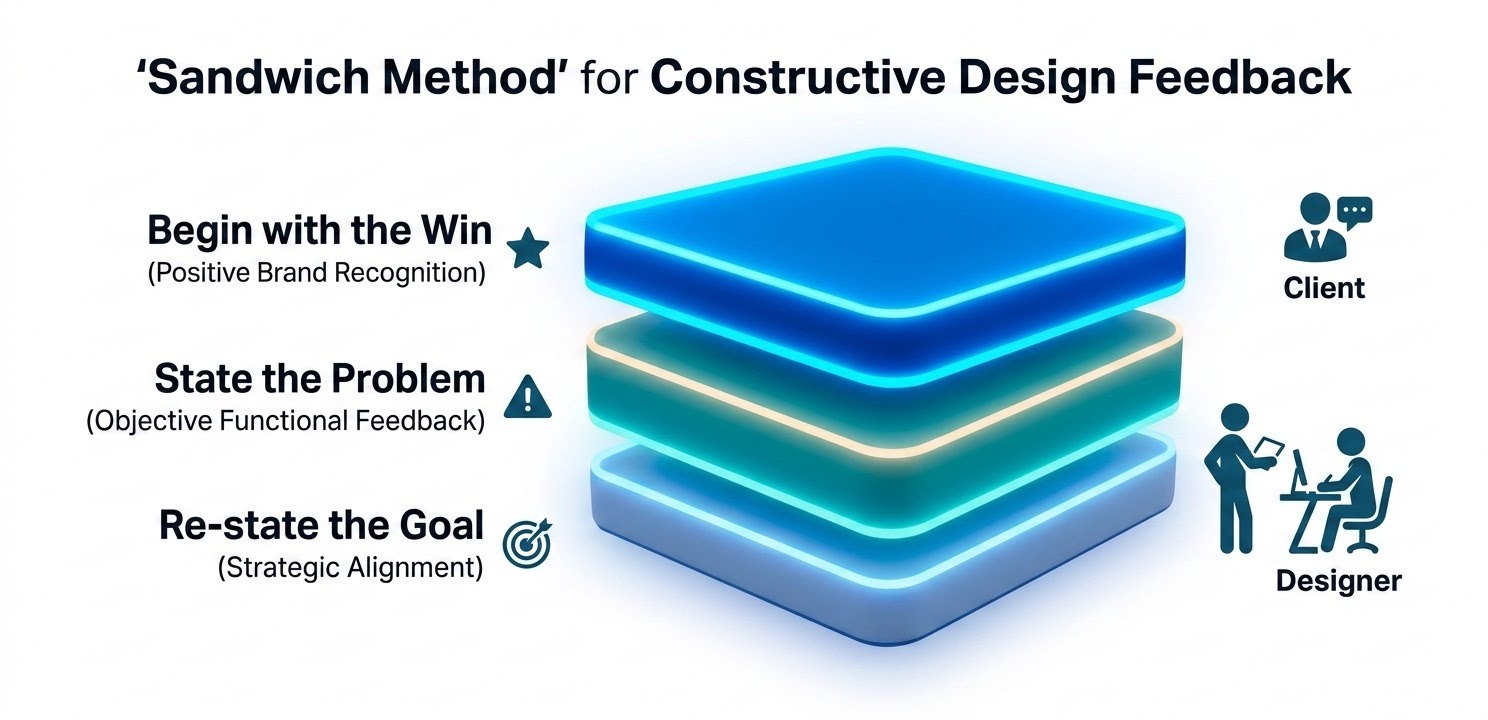
In providing feedback, never make general statements such as "this doesn't seem right" or "it needs to be more professional." Rather, apply the "Sandwich Method":
-
Begin with the win: Recognize the parts that do fit your brand image.
-
State the problem: State the exact problem and be precise in explaining it. Speak about function and conversion rates and not personal opinions.
-
Re-state the goal: Remind what you wanted.
Thus, you motivate your freelance designer to solve the problem and not justify his/her artistic choices. Remember that the design is not the entire solution to your problem; the message is another one. Therefore, make sure that your message and design complement each other by reading our [Tips for Crafting Better SEO Content].
Milestone Management
We are fanatics about milestone tracking on creative projects. If feedback on a project is only given at the end of the delivery, it usually causes too much scope creep and gets out of hand. This is why we break down a project in three big phases to give feedback in time: Wireframes, Mockups and Final Assets.
Initially go through the wireframes in order to verify the structural logic and the user flow of a website or a web application before the designer invests too much time in the styling of high-fidelity mockups of the sites. Upon receiving the mockups review the sites’ aesthetic and the sites’ brand identity implementation.
Finally in the phase of the final assets only verify and fix any possible errors that could have been introduced throughout the whole process of designing a website or a web application.
This way one is able to verify and fix possible errors in the designing process as early as possible and thus keep a project on schedule and within its initially proposed scope instead of allowing it to get impacted by scope-creep and turning into a nightmare. In this way the process of making corrections to a designer’s work is turned from a nightmare into a controllable process
Launching with Confidence
A successful website redesign begins long before design work starts . A detailed project brief and provides direction, reduces misunderstandings and helps designers build a website that supports your business objectives
Your website redesign project is more than just a new design for your website. It is a business strategy aimed at increasing growth for your company. The Freelance Designer Brief is one of the most critical components to achieving this end and we have explored the ins and outs of the brief in this guide.
The brief is key to avoiding a project that becomes mired in revising and instead launches on time. By transitioning from ambiguous requests to an outcomes-focused brief, you transform your designer into a business asset.
The success of a new website design is determined before the first wireframe is drawn. The project will succeed or fail during the internal design brief discovery period, when you start the technical SEO to cement the foundations, and go through the formal feedback loops to refine the design.
If you can establish clear performance metrics, and a user-focused mapping process, then your designer can get on with doing their best work – designing a great online store that converts.
Don’t let your project fall victim to the blank page problem – that initial hurdle to starting your project that causes so much drift. Our AI Task Pipeline enables you to write a brief for your business goals in minutes, instead of days.
The GigMint platform also enables you to match business goals with the top 1% of the world’s talent to execute a website redesign strategy with the level of professionalism required, on day one of your project.
The digital landscape is changing rapidly. A beautiful redesign of a website is not enough; the site needs to generate returns on the investment. Whether a complete overhaul of the information architecture of the entire site or a fine-tuning of a single landing page, GigMint.ai gives you the ability to get started right away.
We give you the tools to structure your expectations and make sure that your next project is a success. If you are looking for a structured way to create a professional redesign brief and connect with experienced freelancers, GigMint.ai provides the tools to help you plan, manage and launch your project with confidence