The Future of Work is Flexible: How to Build a Scalable Freelance Workforce
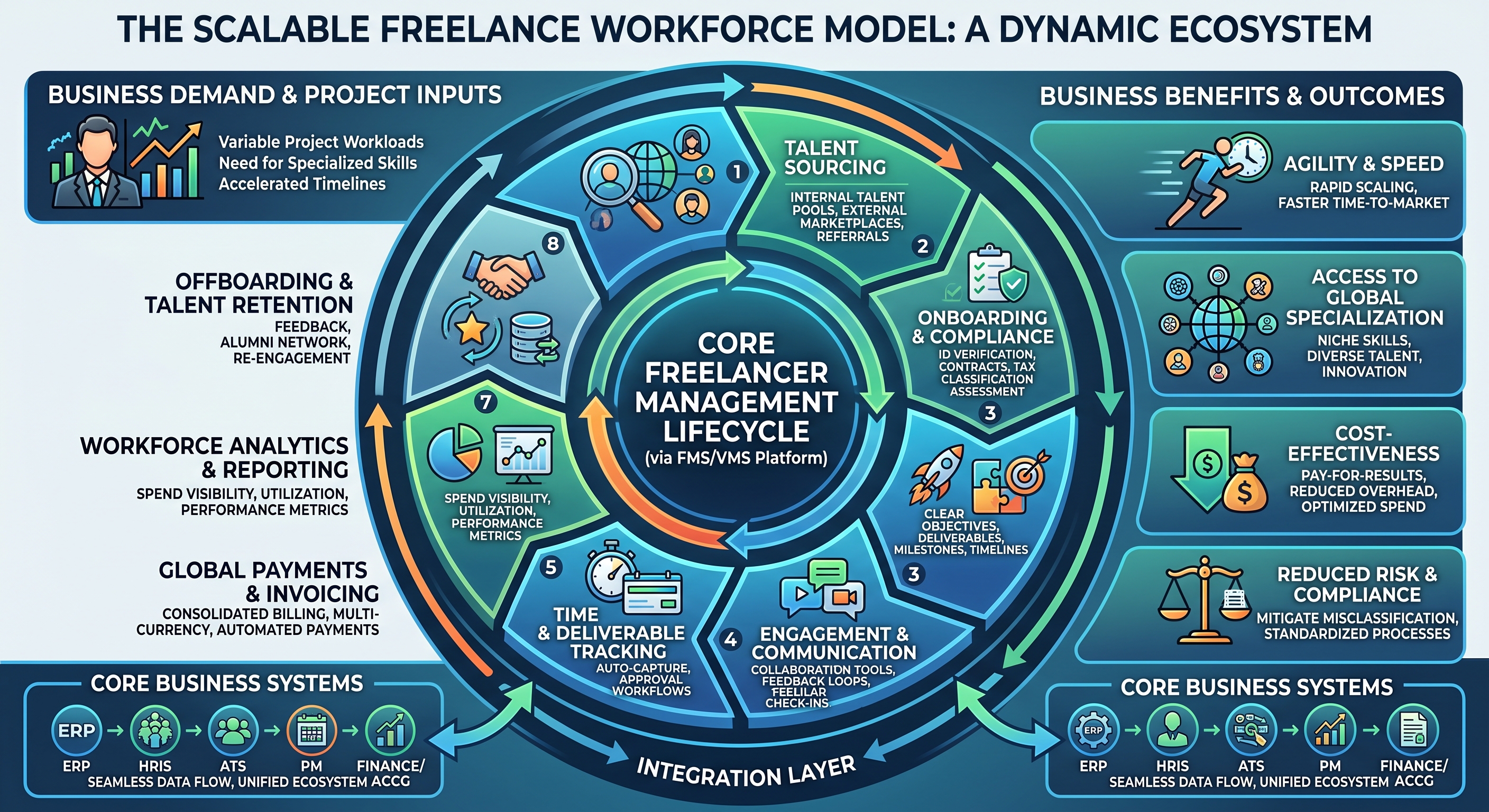
Future of Work is Flexible: Scalable Freelance Workforce
Overview
The conventional nine-to-five work culture is now irrelevant. With the emergence of "the Age of Agility," location does not determine efficiency anymore. The worldwide gig economy, which has changed from an auxiliary Scalable freelance workforce pool into a key strategic asset, helps organizations get access to talented individuals who will deliver high-impact results right away.
In the modern business environment, effectiveness is not connected with having more people, but with being able to adapt quickly and get qualified specialists at once.
This is the move towards the adoption of the Liquid Workforce approach. Being focused on competitiveness and talent availability rather than traditional organizational systems brings incredible resilience for the organization. Thanks to technological progress such as cloud computing and asynchronous collaboration, there are no limitations any more for using elite borderless talents.
But building a scalable freelance workforce involves more than simply working with contractors. It entails changing your mindset and considering external resources as partners rather than just another vendor in a transactional business model.
Once you get to grips with this process, your company will be able to introduce new products faster, enter the foreign market and perform better than other companies with static organizational structures.
But the evolution of work will be not only about the place of work. Building a scalable freelance workforce will be defined by its elasticity – it will grow at times of need and shrink at times when the focus is changing, but the quality of work will stay at the same level always.
The document presents the guide on how to build such an infrastructure. It is not only about the "why", but mostly about the "how" of the gig economy.
1. Why Flexibility is No Longer Optional
There are various economic and cultural factors that have made flexibility at the workplace essential for organizations. The advent of globalization and the digital revolution has created a level playing field whereby talent can add value from any part of the world that has access to the internet. At the same time, the “Great Reshuffle” has brought to light the fact that talent now expects as much autonomy and purpose as salary.
The Demographic Driver: Gen Z and Millennials
These are the new people in the Scalable freelance workforce who have different perspectives on life and work. They form the group of “digital natives” who have always had access to instantaneous communication throughout the globe.
To them, the concept of sitting in one particular cubicle working for forty hours every week seems old-fashioned; it is even irrational. These young people appreciate flexibility, learning, and engaging in varied activities. Organizations which fail to provide the flexible means of employment will become less and less attractive to the future talent pool.
Economic Volatility and the Need for Elasticity
In times of global economic instability, fixed costs are a burden on businesses. Traditional employment carries high sunk costs that include recruitment costs, benefits, office spaces, and equipment. A liquid Scalable freelance workforce makes it possible to turn those fixed costs into variable costs.
It provides a company with financial flexibility that will help withstand hard economic times without undergoing the painful process of laying off staff en masse. At the same time, it helps to take advantage of opportunities by increasing production capacity through a pre-screened pool of freelancers.
This new approach to business entails for companies to learn how to find a good compromise between freedom and stability. For the one part, freelancers need to feel independent; for companies, projects' continuity and reliability are important.
Those organizations that manage to do it successfully create a space in which outside talent feels itself like a business partner. By providing freelancers with clear objectives and valuing their independence, companies may be sure of getting the most reliable partners among freelancers.
Actionable Strategy: The "Partner-First" Engagement Model
In order to get hold of the best talent among the freelancers, it is essential to recognize the professional in them. That involves giving them comprehensive project briefs and deadlines, along with on-time payments.
It involves including them in the “why” of what they need to do. The reason being that when the freelancer knows about the business objective, he is most likely to innovate.
"Follow-the-Sun" model has become a great competitive strength. Companies that take advantage of their Scalable freelance workforce around different time zones have the ability to be efficient round-the-clock. One group is asleep while the other is working on improving things.
The whole process takes less time and the customer support becomes quicker. It is the greatest example of how geographical distance can become an asset.
Example: 24-Hour Product Development
Picture an IT company having its chief designer in New York, front end developer in London, and quality assurance tester in India's Mumbai. The designer completes his sprint cycle by 5:00 PM EST, while the developer begins work on that by 9:00 AM GMT and then the QA tester performs testing of that build at 9:00 AM IST.
Before the designer is able to log in again the next morning, the functionality is developed and tested. This increases productivity by three times compared to the local time zone approach.
2. Defining a Scalable Freelance Workforce Strategy
Creation of a Scalable freelance workforce labor force starts with an extensive Workforce Audit. Companies need to know which positions fall under “Core” positions, those that are vital and carry the DNA of the organization. Other positions will be considered as "Flex" positions.
Flex positions usually require expertise in some area, are project-based, or are volume-based. In this way, companies are able to secure their core while making their outer boundary very flexible.
Mapping the Talent Ecosystem
The audit should give you a picture of your talent requirements. Core positions can include your CEO, Head of Product, and strategists. Flex positions may include content creators, niche coders, user experience researchers, and digital marketers.
Your objective here would be to create the "Core and Satellite" approach whereby a steady core group inside your organization handles a revolving but steady stream of satellite experts. This will allow you to expand the satellite group and still ensure continuity in your brand's positioning.
Strategic forecasting of resources follows next. By utilizing predictive analytics, the managers can forecast the peaks of projects and align their talent acquisition with the peaks in the market.
Rather than scrambling for talent once a project is started and faced with the talent deficit, the scalable approach requires having a ready-to-go, "warm" pool of freelancers at hand. That's what predictive hiring is all about.
Tactical Tip: Building the "Warm" Bench
Develop a list of freelancers who you have hired before or have tested for their capabilities. Arrange them based on their skill levels, availability, and past performance.
Always reach out to the best of them regardless of whether or not you have an urgent assignment at hand at the moment. This will help keep the brand in the minds of these professionals, and they will be more inclined to put your projects ahead of others in case of any urgent requirements. “Talent Pooling” is a key element of fast scaling.
Firms have to switch from transactional hiring to relational hiring. They need to move towards developing a dedicated community of freelancers for the firm. It has been seen that when freelancers are brought into the story of the brand and feel a connection with the brand, they deliver better results and become valuable assets for the organization.
Cultivating the External Community
Invite your frequent freelancers to internal town halls (where relevant), discuss company achievements, and give them access to training materials. This tiny cultural effort yields tremendous returns in reliability.
Freelancers who feel like a part of your team will do everything to make sure the project is successful. At gigmint.ai, we believe community building is the most efficient way of managing risks for freelancers.
3. Tech and Talent Management
For the proper management of such an open-ended and dynamic workforce, the proper technology stack becomes non-negotiable. Collaboration technologies such as Slack, Notion, and Trello act as the key elements that help bring together such asynchronous teams across different time zones and make information accessible for all, irrespective of where they are located.
The technologies have to be set up in a way that ensures transparency and clear communication as the two primary operating principles. Otherwise, the Scalable freelance workforce will fall victim to the same issues.
Optimizing for Asynchronous Work
In the world of a globalized, flexible workspace, it is not enough to use only real-time collaboration techniques. Instead, you have to learn how to communicate asynchronously.
It implies that a culture of documentation should be implemented within your business; all decisions, processes, and updates should be documented in one place such as Notion wiki. "Single Source of Truth" helps a freelancer working in Tokyo to understand precisely what has been discussed at a meeting held in London without waiting for any sync-up. This will save your time and make you more productive.
\
The implementation of artificial intelligence is another important element that changes the way freelance teams function today. Progressive companies provide their freelancers with AI writing assistants in order to make sure that tone consistency is kept and analyze content performance through various advanced tools on AI-powered search engines.
This combination of human ideas and artificial intelligence is typical for a Scalable freelance workforce of the future. At gigmint.ai, we consider AI to be a multiplier of freelance productivity.
Implementing the AI-Freelancer Synergy
It is important to equip your freelancers with state-of-the-art AI tools as well as clear instructions on how to apply them. Using AI for generating the initial outlines or doing research before the creative input of your specialists takes place guarantees the creation of content that will be both analytical and emotionally engaging at once.\
Using AI for detecting duplication as well as setting up a limit on word-counts is essential to maintaining the originality of content and, therefore, making sure that the "Liquid Workforce" lives up to all quality requirements set by the brand. In other words, these tools make governance possible when scaling teams.
Cultural onboarding and governance tools become the final piece of the puzzle in terms of building an effective infrastructure. The process of incorporating contractors to the ethos of the brand with the help of standard "Standard Operating Procedures" (SOPs) becomes an important tool that ensures that the contractor becomes productive immediately after being onboarded.
Strategy: The Automated Onboarding Flow
Create a dedicated portal just for your external talent. This will comprise videos on the company culture, access to the style guide of your brand, technical information on how to set things up, and a collection of SOPs. In doing so, you automate the administrative part of the onboarding process, which means that your project managers can concentrate on the strategic part of the work.
4. Compliance, Security, and Quality
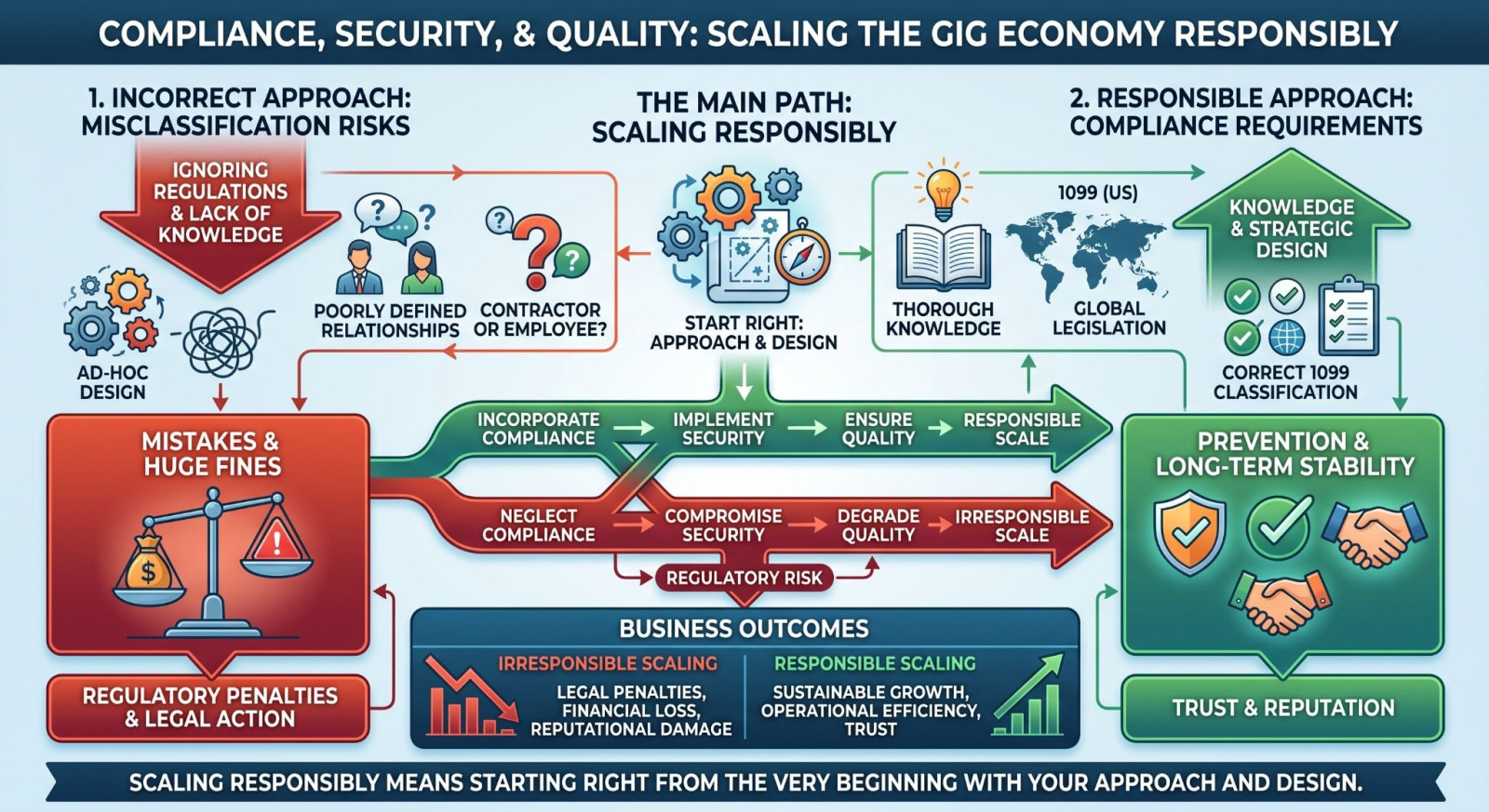
There are some risks associated with scaling up the gig economy that need to be considered in terms of the regulations. A company should possess thorough knowledge about 1099 classification in the US and analogous legislation around the world to prevent mistakes and huge fines for the incorrect classification of their contractors. Scaling responsibly means starting right from the very beginning with your approach and design.
Navigating Global Compliance
When recruiting people from across the world, you will have to deal with complicated local labor laws. Most businesses hire an EOR or special freelance management platforms that will manage such things as signing of local contracts, tax withholding, benefits compliance and other legal aspects.
This way, the company will be able to save the time of their HR specialists and stay compliant everywhere where they recruit talent. Otherwise, it will face serious consequences.
As well, security is an essential aspect of successful functioning. With a distributed team of freelancers, it is crucial to protect your intellectual property and apply "Zero Trust" architecture and encrypted silos.
Role-Based Access Control (RBAC)
Implement RBAC to manage the permissions throughout your software stack. The freelance writer would have permission to access the CMS and related research directories and not the finance system or the entire customer base.
Multi-factor authentication (MFA) and use of secure VPNs for any sensitive activities should be used here as well. These basic principles give us an adequate perimeter around the security that works for a highly distributed Scalable freelance workforce .
Consistency must be achieved without micromanaging everything in sight. The organization must set up the "Outcome-Based" quality control models. Achieving outcomes while leaving processes to the discretion of the freelancer and using automated feedback loops will ensure that high quality is achieved without violating the freelancer’s right to freedom.
Outcome-based approach is the only way forward here. At gigmint.ai, we promote "Freedom within Frameworks."
Example: The Quality Scorecard
Rather than contacting hourly, offer them a "Quality Scorecard" for every deliverable that can consist of scores on branding tone consistency, factual correctness, SEO-friendliness, and timely delivery. Offer them detailed feedback at the end of each project based on their scores. This is a data-based feedback mechanism through which they can self-improve without putting much pressure on your team members.
5. Best Practices for Growth
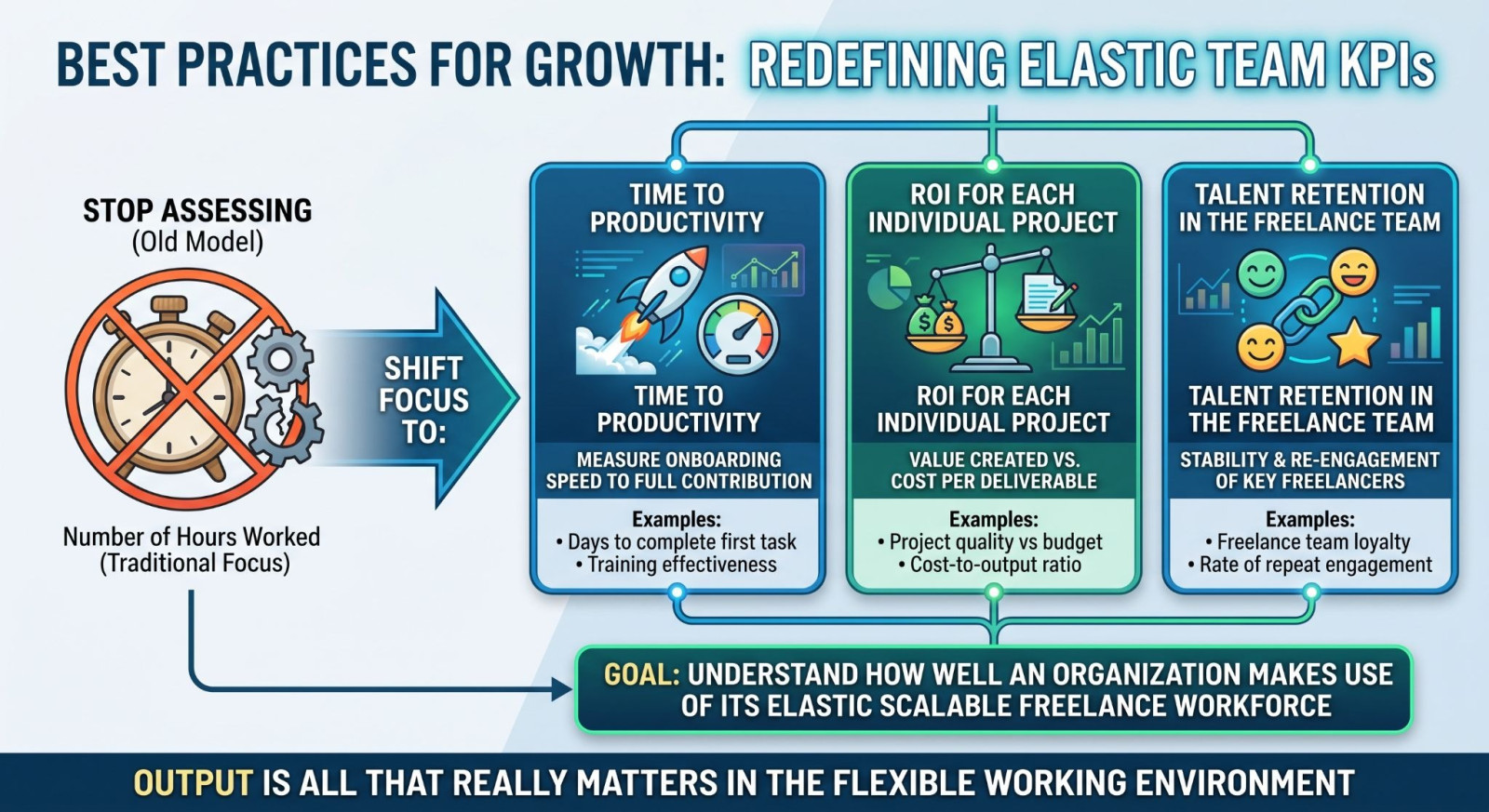
In order to assess the success of the elastic team, KPIs will need to be redefined. It’s necessary to stop looking at how many hours people work and start assessing “Time to Productivity,” ROI for each individual project, and talent retention in the freelance team. This will give an idea of how well an organization makes use of its elastic Scalable freelance workforce. Output is all that really matters in the flexible working environment.
New Metrics for a New Era
There’s a “Skill Coverage” metric, which is basically the number of the necessary skills provided by your freelance pool against the number of the skills to be hired. And one more important metric is “Freelancer Satisfaction.” With the help of surveys among your external workforce, you will be able to detect any issues in the process and make yourself a “Client of Choice,” having the opportunity to get the best freelancers available.
The loops of optimization are equally important for the further development of a company. The creation of structured debriefs after each project will provide your team with an opportunity to enhance the quality of cooperation and develop the concept of “Onboarding-as-a-Service” for your freelancers. And the system of working with the external Scalable freelance workforce will become increasingly effective.
The Post-Project Retrospective
Every time you reach a major milestone, conduct a quick review process with both the internal lead and the external participants. What worked well? What created a bottleneck? What could make your brief better for next time? Use the feedback gained from these processes to refine your SOPs and onboarding practices. In such a way, each project will become a new contribution to your organizational framework.
As the labor force expands, the nature of the ramp becomes more complicated. One useful technique that could be applied here is appointing "Lead Freelancers" who would coordinate sub-teams. The hierarchical system will enable you to either expand or shrink your team very quickly without increasing the overhead of the internal management layer. This system will empower the most knowledgeable freelancers to lead other people.
The "Pod" Structure for Massive Scale
Group your freelancers in self-sufficient “pods,” with an external leader who can be trusted. A "Content Pod," for instance, could comprise one lead editor with five freelance writers reporting to him or her. The internal marketing manager only has to deal with the lead editor, who manages the day-to-day activities of the writers. You would be able to increase from five writers to fifty without burdening your internal personnel.
Final Thoughts
The growth of the scalable freelance workforce is a three-way win because it offers agility for the organization, freedom for the employee, and increased value for the customer. Organizations that manage to achieve the transition will be more agile, more innovative, and more able to deal with future uncertainties. “Liquid Workforce” is no longer an alternative model—it is the core growth strategy
This trend is not only about productivity—it’s also about unleashing human potential. By breaking down the boundaries of geography and strict contracts, we are enabling some of the best minds to address the most challenging tasks. This is the biggest contribution of the flexible work revolution.
As we look towards 2030, the capability to access global talent clouds is going to be the biggest point of difference between leading companies and followers. Companies that will succeed will be the ones that will have learned how to manage a liquid workforce, where geographical and contractual constraints will help bridge talent gaps. Scalability will be the most desired characteristic of leadership because assembling and de-assembling high-performance teams will be the key to success.
There will be a need for more advanced platforms and tools, which will make it all happen – from matching talent using artificial intelligence to processing global payroll. Technology will disappear in the background and make it easier to focus on doing good work and developing strong professional connections.
The end goal is the "Borderless" organization – a workplace where talent can be located anywhere, and work is not some place that one travels to, but a service that one delivers. This is the vision of the future, and flexibility is key to creating a more nimble professional environment. We are proud to stand at the cutting edge of this change, providing the insight and tools necessary for building tomorrow’s workforce.
Organization that embrace a scalable freelance workforce today will be better positioned to adapt , innovate , and compete tomorrow. Building a flexible talent strategybis no longwer optional its a practical step toward longterm business resilience abd growth