How AI Recruitment Find Top Talent Faster
How AI Recruitment Find Top Talent Faster
I Overview
The task of finding qualified candidates is always associated with a number of time investments that recruiters have to make. They need to check numerous applications, evaluate their skills, schedule interviews, and communicate with candidates. Recruitment through traditional methods becomes quite lengthy and difficult, which may make it harder for recruiters to find suitable candidates.
AI recruitment can help simplify all these activities significantly. AI tools may assist with resume screening, candidate matching, talent sourcing, scheduling of interviews, communicating with candidates, and recruitment analytics.
These technologies will not replace recruiters in their work but will decrease the amount of repetitive administrative tasks and leave more time for evaluation and decision-making.
The following article discusses how AI helps recruiters find top talents faster, how businesses may benefit from using AI in recruitment processes, what AI applications in recruiting exist today, how AI may contribute to improving candidate experience, and what the latest trends in AI applications are.
This information can be useful for businesses willing to adopt innovative technologies and improve their recruitment process.
II. The Current State of Talent Acquisition & The Need for Speed
The current era of talent acquisition can be likened to a race against time. With each and every job opening that a company advertises, whether corporate or technical in nature, the talent acquisition team faces an enormous influx of applicants, with figures often ranging in the hundreds or even thousands of individuals applying for one job position. In the present world, the task of sifting through such a large number of resumes becomes a tedious process.
The Time-to-Hire Bottleneck
The statistics from industries paint a disturbing picture in that the average time to hire has increased steadily, taking anywhere from 36 to 44 days around the globe and even much more for highly specialized and technical positions. Such an extended period is quite problematic since it brings about an additional burden.
Maintaining an empty post reduces efficiency within a company while increasing work pressure on the staff and resulting in the loss of income. In another respect, hasty recruitment to fill the gap may lead to an expensive hiring mistake. Research in the industry suggests that the expenses incurred by such mistakes may amount to no less than 30% of the annual income of the hired individual.
Where Manual Recruitment Processes Create Delays
Traditional methods of recruitment include use of application tracking systems, spreadsheets, emails and manual resumes screening. The traditional tools are useful but a lot of time may be spent by recruiters when evaluating candidates, searching for potential candidates and coordinating the communication process.
Keyword-based search might miss out some candidates who possess a lot of experience that is not stated in the specific keywords. A candidate might have project management experience but he does not state that particular job title or keyword in his CV.
The AI-based recruiting tool will be able to scan the candidate’s profile taking into consideration the context of the content provided rather than the specific keywords.
HR Technology Transformation
The HR tech world experienced tremendous transformation. We are way past the times when the recruiting process was handled by keyword matching databases that automatically filtered out perfectly suitable candidates just because of using different terminology for a certain skill. The modern tech world is all about contextual and machine learning platforms. Artificial intelligence allows you to overcome past challenges and create intelligent pipelines instead.
III. Core Ways AI Accelerates Talent Discovery
With the numbers of people applying continuing to soar, traditional recruitment cannot be sustained by sheer force. Identifying the perfect match for a position demands precision, scale, and speed—none of which are qualities that manual procedures possess.
AI has revolutionized the whole process, taking hiring away from being a reactive and administrative task and into a proactive and data-driven process.
Here are the four key ways through which AI boosts talent identification and makes top talent hiring possible.
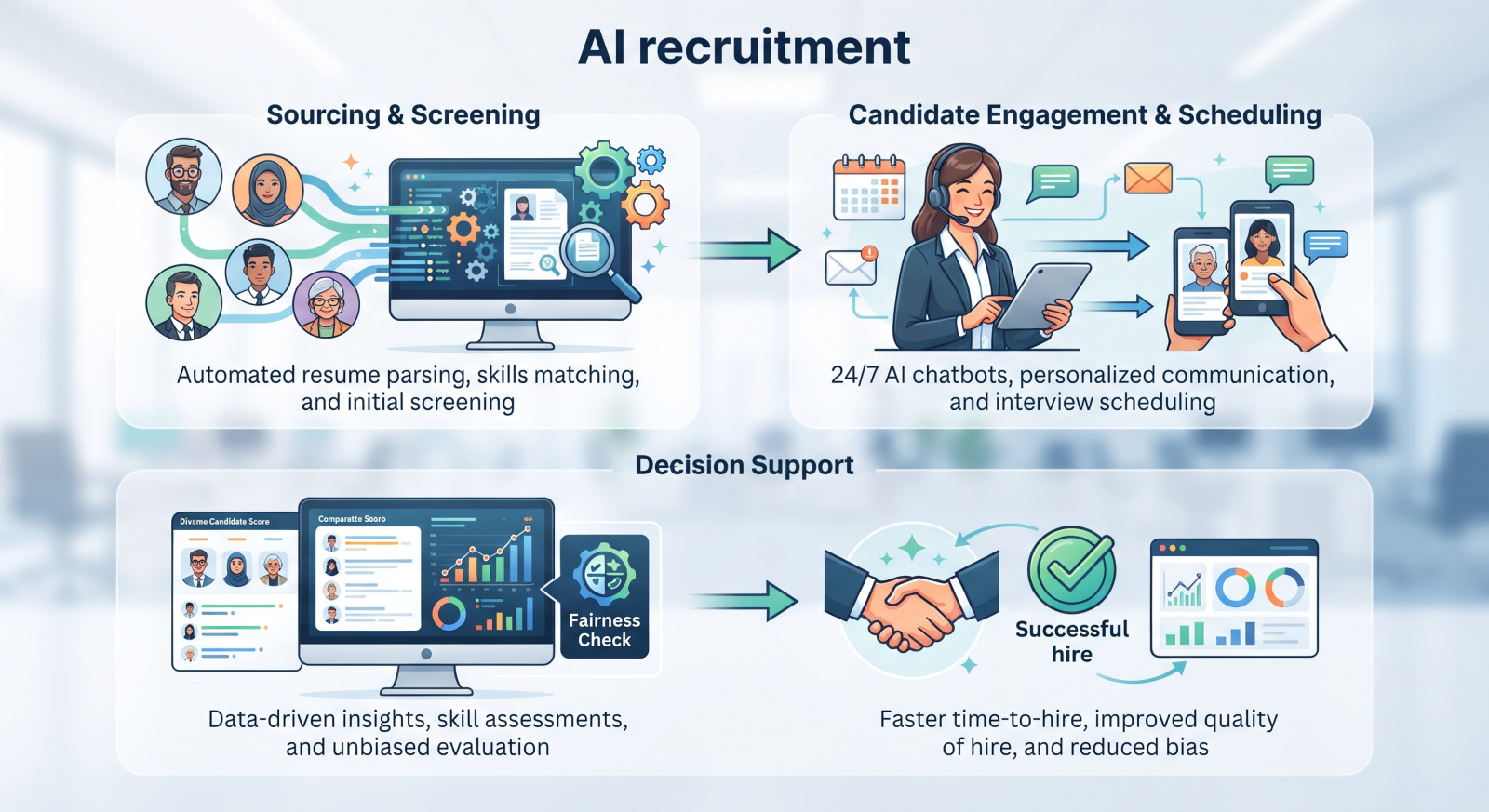
1. Intelligent Resume Parsing & Screening
Boolean keyword searches have for years defined recruitment gatekeeping practices. Recruiters would enter keywords such as "Python," "Project Management," or "Salesforce" into the database, leaving out those without a perfect match.
The problem with the traditional approach is immense: it fails to account for transferability, gets the context wrong and rejects great candidates due to a slight difference in terminology.
The new generation of AI recruitment software takes advantage of modern Natural Language Processing (NLP) and contextual machine learning capabilities. This way, the software understands resumes in the same way as a seasoned expert does.
Rather than looking for separate string of text, NLP looks at the context in which a particular skill has been described by the candidate, and thus recognizes that someone who worked on the cross-functional product launch in a fintech startup has transferable project management skills despite the fact that it might not be the exact job title.
2. Automated Talent Sourcing and Passive Candidate Engagement
The best talent is never looking for a job. The best performing professionals are already working in their organizations and doing well in what they do, thus making them invisible to the active job boards.
In order to recruit this difficult to reach talent pool, recruiters need to actively source passive candidates. Sourcing manually in the professional networks, specialist communities such as GitHub and portfolio websites takes up much of the recruiters' time.
By using AI technology in the talent sourcing process, recruiters can search through huge digital ecosystems in an ethical and efficient way. Recruiting platforms can leverage AI algorithms that will analyze performance profiles of an organization's best performing talent and, based on the analysis of their career paths, skills and experience, find similar talent externally.
Once this has been done, generative AI can help overcome the personalization barrier. This way, instead of reaching out with a generic, cold message, AI can write highly personalized messages to the prospective candidates, which will mention their open-source projects or publications, and lead to a better response rate.
3. Predictive Analytics in Candidate Matching
Recruiters have historically evaluated their candidates based on several criteria, including skills, experience, qualification, and past jobs. The process of matching that is powered by AI algorithms could look through these criteria and spot certain patterns that could be useful to the recruiters while considering which candidates deserve more attention.
Predictive analytics could also help compare information about the candidates to the data from the past recruitment periods. All predictions should be viewed as additional pieces of information.
AI systems analyze the data about previous hiring practices within the organization by finding correlations between hiring profiles and later performance, retention, and career progression. Predictive algorithms will be able to evaluate candidates not only in terms of their suitability for a current position, but also in terms of future tenure and performance potential.
Predictive matching goes beyond traditional criteria of pedigree and predictability of career path by focusing on the candidates' competencies, ability to adapt and solve problems. It can help recruiters prioritize candidates who appear to match the requirements of a particular role.
4. Conversational AI & Smart Scheduling
Tasks such as handling queries from the candidate, scheduling interviews, and sending reminders can consume a considerable portion of recruiters’ time.
Chatbots can automate the response process for common queries by candidates and gather preliminary information about them. Similarly, scheduling tools can be used to plan interviews among the candidates, recruiters, and hiring managers.
The chatbots and scheduling tools will cut down on communication and give recruiters the time to conduct interviews and evaluate candidates.
Using conversation AI technology and intelligent scheduling software helps remove such bottlenecks altogether. Using chatbots embedded into the career website or application process helps engage candidates 24/7, ask initial pre-screening questions, and assess their qualifications right away.
What’s more, once the candidate gets past the initial screening phase, intelligent scheduling assistants become involved in arranging appointments. Rather than trying to synchronize the schedules of the recruiter, hiring manager, and candidate via numerous emails back and forth, the candidate is able to get his/her slot right away thanks to artificial intelligence.
IV. Enhancing Candidate Experience and Reducing Bias
In a scenario where speed and efficiency are paramount factors when assessing recruitment performance, mere velocity cannot be a measure of recruitment in the modern age. Quality of hiring is contingent on two other pillars – providing a great experience for candidates and avoiding unconscious bias. With the competition to attract talent at an all-time high, those companies who do not value their candidates’ time or uphold fair practices will soon lose out to their competitors.
There are numerous opportunities offered by artificial intelligence in improving the engagement level of candidates and ensuring equity.
The Candidate Experience Imperative
The AI recruitment landscape today is characterized by the elusiveness of top talents. Research consistently proves that high-end candidates, especially those in technology, engineering, and other niche areas, disappear from the market in just 10 days on average. Lack of speed in the hiring process and lack of communication on the part of companies result in very high drop-off rates.
The conventional recruitment process is known for creating the "black hole" effect: candidates spend hours writing and customizing their resume and application, but hear nothing back. This is what AI can change by shifting communication to real-time.
Intelligent ATS and chatbots will make sure that applicants get immediate feedback, status updates, and estimates of timelines. This way, organizations will be able to build their employer brand and retain the interest of the best candidates even if they go somewhere else from this talent pool.
Mitigating Unconscious Bias
Decision-making among humans is susceptible to various cognitive biases, including affinity bias, which prefers individuals having similarities with the recruiter, halo effects, or preconceived ideas associated with an individual's name, education institutions, and demographics despite good intentions from the side of recruiters.
AI recruitment tools provide a perfect solution for overcoming such biases through blind screening and standardization of the evaluation process. With sophisticated algorithms, recruiters can automate the process of removing any data from the resume that may identify its author—name, photo, gender and age, and education background, thereby leaving only core competencies, projects, and skills for the evaluation.
Standardizing the criteria of the assessment process for all recruiting pools makes machine learning models evaluate every candidate based on the same objective criteria.
The Human-in-the-Loop Philosophy
Even with the revolutionary nature of AI technology, it is crucial to acknowledge an inherent truth – AI has been created to enhance the work of human recruiters and hiring managers.
AI is good in dealing with large volumes of data, finding patterns, removing noise and conducting routine processes extremely fast. But AI does not have emotions, intuition and empathy to be able to evaluate cultural nuances, leadership abilities and chemistry between people.
The most efficient teams of talent acquisition use an approach based on the principle of "human in the loop". AI performs all the hard work of searching for candidates, screening and scheduling, and human recruiters concentrate on what they can do best – build meaningful connections with people, conduct efficient interviews and make empathic hiring decisions.
V. Integrating AI into Your Existing Recruitment Workflow
The process of moving from traditional hiring practices to the new technology-driven model does not imply going for the either-or choice but taking a step towards that direction. Most talent acquisition executives are wary of adopting AI technology because they fear that this new technology will shake their current model. Modern AI solutions are purpose-built for integration or replacement of legacy systems.
Legacy ATS vs. Modern AI-Native Solutions
The starting point of any good recruitment process is technology. The existing legacy applicant tracking systems (ATS) have been used for decades as digital filing cabinets that store CVs. Although such legacy systems do a good job at complying with regulations and managing basic records, they were not designed to work with the current volume of data and talent intelligence.
The problem with the legacy technologies lies in the fact that they are based on rigid database queries, data input and communication silos, and thus put the recruiters into an administrative trap.
Modern AI-driven software, including Gigmint.ai, turns ATS into a predictive talent acquisition system that uses big data to make informed hiring decisions. As you analyze the current tech stack, bear in mind that there are several questions that need to be asked: is your system attracting passive candidates or only reacting to the ones applying?
Step-by-Step Implementation Strategy
Deployment should be done through a structured and phased strategy to ensure smooth transition for your recruitment team and not overwhelm them:
Phase 1: Finding the bottleneck: Before deploying any technology, conduct an audit of your current recruitment pipeline to identify where your major bottlenecks are. Are you overwhelmed by having to do initial resume screening because of the number of applications received for entry level positions, or are you losing quality candidates at the scheduling stage? This will ensure that you deploy the first wave of your AI in places that will have the greatest impact.
Phase 2: Deploying AI screening in one high volume department: As opposed to rolling out AI in the whole organization at once, conduct a pilot program on one high volume department such as customer support, sales or entry level engineers. This way you can start testing the algorithms, fine tune scoring, measure time-savings and gain trust in the technology.
Phase 3: Train recruiters and hiring managers on collaborative AI tools: The success of any technology is tied to the users of the technology. Training on the use of the technology is important in promoting the culture of adopting the technology. Train your recruiters on how to utilize recommendations from AI, utilize the conversational bots and maintain "human in the loop."
Measuring Success (KPIs)
In order to test the value of the AI integration in practice and continuously optimize it, recruiting managers need to follow the key performance indicators (KPIs). Among them there are:
Time to Accept: The period required between opening the requisition until the candidate accepts the offer. Integration of AI will be beneficial in reducing this time dramatically.
Cost per Hire: The decrease in administrative work time, agency fees, and advertising costs due to automation of candidate searching and selection.
Quality of Hire: Evaluation of the post-hire performance indicators, employee retention rate and satisfaction ratings of the hiring manager at 6 and 12 months after the hire.
Satisfaction Rate and Retention of Recruiters: Internal satisfaction ratings. Thanks to automation of data input and candidate sorting tasks, AI frees up more time for recruiting managers to build relationships with candidates.
VI. Future Trends in AI Recruitment
With continued growth in artificial intelligence technologies, the impact of AI on talent acquisition becomes much more than just solving current bureaucratic issues. The new frontiers in HR technology will shape how capabilities will be measured, pipelines built, and the international workforce managed.Having knowledge about these trends in the making will give an edge to the talent acquisition professionals.
Hyper-Personalization: Personalized Career Paths and Skill Gap Analysis in Real Time
The candidate experience of the future won’t start from clicking “apply” but will begin with engaging a candidate through a highly personalized and proactive experience. The AI recruitment eco-system of the future will take advantage of real-time skills gap analysis and provide candidates with custom-built career paths long before a formal job opening arises.
Instead of a conventional job description, there will be a dynamic matching of the changing skills of an individual with the changing requirements of the organization, with micro-learning suggestions and mentoring being offered. For recruiters, this will mean creating a continuous dynamic community of talent that is built upon nurturing a candidate’s overall career path.
AI-Driven Simulations and Sentiment Analysis
Classical methods of resume filtering and fixed questions-and-answer interviews are becoming outdated quickly, as there are already next-generation technologies for recruiting candidates using immersive, experiential assessments.
The use of artificial intelligence to create immersive simulations of working conditions, in which a candidate will be put through an actual day in the life of the job, is being adopted by the latest recruiting technologies.
New developments in the field of video interview software have led to a sentiment and competency analysis technology, which goes beyond analyzing verbal performance. Using advanced multimodal AI, a clear understanding of the candidates' thinking process, adaptability, and emotions can be achieved.
The Role of Platforms Like Gigmint.ai
With the boundaries between permanent jobs, contract-based jobs, and agile talent markets becoming increasingly unclear, the need for speed and intelligence has never been greater. Traditional recruiting systems simply fail to cater to this rapidly changing paradigm.
It is the organizations such as Gigmint.ai that have shouldered the mantle of revolutionizing the coming age of the fast and intelligent job marketplace. Gigmint.ai brings revolutionary AI matching services, workflow automation and hiring with humans – all three of which help businesses thrive in the future of work.
Frequently Asked Questions
1. Is there a chance that AI will replace recruiters? AI performs routine tasks, while recruiters can concentrate on establishing relationships with potential candidates and making the final decision regarding hiring.
2. How can AI resume screening help avoid bias? Using advanced AI, one can use blind screening techniques – remove any names, photographs and other identifying information and assess the candidate only based on his/her skills and experience.
3. What is the concept of predictive hiring analytics? This refers to the analysis of a company's history to predict future performance, retention, and cultural fit of the candidate.
4. In what way will AI chatbots assist the applicant? The AI chatbot will be available all day, will answer any questions from the applicant and give immediate feedback to eliminate the "resume black hole" problem.
5. Can AI find passive candidates? Yes. AI finds qualified passive candidates through professional networking websites, GitHub, and portfolio websites and generates personalized recruiting messaging.
6. Does it take a lot of effort to integrate AI recruiting solutions? Modern AI-friendly solutions easily integrate with your legacy ATS architecture via structured phased pilots.
7. How do immersive AI assessments work? They include interactive simulation and coding tests to measure real-life problem solving in stressful conditions.
VII. Call to Action
Today’s status of talent acquisition has transcended the limitations of manual spreadsheets, the keyword match approach and lengthyAI recruitment processes. The factors that once hampered organizations have now become the key driver of growth and development.
Using automation through natural language processing, reducing human bias through blind screening and using predictive analytics, artificial intelligence has now become an irreplaceable component of innovative recruitment.
Considering the emerging trends of hyper-personalization, immersive assessments and talent ecosystem proactivity, the future is obvious – organizations that will use outdated and fragmented systems will inevitably lose their top candidates in the highly competitive job market. Transforming your recruitment process with intelligent automation provides an undeniably unique competitive advantage.
Are You Ready to Get Rid of the Resume Abyss?
Review your current recruiting funnel – at what point do you face maximum friction? Whether you are inundated with unqualified resumes or simply cannot arrange interviews with the best candidates, modern technologies can make a complete difference in your talent acquisition process. See how Gigmint.ai uses artificial intelligence to streamline your recruiting process. Schedule your demo now.