How AI Recruitment Improves Talent Acquisition
How AI Recruitment Improves Talent Acquisition
I Introduction
This is the irony of AI recruitment in the present age and a major constraint in any business. This involves a situation where organizations are overwhelmed by hundreds of non-qualifying candidates at the same time as they struggle to identify the perfect candidate to grow their organization.
HR departments are buried by resumes and other modes of communication and have to wait for months to make a decision. The end product of such a process is increased costs in hiring, frustrated hiring managers, and losing high-caliber individuals to rival companies.
Traditional recruiting processes, which include the use of manual resume searches, keyword-rich job portals and Applicant Tracking Systems, are increasingly becoming ineffective in the face of the current challenge.
These outdated processes, designed for a period when there were fewer applicants and slow business cycles, use very rigid logic that disqualifies great talent while favoring those candidates that know how to pass the filters.
In comes artificial intelligence. Not any more reserved to the domain of experimental technology buzzwords, AI and machine learning have quickly evolved into essential building blocks for human resources.
However, there is still something inherently human about the true purpose of HR. The human recruiter is not replaced with AI; instead, he or she becomes superhuman thanks to AI.
By automating the mundane administrative processes, predicting future candidate success, removing unconscious bias, and tapping into hidden pools of passive candidates through intelligent platforms such as Gigmint AI, artificial intelligence enables HR professionals to move away from tedious data entry and concentrate on what’s important – connecting with the great people.
II. The Evolution of Ai Recruitment: From Manual Sifting to Smart Sourcing
In order to comprehend how artificial intelligence has come to be such an important factor in current talent acquisition, we need to first look at the way the hiring process has evolved over the years and a couple of decades.
The hiring industry has always been one that has developed through various technological phases depending on the number of applicants, the available technology, and the demands of both parties.
A Brief Historical Context
Era 1: Paper Resumes and Job Boards
In its early stages, technology simply acted as an online bulletin board where companies advertised their job openings on online job boards and job seekers sent either physical copies of their resumes or electronic copies in PDF format via email.
The recruiters would then go through piles and piles of paper and emails looking for resumes and cover letters to read one by one. Even if extremely personal, this stage was extremely slow, location-bound, and unable to cope with peaks in volume.
Era 2: Early ATS and Boolean Keyword Filtering Technology
Due to the surge in numbers of applicants following the rise of the internet era, early applicant tracking systems were developed to store and process candidates' information.
The systems of that period were predominantly built on strict boolean filtering based on keywords that needed to be matched exactly in order to pass the AI recruitment system's filter regardless of the actual transferable skills of a candidate.
Era 3: The AI-Driven Ecosystem
At present, the ecosystem of AI technology is maturing. Advanced systems use semantic search, predictive models, machine learning algorithms, and conversational bots. Rather than trying to find exact string matches, advanced systems understand the meaning of the searches, the trajectory of a person’s career path, and his or her alignment with company culture. They are able to recruit people, assess their skills and eliminate all the hassle associated with the Ai recruitment process.
Pain Points of Legacy Systems
Even after decades of technological evolution, companies using obsolete recruiting software still experience critical business roadblocks:
The “Black Hole” Experience with ATS Software: Candidates apply through the dark holes and receive no response afterward. Such a process negatively impacts company branding, discourages the best talent from applying, and creates major frustrations for everyone involved in the recruiting process.
Recruiters' Burnout: Contemporary recruiters have to waste countless hours dealing with mundane tasks such as setting up meetings, performing preliminary screening interviews, and managing manual data entry within various applications. Thus, they lack time to build effective connections.
Skewed Performance Metrics: The inefficiencies of old-style recruiting processes result in slow time-to-fill metrics, increased cost-per-hire numbers, and costly wrong hires impacting team collaboration.
The Paradigm Shift: From Reactive to Proactive
And the key lesson that emerges from the entire history of development of talent sourcing strategies is a complete paradigm shift in talent sourcing approach. Companies used to "post and pray" for too long, sitting back and waiting for candidates to apply on their own accord using regular channels such as job boards.
Smart sourcing is based on an entirely different logic. Thanks to the use of artificial intelligence and intelligent tools, such as Gigmint AI, companies will be able to take a proactive and data-oriented stance, reaching out to passive candidates and getting ahead of the curve when it comes to staffing.
III. Core Pillars: How AI Transforms Every Stage of the Hiring Funnel
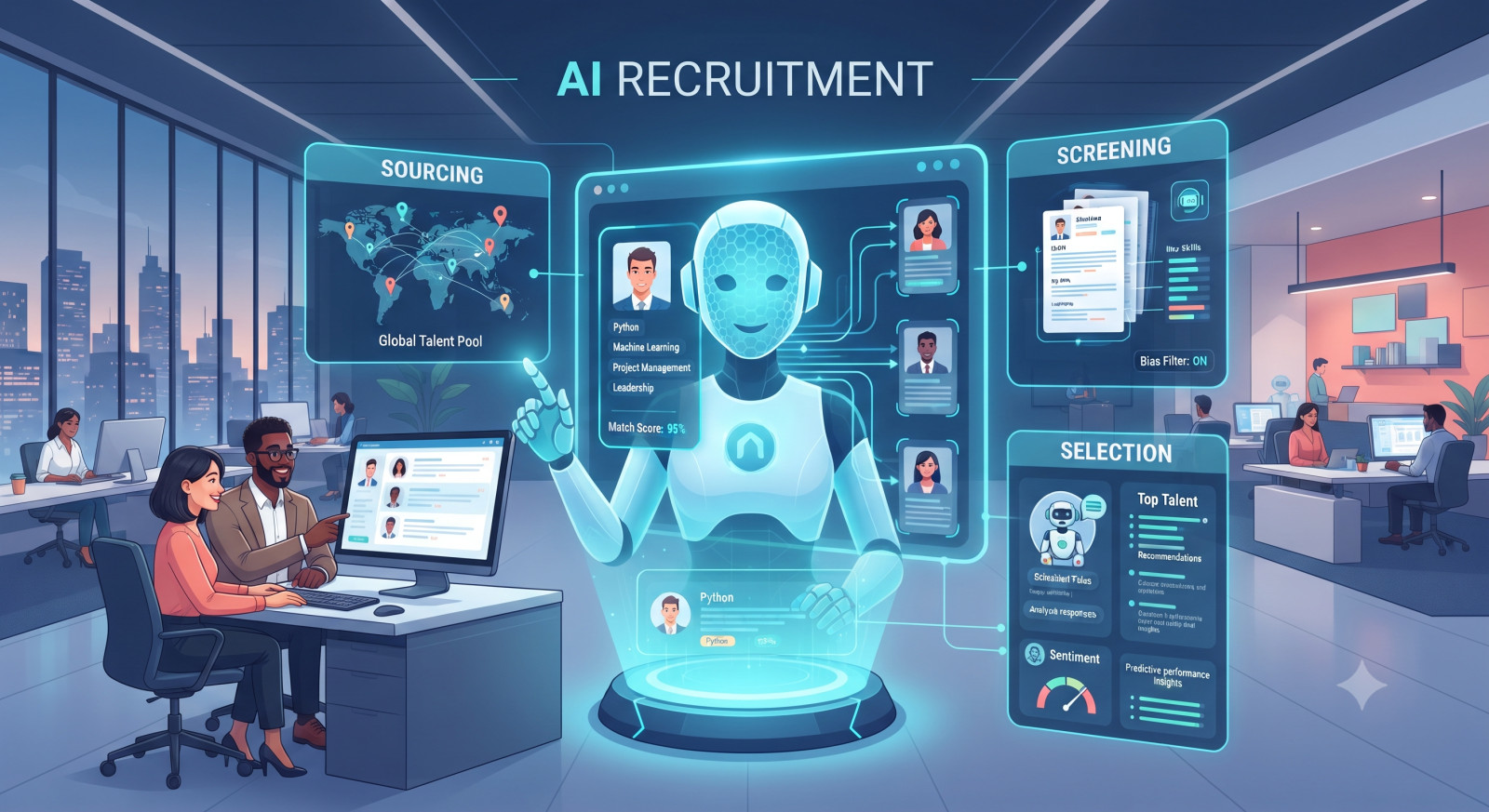
AI is not one singular tool. On the contrary, it is an eco-system of several layers of algorithms aimed at optimizing all the individual contact points in the recruitment process.Now, let us review how AI transforms the four main pillars of the modern Ai recruitment funnel.
Pillar 1: Talent Sourcing and Discovery
The traditional way demands the recruiters to carry out manual search on professional networking sites, social media profiles and alumni databases. This method is bound to have its constraints because of human limitations.
Global Talent Network Scanning: The artificial intelligence-based talent sourcing technology searches across huge digital environments, open source codes, academic databases, and professional networks in order to find candidates matching technical requirements, even if those candidates are not interested in applying for an open position.
Uncovering Passive Candidates: There is an immense number of passive candidates in the global labor force – professionals who are currently employed and doing well in their positions but can potentially be interested in changing careers. AI technologies are used to analyze behavioral patterns, professional achievements, and digital footprint in order to discover which candidates are open to change.
Keyword Matching vs Semantic Search: Where the old school application tracking systems filter candidates based on exact matches (for instance, if a recruiter looks strictly for "Python developer"), semantic AI understands the intention behind such keywords and knows that a candidate with experience in "Django and backend data pipelines" is relevant enough.
Pillar 2: Resume Screening & Candidate Matching
With the flood of applications comes the sheer quantity that may easily drown even the biggest of HR departments. Here is where AI completely transforms the process with state-of-the-art Natural Language Processing (NLP).
Context-aware NLP Parsing: The power of NLP lies in its ability to read between the lines of a resume and discern career growth, size of projects, leadership skills, and industry-transferable skills.
Automatic Scoring & Ranking: Machine learning algorithms assess new hires by comparing them to previous role requirements and the current dynamics of the existing team, thus creating an alignment score. In this way, recruiters will be able to prioritize the best applicants right away.
Operational Efficiency: Companies adopting the AI-powered candidate selection system claim a 75% decrease in time needed for resume screening and, therefore, a faster movement of qualified candidates through the funnel than competitors have.
Pillar 3: Candidate Engagement & Experience
The silent killer of AI recruitment pipelines is candidate drop-off. When the candidates are met with radio silence or poor scheduling software interface, they abandon ship. The solution is the utilization of AI in the form of intelligent engagement.
24/7 Conversational AI: The intelligent chatbot will be able to handle all of the applicant's queries around-the-clock related to company culture, benefits, and job specifications.
Personalized Status Updates: Automated message flows ensure that the candidate is kept updated on his progress through the entire evaluation process, thus greatly enhancing the sentiment of the employer's brand among candidates.
Smart Scheduling: The AI-enabled calendar assistant solves the problem of the "calendar tennis" by automatically arranging an appointment between the hiring manager and top candidates within seconds.
Pillar 4: Assessment, Pre-Screening, & Predictive Success
Beyond merely ensuring that there is someone sitting in a chair, the objective of AIrecruitment is to identify and hire an individual who will prosper and stick around. AI brings science into the process before the interview.
Competency-Based Video Analysis: Contemporary AI software evaluates structured video interviews, focusing on objective aspects of speech patterns and communication style, as well as problem solving structure, rather than more superficial criteria such as looks and background.
Modeling Success Through Predictive Analysis: By employing machine learning techniques, it is possible to determine the profile of candidates most likely to succeed based on the attributes and careers of previous successful employees.
IV. Fairness, Diversity, and Inclusion: Can AI Eliminate Unconscious Bias?
Perhaps the most important benefit of the use of artificial intelligence in the recruitment process is that of an equal and merit-based recruitment process. However, the combination of artificial intelligence and diversity requires extreme caution.
The Human Bias Problem
Decision-making by humans is inherently susceptible to cognitive bias. Recruiters tend to succumb to the following cognitive biases:
Name and Demographic Bias: An unconscious bias due to a person's name, ethnicity, or location.
University & Pedigree Bias:AI Recruitment for candidates hailing only from a small number of top universities with disregard for talent coming from regional institutions and bootcamps.
Gender Coded Job Description: Use of overtly masculine and gender-biased language within job descriptions leading to deterrence of female and minority candidates.
AI and Fairness
Anonymous Processing during Initial Recruitment Screening: AI-based recruitment software may be used to remove all personal information from the CVs of candidates, such as names, images, age, and institutions attended.
Job Description Writing without Bias: The AI writing tool identifies gender biases in your writing and helps you rewrite the job description in order to draw a variety of candidates for the job opening.
The Catch: Addressing the Elephant in the Room
Although technology can solve human bias issues, it isn’t the magic wand to fix all our problems. The algorithms used are trained on historical data, and where that historical data shows industry-wide bias, it can lead to the perpetuation and even amplification of these biases, falling into the “garbage in, garbage out” category.
Human-in-the-Loop: Real fairness comes from thorough human scrutiny, audit of algorithms for disparate impact, and varied training data sets. If properly utilized, AI will be a tool that works as a reflection and helps create a better workforce environment.
V. Strategic Advantages for Businesses and Recruiters
The use of artificial intelligence in AI recruitment is not just a means of making things more efficient; rather, it is a powerful strategic tool that changes the company’s bottom line and its competitive stance.
1. Greatly Reduced Time to Hire and Cost per Hire
Through the automation of all tedious processes, the elimination of endless scheduling loops, and immediate detection of suitable candidates, companies achieve great efficiencies. The faster process of hiring directly results in reduced cost per hire numbers and prevents any losses due to empty job positions.
2. High Quality of Hire and Retention
Through the use of predictive analytics for making accurate matches, the firm is guaranteed that the individual not only has the technical expertise but also the behavioral attributes to build long lasting relationships within the firm.
3. Empowering the Recruiter
Rather than replacing HR managers, the use of artificial intelligence frees them. Instead of spending their time doing tedious administrative tasks, artificial intelligence enables HR professionals to become strategic talent counselors, culture advocates, and strong brand ambassadors.
4. Smooth Business Scalability
In periods of hyper growth, businesses will have the need to scale their teams rapidly. With manual recruiting, the company would have to increase its number of HR managers unreasonably. Artificial Intelligence enables a business to scale its hiring process without proportionally increasing the HR team size.
VI. The Future of Work: Emerging Trends in AI Recruitment
As advancements in technology continue at an increasingly rapid pace, the realm of AI recruitment will yield further game-changing developments for future-minded companies.
Job Creation & Custom Outreach through Generative AI
With generative AI, companies are changing the way that they advertise themselves. Companies can create highly personalized job descriptions, as well as tailor outreach communications to their dream employees in a matter of seconds.
AI for Internal Mobility & Upskilling
The future of AI recruitment isn't just recruiting from outside, but recruiting from within. Today's AI platforms have the capability to sift through databases of employees to discover unknown skill sets, employees ready for advancement, and upskilling plans for them to help fill organizational needs in the future.
The Human-in-the-Loop Imperative
The more advanced automation technology becomes, the greater competitive edge will be the balance between the scale of technology and true human empathy. Companies that will be able to employ AI to process the information while allowing humans to develop relationships with applicants will become the most successful.
VII. Conclusion & Call to Action with Gigmint AI
We have now come to a crucial point in talent acquisition technology. Companies who are relying on their legacy ATS software and manual filtering of resumes will soon be left behind in the race by those who are adopting AI recruitment.
Gigmint AI helps organizations in connecting with the top-notch candidates through the use of advanced artificial intelligence, machine learning, and intelligent matching of candidates with organizations.
Are you keen on improving your hiring process and removing the obstacles to recruiting the best talent from all around the world in an impeccable way? If yes, then book a demo with Gigmint AI right away.
VIII. Frequently Asked Questions (FAQ)
1. Define AI talent acquisition.
It is the employment of AI and machine learning in automating and optimizing processes related to recruitment including sourcing, resume filtering, and matching.
2. What makes AI better at resume filtering?
With the help of the sophisticated Natural Language Processing (NLP), it will not only be able to filter resumes but to score and rank them in terms of how well candidates are suitable for a particular position.
3. Is it possible for AI to remove all unconscious biases in hiring?
Despite that, AI is very efficient in removing biases as it will not consider demographic indicators and debiases job postings, still it needs proper human supervision and adequate training sets to avoid algorithmic bias.
4. Does AI replace human recruiters?
No. AI does the routine of organizing meetings and sorting data while human recruiters concentrate on networking and dealing with people.
5. Semantic search in recruitment.
Semantic search does not only rely on keywords to assess a candidate’s experience, thus avoiding filtering out good but non-conventional talent.
6. How does Gigmint AI help companies hire better?
Gigmint AI uses the latest machine learning technology to facilitate seamless connections between visionary firms and talented individuals, overcoming all kinds of recruitment inefficiencies.
7. What is the effect of AI on time-to-hire?
Businesses that implement AI-based recruiting solutions claim to see an immense reduction in time-to-hire – sometimes up to 75% less from screening and coordinating efforts.
8. How do conversational bots enhance candidate experience?
Conversational AI and chatbots work 24/7 to answer applicants' queries, give individualized feedback, and overcome any drop-off caused by lack of communication.
9. How can I get started with Gigmint AI?
It is easy to update your hiring process and attract top-notch talent by checking out Gigmint AI to schedule a demo now.