How to Build a Secure Website: Best Practices Every Developer Should Follow
How to Build a Secure Website: Best Practices Every Developer Should Follow
1. he Imperative of Web Application Security
In the interconnected economy of today, where everyone can make money online using their skills, trust is the highest currency. Be it an enterprise, a high-frequency finance portal, or a groundbreaking freelance and AI platform like gigmint.ai, your website will be under attack on an everyday basis.
Today's cyber attacks are not something that happens once in a while but a part of everyday life of any company. As recent cybersecurity statistics suggest, there is a cyberattack every 39 seconds worldwide and this costs the global economy trillions of dollars each year. For contemporary websites with highly sensitive information about their users, intellectual property, and financial transactions, one single data breach can lead to immediate loss of millions in revenue and user trust.
Historically, website development has been all about rapid release and constant feature updates, while security was left behind until the very end. In this regard, in times when there are automated scrapers, credential stuffing bots, and zero-day exploits, this attitude is completely outdated. Web developers and software engineers should change their mentality to the one of "Security by Design" and incorporate safety measures into the process of software development lifecycle (SDLC).
This ultimate guide is all you need for developing your websites in a way that maximizes their safety. In this guide, we will review all web application security practices, gradually transitioning from such basics as network and transport layer security to such advanced aspects of website protection as application hardening, authentication, input validation, and continuous integration pipelines. Using all of these secure website coding principles and adding a thorough website security checklist to your routine will help you create resilient and performant web applications.
2. Foundation Level: Transport Layer and Infrastructure Security
Before starting to write any business logic or database structure, the perimeter needs to be secured. When considering modern web applications, whether it is a deployment of an enterprise fintech website or an expansion of an AI-based freelance website like gigmint.ai, the network and transport layer security becomes your initial defense. When your system exposes its transport layer security, no matter how perfect your application layer coding is, it won’t offer any security for your users.
Security of this layer demands a methodical approach to encryption and domain integrity.
Enforcing HTTPS Everywhere
Modern web platforms cannot do without Hypertext Transfer Protocol Secure (HTTPS). It is an inevitable prerequisite that is mandatory due to the policies of modern browsers, search engines, and regulatory bodies.
-
The Way SSL/TLS Certificate Works: The mechanism of HTTPS works based on Transport Layer Security that allows encrypting all data transfers between the client browser and your web servers. Migrating from old-fashioned Let's Encrypt certificates to enterprise-level or wildcard ones helps to have proper encryption in effect for all subdomains. Whatever the case, the certificates should always be tracked for expiration.
-
No Mixing of Content Messages: If you visit a website via HTTPS, you are not supposed to access any sub-resource (scripts, styles, images, APIs) via HTTP protocol, or else it would pose some sort of threat since your opponent could manipulate those resources that would be not encrypted, hence defeating the whole idea of securing the website.
-
Enabling HSTS (HTTP Strict Transport Security): To protect yourself against any kind of downgrade attacks whereby your opponent might intercept your very first HTTP message and then force you to connect through HTTP protocol, you have to enable the strict-transport-security HTTP header.
Secure DNS and Domain Management
The domain name of your application can be considered as its online address. If an attacker manages to breach the DNS records, he would have the power to redirect users’ traffic, interfere in the authentication process, and run phishing campaigns.
-
DNSSEC Implementation: Domain Name System Security Extensions (DNSSEC) are essentially the process of applying cryptographic signatures to DNS records, which would confirm that clients are talking to your real servers instead of an attacker's poisoned cache.
-
Hardening of the Domain Registrars: The domain registrar could be a target of the social engineering attack and the credential stuffing attacks. MFA, FIDO2/WebAuthn key, and registry locks will ensure that any attempt at compromising the domain details is unsuccessful.
Web Application Firewalls (WAF) and CDN Integration
-
Malicious Traffic Filtering: The WAF analyzes all HTTP/HTTPS traffic by implementing signature-based and behavioral filtering to automatically prevent attacks like SQL injection, cross-site scripting, and malicious botnets from ever getting to your application servers.
-
DDoS Volumetric Attack Protection: Today’s sophisticated distributed denial-of-service attacks have the capability to flood the origin servers with terabits of useless traffic, which is effectively absorbed and filtered by edge security routing to ensure high availability and uptime for live user engagement on their platforms
3. Application Security: Authentication and Authorization
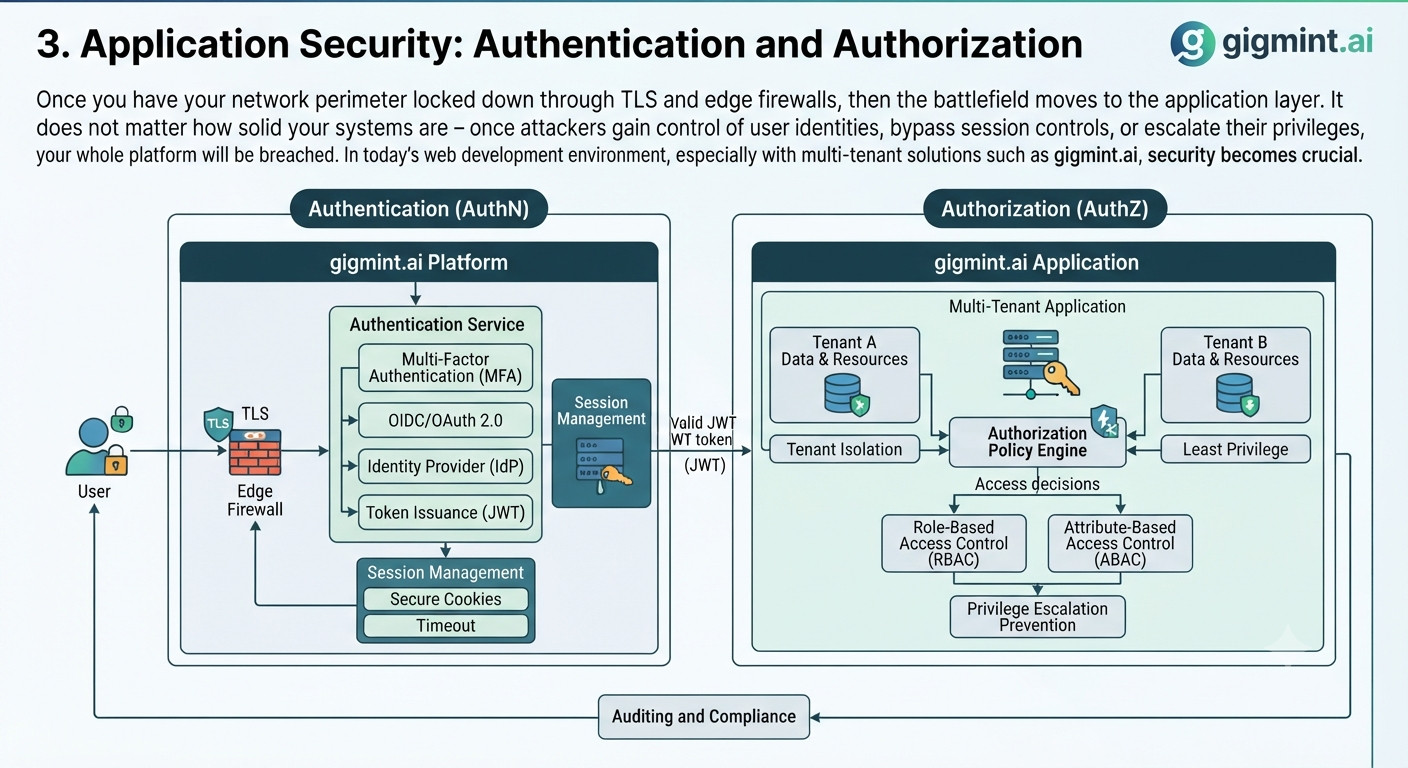
Once you have your network perimeter locked down through TLS and edge firewalls, then the battlefield moves to the application layer. It does not matter how solid your systems are – once attackers gain control of user identities, bypass session controls, or escalate their privileges, your whole platform will be breached. In today’s web development environment, especially with multi-tenant solutions such as gigmint.ai, security becomes crucial.
Robust Authentication Mechanisms
The time when the use of password alone was enough has passed. The password can be broken down through brute force attack, credential stuffing, and phishing. The modern-day website should therefore use more than one authentication technique.
-
Bridging to Beyond Passwords: Encourage your users to make a shift towards more secure authentication techniques like Passkeys and WebAuthn. Using biometric sensors or hardware security keys will make sure that there is no credential theft through phishing because it offers a flawless experience to the user. If the password is being used, then MFA using TOTP or push notification can be used.
-
Password Storage: Always avoid storing passwords in plain text format and never employ hashing mechanisms that are weak or quick such as MD5, SHA-1 or SHA-256. Use very strong and highly memory-hard cryptographic hashing mechanisms such as Argon2id and bcrypt along with per-user salt for maximum security against offline dictionary and rainbow table attacks even in case of database compromises.
-
Login Rate Limitation: Automated bots try to exploit login, registration and password reset routes by sending automated credential-stuffing scripts on these critical routes. You must enforce very strict rate limiting, IP address throttling and CAPTCHA mechanisms on these routes.
Token Management and Session Security
Token-based stateless authentication has emerged as the preferred architecture for contemporary SPAs and microservices, misconfiguration may result in very dangerous session hijacking attacks.
-
Best Practices for JSON Web Tokens (JWTs): Shorten the lifetime of tokens (for instance, 15 minutes for access tokens) and provide them with secure and cancellable refresh tokens stored independently from them. Make sure to use secure signing schemes and avoid using symmetric schemes (such as HS256 scheme) in favor of asymmetric ones (like RS256 scheme).
-
Security Settings of Cookies and Secure Storage: Do not store any kind of sensitive tokens in localStorage or sessionStorage as they will be susceptible to XSS attacks. Instead of it, you should send tokens through cookies, which have to be set up with all necessary security options: HttpOnly flag (prevents the cookies' access by JS), Secure flag, and SameSite=Strict/Lax flag (counteracts CSRF attacks).
Role-Based Access Control (RBAC) and Attribute-Based Access Control (ABAC)
-
Authorization and Authentication: Made Simple. As far as the authentication process of your application goes, the user identity will be determined first of all. The next thing is the authorization process, where the system figures out what this user can do. Weaknesses in the authorization process of your application may result in breaches and even privilege escalation.
-
How to Prevent IDOR: Always distrust client-provided identifiers. For being able to access /api/projects/4821, a user’s authorized session should verify that the user in question is the owner of the project or has administrative rights.
-
Enforcing the Principle of Least Privilege: This applies to design of routes for administrative users, clients, and freelancers on gigmint.ai. The internal microservices and database operations should be restricted to absolutely minimal permissions necessary for their tasks.
4. Input Validation, Sanitization, and Data Protection
Once transport layers have been secured and authentication points strengthened, the struggle becomes one in terms of how the data is processed. Any user-supplied data—be it in the form of a profile description by the freelancer, budget details provided by the client, or the signed contract—is a possible avenue through which malware infection can take place.
It is important to keep in mind that when developing websites, trusting user-supplied data is the number one architectural weakness in contemporary web development.
To create a reliable site such as gigmint.ai, you need to assume hostility on the part of all received data.
Defending Against Injection Attacks
Injection flaws arise because unverified input from users is used to interpret commands or queries. If attackers succeed, they will be able to perform any operation on the database, change server files, and even control system processes.
-
SQL Injection (SQLi) Defense: SQL injection attack vector is arguably one of the oldest and most devastating application security vulnerabilities out there. Do not concatenate user input directly into your SQL string. Instead, always use parameterized queries for all your SQL operations in order to prevent users’ input from being considered as a code to execute. Make sure when you use some Object Relational Mapper library like Prisma, Sequelize, or Hibernate, you use query builders provided by those libraries.
-
Command and Code Injections: Besides databases, applications often have to execute some actions on the operating system level or even via some execution engine like JavaScript or Python.
Cross-Site Scripting (XSS) Mitigation
-
Three Vectors of XSS: Learn the differences between Stored XSS (malicious code stored in the database and served to future visitors), Reflected XSS (payload bounced back off the unvalidated request parameter), and DOM Based XSS (improper handling by client side JavaScript of unsafe input sources).
-
Encoding Output for Context-Awareness: Before rendering the content produced by the user on the browser, the context aware output encoding, which includes HTML entity encoding, JavaScript variable encoding, or URL encoding should be performed to disable script tags from executing on the browser.
-
CSP Implementation in Web Content: CSP may be implemented using HTTP response headers (Content-Security-Policy) where only certain sources are authorized to load scripts, style sheets, and images, but not to run any inline scripts.
Cross-Site Request Forgery (CSRF) Protection
While modern frameworks of browsers and same-site cookie settings have made the implementation easier, knowledge of CSRF attacks and its mechanics is essential in multi-tenant SaaS systems.
-
Anti-CSRF Tokens (Synchronizer Token Pattern): Cryptographic tokens that need to be added for state-changing requests such as changing profile credentials or money transactions in every POST/PUT/DELETE request.
-
Utilizing the Modern Browsers’ Mechanisms: Configure the cookies for sessions in order to have proper SameSite settings (either Strict or Lax) so that browsers don’t append session IDs by themselves during cross-site requests.
5. Secure Coding Standards and Dependency Management
Despite strong defenses around your perimeter, strong transport security, solid authentication systems, and input validation, there may be a way to breach into your application code somewhere inside the stack. Today’s software development landscape is built upon the foundation of open source software, packages, and third-party APIs. While this creates a more agile development cycle, it also makes your system vulnerable because of the complexity of supply chains involved.
For creating a safe environment similar to gigmint.ai, you will need to establish certain security guidelines and maintain strict control over the third party components.
Managing Third-Party Dependencies and Supply Chain Security
Today’s applications are written using an enormous number of open source codes. An average application of JavaScript, Python, or Ruby can have thousands of transitive dependencies that are delivered through various tools such as npm, PyPI, or RubyGems. Even one hacked account of an upstream maintainer, or one backdoored utility library can compromise your entire stack.
-
Dependency Scanner Automation: Don’t depend on code reviews to identify dependencies’ problems; automate your vulnerability scanning using automated vulnerability scanners like Dependabot, Snyk, GitHub Advanced Security or npm audit and incorporate them in your CI/CD pipeline. This will enable your vulnerability scanners to compare your dependencies' tree with live CVE databases to automatically highlight any vulnerable or outdated packages before deploying them into production.
-
Generation of SBOM: Your corporate needs together with security framework considerations make it necessary to have full transparency with respect to your software components. Always maintain SBOM (Software Bill of Materials) for your build artifacts. In simple terms, SBOM is nothing but the ingredients of your software which allows you to assess the impact in case of zero-day vulnerabilities in an open-source library.
Error Handling and Information Disclosure Best Practices
Your application’s handling of failure is just as important as its handling of success. In cases where an unforeseen exception, such as database timeout or null pointer exceptions, occurs, the application must fail gracefully without exposing any of the inner workings of your application.
-
Avoiding Exposure of Stack Traces in Production Environment: Most default error pages provide verbose error messages which include information like stack traces, schema of the databases being used, paths of the inner files, and version of the frameworks being used. Hackers use all of this information to map your application architecture and find vulnerabilities within it.
-
Logging Sanitation: Centralized and Secured: Thorough logging is critical for security audits, threat detection, and forensic investigations. Yet, in many cases, logs end up becoming a second-order liability through poor management practices. No logging of sensitive information should ever take place – no plain text passwords, authentication information, session tokens, credit card numbers, personally identifiable information (PII), etc. Centralized log management in JSON format, where sensitive values are automatically masked prior to forwarding the log entries to central log aggregators like Datadog, ELK stacks, or AWS Cloudwatch.
API Security Architecture
With the move to microservices, SPAs, and mobile frontends, an API interface becomes a critical point of accessing sensitive logic and backend data stores of any system. Irrespective of whether you're building a RESTful API or using GraphQL API endpoints, making your API interface secure will require careful architecture.
-
Vulnerabilities of REST vs. GraphQL: REST APIs have to perform strict resource-level authorization checks at each endpoint and not use predictable structure of request parameters that will facilitate enumeration attacks. The vulnerabilities of GraphQL include deep query nesting attacks and unbounded batching operations that can overload your server. Perform query complexity analysis and apply depth limitations and validate schemas to avoid denial of service vectors.
-
API Interface Rate Limiting, Throttling & Pagination: Open access to API endpoints invites automated scraping, password attacks, and brute-force exploitation. Use aggressive rate limiting and IP throttling for all the endpoints whether protected or not. Moreover, limit pagination of resource-intensive queries against the database in order to avoid malicious clients sending large payloads
6. Deployment, CI/CD Security, and Continuous Monitoring
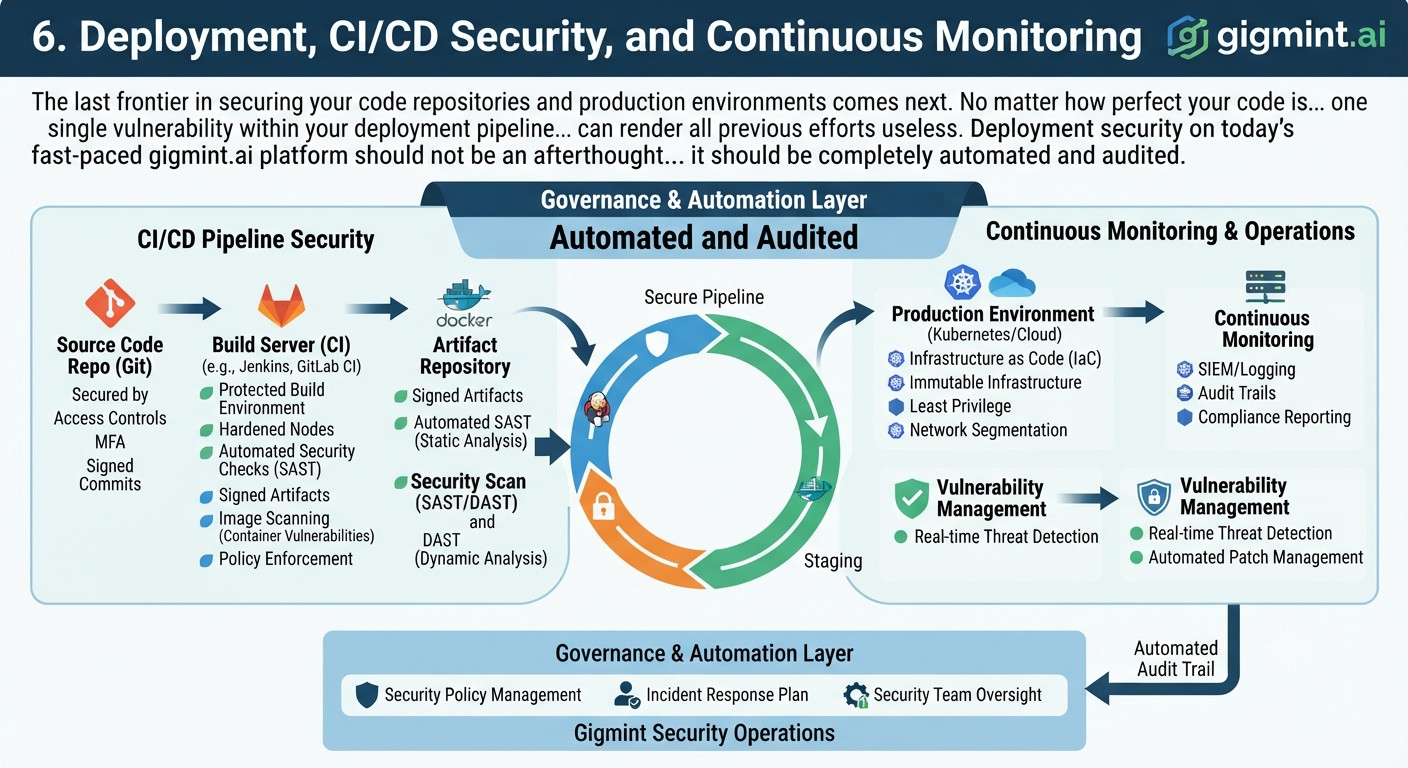
The last frontier in securing your code repositories and production environments comes next. No matter how perfect your code is and how robust your input validation is, one single vulnerability within your deployment pipeline or your server infrastructure can render all previous efforts useless. Deployment security on today’s fast-paced gigmint.ai platform should not be an afterthought handled by a single systems administrator; it should be completely automated and audited.
Hardening the CI/CD Pipeline
God-like privileges exist for your CI/CD pipeline as it has access to everything. It means that they will be able to access code repositories, staging areas, production clusters, and also secrets such as database credentials or API signing keys.As soon as a hacker has compromised your CI/CD pipeline, there is no code review anymore.
Secrets Management Best Practices. Don’t hardcode secrets, API keys or private certificates in your source code, in your repositories or in your Dockerfiles. Use separate secret management tools like HashiCorp’s Vault, AWS Secrets Manager, GitHub Actions Secrets, Google Cloud Secret Manager and so on. These secrets then are dynamically injected to your build and runtime environments as environment variables. These then are automatically deleted from your build logs as well.
Integrating SAST and DAST: Integrate security scanning throughout the whole pipeline process. Make use of static application security testing (SAST) tools such as SonarQube, Semgrep, or Checkmarx and perform source code analysis for any vulnerabilities prior to merging. At the same time, include dynamic application security testing (DAST) tools in your staging environment and scan the live endpoint for any configuration issues and injections.
Container and Serverless Security
These technologies improve the scaling but create different security attack vectors.
-
Docker Container Security Practices: Do not use root processes inside production containers. Specify non-root users in your Dockerfile. Maintaining light base images, choosing minimal operating systems such as Alpine Linux or distroless images decreases the number of packages and, therefore, the number of vulnerabilities. Scan your container images for the CVEs before uploading them to the artifact repository (Amazon ECR, GitHub Packages, etc.).
-
Serverless Infrastructure Security: The use of serverless infrastructure transfers the management of infrastructure to cloud providers, application configurations are your own responsibility. Make sure that the least privileges principle is applied to serverless function execution roles by limiting the access to database tables or storage buckets to the extent necessary for execution of these functions. Encrypt the serverless environment variables using cloud native solutions.
Incident Response and Vulnerability Management
There isn’t any system which cannot be hacked. Security maturity is measured not only by the extent to which you are able to fend off attacks, but also how fast and openly you are able to identify, isolate and recover from security threats.
-
Creating a Vulnerability Disclosure Policy (VDP): Your security researchers and responsible hackers are some of the best friends you have out there. Set up a Vulnerability Disclosure Policy (or a selective bug bounty program) with a security contact email address (security@gigmint.ai) so that any vulnerabilities discovered by these people can be reported responsibly without being sued.
-
SIEM and IDS Integration: Setup a comprehensive Security Information and Event Management system and Intrusion Detection System. Get yourself real-time notifications for any suspicious activity, like abnormal login failures, data thefts or privilege escalations.
7. Developer Checklist
Constructing a safe web platform is not a one-shot effort; neither can it be a last-minute checkmark on your way to launch. As you've come to see from our discussion in this guide, today's web platforms such as gigmint.ai live in an ever-present and automated world of digital threats. From ensuring tight transport layer encryption to securing authentication gates, sanitizing user inputs, handling third party dependencies, and securing your deployment pipeline, safety should run across all the levels of your software development life cycle (SDLC).
"Security by design," security left shift at early architectural stages, and automatic scanning for vulnerabilities are what you need in order to equip your engineering team with tools for scaling safely.
Frequently Asked Questions (FAQ)
1. Explain "Security by Design". It is the concept of integrating security controls and threat modeling into each stage of the SDLC right from day one, instead of considering security as an afterthought just prior to releasing the application.
2. Should you store the JWTs in localStorage? No. Because the localStorage can be accessed using JavaScript, hence the tokens can be stolen using XSS attacks. Store the tokens in HttpOnly, Secure cookies.
3. Why are parameterized queries used to protect against SQL Injection Attacks? In parameterized queries, user input is separated from SQL query code in such a way that inputs are treated as data only by the database.
4. Differences between Authentication and Authorization. Authentication is the process of recognizing users through the use of their login credentials or password. After the recognition of the users, the next process is to determine what they can access.
5. Why are MD5, SHA-1, etc. no longer acceptable password hash functions? Legacy password hash functions are cryptobroken. They are fast to compute (a performance characteristic from a bygone era), so they can be quickly tested using very large numbers of GPUs, and also can be quickly precomputed into large tables of hashes (known as rainbow tables) for later lookups. We have had faster password hash functions for years, like bcrypt, PBKDF2, and scrypt; and recently, Argon2id, winner of the Password Hashing Competition, which is the currently recommended password hash function.
6. What is the Content Security Policy (CSP)? It is an HTTP header that allows controlling the sources from which scripts, styles, and other media will be loaded, making the inline XSS attack payload useless.
7. How do anti-CSRF tokens protect state-changing requests? Anti-CSRF tokens are random, per-session, and cryptographic. Therefore, they can be included with actions such as form submissions and API mutations to prevent third party sites from injecting inline XSS to perform actions on another user’s behalf. Such tokens must be included with every state-changing request to be effective.
8. What is the role of an SBOM in software supply chains? The Software Bill of Materials (SBOM) for a given software component contains an inventory of used open-source software (OSS) and even further all transitive dependencies (e.g. also used in OSS) and thus facilitates the fast identification of vulnerable components in case of a so-called zero-day attack.
9. Why do you have to hide the stack traces in production? A very detailed error message in production (so-called verbose error message) for example contains information about the used file system and paths, used frameworks and versions and database schemes. And everyone knows that attackers only need such information to draw up an architecture of a target system and then to attack the weakest point.
10. What good can gigmint.ai get from a Vulnerability Disclosure Policy (VDP)? A VDP provides a secure, legal way for ethical hackers and security researchers to report unknown vulnerabilities on the gigmint.ai platform before malicious actors can exploit them.