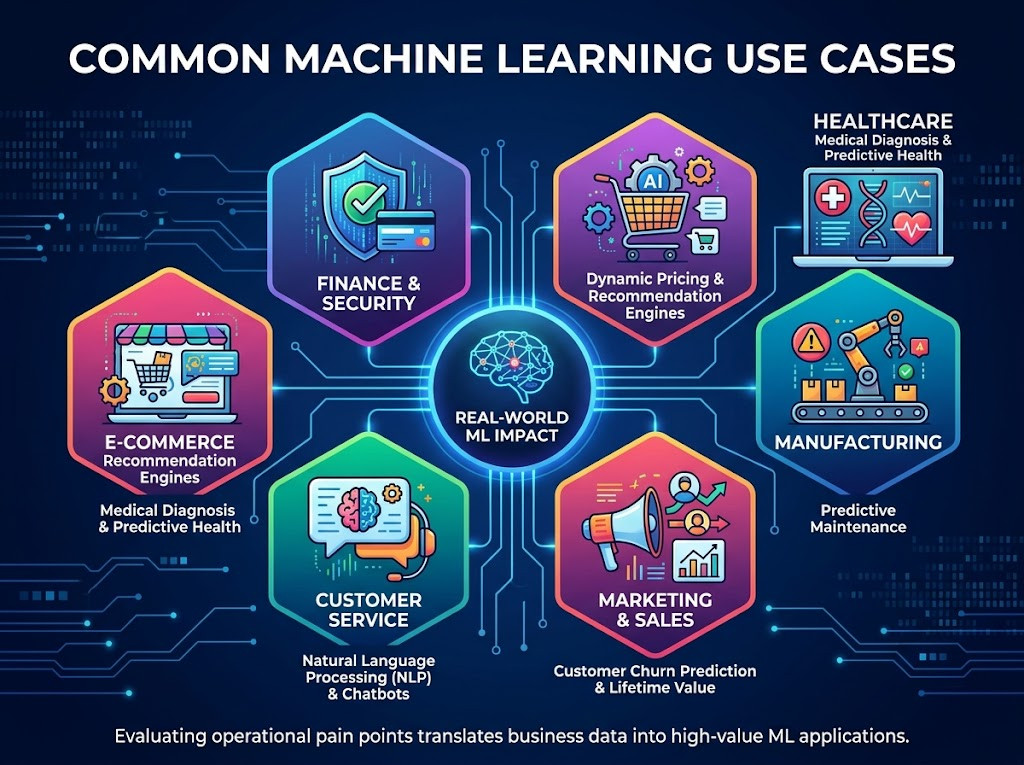
How to Choose the Right AI Tech Stack for Your Next Project
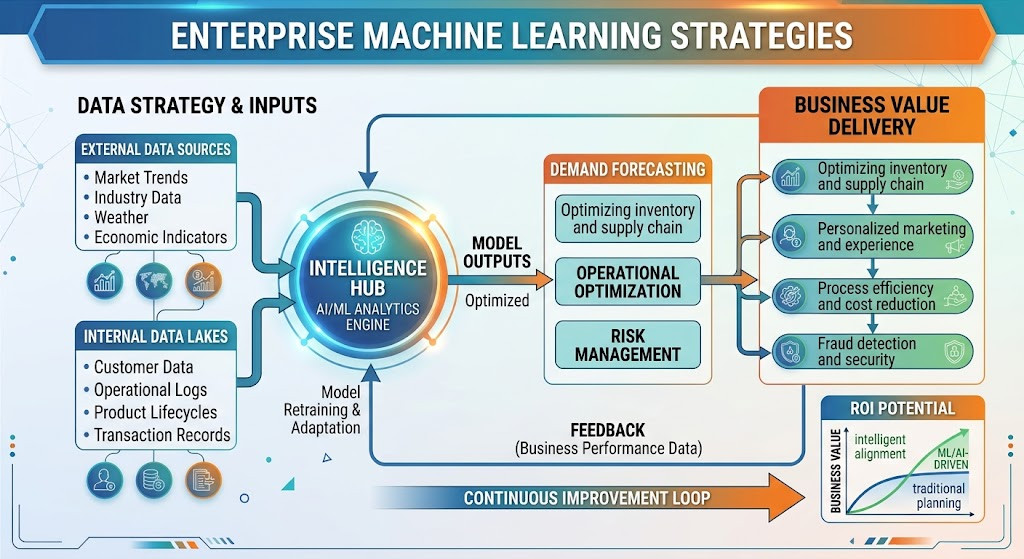
How to Choose the Right AI Tech Stack for Your Next Project
So rapidly does the progress of AI technology take place that many technical managers feel they are not in the midst of a Renaissance but rather an avalanche. Every week, another foundational model becomes available, a "must-have" framework gathers momentum in GitHub, and another vector database comes up with a solution to the latency problems of the preceding ones.
Rapid change has led to a new type of challenge — analysis paralysis for AI technology stacks. Choosing a foundation amidst hundreds of overlapping solutions could hardly be more difficult
AI Tech Stack Definition
An AI tech stack is basically the architecture that converts data into information. In most cases, an AI tech stack consists of three different layers:
The Data Layer: Infrastructure that allows for ingestion, cleansing, and preparation of proprietary or open data used to feed the models.
The Model Layer: An engine of the application that consists of the foundational models (LLMs, vision models) and frameworks for fine-tuning or training.
The Deployment & MLOps Layer: An operational part responsible for API connectivity, containerization, and important observability tools
Why Your Stack is a Strategic Business Decision
Picking your stack goes beyond being an IT decision—it is a key business move. The choice of a properly engineered stack will define your speed to market, your costs of running in the cloud for many years to come, and your flexibility to change course when the landscape inevitably changes.
If you choose the wrong stack, you can end up creating "technical debt by design" and being locked-in to costly vendors or unable to scale, which can ruin your projects.
This guide will provide you with a clear strategy to assess your needs against the modern AI landscape.
II. The Anatomy of an AI Tech Stack
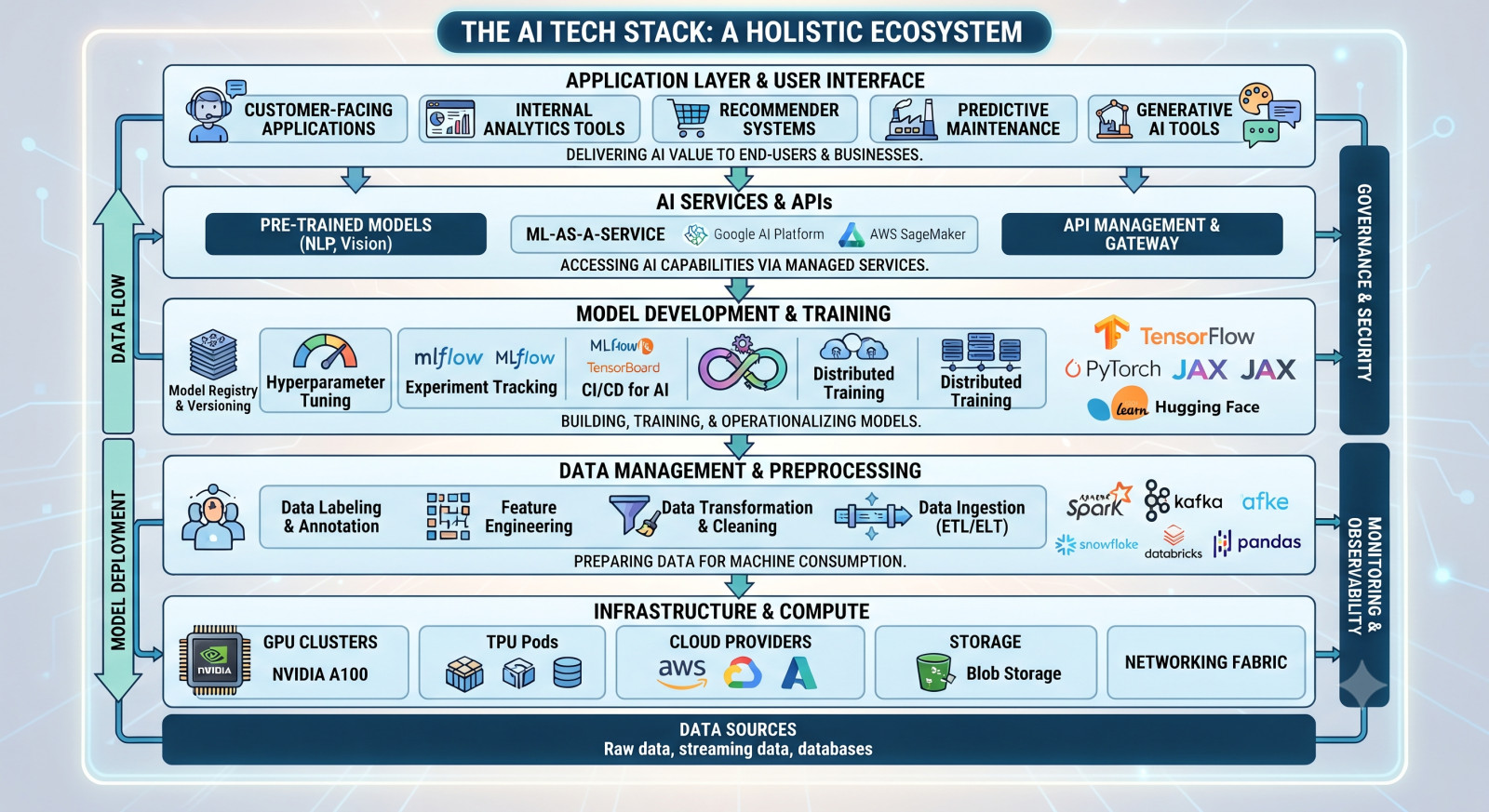
For developing an AI application that has resilience, the first thing that you need to do is to look at the infrastructure holistically as an ecosystem and not as a set of disjointed systems. Understanding the interactions between these layers is the key to designing AI architectures.
1. Data Ingestion & Preprocessing: The Core
The performance of any AI depends on how good the underlying data is. The "Data Layer" is where data is converted to be machine consumable.
Ingestion: Some tools like Apache Kafka and Airbyte are very useful when it comes to collecting and syncing data from different sources in the training environment.
Cleaning & Labeling: If your model requires supervised learning, then some tools like Labelbox and Snorkel AI help in making the cumbersome data labeling process easy.
Storage: With the advent of LLMs, there is a shift towards using vector databases to manage the unstructured data.
2. Development & Training: The Engine
This layer is where you refine your model logic at the core level.
Frameworks: The comparison of PyTorch and TensorFlow is still relevant. PyTorch, owing to its dynamically created computational graph, was used as a means of conducting research and prototyping, while the solid ecosystem of TensorFlow makes it desirable for businesses.
IDE & Compute: Besides a local IDE, such as VS Code, you also need to include remote compute in your stack. It doesn't matter whether you work with cloud-based Jupyter notebooks, SageMaker, or Vertex AI, or have your own GPU cluster—here your priority is speed of experiments without loss of reproducibility.
3. Model Serving & Deployment: The Bridge
Moving your model from a prototype on your laptop to a deployable API needs a robust deployment layer.
Containerization: Docker and Kubernetes are a must in order to ensure consistency between behavior of your model in development and production environment.
Serverless Solutions: If you have unpredictable traffic patterns, you can greatly cut costs on infrastructure by using serverless inference endpoints provided by companies like AWS Lambda (if you work with smaller models) or specialized serverless GPU instances
4. Monitoring & Observability: The Safety Net
In contrast to legacy applications, AI models are probabilistic in nature and susceptible to deterioration.
Monitoring Performance: Arize AI and WhyLabs can be used for monitoring "model drift," which happens when the accuracy of your model starts to deteriorate as a result of changes in the data it encounters in the real world from its training dataset.
Model Bias & Safety: As the models grow in size, it becomes important to detect harmful model outputs, hallucinations, and any biases. Observability means more than keeping logs; it involves auditing the decision-making process of your model to maintain its reliability.
With this four-layer stack, you can create a feedback loop where data is collected and utilized in training models, deployment makes the model available for use, and observability maintains its health. The following section explains how to align your project constraints with these layers.
III. Phase 1: Defining Your Project Constraints
Before choosing any tool, one needs to define the problem he or she is trying to solve. It is absolutely meaningless to try to build an AI stack without having an idea about his or her limitations.
The process of solving a business problem will lead one to over-engineering or even to the situation where one gets stuck after three months of work in case he or she does not understand what he or she is doing. During this stage, we align the business problems with the technical requirements of the AI stack.
1. Use-case classification: start with the output
Your tech stack is your servant for solving a problem. First of all, think of what the output of your AI system is.
LLM-based RAG (Retrieval-Augmented Generation): If you are building a knowledge base chatbot, then the core of your stack will be vector databases (Pinecone, Milvus), embeddings, and LangChain or LlamaIndex.
Computer vision: Object detection and image segmentation projects need a lot of high-throughput GPU power with special preprocessing pipelines which are different from text ones.
Predictive analytics/time-series: Data ingestion pipelines (Kafka, Spark) and feature stores are important if you want to do some forecasts and/or anomaly detection.
2. The "Build vs. Buy" Dilemma
This is the most crucial decision in your architectural design process. Do you want to capitalize on a proprietary API or host an open-source model yourself?
The Case for "Buy": If time-to-market is your primary KPI, OpenAI, Anthropic, and even Google Vertex AI offer unbeatable value. You don’t have to invest in an infrastructure for storing and serving model weights and training it on a cluster of GPUs. The downside is higher costs in the long run.
The Case for "Build": The usage of open-source models such as Llama 3 or Mistral enables privacy, flexibility in terms of tuning models, and cost-effectiveness.
3. Performance Requirements: Latency vs. Throughput
All artificial intelligence systems do not have to be incredibly fast. You have to know what is more important for you:
Latency-Sensitive: If you build a conversational agent which works in real time, your stack will be optimized for cold start times and inference time. This will mean that you need to use small quantized models and run your models at the edge.
Throughput-Sensitive: If you process millions of documents during an offline batch process, latency will not matter as much as throughput.
4. Budget & Resource Realities
License & Cost: Are you okay with tokenized costs, or can you afford the capital investment for a predictable cloud infrastructure cost per month?
Expertise of the Team: Can you handle the maturity for managing a Kubernetes deployment and drift management or is your team at the level of Python scripting at the moment?
The choice of a stack beyond the expertise of your team is one of the main reasons why startups fail. In case your team is lean and focused on fast time-to-market, then go with managed services. And if you are developing an enterprise-level product, it is always better to invest in building ML platform expertise internally from day one.
By considering these constraints in your decision-making process, you will be able to choose from “everything out there” to a handful of options that actually fit your project.
IV. Phase 2: Key Selection Criteria
After identifying the key constraints of your project, the next step is choosing the right tools among many existing ones. Today’s “cool” tool may become a real pain tomorrow. To have a robust AI infrastructure, you have to consider four aspects listed below in your decision-making process.
1. Scalability & Future-Proofing: Not Getting Locked-In to Any Specific Vendor
With the rapid development in the field, the current market leader may quickly turn into something else. The main mistake in developing any AI system is building a tight dependency on a specific vendor’s solution.
Abstraction Layers: Always try to use some abstraction layer provided by orchestration platforms like LangChain or LlamaIndex. It enables you to easily replace the underlying model – for instance, to change from using the API from OpenAI to using some locally installed Llama model.
Interoperability: Prefer tools which use widely adopted open standards like Parquet (for data storage) or ONNX (for models interoperability). Otherwise, you become dependent on the roadmap of the chosen vendor.
2. Ecosystem & Community Support
An AI library is just as good as the community behind it. If you run into an ambiguous problem during implementation in production late at night, then the documentation quality and the GitHub community will be the most precious things to you.
Documentation and tutorials: Is the library documentation maintained, and up to date? Avoid “black box” libraries with a lack of transparency.
Community Velocity: Look at the GitHub repo. When is the last commit? What is the issue resolution velocity? An extensive and active community will make the project much safer than a niche library that could be deserted by its creators next year.
3. Integration Capabilities
The choice of the stack you make for your AI solution doesn’t live in vacuum; it must fit well into your existing data warehouses, cloud vendors, and CI/CD pipelines.
Cloud Agnostic vs Cloud Native: While cloud native solutions like AWS SageMaker and Google Vertex AI will allow you to integrate everything smoothly with the rest of your cloud stack, their migration to another cloud would become challenging in the future.
It is also important to determine whether your team has sufficient skills to work with agnostic containerized stacks (like the one built on Kubernetes) or managed cloud native stacks.
Languages support: Though everybody uses Python for AI, it is important to check whether your chosen stack is easily integrated with your backend. Does it offer REST or gRPC API?
4. Security & Compliance
For enterprise applications, security is a must. In order to process PII, one needs to use a stack where data privacy is not an afterthought.
Data Residency & On-Premise Processing: If your domain includes HIPAA (healthcare) or finance, then you are probably restricted in using public APIs to transmit data. In this case, you need a stack that allows for on-premise or VPC-based deployments for models.
Features of Governance: Try to find tools that will allow you to have fine-grained access controls, audit logs, and data encryption at rest. If you do not know how to manage data lineage and compliance in your selected stack, it is unlikely that you can use this stack in production.
With these criteria being your filter, you will avoid falling into the "hype trap" and will build a proper architecture.
V. Phase 3: The Practical Tech Stack Comparison
Now that you have set your constraints and selected your criteria for tool selection, it is time to assess the "state of the market". Picking a tool in today’s market landscape is a question of achieving a proper balance between brute force, developer experience, and production stability.
1. Frameworks: PyTorch vs. TensorFlow
The war between PyTorch and TensorFlow continues to remain the biggest battleground in AI engineering.
PyTorch (The Scientist’s choice): PyTorch has been firmly established as the preferred choice of scientists and rapid prototypers alike. Its "eager execution" and pythonic design makes debugging a breeze. If your team plans on experimenting with customized model architectures and cutting edge NLP science, then PyTorch's flexibility works wonders for you.
TensorFlow (The Industrial Machine): TensorFlow remains the tool of choice for large scale production projects. The TFX (TensorFlow Extended) ecosystem provides a powerful set of tools for developing end-to-end production pipelines including specialized libraries for model serving and deploying models to mobile/edge devices. If you have production constraints such as strict CI/CD pipeline and cross-platform compatibility requirements, then the rigidity of TensorFlow may even become an advantage
2. Vector Databases: The Foundation of RAG
The most frequent use case of modern AI applications is Retrieval-Augmented Generation (RAG).
A vector database is "the long-term memory of your LLM."
Pinecone: A managed and cloud-native vector database. This is the choice for teams who prefer not to manage their own infrastructure and concentrate fully on app logic.
Milvus/Weaviate: Heavyweight solutions for enterprise scale demands. The most feature-rich solutions, hybrid search (keyword + semantic) and better fit for on-premises/multi-cloud deployments.
ChromaDB: The lightweight solution. An open-source, lightweight database which is extremely easy to spin up locally. This is the best option for prototype and small-scale datasets where any management overhead would be an overkill.
3. Orchestration & LLM Frameworks
These serve as the connectors for the models, data, and application logic to fit together.
LangChain: The tool that comes across as the most modular of all frameworks and is perfect for handling the logic chains that are agentic workflows, memory, and prompt templates. It has the largest number of ecosystem integrations which makes it the safest choice for almost all the projects.
LlamaIndex: When LangChain is designed for “chains,” then LlamaIndex is designed for “data.” If ingestion, indexing, and query generation of large amounts of proprietary documents are what you have in mind, then LlamaIndex is the way to go.
4. Deployment Platforms: Where AI Lives
The hosting location of your model will dictate your latency, price, and ability to go insane.
Hugging Face Spaces: The quickest way from model to demo. Ideal for PoC (Proof of Concept) purposes and collaboration with stakeholders. But definitely not the optimal choice for highly concurrent production use cases.
Managed Services (AWS SageMaker, Google Vertex AI): They offer you a complete MLOps platform. You have to pay extra to get all the benefits of monitoring, labeling, and auto-scaling included. "Safe" choice for enterprises who don’t want to develop their own platform team.
Custom GPU Clusters (Kubernetes/KServe): Full control. Using custom GPU clusters, you get maximum performance and minimum latency in the long run. It will require a dedicated DevOps team, but for SaaS companies that want to scale, it’s the only sustainable long-term solution.
VI. Phase 4: Avoiding Common Pitfalls
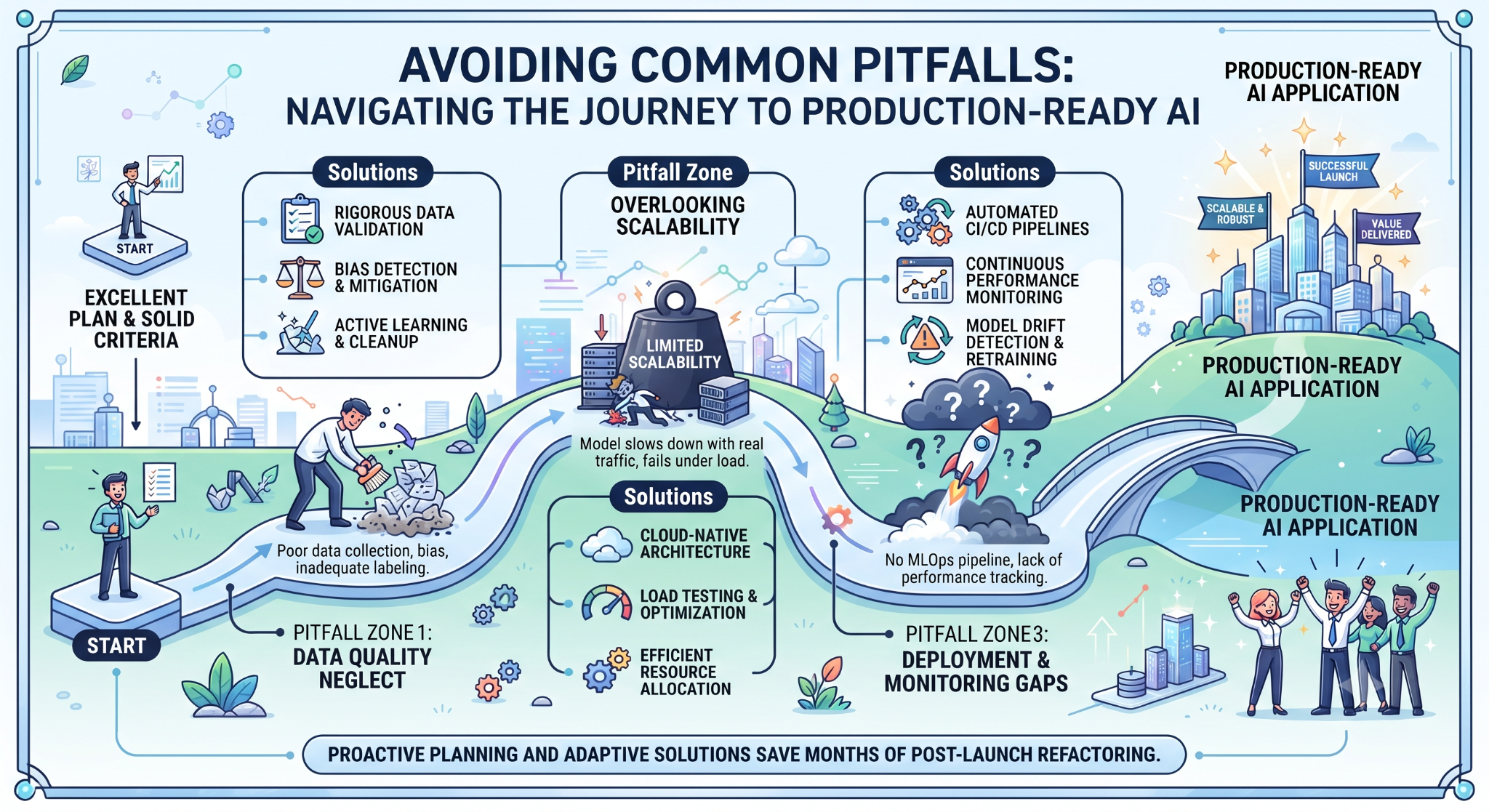
Despite having an excellent plan of action and a solid criteria list, the journey to creating an AI application ready for production is full of "hidden" pitfalls. Avoiding these common mistakes will help avoid months of refactoring after project launch.
1. Shiny Toy Syndrome
Currently, the world of AI is full of emerging frameworks and solutions, being introduced almost every day. It is tempting to integrate the newest "hottest" library from GitHub, but there are serious risks associated with using trending technology. Emerging tools are not yet ready to be used at scale in most cases due to unstable nature, lack of documentation and updates.
The Fix: Is this solution to a problem my current stable stack cannot solve? If the answer is "no" or the library is in its alpha/beta phase with low community adoption, it's better to stick with the old "boring" technologies until there is a real business case to change something.
2. Ignoring Data Quality
The most frequent fallacy is the assumption that having a better model or more advanced vector database can help fix problems with the quality of data used. On the contrary, "Garbage In, Garbage Out" is an even greater problem in artificial intelligence.
The Solution: Allocate 80% of your time to working with data. Focus on having effective data cleansing, validation processes and labelling procedures rather than building the perfect model. The stack of tools you use should support data quality audits, not just fast training
3. Neglecting MLOps from Day One
Many organizations approach MLOps (Machine Learning Operations) as something to take care of only "after the model is done". This is a huge mistake. Once you recognize that you have a problem with model monitoring, drift detection, or automation of the training pipeline, you will be dealing with an unstable, unobserved production system.
The Solution: It’s essential that you create your MLOps infrastructure together with your development environment. Begin with setting up your initial logging, performance tracking, and automated tests for your models from the first moment you deploy a model to production. Ensuring that your deployment is of the highest quality and not an afterthought will make sure that your stack is production-ready from the get-go.
This way, you won’t over-engineer your solution with the help of technologies, and your project will be valuable for your company.
VII. Strategic Recommendation
Operating within the field of AI is about finding the "perfect" solution, which will be obsolete next month.
It’s about setting the groundwork that gives enough stability for production yet leaves enough flexibility to integrate the next generation of advancements.
Decision-Maker’s Summary Checklist
Before you commit your next AI spend, ask yourself these four questions:
Constraint Alignment: Are you clear on your use case, and did you make an explicit "Build vs. Buy" decision based on the skill set of your team?
Criteria Filtering: Is your stack vendor-agnostic, with solid community support and the required level of security compliance in your industry?
Infrastructure Readiness: Did you include MLOps and observability from the very beginning, or are you putting off this important aspect to the future?
Data Integrity: Is your stack designed around the integrity of your data and its auditing, or are you leaning too much on complexity of models?
Final Advice: Build for Change
The commonality among the best performing AI companies is that they all begin small and go fast. Be careful not to fall for the "Shiny Toy" problem of using the newest library because it's new even if your infrastructure is already up and running. You should create a system that is modular enough to be changed when the next big thing shows up.
Partner with GigMint
Building the correct AI technology stack can be a game-changer for your company. If you find yourself overwhelmed by "analysis paralysis" or unable to turn an intriguing prototype into a scalable solution, there is no need to go through it alone.
Our team at GigMint is all about designing scalable AI infrastructure that will grow with you. From building a strategic roadmap for your MLOps infrastructure to moving to a cloud-agnostic architecture, we have got your back.
Curious how we could help you future-proof your AI architecture? Contact us now.
Frequently Asked Questions (FAQs)
1. What is an AI tech stack, and how does it differ from a regular web development tech stack? While a standard web tech stack (consisting of database storage, backend, and frontend) provides solutions for deterministic outputs, an AI tech stack is composed of specific layers that allow the processing of data ingestion, model training or API orchestration, vector embedding storage, and continuous MLOps monitoring.
2. Should I build my model of the AI or use the already existing API, which can be readily available? In almost all situations, using managed APIs (for instance, OpenAI, Anthropic, Cohere) would be the most efficient way of checking the product-market fit. There might be cases where you would prefer to use open-source models (such as Llama, Mistral) or even construct your own models.
3. What is the purpose of vector databases in the stack of AI technology? Vector databases (for instance, Pinecone, Milvus, Weaviate or ChromaDB) store high-dimensional embeddings. They are important for retrieval augmented generation (RAG) use cases which make it possible for large language models to query internal documents of the company and outside knowledge sources in real time.
4. PyTorch vs TensorFlow: Which one should I pick for production? Even though PyTorch has taken the lead position regarding the research and academic use cases due to its dynamic graph computation approach, TensorFlow still remains a good choice for the large-scale corporate productions although PyTorch has narrowed the gap significantly in recent times. Pick according to your team core competency.
5. How can I avoid vendor lock-in with my chosen cloud provider or model of AI? To make sure that you will be able to change your cloud provider and model of AI later, use orchestration platforms like LangChain or LlamaIndex to wrap up your model logic and do not include proprietary API structure into your core application.
6. What are some hidden costs of AI technology stack? Other than the costs of paying initial API tokens or renting GPU on the cloud, hidden costs may include labeling of data, maintaining pipeline, scaling of vectors, and MLOPs overhead for monitoring model drift, hallucinations, and vulnerabilities.
7. Why must MLOPs be adopted on day one? Adopting monitoring after launching the product will bring issues such as model degradation, silent failure, and non-compliance. Adopting MLOPs in the early stage will ensure that monitoring is done regarding latency, token spend, and data drift before it impacts the user experience.
8. How do I deal with data privacy and Personally Identifiable Information (PII) in AI projects? In cases where the project involves any sensitive data of the user, then reliance on the cloud APIs will result in compliance issues, for example, GDPR or HIPAA. Hence, in such cases, the technology stack must include local models or private virtual clouds.
9. What team size is required to keep up-to-date with a modern AI app? Orchestration and APIs make it possible for small teams to launch MVPs; however, a production-ready custom-built AI stack needs a combination of backend, data engineers, and a machine learning expert for fine-tuning and securing the infrastructure.
10. In what way can GigMint assist in building or improving my tech stack for AI applications? GigMint helps companies connect with top-tier engineering talent and architectures. Regardless of whether you require advice on your existing infrastructure, a vector database selection, or even an enterprise RAG pipeline scaling, GigMint can assist.