How to Write a Project Description That Attracts Top-Tier Talent
How to Write a Project Description That Attracts Top-Tier Talent
The most challenging aspect of any important endeavor is not the actual undertaking, but rather the difficulty of overcoming the obstacle of the “blank page.” In their haste to overcome this first challenge, companies tend to list overly general job specifications and descriptions and find themselves submerged under a wave of proposals from incompetent candidates who have simply copied and pasted someone else’s submission.
The cost of this friction is steep, both monetarily and in terms of valuable time spent screening candidates that are off the mark. The problem that many hiring managers miss is that top-notch, high-end professionals who provide "ROI" are inherently risk-averse.
These workers value their reputation and time, and will seek to avoid projects with unclear or undefined briefs since such an assignment indicates an unorganized client and scope creep on the horizon. In today’s world of freelancing, the level of difficulty of your hiring process is directly related to the quality of your project brief. If your brief is unorganized, you won’t get top-notch workers—they'll avoid you!
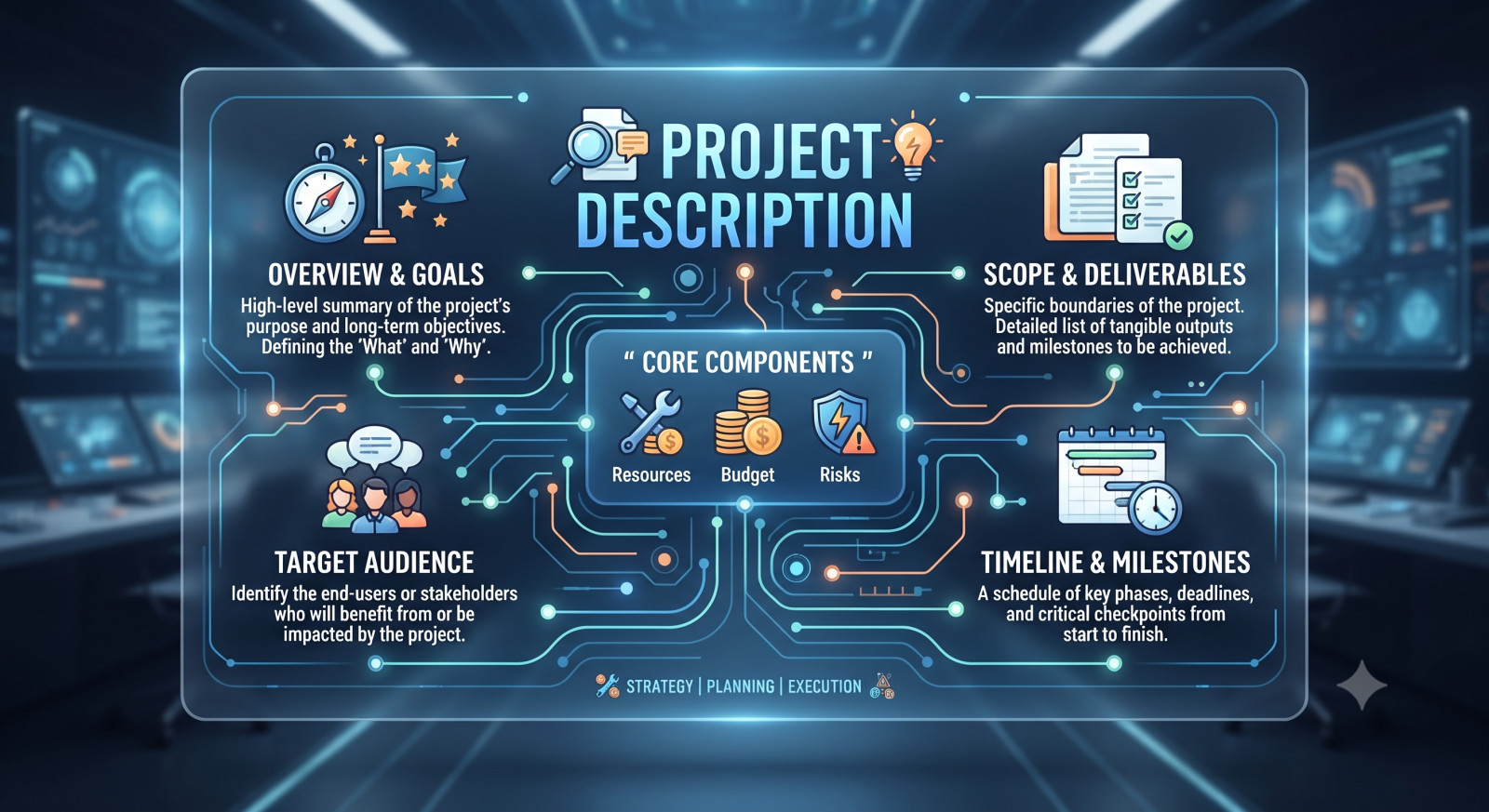
The project description will not be only a list of tasks to be done but your most important marketing tool. This will be the starting point of interaction between your vision and the person capable of bringing it to life.
By understanding how to properly create a project description—and using AI for creating your strategic vision in such tools as [Internal Link: The Future of Frictionless Briefing]—you can reduce operational friction right away, ensure proper expectations right from the start, and always get the best people on your biggest projects.
2. Why Your Project Description Is Your Most Important Asset
The project brief is much more than an administrative necessity or just another checkbox on the road to putting a job up for hire; it is a strategic document that serves as your professional representative when you are not there to speak for yourself.
In the high-pressure world of recruiting top talent, the brief becomes your most important document that signals your business acumen and management style. When you are not there to explain your interpretation of an ambiguous requirement, clarify a technical detail, or control the details of the work flow, the brief is your only representative.
For the person who is hiring, the accuracy and thoroughness of this document act as a quiet testament to their skill in managing difficult projects. The fact of having a well-thought out project description sends a message to the world that the company doesn’t just need help, but they need help in an environment where excellence will be appreciated.
It takes the whole process away from being one of desperation and turns it into a process of selection, whereby a minimum standard of respect and professionalism is set even before the first interview.
The 'Talent Magnet' Theory
Under the "Talent Magnet" theory, the project description functions as a high-frequency signal broadcast to the marketplace, specifically designed to resonate with first-rate experts while filtering out the noise of lower-tier applicants.
High-end talent—the unique specialists whose work directly generates exponential ROI—operates with a mindset fundamentally different from the average worker: they are inherently risk-averse regarding their professional time and reputation.To these people who can be described as elites, having a vague brief is one of the biggest "red flags" signifying chaos on the part of the client, unclear goals, and ultimately the presence of scope creep.
These people know that beginning a project with such a brief means there is going to be friction and changes that are going to lead to ultimate failure. Therefore, these people utilize the brief as their risk mitigation strategy; instead of looking at what is in the brief, they try to assess how.
A good brief becomes an excellent magnet for these people because it gives them psychological safety. It tells them: "This client has done the heavy lifting of defining success, understands the technical constraints, and possesses the professional apparatus to support a top-notch result."
This perceived operational maturity is often the deciding factor for experts who have their choice of projects. By investing in the brief, you are not just describing a job; you are de-risking the engagement for the exact people you need most, making your project the most attractive option in a competitive landscape.
A technically sound and articulate brief becomes a magnet for first-rate experts who would understand from it: 'The client clearly understands his needs, respects my time, and has all the professional apparatus for a top-notch result.' So, when you spend time on the description, you do not just attract candidates; you select competent ones.
Eliminating the 'I’ll Know It When I See It' Feedback Loop
There may be no phrase more depressing to a professional than “I’ll know it when I see it.” Reactive management is the key source of project drifting, burnout of contractors and financial overruns. The absence of an exact brief leaves the definition of success up to fate and forces you to guess the expectations of the freelancer and punish them for their inability to guess correctly.
On the other hand, an exact project description is a contract of clarity. You have to define what success means in terms of the specific metrics, technical limitations, and deliverable products. This way you ensure that there will be no scope creep and align the interests of the contractor with yours right from the start of the process.
Clarity is essential for modern freelance collaboration. According to a recent HBR analysis, the ROI from freelancing is highly dependent on the precision of the initial brief and your ability to define your expectations as a client.
3. The 4 Pillars of a High-Converting Project Description
In order to take your brief beyond a mere checklist and craft a document that will motivate the elite experts to apply for the position, there are four core pillars you should use to construct your brief.
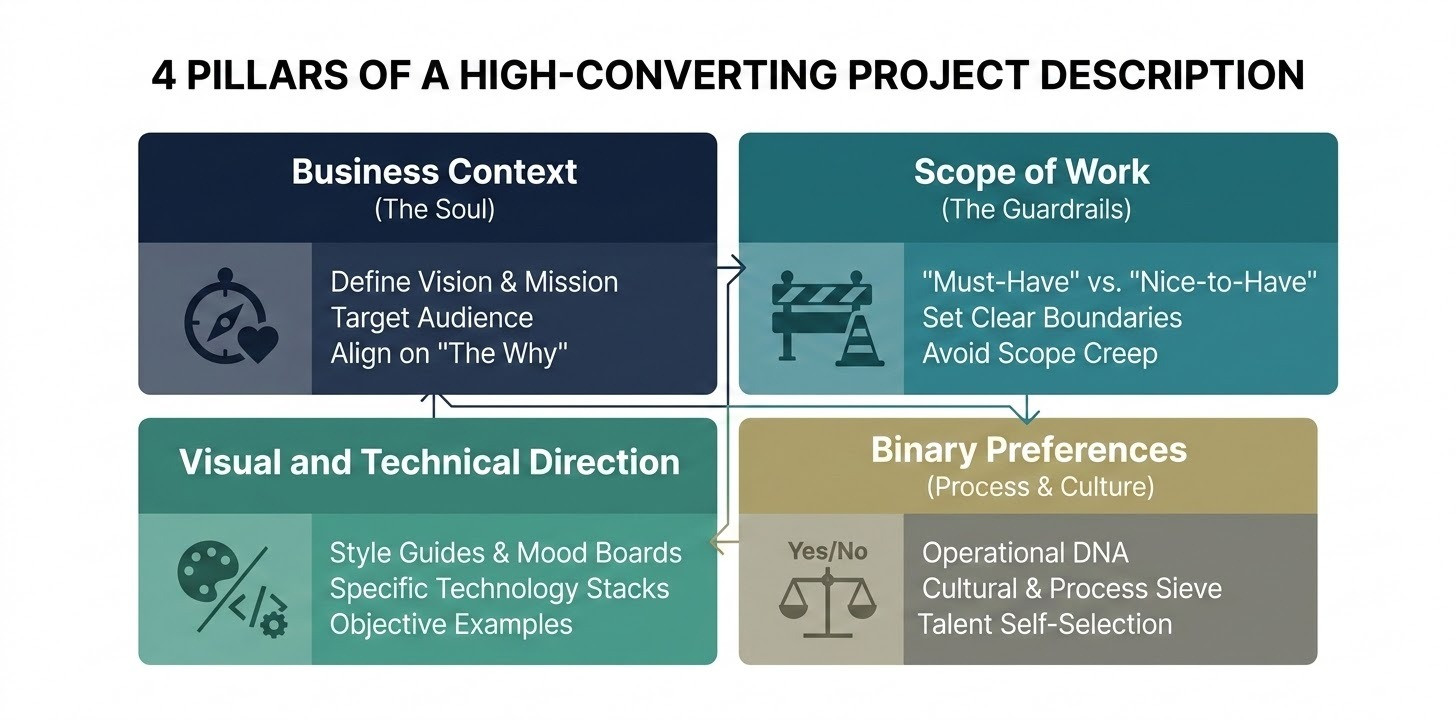
Pillar 1: The Business Context (The "Soul")
A top-notch expert never operates in isolation; he or she needs to know how the project will affect you. Mid-range labor concentrates on "the what," while high-end professionals become preoccupied with "the why."
Giving context to your business allows the expert to make strategic decisions within the process that will help you reach your final goal. You need to state your mission, the target audience, and your market position.
This project will be successful when [Target Audience] will be able to [Specific Desired Action]."
Pillar 2: Scope of Work (The "Guardrails")
The biggest factor behind projects failing is the lack of clearly stated scope. In order to safeguard your financial resources and also the freelancer’s time, you need to set clearly defined borders. This means separating what are known as "Must-Have" elements from those which are termed "Nice-to-Have". The Must-Have items are the non-negotiable aspects needed for the product launch.
Pillar 3: Visual and Technical Direction
Subjective adjectives are the bane of productivity. Words such as “clean,” “modern” and “innovative” carry very different meanings for different people. If a client wants something “professional,” what the specialist may end up producing will likely be corporate and in shades of blue, whereas the client was expecting something clean and monochromatic.
This can be avoided by supplying objective examples – mood boards, current style guides of the client’s brand, and technical frameworks for building the website ("Must be built with Tailwind CSS and Next.js").
Pillar 4: Binary Preferences ("What We Like" vs. "What We Hate")
This pillar serves as the cultural and process sieve. With the help of your binary preferences, you can rule out all doubt about what your process and taste are. This way, you create a self-selection process among candidates who won't be suitable due to their working methods and approach to design.
Process: Asynchronous Slack updates are preferred rather than synchronous stand-ups every day.
Code: We like clean and plain CSS rather than frameworks filled with unnecessary features.
Communication: Direct feedback without any corporate politeness rather than lots of words and phrases.
Thus, the pillar guarantees not only technical fitness of your chosen candidate, but also the suitability of his/her personality according to your organizational culture.
4. Technical SEO and Project Success
A well-designed site can be a liability for your business if it unintentionally ruins your search engine ranking. Many HR people tend to use the project description as a creative brief without realizing the fact that the site itself is primarily a technical product. Failure to include mandatory SEO/performance guidelines in the brief will mean giving control over the technical architecture of the site to a freelance designer.
Protecting Your Digital Assets
It is during the phase of redesigning that the risk of losing your rankings is the greatest one. No matter how beautiful the design you implement is, it can ruin your search rankings, if it affects the “authority” your website has accumulated over time. This is why it is essential that your project description explicitly instructs your designer to save your website’s digital legacy.
Make sure that your designer conducts an audit of the URL structure of your website prior to implementing any changes. The project brief requires the creation of the 301 redirects map of each popular web page, thus ensuring that you do not create a lot of 404 pages.
Performance Standards: The New Reality
Modern-day SEO goes hand-in-hand with performance. The search engine algorithms have started prioritizing “page experience,” making speed and accessibility absolutely necessary elements. In your brief, you need to formulate concrete goals in terms of metrics from the Core Web Vitals from Google—that set of metrics that favors visual stability, interactivity, and performance.
Demand that your designer designs for mobile first. Interfaces need to be optimized starting from the smallest possible screen sizes, not made to fit smaller ones after being designed for the largest screens. Besides, demand WCAG compliance. It is not only an ethical decision but an SEO best practice as well.
Search crawlers evaluate your website in the same way as assistive technologies. Thus, by defining these performance and accessibility metrics right from the start in your project description, you make sure that your future digital storefront is lean and fast.
5. How AI Simplifies the Writing Process
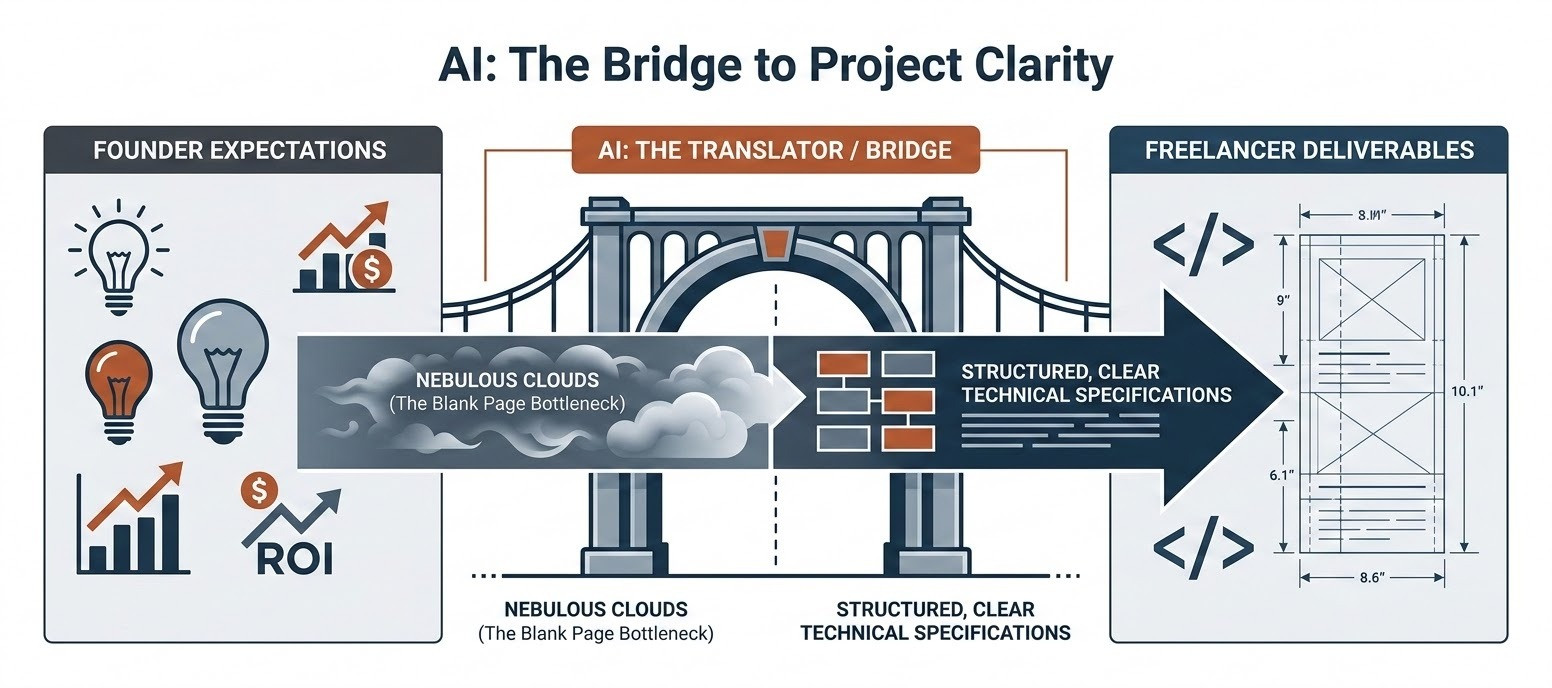
The biggest problem faced when hiring is the distance between what the founder expects and what the freelance worker actually accomplishes. It isn’t solved through additional meetings, but rather improved documentation. Here is where AI enters into the equation.
The Friction of the Blank Page
The issue of the “blank page” goes beyond being merely a matter of writing; it represents a cognitive bottleneck. When you start working on a project description, you try to convert nebulous business aims into tangible technical specifications, which entails a certain set of rather rare skills.
AI solutions, like GigMint.ai pipeline, remove this roadblock because they serve as a structural architect of your intentions. Rather than looking at a blank page waiting to type something down, you put in the business goals you have in mind—“I should improve our conversion rate,” or “I should speed up and increase security of the checkout process,”—and then the AI turns them into a polished brief.
The Translator Effect
The main reason for any project to fail is the failure of translation. The language of a business owner is the language of "Market ROI," while the language of a top engineer or a top designer would be "Technical Constraints" and "User Experience." These two without translation spend the first couple of weeks understanding each other's language.
The role of AI here is a professional, unbiased translator. It translates your desired outcomes into technical specifications of how it should be built. The result is the creation of a document that has two purposes: to sell your business to the freelancer and to provide a developer with the technical instructions to build it.
Moving Beyond the Manual Bottleneck
One of the biggest transformations due to AI-based briefing is how it changes the process of matching talent. The standard way of recruiting involves manual filtering, which is a time-consuming and biased process. As soon as you put up a "vague" brief, you get a huge number of applications that are impossible to filter manually.
But if you make an effort to provide an AI-oriented and strict brief, you will have to deal with high-quality data that the algorithm may actually match. Defining the stack, constraints and objectives helps the matching system recognize not only the people who are "available," but those who are "capable" among the top 1% of talent. You do not have to filter the resumes anymore, you are being matched to the best expert who fits the operational DNA of your project.
6. Feedback Loops and Iteration Management
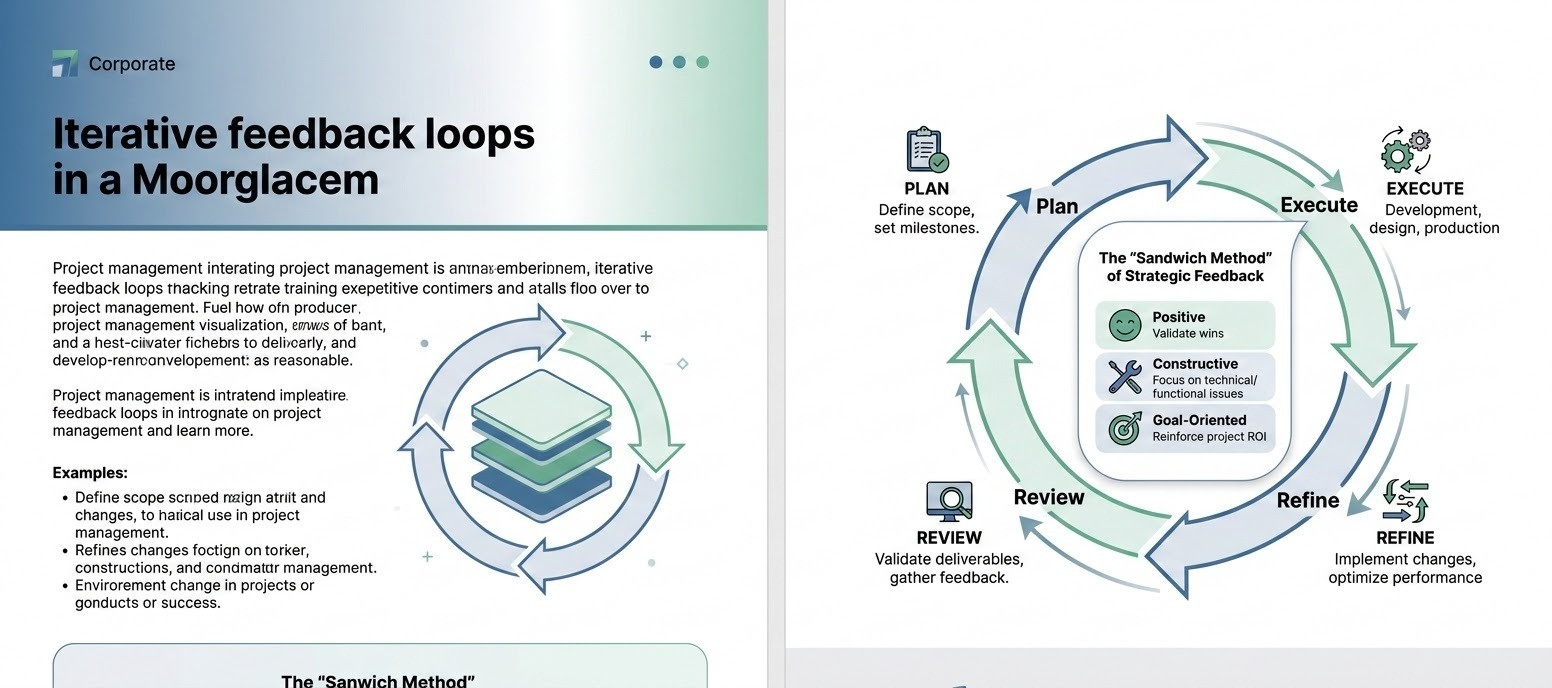
Getting elite talent on board is just the first step toward a successful project; the next step – and one that is perhaps even more important than the former – is how the product is managed.
High-end talents don’t work in isolation, and no matter how accurate the specifications, there will always need to be a process of review and refinement to make sure that the final product continues to meet the changing requirements of the business. Without a process for critique and refinement, a project will succumb to last-mile resistance.
The 'Sandwich Method' of Strategic Feedback
In order to retain the expert’s momentum and motivation, the feedback needs to be presented as a strategic approach rather than a punishment for something gone wrong.
The well-known “Sandwich Method” is commonly used in the field as an efficient approach that allows combining the maintenance of professional relations and a technical discussion of the problem. It starts with positive feedback: one needs to highlight some “win” when the specialist has fulfilled the requirements set by the brief.
The core of the “sandwich”, or the middle part of it, discusses the specific problem of technical or functional conversion. It should be objective and not related to personal preferences, but only to the fact that some particular point fails to comply with the predefined guardrails. The feedback ends with the reminder of the future goal that is associated with the project's final ROI.
Eliminating the 'Big Reveal' Failure Mode
The most prevalent reason why a project fails catastrophically is the "Big Reveal," whereby the freelancer operates on his own for weeks before showing the client the completed deliverables.
The result in such cases is a product that cannot be utilized and an empty budget, since any slight misdirection from the very start causes cumulative errors that render the project unusable by the time it comes to completion. Elite projects minimize such risks through the use of Milestone Management.
By segmenting the work into clearly-defined and non-negotiable stages—like Wireframes, Mockups, and Final Assets—you create logical circuit breakers. By reviewing the wireframe at the first stage, you will be able to detect any architectural errors early enough so as to make corrections cheaply.
Using such a milestone management structure guarantees that by the time you get to the final polish, the basic logic of the project has been validated. Those interested in further optimizing their project process should make sure to adhere to Best Practices for Remote Team Collaboration in order to ensure that their external team mates are aligned with the strategy internally.
7. The Long-Term Impact of Clarity
The path to discovering and recruiting high-caliber talent starts not when you begin reviewing resumes and holding interviews but much earlier, starting with the blank page on which you will outline your requirements.
As we discussed in this book, a well-written project description is much more than just an advertisement for a job vacancy—it is a good investment in the result of your project. By moving from fuzzy, informal requirements to a structured and technically correct brief, you automatically get rid of the clutter and send the signal to the best professionals in the world that you are their potential client.
The famous "talent gap," which many businesses often complain about, is sometimes nothing but "clarity gap." When you take the time and effort to understand the business context of your project, set clear scope boundaries, demand certain performance levels and visual/technical direction, you simply remove the obstacles that make top-tier experts go away.
Enough of guessing, enough of filtering through thousands of incorrectly aligned submissions, and enough of being satisfied with second-rate outcomes. Developing a standardized process around your project briefing is the one thing that will assure your success. From designing a complicated digital product to polishing your company's brand identity, the level of your outcome depends on the quality of your input.
Don’t let your next project become the victim of "blank page syndrome" and the chaos of scope creep. Employ the power of the GigMint.ai pipeline to turn your vision into a well-written industry standard brief that doesn’t just recruit talent but recruits the right talent. Go to GigMint.ai now and create a brief for your next project.
FAQ: Writing Project Descriptions for Top Talent
1. Why is the "Blank Page" problematic in recruiting?
Because it results in imprecise language, which attracts the wrong talent and generates costs.
2. Why are highly successful professionals afraid of risks?
Because they care about their reputation and will not work with disorganized clients due to scope and time waste.
3. What is the "Talent Magnet" concept?
An exact technical brief shows professionalism and attracts talent because it implies a structured process.
4. What are the 4 components of a good brief?
Business Context, Scope of Work, Visual/Technical Direction, and Binary Preferences.
5. Why does "Business Context" belong to a brief?
The best talent requires context to make relevant decisions from an ROI perspective.
6. How do "Guardrails" save a project?
By clearly stating "Must Haves" and "Nice to Have" we prevent budget issues and ensure launch readiness.
7. Why should we refrain from using subjective adjectives such as “clean”?
Because they carry different interpretations; rather use objective ones such as mood boards or particular technical frameworks.
8. What is the advantage of “Binary Preferences”?
They serve as a filter that allows candidates to filter themselves according to your culture and processes.
9. How is SEO part of a project brief?
Compulsory guidelines for performance and URL construction protect your search ranking against being unintentionally destroyed by designers.
10. How does AI play its part in briefings?
AI works as a structural architect; it helps to define business goals in technical specifications.