Machine Learning in Business: Benefits, Use Cases, and Future Trends
Machine Learning in Business: Benefits, Use Cases, and Future Trends
1.Overview
For many years, AI was thought of as a far-fetched technology that could only be seen in research labs and in science fiction movies. AI has become a significant part of business strategy which allows organizations to analyze data, optimize their processes, personalize customers' experience and make well-informed decisions. In the process of implementing these technologies, machine learning became a crucial factor in increasing efficiency, meeting changing customers' needs, and ensuring competitiveness of a company.
The contemporary world of business produces enormous amounts of information on a daily basis. However, data does not bring any value to a company. The difference between successful and unsuccessful organizations lies in their ability to transform data into useful insights and use these insights for making better decisions. This is where ML comes into play.
Machine learning is an area of artificial intelligence that allows computer systems to learn from data, recognize patterns, and make decisions or predictions based on this information, even when no specific algorithms have been used to program computers to accomplish a certain task.
In this guide, we will cover the main advantages of using machine learning in business, its various applications, and the current trends in this sphere. Whether you want to increase efficiency, improve your relationship with customers, or add some elements of personalization to your services or products, you should know about machine learning.
2. The Core Benefits of Machine Learning for Business
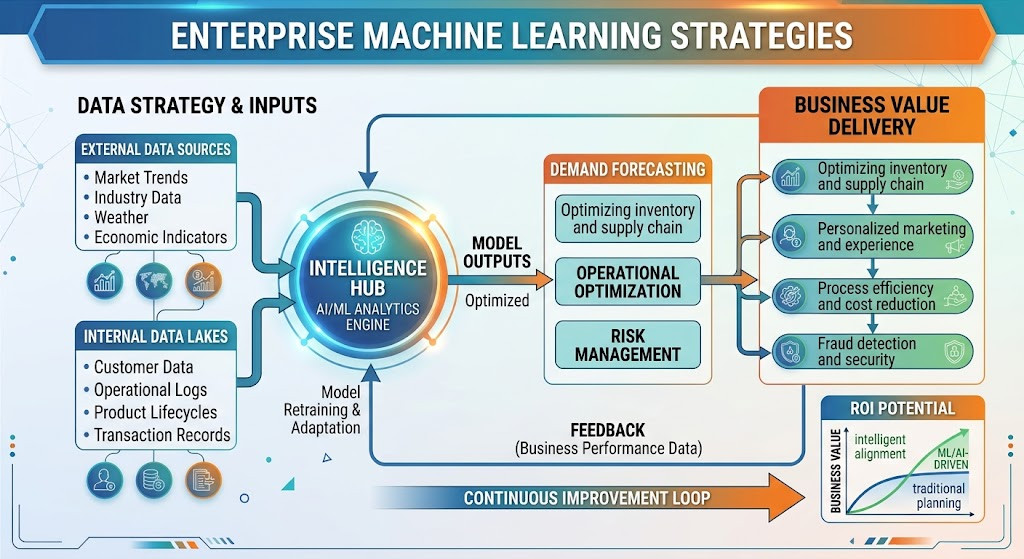
In today’s world of uncertain market dynamics, agility is the main goal of every business. Machine Learning (ML) provides the power to achieve agility and take actions from a more proactive rather than reactive stance. The integration of ML in business processes allows unlocking a wide range of benefits that touch all areas of business.
Operational Efficiency: More Than Just Automation
Operational efficiency is the most obvious and tangible benefit provided by ML. While automation takes care of rule-based repetitive tasks, ML is the best option for performing tasks that require some nuance.By making use of NLP algorithms for classifying thousands of tickets or computer vision methods for ensuring quality control during counting of inventory, you will enable your employees to refrain from performing tedious tasks prone to mistakes and devote themselves to accomplishing meaningful projects.
Data-Driven Decision Making: No More Guesswork
Every business manager understands what it feels like to take a decision lacking proper data.
Predictive analytics, which is an integral part of machine learning, eliminates guesswork by providing proof
Using historical performance data, market trends, and outside factors, ML algorithms are able to give an accurate prediction of future outcomes. If it is anticipating seasonality changes or finding out which product lines are going to be successful, ML gives businesses the vision required to adapt before the market change becomes a problem.
Improved Personalization at Scale
"One size fits all" marketing strategy is extinct. Modern consumers require a company to anticipate their needs rather than react to their actions. ML allows companies to analyze vast amounts of behavioral data – clicks, dwell time, purchasing history, and even sentiment analysis – and personalize consumer experience based on that. When a recommendation system offers exactly what the customer needs when they need it, you are no longer selling a product – you are building customer loyalty.
Risk Mitigation & Fraud Detection
For most companies, the biggest danger lurks right under their noses. Whether it's a complicated financial scam or an inconspicuous issue with your supply chain, it would be impossible for any human analyst to keep track of the sheer amount of data needed to catch every threat. Machine Learning systems are incredibly efficient when it comes to detecting "anomalies." Using the baseline of "normal" activity, they can spot deviations and enable the company to eliminate threats before they turn into serious financial and reputational damage.
Cost Saving: Scaling Without Hitches
Traditionally, scaling up your operations meant hiring more people. With machine learning, you're able to separate growth from rising expenses. With automation of backend processes and machine learning-powered forecasting, it's possible to handle a 10x volume increase without adding too many people to your payroll. By eliminating inefficiencies and making use of all available resources, ML guarantees minimal costs while you scale up.
3. Key Use Cases
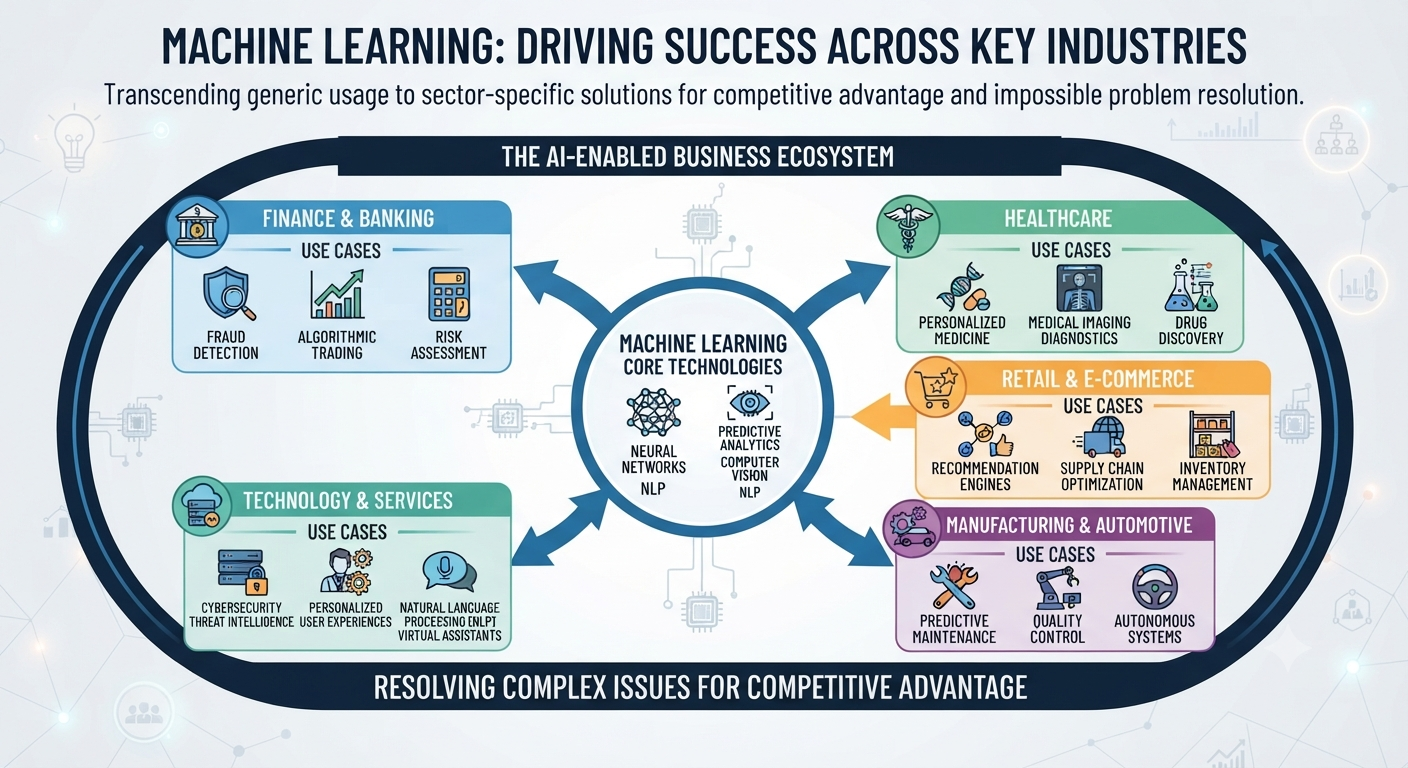
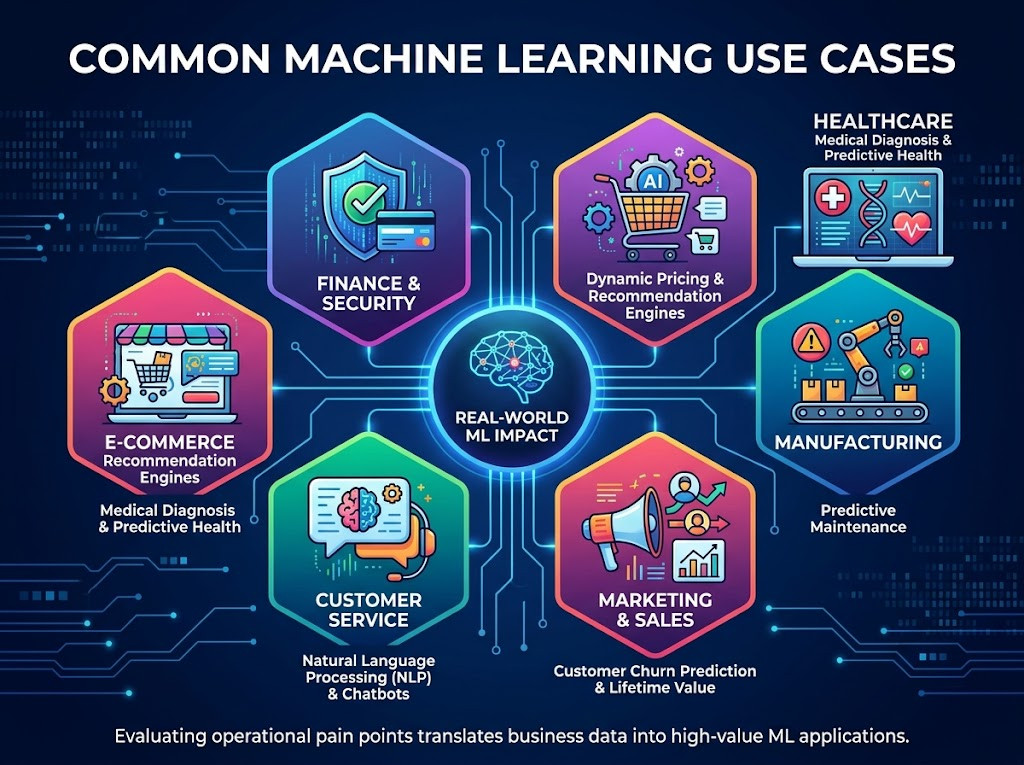
Machine learning is not an experimental phenomenon anymore; rather, it is the very driver of success for the world’s top-performing organizations. By transcending its generic usage to sector-specific solutions, ML helps businesses resolve complex issues which once seemed impossible. This is how different industries are capitalizing on this technology to extend their limits and establish a competitive advantage.
Marketing & Sales: Connecting with Customers
In the new digital economy, the success in marketing isn't about coverage anymore, it's about reaching the right customers at the right time.
-
Predictive Lead Scoring: Contrary to traditional practice, where sales leads were treated with equal importance, ML-based models process massive datasets, including website visit information, email activity and firmographic information, to determine what prospects are most likely to be converted. The ability to assign a predictive score to each prospect helps to save valuable time and increases the chances of success.
-
Dynamic Pricing Models: Dynamic pricing was originally applied by airlines and the world's largest ride-sharing company, but now with machine learning capabilities, every retailer has access to it. ML algorithms track competitors' prices, inventories, real-time demand, even weather conditions in some cases, and dynamically change the price according to the situation in order to maximize the revenue.
-
Recommendation Engines: Using purchase history, browsing and interaction on various channels, ML generates highly relevant recommendations for customers. It's more than just raising the average order amount – recommendation engines help to reduce the paradox of choice and guide customers towards purchasing.
Finance & Banking: Security and Precision
The finance industry allows virtually zero tolerance for mistakes, therefore requiring ML as a necessary instrument to handle complexity.
-
Automated Credit Scoring: Classic algorithms use insufficient data, thus excluding many people who could be qualified for lending. ML uses additional non-traditional parameters such as rental payments or power consumption, allowing to get a more complete picture of creditworthiness. In doing so, ML enlarges the pool of potential customers of financial services but still ensures the reliability of risk evaluation.
-
Real-Time Fraud Detection: Systems that process millions of transactions per second using ML technology detect abnormalities like impossible transactions or huge deviations from users’ spending habits within milliseconds. Such a preventive system saves banks billions of dollars per year.
Supply Chain & Logistics: Orchestrating Complexity
ML offers the insights and foresights required to keep the supply chain running smoothly in such an uncertain environment.
-
Predictive Maintenance: Sensors from the Internet of Things placed in the manufacturing and transportation equipment provide live performance data to ML algorithms, which help predict mechanical breakdowns in advance to schedule timely maintenance and avoid expensive unscheduled stoppages.
-
Demand Forecasting: By analyzing fluctuations during specific seasons, previous sales data, and economic happenings around, ML enables organizations to maintain ideal stock. This helps save the organization from the double-edged sword of stockouts, which cost them business opportunities, and overstocking.
-
Route Optimization: ML algorithms analyze multiple parameters including traffic conditions, weather conditions, fuel prices, etc., to identify the most optimized route.
Human Resources: Elevating Talent Strategy
-
Talent Acquisition Using AI: ML algorithms will examine thousands of CVs in seconds, ordering them according to their skill set and match. That way, the recruiter gets an opportunity to find a 'diamond in the rough' that may not get noticed by a human recruiter.
-
Employee Retention Analytics: Thanks to machine learning algorithms, HR managers can learn about early signs of employee burnout, lack of enthusiasm and motivation, such as a change in the level of engagement, less participation in internal communication channels, or a change in the speed of completing projects.
Customer Support: The 24/7 Advantage
Support in modern times involves the three main components of speed, consistency, and empathy.
-
Intelligent Chatbots & Virtual Assistants: In contrast to traditional bots that operated based on scripts and were very inflexible, modern virtual assistants, thanks to machine learning, use NLU technology for understanding the meaning and context of messages. The bots can perform complicated actions like processing of returns and can even defuse customers’ frustration. It guarantees round-the-clock expert support without proportional increase in personnel costs.
4. Implementing Machine Learning
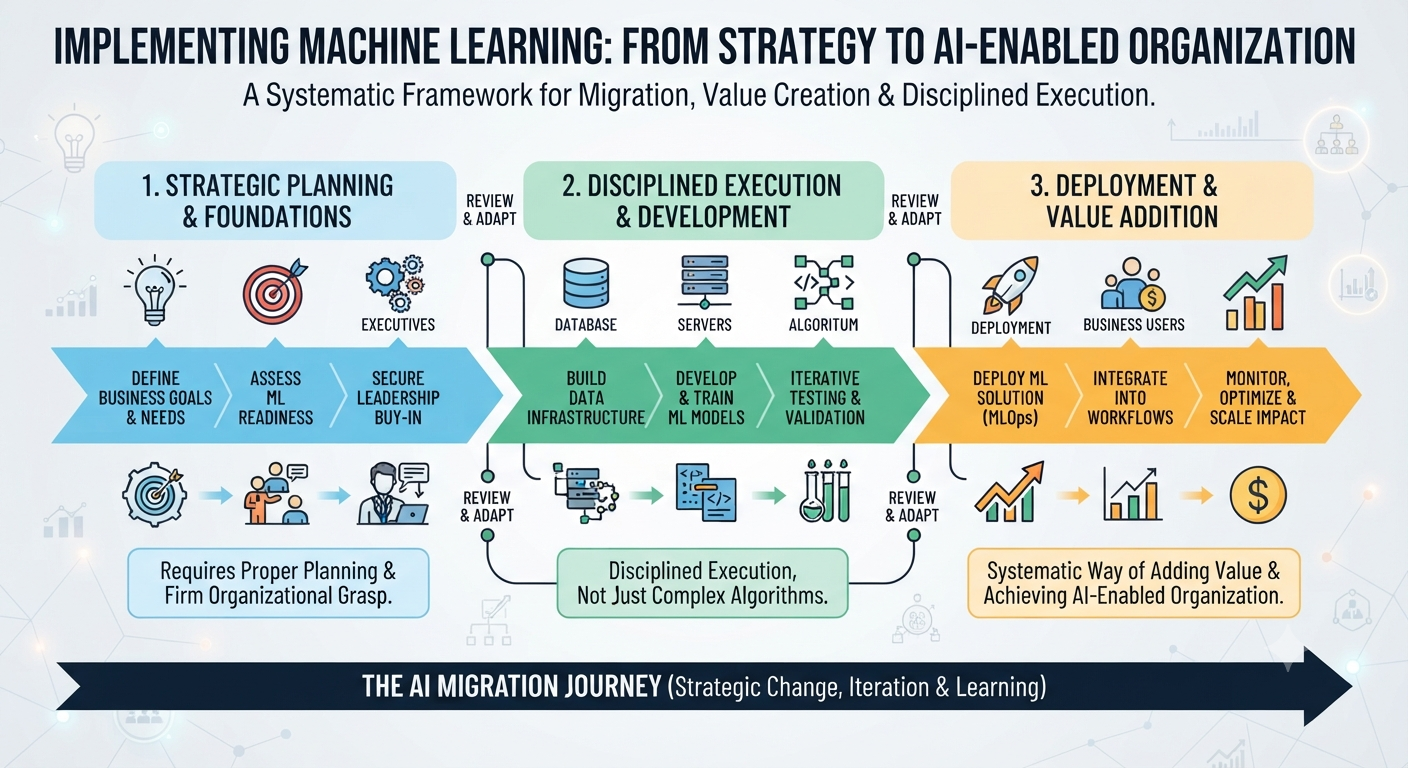
The migration to an AI-enabled business organization is not usually a “plug-and-play” affair. It involves strategic change, which needs proper planning, disciplined execution, and a firm grasp of the needs of your organization.
Successful deployment of machine learning (ML) involves much more than using the most complicated algorithm; what matters most is having a systematic way of adding value.
Spotting High-Impact Problems
The biggest mistake organizations make when adopting ML is getting the cart before the horse. This means starting with the technologies before they are actually sure of the problems at hand. Before seeking out skilled personnel and tools, one has to identify the following “high-impact” friction points:
Where you have plenty of quality data.
Where the process in question is repetitive but needs a certain level of nuance beyond what basic if-then automation can achieve.
Where improved performance would directly impact either revenue, costs or customer satisfaction.
To start off, begin small. In lieu of transforming your whole organization digitally, choose a particular small pilot project such as streamlining a small part of your supply chain or personalizing your email subject line to increase open rates.
The Importance of Data Quality
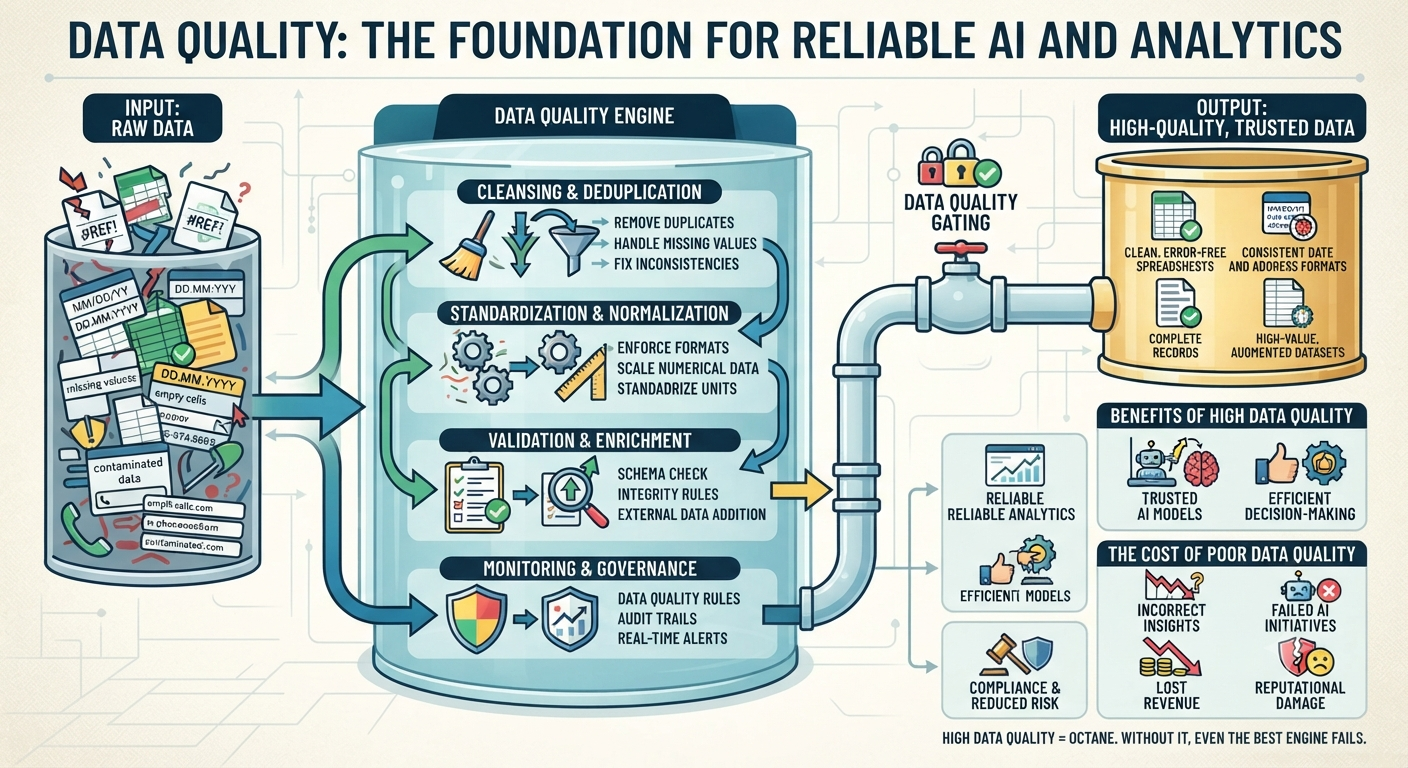
In the realm of Machine Learning, "Garbage In, Garbage Out" is the ultimate mantra. The algorithm is as good as the data with which it has been trained. Any flaws in historical data – lack of completeness or bias – would result in your model suffering from the same, which means inaccurate predictions and disastrous business outcomes.
Prior to going live with your models, spend enough money on "Data Hygiene". It includes consolidation of data silos, cleansing of historical data and proper governance policies.
-
Build vs. Buy: The Decision That Counts
Amongst all the decisions that the leadership has to take, one of the important ones is whether to create custom models in-house or rely on existing, SaaS-based, ML solutions.
Always opt for buying at the onset. You can get pre-trained models to help with sentiment analysis, demand forecasting or churn prediction.
You build an ML solution when the competitive edge depends on proprietary data or such a unique process that cannot be described using ready-made models. You will benefit from building ML from scratch in terms of customization and integration, but will need a data science team devoted to this project.
Measuring the Success: KPIs and ROI
But how do you measure success? You have to determine your KPIs even before you deploy your first ML model.
If you are working with the recommendation system, your KPI can be defined as "Average Order Value (AOV)" or "Customer Lifetime Value (CLV)." For a fraud detection system, the KPI is "False Positive Rate" and "Total Loss Avoidance."
ROI for ML is not just the cost of development but also the cost of doing nothing compared to additional efficiency, growth, and risk mitigation.It will be possible to clearly demonstrate the importance of your project to all stakeholders through performance metrics benchmarked before and after the implementation.
5. Challenges and Ethical Issues
To succeed sustainably, a company has to go beyond just technological problems and consider the difficulties related to the application of AI.
The Challenge of Data Privacy
Nowadays, data is the biggest asset for a business but also one of its greatest liabilities. As the ML models need large volumes of data to operate effectively, companies often encounter various issues associated with it. Besides the fact that there are different regulations such as GDPR, CCPA and others requiring governance of the process of data collection and processing, there is a problem of building customer trust.
To avoid any risks in this situation, it is necessary to use the "Privacy by Design" concept. It implies anonymizing sensitive data upon its collection, encrypting the data and creating clear data usage policy. In case customers trust the way the company treats their information, they will be more willing to cooperate thus supplying the company with the high-quality data necessary for ML models to work effectively.
Bias in Algorithms: The Fairness Mandate
These machine learning algorithms are not impartial; they are a product of the data that goes into them. If there are any biases present in the historical data used for your training—whether it pertains to gender, race, or socio-economic background—you can be certain that your algorithm will be biased as well.
This is not only an ethical obligation but also a serious business risk. Your recruitment process or your credit scoring algorithm could easily cause reputational disaster and possible legal repercussions if they are not free from bias. When it comes to achieving fairness, you will need to audit the training data set for its representativeness as well as use "explainability" systems.
The Skills Gap: Closing the Talent Divide
Most companies experience paralysis because of the lack of AI professionals, but the answer might not be in hiring just one or two PhDs.
What needs to be done is to take a dual approach. Enhance your existing employees, analysts and software engineers who are familiar with your industry, through the use of “low-code” or “no-code” ML systems.
Also, make sure that you cultivate a data literacy environment in the whole company. This way, when the non-technical people have an understanding of the logic behind ML suggestions, they will be great collaborators in finding valuable cases.
Integration Challenges: Managing Legacy Systems
One such challenge, which tends to be the least talked about, is “technical debt” in terms of legacy systems. Legacy systems are used by most organizations because they are not designed to deal with the kind of data processing needed by ML.
Adding ML into these legacy systems tends to be the toughest aspect of implementing ML. It would be unwise to rip out everything and start fresh with something new. The better approach would be to take a modular approach whereby you design an API layer around these legacy systems such that they can send data to a data lake running your ML models in the cloud.
6. Future Trends
The development of machine learning is evolving and going from experiments to ubiquitous, smart infrastructures. Looking ahead into the future, there are several important developments that we are going to see that will transform businesses.
Generative AI Becomes Part of Business Processes
Currently, we experience the move from "predictive" AI to "generative" AI. While earlier machine learning models were developed in order to be used for analyzing data and predicting something, now the models are capable of generating something new, such as texts, codes, and design elements.
The future of businesses will consist of combining both methods: the prediction of customers' needs with the use of machine learning and creation of a personalized response through the use of generative AI.
MLOps and Scalability
With hundreds of models being used by companies, the limitation is no longer development but operations. This is where MLOps, or Machine Learning Operations comes into play – a method of automation of the ML model's lifecycle management. The same way DevOps was a game changer for software deployment, MLOps brings an approach to continuous integration, deployment, and monitoring of ML models. This is essential for scalability – models should be accurate, secure, and efficient even under new market conditions and changing data flow.
Small Data ML
The talk about "big data" has been around for many years, overshadowing small companies. But now we are entering the era of "Small Data" machine learning. With the use of transfer learning and data synthesis, companies will be able to train highly efficient models based on small or niche data sets.
Hyper-personalization: The "Segment of One"
We are going from the large demographic groups to the “segment of one.” With ML in real time, businesses will be able to give the person a personalized experience based on their current situation, mood, and intention. It is the kind of hyper-personalization which will turn the marketing funnel into an entirely new process of communication.
7. Frequently Asked Questions (FAQs)
What is the difference between AI and Machine Learning?
Machine Learning (ML) is a particular part of AI in which algorithms learn from the patterns of data to achieve the desired result without being coded for such a purpose.
How long will it take me to see ROI from using ML?
It depends on the type of use case. If it is simple automation (like chatbot support), then it takes several weeks. Predictive analytics is more complex and may take up to 6 to 12 months of data learning and integration.
Do I need a data science team for my business to implement ML?
Not really. You do not need to employ such a team if you want to train models yourself. There are quite many "no-code" or "low-code" SaaS services that provide the option of using ready-made models of Machine Learning.
Is Machine Learning secure enough for enterprises to use?
Yes, if it was developed based on "Privacy by Design." Modern Machine Learning environments are very safe if they use strong encryption, safe APIs, and comply with such standards as GDPR or CCPA.
Will Machine Learning be useful for my small company?
Of course. "Small Data" Machine Learning will enable you to get impressive results with the help of transfer learning technology, making AI work effectively despite not having large data pools.
What is the main prerequisite for starting an ML project?
Quality data. The quality of ML algorithms depends entirely on the quality of data used. Prior to starting your ML project, concentrate on preparing your existing data silos.
How can I find the right pilot project for my ML?
Select high-impact, repetitive activities which produce large amounts of digital data and in which current processes are inefficient or inaccurate.
Can ML take over human decision-makers?
No, ML technology was developed as an aid to enhance human intelligence through predictive analysis so that the management could make better decisions.
What is "MLOps"?
MLOps are operations associated with automation of the lifecycle of ML models development, deployment and maintenance of their performance accuracy and stability through changing business data.
Does there exist a chance of bias in algorithms?
Yes, algorithms are biased in accordance with the past data. It is important to audit the training datasets and use explanation tools to guarantee fairness of automated decisions.
8. Call to Action
Machine learning has grown from being just an emerging technology to becoming an indispensable element of today’s corporate strategy. Whether it is used for increasing efficiency, making decisions based on data, personalising client experience, and discovering new opportunities, machine learning provides companies with concrete means for gaining competitive advantages.
At the same time, its effective application implies not only adoption of advanced technologies but also the availability of quality data, clearly stated goals, relevant competencies, and an appropriate ethical and data protection approach. Small-scale pilots may be helpful for such an undertaking.
With the development of technologies such as generative AI and MLOps, the scope of machine learning applications is bound to expand further. The companies that know how to exploit them strategically will find themselves in the advantageous position where they could leverage their efficiency, adapt to the changing demands of customers, and develop further.
In GigMint.ai, we work together with businesses to create a connection between the current situation and the potential that is inherent in artificial intelligence and machine learning. Whatever your level of experience in using these solutions may be, whether you are planning your first ML pilot project or developing an existing solution, our experts will help you.
Are you ready to embark on your journey of transforming into an AI and ML enterprise? Learn how GigMint.ai can help you in doing that.