Navigating the Modern ML Landscape: From Prototype to Production
Navigating the Modern ML Landscape: From Prototype to Production
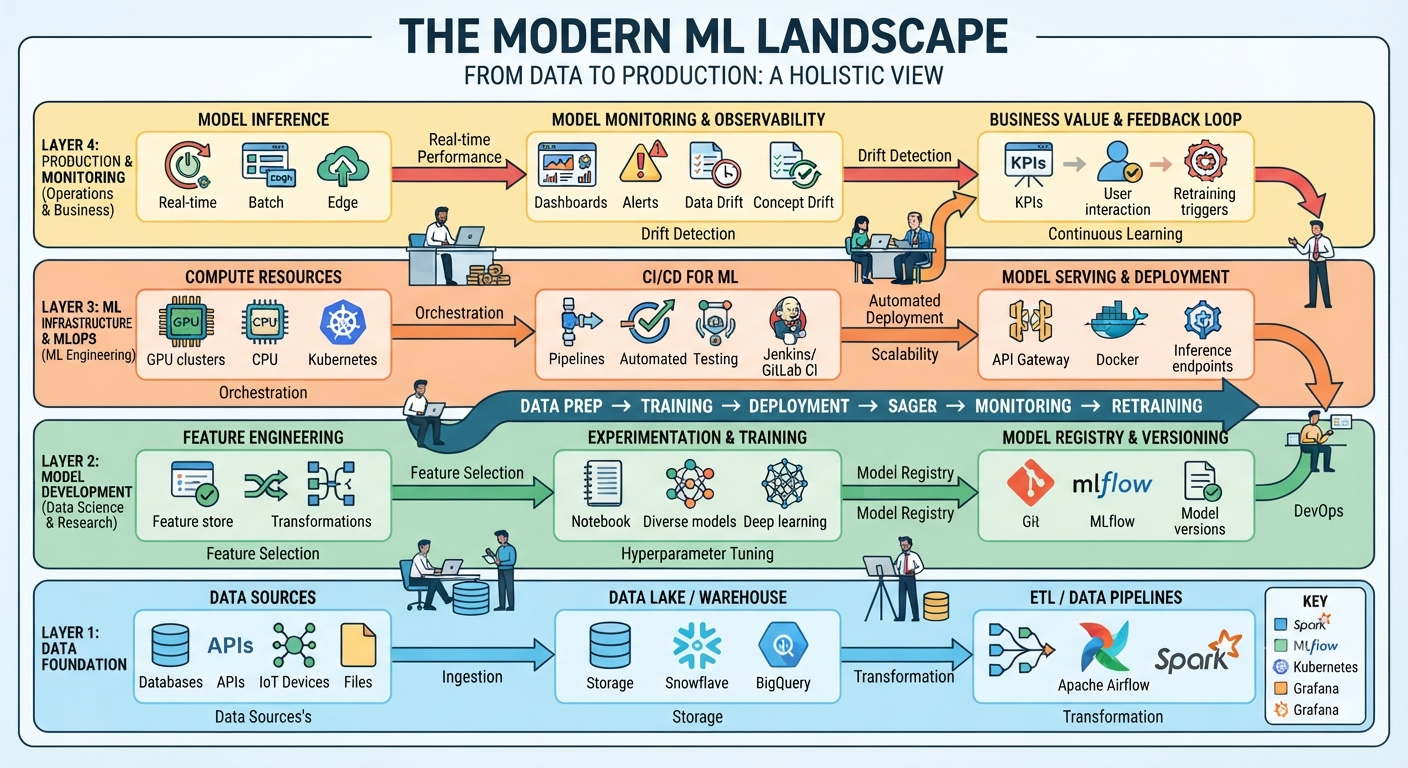
The golden age of artificial intelligence is no longer characterized by the excitement of "what does it do?," but by the tough question of "how does it scale?" Though there are many exciting developments around generative AI models and workflows, the difference between a cool demonstration in a lab environment and a solid, scalable application is as big as ever before.
Despite the huge investments that companies keep making in their AI infrastructures, many fail to see any positive ROI on these investments because they overlook how complex it is to translate a neat little proof-of-concept into a production-scale project.
It is the gap described above where the biggest challenges in Machine Learning lie. It is not about algorithms or even computing resources anymore. It is about a complete rethinking of the development process as well as the endurance of the team to withstand all those challenges of working with real-life datasets and infrastructure.
That is where the need for this guide comes in. In the course of this guide, we will be breaking down the most common challenges faced by today’s machine learning process. Starting from problems with data quality all the way to technical, operational challenges and the need to manage responsible AI. Going beyond just implementation and applying the strategic approach provided herein will allow you to make your experimental AI venture a lasting one.
Solving the Data Quality Crisis
Many teams rush headfirst in pursuit of complex algorithms when developing models without stopping to consider the source material behind them: data. The industry has recognized the simple truth that if there are fundamental issues with the data, then the only thing that will save you from failure is not tuning your model's hyperparameters, but fixing the data itself. Solving the problem of data quality is one of the most crucial steps for overcoming the typical difficulties associated with Machine Learning.
Solving the Problem of Noisy and Incomplete Data
Contrary to what we usually see in the benchmarks from academic publications, real-life data is often noisy, full of missing values, and is liable to corruption. Automated pipelines have become a requirement rather than an option.
Rather than manually inspecting data for quality, today's pipelines use automated feature generation along with statistical methods to validate them.The methods of MICE and K-Nearest Neighbor (KNN) enable the extraction of useful features without the introduction of any artificial bias, while at the same time making sure that “garbage in, garbage out” cycle does not happen due to automated anomaly detection during the process of data ingestion.
Data Imbalance: Beyond Oversampling
An imbalanced data set, where one class has far more instances than another, is an archetypal bottleneck, in such fields as fraud detection and medical diagnostics in particular. While the standard method of addressing the problem, which includes, for instance, the application of the SMOTE algorithm, surely has its strong sides, it is still likely to lead to overfitting.
The contemporary solution lies in the synthesis of new data points through the use of generative adversarial networks (GANs) or diffusion models, which synthesize high-quality representations of the minority class without simply reusing existing data points. Cost-sensitive learning, where the optimization problem is tailored such that it penalizes classification mistakes for the minority class with greater severity, has become a common approach.
The Shift to Data-Centric AI
One of the biggest transformations currently taking place within AI is that of the transition from “Model-Centric” AI to “Data-Centric AI.” In the past, the objective has been to ensure that the data remains the same and iteratively improve the model. In today’s world, it is important to note that smaller, curated and better quality datasets beat larger and noisier datasets every single time.
The emphasis on the quality of the dataset over the quantity allows the team to iterate faster and become more interpretable. This includes strict data labeling practices, active learning where the model is able to understand which data it needs for learning, and constant monitoring for distribution changes in data. This approach ensures that the model created is not only accurate but resilient enough to cope with the dynamic environment of production.
Navigating Model Complexity and Selection
Whereas in previous stages of development, organizations had issues with their data readiness, at this stage, the problem lies with architecture choices. Indeed, it is quite tempting for companies in 2026 to apply the biggest model out there. It is important to keep architectural sophistication within limits of the actual operation. Successful implementation at this stage rarely has to do with selection of "the newest" model, but rather with selecting the "correct" one.
The Problem of Overfitting vs. Underfitting
In an age of big neural networks, the traditional problem of overfitting vs. underfitting has become more sophisticated. Overfitting describes a situation when the model captures the noise of the data, rather than the underlying trend, thus not being able to generalize in production settings. Underfitting means that the model was too simple for the data at hand.
For overcoming the problem of overfitting vs. underfitting, the use of traditional train/test splits is no longer sufficient. The use of K-fold cross-validation remains the gold standard but in cases where high dimensional models were developed, we also apply Early Stopping by the validation loss, Dropout in neural nets, and L1/L2 regularization of the coefficients.
Moreover, the move towards Weight Decay and Stochastic Depth becomes crucial in the case of deep, transformer-based models. It aims at making sure that the model will learn generalizable features instead of learning each particular example. Through a strict monitoring of the "generalization gap," which is the difference between training and validation results, one can tune the hyperparameters to get to the "Goldilocks zone" of the ideal model complexity.
Algorithm Selection: Objectives vs. Architectures
The frequent error of an ML strategy is the "performance at all costs" approach. In the context of highly regulated environments such as finance, medicine, and law, no matter how accurate, a black box model is often a disadvantage. When choosing an architecture, it is important to Evaluate Predictive Performance and Model Interpretability.
In case of efficiency being the sole aim, such as in recommendation systems or real-time bidding, deep learning architectures can be used. In other cases, when it comes to decision-support systems where people have to know the reasons behind a particular decision, less sophisticated models like Gradient Boosted Trees or even Bayesian models usually work better than complicated deep neural networks.
Our recommendation is a "tiered architecture" strategy:
Baseline: Create an interpretable model first to set the performance level.
Challenger: Build a complex model to see whether the performance gain is worth the loss of interpretability.
Audit: Employ SHAP and LIME approaches to explain your model predictions. When your "challenger" fails to be interpreted for a stakeholder, it may be safer to go back to baseline or hybrid solutions.
Scaling Agentic AI: Challenges in 2026
2026 marks the emergence of Agentic AI—systems that do not merely predict, but take action on their own. Scaling agentic systems poses new obstacles that traditional ML pipelines are not designed to address. Whereas predictive models work statically, agents work in dynamic cycles, needing state management, tool utilization, and ability to correct themselves.
The main challenge here is Agentic Drift and Loop Instability. In case an agent performs a task that consists of several steps, one error in the first step will carry throughout the entire procedure resulting in catastrophic consequences.
In order to deal with that, developers need to implement:
Human-in-the-loop (HITL) Gateways: Steps that require approval for each action of significance.
Semantic Memory Management: Making sure that the agents have context while working in long-lasting and multi-agents collaborations.
Deterministic Tool Guardrails: Defining clearly what input and output each external tool should get from the agent to avoid "hallucination-led" failures.
Scaling agentic systems calls for treating the AI like an employee
Bridging the Prototype-to-Production Gap
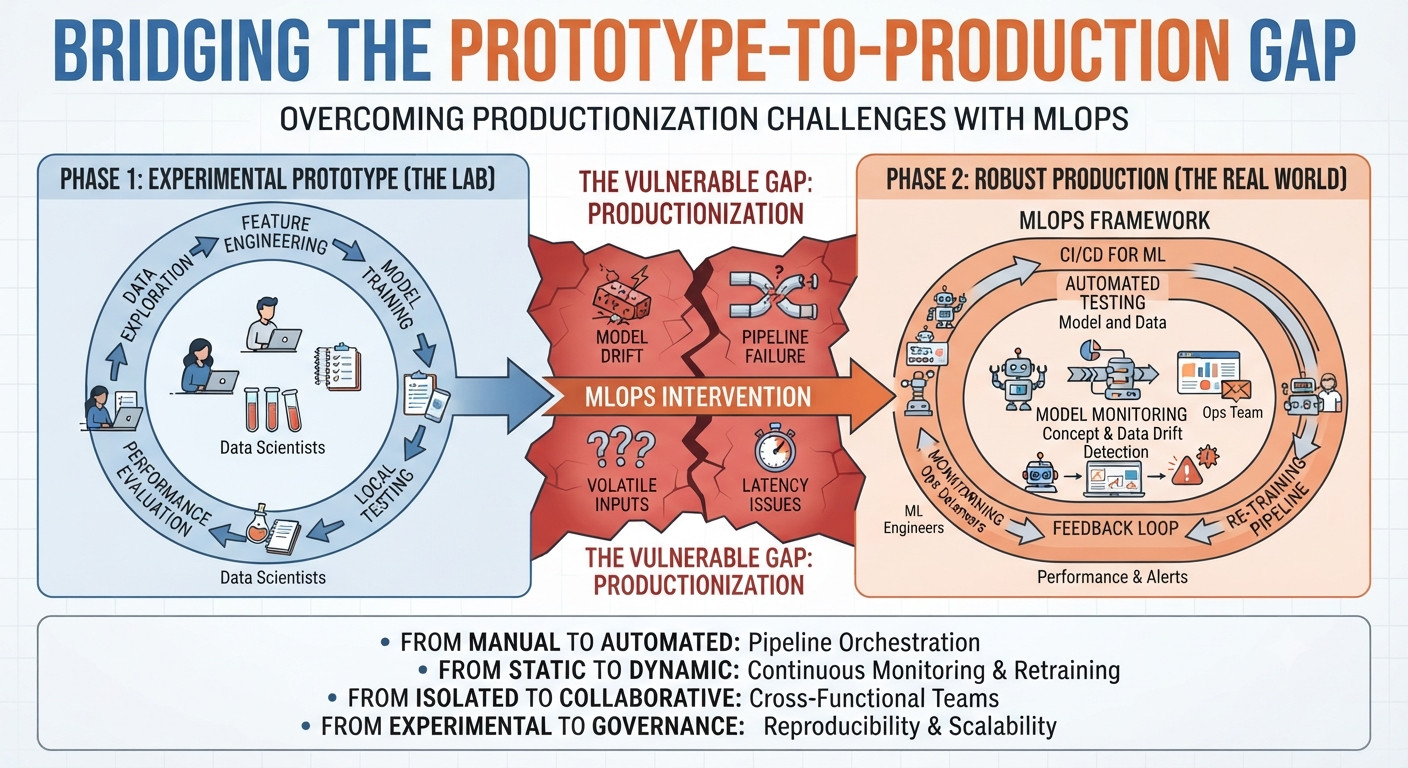
The most vulnerable part of the ML lifecycle is called "productionization"—the moment when a well-performing model is introduced into a setting of volatile input variables. As much as the performance of a model is optimal in the controlled environment of a lab, once in production, it can be subject to a whole range of Machine Learning issues. In order to overcome this barrier, it is essential to go beyond the scope of experimental data science into the area of MLOps.
Computational Costs and Resource Optimization
As the models become more complex, their “tax” on the underlying infrastructure also increases. Scaling an AI project without having a solid approach to optimizing resources is one of the main reasons behind projects' failure in 2026. The core of the problem is efficiency at the architectural level.
-
Hardware acceleration: While using specific hardware (TPU/NPU) is only a start, teams should apply tricks such as quantization (switching model weights precision from FP32 to INT8/FP8) to significantly decrease the memory size and latency while still maintaining accuracy.
-
Knowledge distillation: We suggest applying a "student-teacher" approach when training a small, fast model using the output of a big heavy model as input.
-
Model pruning: Reducing the number of neurons or attention heads that do not have much impact on the output can result in more efficient ("thinner") models.
Model Drift and Monitoring: Implementing Real-Time Feedback Loops
A model that is in production is a living being; its usefulness may become obsolete owing to change in the underlying data (data drift) or changes in the distribution of input variables and target variables (concept drift). "Silent failure" is something to which we should say goodbye; passive monitoring is not enough any more.
We propose a Continuous Monitoring Framework that should do more than just recording loss:
-
Performance Tracking: Creating live dashboards where the live prediction distribution can be compared with the baseline training distribution.
-
Feedback Loops: Creating an event that will automatically trigger retraining of the model if its performance level falls under a certain threshold.
-
Monitoring Distributional Drift with Alerts: Applying statistics like Kolmogorov-Smirnov to monitor the distributions of input variables. If there is significant deviation between the "unseen world" and the "training world," then humans need to be notified right away.
Scalability and Orchestration: Managing Complex Multi-Agent Workflows
In the age of agentic AI, the production processes are characterized by complex dependencies of many stages in a workflow. In contrast to conventional software services, multi-agent workflows are inherently non-deterministic, making orchestration quite challenging.
Pipeline Orchestration: Tools that can perform the functions of task scheduling and dependency management (e.g., DAGs) are necessary. The ability of teams to track the "provenance" of the decision made by an agent is useful because it will help track the individual steps in a multi-step workflow.
Patterns for Resiliency: To deal with the uncertainty of LLM-based agents, we suggest using circuit breaker patterns. Whenever an agent does not produce a proper output or encounters a processing timeout, the system is able to automatically switch to a backup model or some kind of recovery routine.
Infrastructure as Code (IaC): The approach when the deployment of an agentic environment is considered code allows one to avoid "environment mismatch" issues that happen in many cases and become one of the main reasons for production downtimes.
By incorporating the mentioned practices into the development process from the very beginning, one can ensure that his/her AI assets are robust, economical and adaptable under changing market conditions.
Building Responsible AI Systems
As machine learning becomes more and more entrenched within the fabric of our society’s critical infrastructure, competence alone is not sufficient. In order for 2026, the following is imperative: being competent, AI must be responsible as well.The failure to consider ethical considerations and governance at each phase of the product’s development process is not an acceptable risk; it is a significant business liability that may lead to severe damage to your company.
Addressing Algorithmic Bias: Audit and Mitigation Approaches
It should be noted that bias is not just something that happens due to data problems; it is a problem in any kind of learning system based on past data. These kinds of biases may perpetuate or even exacerbate existing social inequality.
What we advocate is the "Audit by Design" approach. It should be done by implementing the following steps, without depending on outside reviews or breakdowns:
-
Diverse Data Sampling: Checking training datasets for representational differences in different demographics or contexts.
-
Adversarial Fairness Training: Including a separate "adversary" model in the training process that would try to predict some sensitive attributes (race or gender) based on the predictions of the main model. In case the adversary succeeds, the model gets penalized and forced to use representations unrelated to these attributes.
-
Metrics of Fairness: Calculating metrics like "Equalized Odds" and "Demographic Parity" during the normal model validation process.
Model Interpretability (XAI): "Opening the Black Box"
"Black Box" is the main issue in fields where the stakes are too high – such as medicine, law, and corporate finance. The lack of understanding is natural since nobody wants to put his life at stake because of some unexplained decisions.
In order to fill in this gap, Explainable AI (XAI) should be used:
-
SHAP (SHAPley Additive explanations): With the help of game theory, SHAP makes it possible to calculate the "importance value" for a certain feature of a certain prediction and explain in a mathematical way the rationale behind the decision of a model.
-
LIME (Local Interpretable Model-agnostic Explanations): LIME is crucial when one needs to interpret predictions made by a model. It helps to do this by modifying input data and examining how the output of a model changes.
-
Stakeholder-centric reporting: We strongly recommend to translate results into understandable descriptions for non-technical stakeholders.
Security and Privacy: Protecting Models and Data
Modern machine learning models become highly vulnerable to a variety of attacks that range from data poisoning to model inversion attacks, where an attacker tries to reverse engineer the sensitive training dataset based on the trained model's output.
The protection against these vulnerabilities entails:
Differential Privacy: It is possible to ensure the model is capable of learning the general features by adding a certain mathematical "noise" to the model's learning process.
Adversarial Robustness: It is possible to create the scenario of red teaming, where the model is exposed to various adversarial attacks, such as gradient-based evasion attacks.
Governance Pipelines: An immutable audit trail for tracking the lineage of the model – from the version history to data lineage and all approval gates to meet the regulatory requirements for AI around the world.
In order to build resilient artificial intelligence systems, it is necessary to change the approach: security and ethics should become a bedrock for trust and innovations.
How to Build a Resilient ML Culture
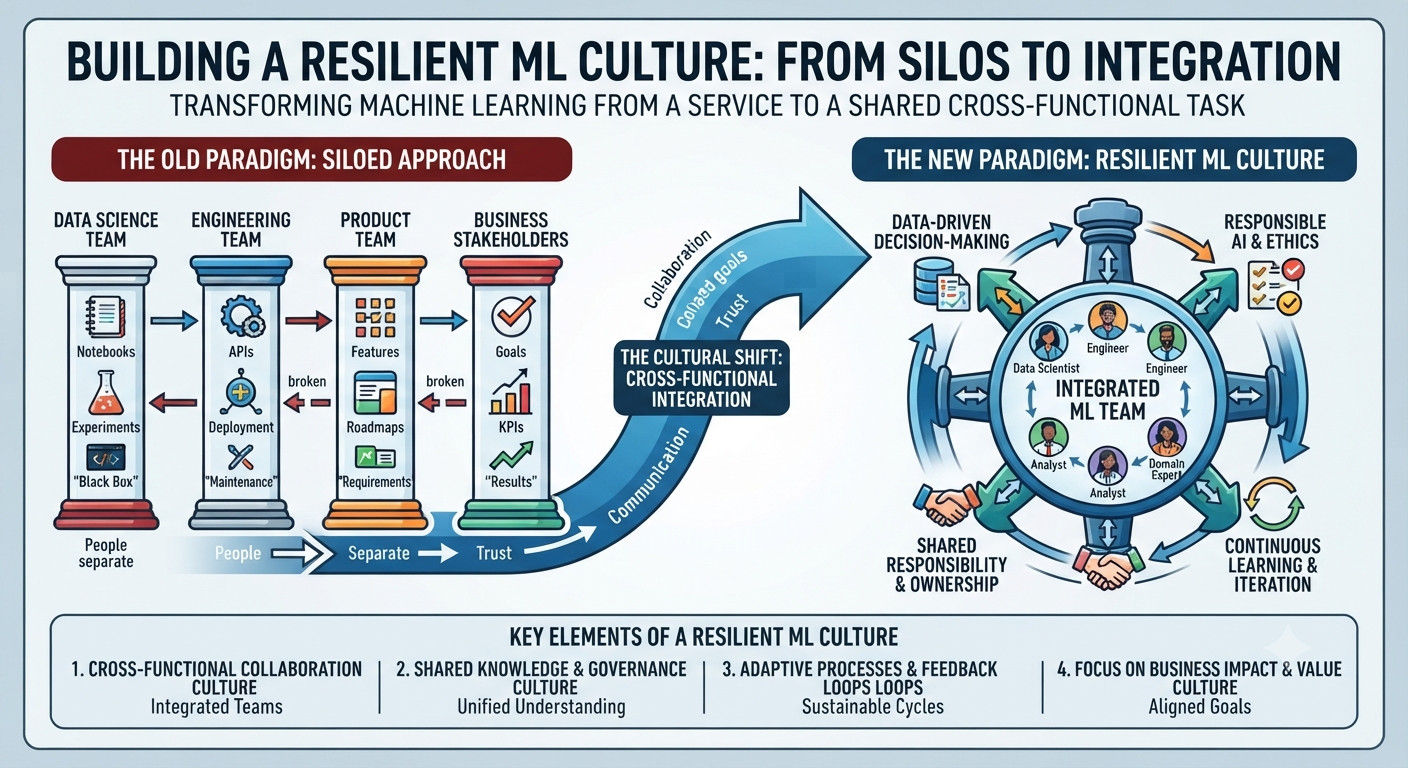
Many of the issues within Machine Learning that have been described earlier in this paper are not purely technical in nature. They stem from the siloed structure of organization. To create effective, sustainable AI, companies need to move away from treating ML as a black box service provided by the engineers to seeing it as an integral cross-functional task.
Closing the Gap with Cross-Functional Collaboration
The translation gap between domain SMEs that understand the business logic and know what exact problem is being addressed and data scientists developing the models is the most common reason for failures of enterprise AI.
We propose establishing "Product-AI pods" that include:
Domain SMEs – bringing information about restrictions of the data and the regulatory requirements of the business.
ML and Data engineers – implementing technical parts of the project and ensuring the efficiency of MLOps pipeline.
Business liaisons – keeping track of the ROI and relevant KPIs.
Redefining Success Metrics: Moving Beyond Accuracy
Early in the project life cycle, "Accuracy" is a nice vanity metric. In practice, this may turn out to be a misleading metric. A model with 98% accuracy that performs badly in 2% of those cases, where the cost of failing is highest, is an overall failure.
The engineering team should start using "Objective-Aligned Metrics," including:
Metrics for Value: Calculation of the value of the business venture based on increased revenue, cost savings, or reduction in time to perform each task.
Operational Metrics: Latency, costs of infrastructure per request, and availability.
Resilience Metrics: Performance of the system during “edge case” testing instead of regular test sets.
As the success criteria are changed from a leaderboard score to the end-user value delivered, the incentive for the engineering team to build reliability into the solution becomes natural.
Iterative Development: Why "Fail Fast" is Critical
Complexity of the contemporary AI technologies implies that a "waterfall" approach to project management, which involves building the whole product before deployment, is doomed to failure. The concept of "failing fast" does not imply any recklessness, but a quick testing of hypotheses.
Focusing on modular and iterative development allows one to:
Test Assumptions Quickly: To make sure that the data includes a signal needed to solve the problem before wasting months on architecture.
Minimize Sunk Costs: In case something goes wrong, it would be better to iterate or change the approach, instead of forcing the failed algorithm to work.
Feedback Loop: Use each release to obtain real-world performance metrics to optimize incrementally.
Resilient cultures understand that failure is just another piece of data. One can use an experimental strategy to be able to address the uncertainties related to AI implementation.
Future Outlook: The Path Forward
The path from a potential Machine Learning prototype to a stable product ready for production is inevitably complex. In this respect, as you've seen through this guide, the most challenging Machine Learning aspects of 2026 can hardly ever be reduced to just one technical problem. Rather, they will involve the intersection of strict data management, architecture, operations and ethical governance.
In the coming years, the nature of these challenges will evolve into something new – emergence of autonomous agentic systems. With the advent of machine learning that performs not individual tasks but coordinated operations of several agents, the need for precision, interpretability and orchestration will become even more important. Businesses focused on "fail fast" approach, data-centric architecture and removal of existing barriers between engineers and domain experts will become leaders of the industry.
Success in this context won't mean only having the latest models. It will mean having a robust system that enables your team to cope with uncertainty, minimize technical debt and make sure that you get the return on your ML investment.
Ready to Overcome Your Machine Learning Challenges?
Gigmint.ai, we know that our strength lies in helping top teams make the transition from experimentation to production possible. Whether it’s MLOps strategy or AI governance, agentic architecture optimization, Gigmint.ai can help bring your ML vision to life.
[Learn More about Our MLOps Consulting Services] or [Get in Touch with Our Strategy Team Right Now] and see how Gigmint.ai can help you advance your organization.
Frequently Asked Questions (FAQ)
1. Why is the quality of the data the biggest ML problem of 2026? The more commoditized machine learning models become, the more important the data itself becomes. Only good data that is curated and representative of reality will help you avoid a "garbage in, garbage out" situation in production.
2. How can I make sure my machine learning model is both performant and interpretable? It depends on the objective of your business. In critical industries, such as finance or healthcare, choose "glass box" architectures or use XAI techniques like SHAP and LIME for interpreting neural nets.
3. What should I do about data drift? Create a system for constant monitoring using statistical tests such as Kolmogorov-Smirnov test for detecting drift.
4. How can small teams control computational costs? Consider model efficiency approaches such as quantization, pruning, and knowledge distillation. You will be able to preserve your performance while cutting down significantly on the amount of hardware and latency you need.
5. Can "fail fast" be a safe strategy in enterprise AI? Yes, provided it is done through an iterative and modular process of development. This lowers sunk costs and enables teams to prove their hypotheses at an earlier stage.
6. What are the consequences of ignoring algorithmic biases? Other than ethical considerations, the ignoring of biases carries the threat of failure of your AI systems from a regulatory, legal, and brand perspective.
7. How can I defend my machine learning models from adversarial attacks? Apply methods such as differential privacy and robustness training to protect your machine learning model from any attempts to poison the data and invert the model.
8. What reasons explain the failure of many ML projects to go into production? In most cases, the cause is the gap between the prototype and the product, which occurs because of the absence of operational excellence (MLOps), organizational silos, and disregard of real-world environmental unpredictability.
9. What is the meaning of "Product-AI Pods"? It means cross-functional teams that comprise domain experts, data engineers, and business partners and whose purpose is to keep AI development relevant to the business value.
10. How is AI moving to agentic systems? Machine learning is going beyond one task inferencing toward multi-agent workflows where autonomous systems need to plan and perform actions.