Top 10 Real-World Applications of Machine Learning
Top 10 Real-World Applications of Machine Learning
I. The Era of Intelligent Infrastructure
The transformation of AI from a mere subject of theoretical research into actual, real-world technology underpinning global commerce represents one of the most pivotal technological revolutions in modern times.
What began in the realms of science fiction literature, university laboratories, and scholarly publications is now driving the behind-the-scenes machinery of our daily lives, determining how we travel to and from our offices on busy city streets, tailoring the content we see in our leisure hours, and safeguarding our money from cyber threats originating outside national borders.
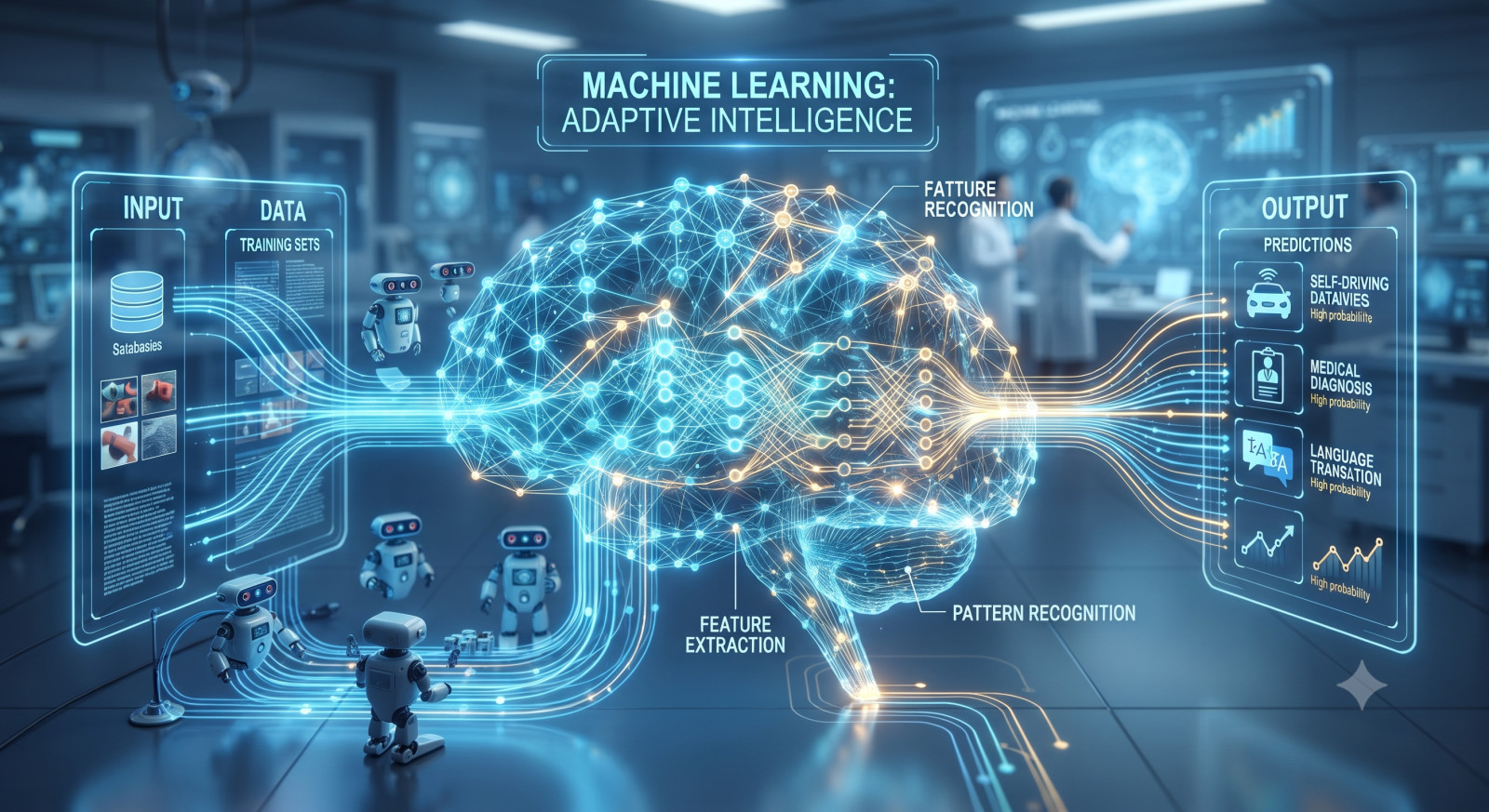
Central to this revolution is machine learning (ML), an active and developing field of computer science, which allows for the operation of software programs in learning from complicated data sets, recognizing patterns, and making autonomous decisions.
In today’s world, machine learning has emerged as the solid foundation of all modern innovations in various industries by completely redefining possibilities when it comes to business process efficiency, automated problem-solving, and highly engaging user experience.
As companies from all kinds of industries compete to implement predictive analytics and intelligent automation in their processes, the need for qualified engineering talent has become more important than ever before.
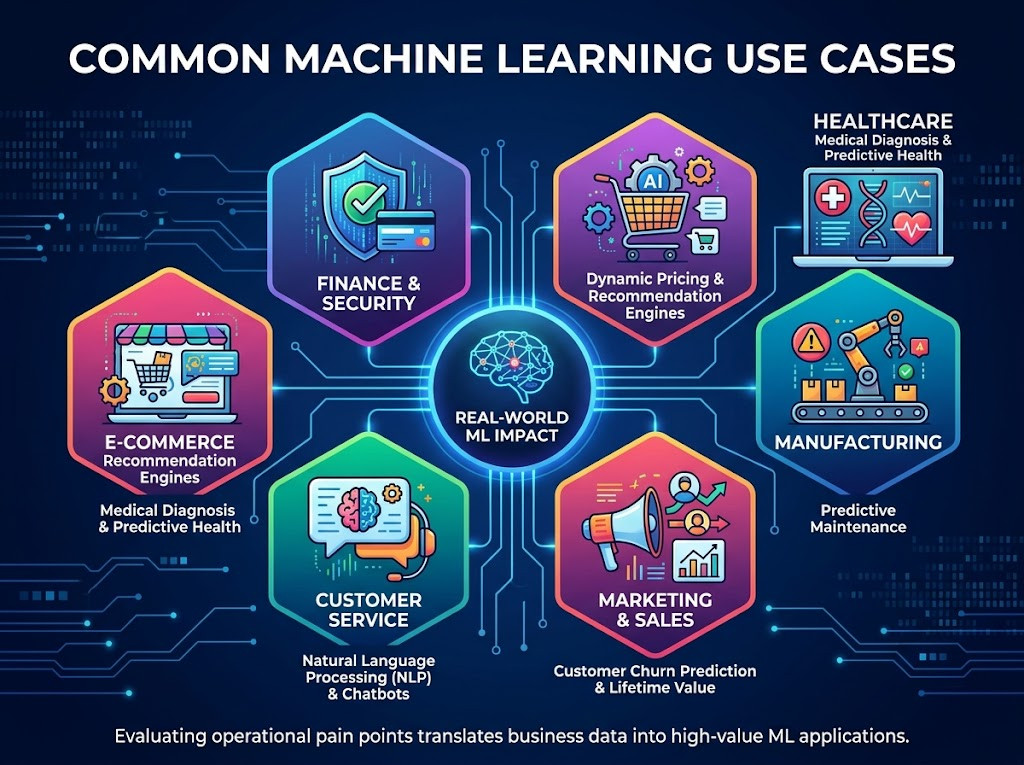
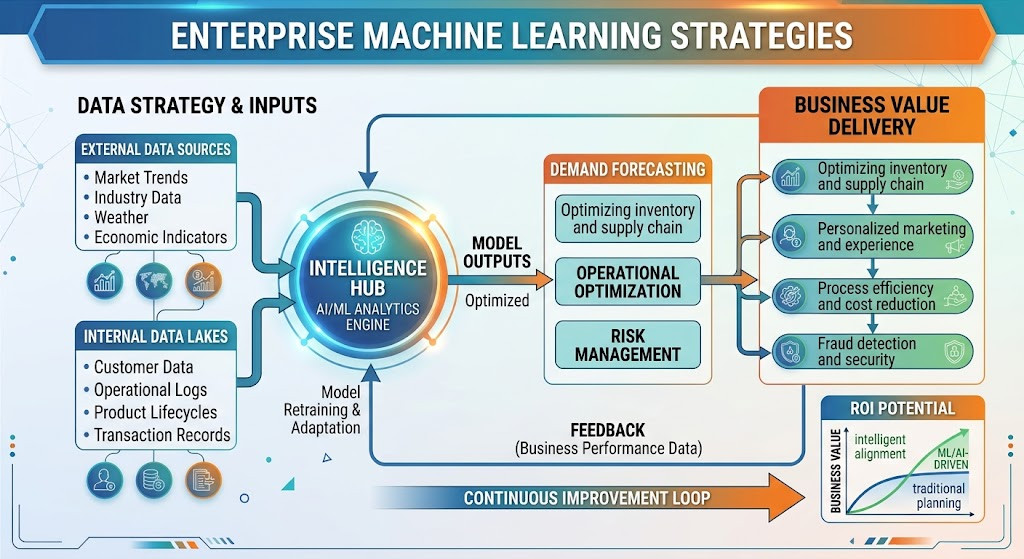
The platforms such as gigmint.ai act as the essential marketplace for innovative digital talent and solutions, bringing forward-thinking companies and the best ML engineers and data scientists together to create these game-changing systems. This detailed article looks into the top 10 Real-World Applications of Machine Learning, showing how these machine learning examples and applications of AI and ML are changing the world of industries.
Section 1: Healthcare and Diagnostics
Transforming Patient Care Through Predictive Diagnostics
In the realm of healthcare, time is of the essence, and there can be nothing more important than complete precision, where one's life may depend on a few moments. Now, machine learning has become a true partner of clinics for diagnosing complex conditions, studying patients' medical history and planning treatment for them for a very long time ahead. By analyzing huge amounts of data from EHRs, genomic sequences, and real-time diagnostics, ML finds hidden patterns and signals, which even the most experienced doctors would ignore.
The Technical Architecture Behind Medical ML
High-dimensional data ingestion pipelines are essential for healthcare machine learning models. CNNs and ViTs are used for analysis of medical images. These algorithms are trained using millions of labeled and anonymized data sets and learn to detect pixel-level abnormalities that represent early stages of diseases. RNNs and transformer-based algorithms analyze sequential electronic health records to predict the deterioration of patients’ condition hours before any symptoms become clinically visible.
Real-World Example
Think about the immense use of CNNs in contemporary medicine. The deep learning algorithms that have been fed by millions of labeled and anonymized medical images can accurately diagnose early signs of physiological abnormalities like micro-calcifications in mammograms, neurodegenerative changes in brain scans, or pulmonary nodules, often more quickly and more precisely than exhausted radiologists. These deep neural networks pinpoint areas of interest through bounding boxes and provide a second opinion to physicians to avoid overlooking a diagnosis.
Business and Societal Impact
Diagnostic machine learning systems’ wide-scale implementation greatly decreases diagnostic errors, expedites the treatment process, and optimizes resources in hospitals due to the accurate prediction of patient influx and bed occupancy rate. For companies willing to deploy such lifesaving technology, gigmint.ai is a platform that helps healthcare institutions contact highly professional ML engineers who will develop safe and HIPAA-compliant data pipelines for predictive purposes.
Section 2: Financial Services and Fraud Detection
Securing Transactions and Mitigating Risk in Real Time
The global financial system processes trillions of dollars through billions of digital transactions, making real-time fraud detection essential. Safeguarding such a vast and constant process needs security solutions that work at the speed of light and instantly adapt to any newly appearing challenges. Machine learning in finance is the main weapon against any sophisticated economic fraud cases through fraud detection algorithms that protect both financial organizations and common users.
Technical Architecture of Financial Security Solutions
Financial security models need to work within tight constraints related to transaction analysis time which is no more than 50 milliseconds. That is why institutions implement ensemble models using gradient boosting machines like XGBoost or LightGBM, and random forest classifiers. Such models analyze hundreds of behavioral features at once including geolocation of the user, spending rate, device fingerprinting, typing style, and transaction history.
Real-World Example
These types of predictive models can be used by credit card companies all around the world for evaluating the risk associated with a transaction in mere milliseconds after the swipe or even a single click online. In the event that someone in New York attempts to buy luxurious items using an IP address from another continent within minutes of doing business locally, the machine learning system will immediately be aware that physical travel is impossible while taking device anomalies into account.
Business & Societal Benefits
Not only do these systems save millions of dollars each year for companies in avoiding the costs of fraud and expensive chargebacks but also improve consumer confidence by eliminating the false positives faced by regular consumers during everyday transactions.
Section 3: E-Commerce and Recommendation Systems
Hyper-Personalization: Anticipating Customer Needs
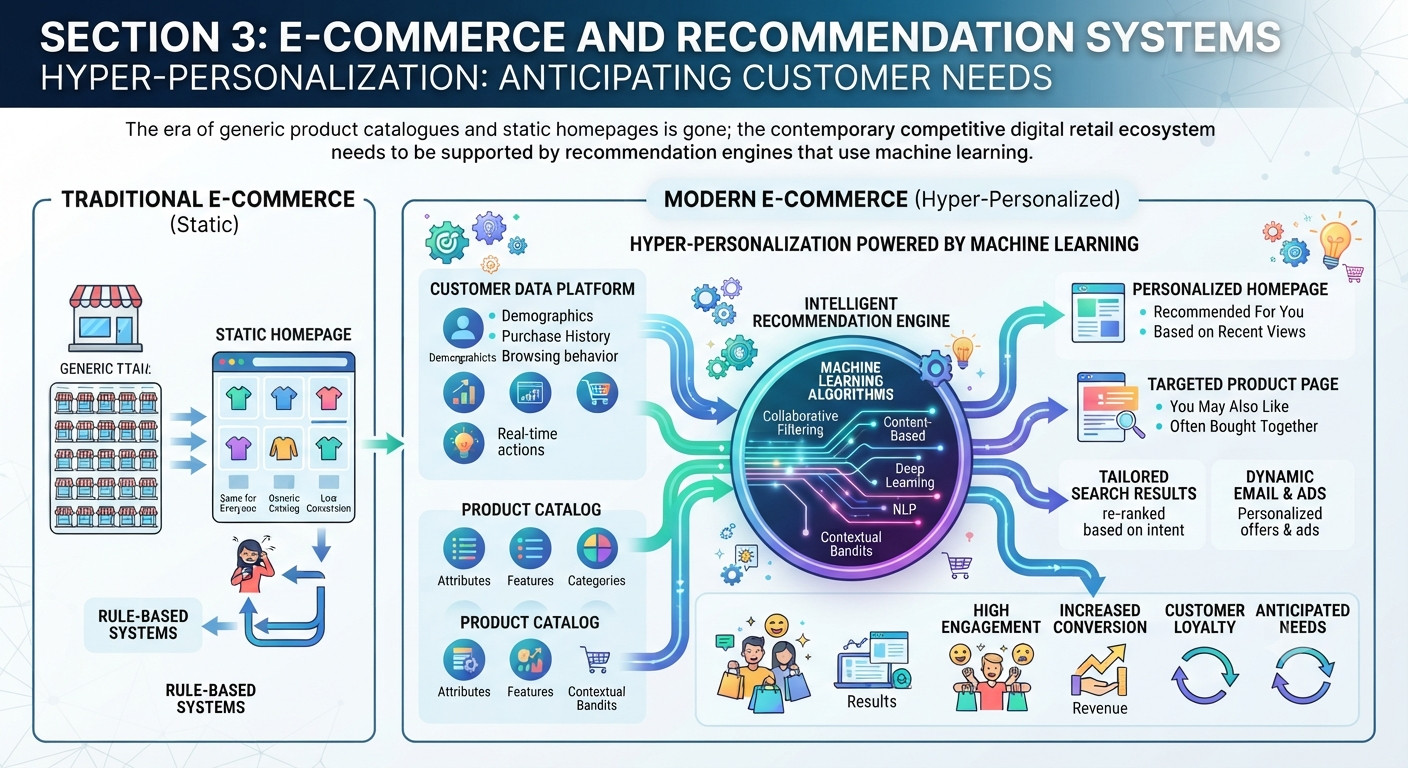
The era of generic product catalogues and static homepages is gone; the contemporary competitive digital retail ecosystem needs to be supported by recommendation engines that use machine learning.
The Process of Recommendation Engine Functioning
The functioning of modern recommendation engines is based mainly on two approaches – collaborative filtering and content-based filtering, combined often in hybrid models through deep matrix factorization and neural collaborative filtering techniques. Collaborative filtering operates by analyzing user-item interaction matrix to identify patterns in tastes among similar users, while content-based filtering considers the characteristics and metadata of particular product/media to suggest similar items.
Real-Life Example
Such companies as Amazon, Netflix, and Spotify use recommendation engines in order to analyze interaction history and other behavioral data of its users in order to build accurate user profiles that can predict future choices of a user better than he or she can. This way, these companies offer tailored carousels on the homepage of their customers.
Business and Societal Impact
Personalization using individualized shopping and media experience plays an important role in increasing the conversion rates, reducing the cost of customer acquisition, and ensuring brand loyalty. Personalization ensures that indifferent consumers turn into loyal brands, and also ensures that the brands maximize the value of the customers.
Section 4: Autonomous Vehicles and Transportation
Future of Autonomous Mobility
It is clear that safe autonomous transportation will require an integration of several branches of advanced AI technologies. To move multi-ton cars safely through an unpredictable human environment, machines have to be able to perceive, understand, and respond to reality immediately.
Sensor Fusion and Deep Reinforcement Learning
Autonomous technology features multi-modal sensor fusion which uses information from LiDAR, radar, ultrasound sensors, and ultra-high definition cameras. Visual and spatial inputs are analyzed simultaneously using computer vision algorithms, while deep reinforcement learning systems simulate millions of different driving scenarios in virtual environments to train the vehicle policy network for edge cases.
Real World Example
The self-driving car pioneers such as Tesla and Waymo use the described complex architecture. The algorithm analyzes continuous input from cameras and sensors in order to make a map of the environment in three-dimensional vector space and to predict the behavior of pedestrians, cyclists, and other cars, thus responding instantly to their movements.
Business and Societal Implications
IIn the long term, autonomous mobility will contribute considerably to lowering the number of fatalities on roads, eliminating traffic congestion in cities and optimizing logistics chains worldwide.
Section 5: Natural Language Processing (NLP) and Conversational AI
Closing the Human-Computer Communication Gap
There are numerous intricacies involved in human languages, right from connotations to sarcasm and cultural phrases. With the arrival of NLP and Conversational AI technology, this divide between human language and machines understanding it has been successfully bridged.
Transformer Architectures and Large Language Models
The emergence of transformers and LLMs has brought an evolution in the field of NLP. The use of self-attention in these modern models helps to process each word in light of all others in the sentence, allowing for the detection of long-range context and much better semantic comprehension than the old models using recurrence.
Example in the Real World
In the real world, enterprise customer services have become greatly dependent on the use of LLMs and advanced tools for sentiment analysis. Advanced conversational AI can address multi-tiered customer questions in several dozen languages at once and maintain continuity and understanding of emotions through the whole conversation.
Business and Societal Implications
Utilizing a conversational AI ensures the provision of round the clock customer support, substantial decrease in the support costs, and enhanced enterprise communication channels to help the human customer support team manage complicated cases.
Section 6: Predictive Maintenance in Manufacturing
Minimizing Downtime with Intelligent Machinery
Machine malfunction without prior notice remains one of the most expensive disasters in industrial manufacturing operations. Scheduled maintenance tends to result in premature or delayed replacements of machine components that are only realized upon occurrence of catastrophic failure.
Time-Series Forecasting and Internet of Things Analytics
The current generation of industrial manufacturing plants comes with Internet of Things sensors embedded on heavy industrial machines. Time-series forecast models and anomaly detectors help in analyzing metrics such as vibration frequencies, acoustic resonance and heat emission in order to forecast the wear of the machines' parts.
Practical Example
Industrial and automotive manufacturing plants use machine learning pipelines for the analysis of the data collected from the sensors. The machine is capable of detecting the slight change in vibration frequency indicating bearing deterioration well in advance of any mechanical breakdown.
Effect on Business and Society
The benefits from predictive maintenance include reduced maintenance costs, no unplanned production stoppage and increased lifespan of expensive industrial machines.
Section 7: Supply Chain and Inventory Optimization Streamlining Global Logistics
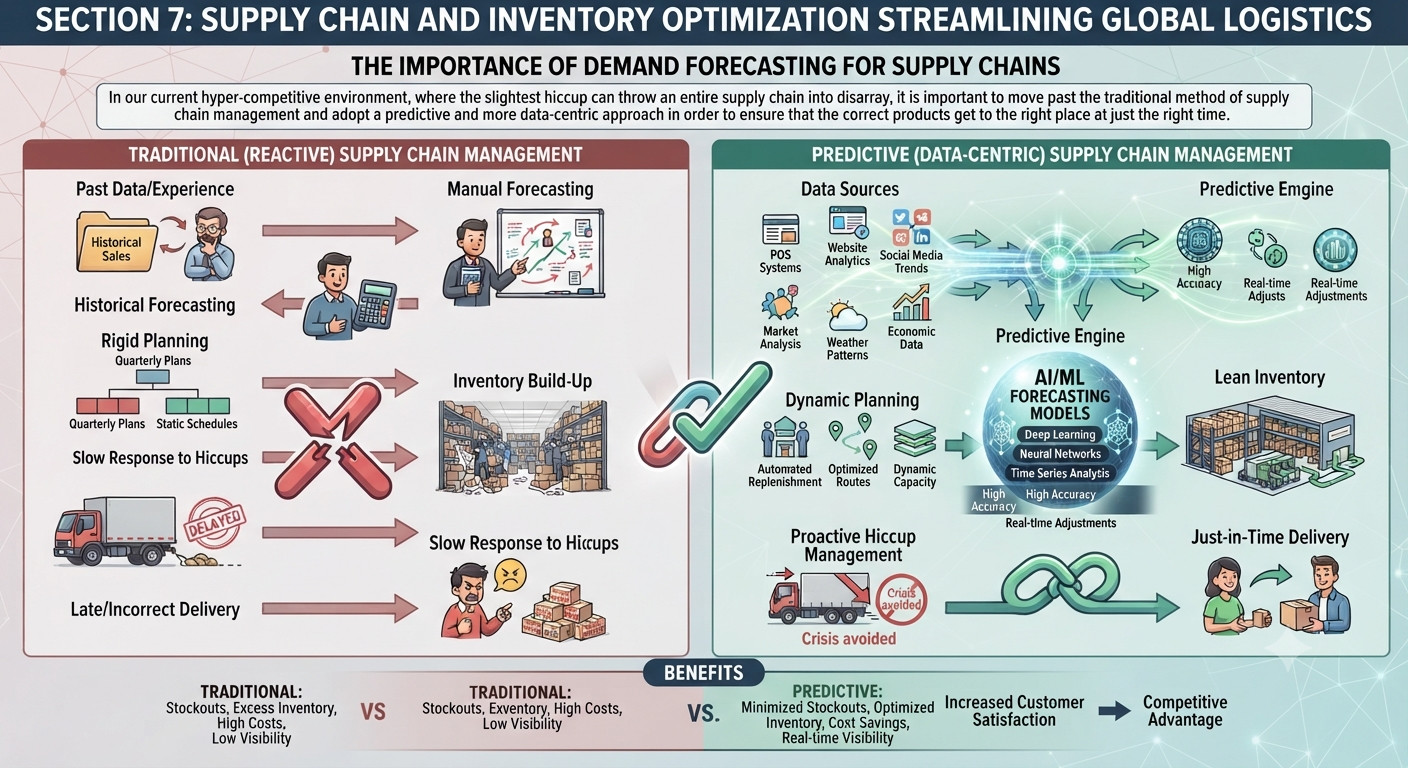
The Importance of Demand Forecasting for Supply Chains In our current hyper-competitive environment, where the slightest hiccup can throw an entire supply chain into disarray, it is important to move past the traditional method of supply chain management and adopt a predictive and more data-centric approach in order to ensure that the correct products get to the right place at just the right time.
Demand Sensing and Routing Optimization
Machine learning models play an important part in transforming the logistics industry. Such models can analyze large amounts of disparate data in real-time, including historical sales numbers, macroeconomic indexes, dynamic supplier lead times, and even other factors like weather changes and upcoming holidays, local community events, etc.
With the use of advanced algorithms like gradient boosting decision trees and graph neural networks, businesses can greatly optimize their warehouse routing, automated inventory placement, and fulfillments. Graph neural networks, in particular, are extremely helpful when it comes to mapping out the intricate network of suppliers and analyzing how the disturbance of any single point will affect the rest of the map.
Real-World Example
Companies like Walmart have been able to leverage the demand sensing algorithms and machine learning route optimization models effectively. Through the analysis of high-velocity point-of-sale data along with other external factors like local weather forecast and other local events, the enterprise system is able to anticipate unexpected regional increases in demand for certain products.
This will help the company to strategically position inventory in advance, while the logistics engine will be able to calculate the optimal routes for shipment and trucking to avoid congested transport corridors.
Business & Societal Impact
The implementation of machine learning in supply chain management offers many important business benefits as well as environmental benefits to society. The implementation of the optimized supply chain not only helps in minimizing the cost of keeping inventories but also significantly minimizes the wastage of products due to spoilage and obsolescence, and completely avoids stockouts which hurt brand reputation.
Section 8: Cybersecurity and Threat Intelligence
Proactive Defense Against Evolving Cyber
Threats
Cybersecurity is essentially a never-ending battle between the cyber attackers with the help of automated technology versus the cybersecurity professionals protecting the boundaries of the enterprises.
The legacy signature-based technologies have become less efficient while dealing with advanced and sophisticated polymorphic malware and multiple staggered attacks on the enterprise networks. In the current times, relying on threat signatures makes enterprises highly vulnerable to zero-day vulnerabilities and devastating ransomware attacks.
Behavioral Analysis and Zero-Trust Automation
In order to deal with these persistent threats, the latest enterprise security solutions make use of advanced behavioral analysis and zero trust automation technologies. Machine learning algorithms keep monitoring and analyzing the behavioral pattern of all devices and users and create a baseline which enables them to detect any structural irregularities that might show the existence of lateral movement or privilege escalation. Through implementing zero trust protocols, the enterprises reduce the operational attack surface significantly and limit the extent of the breach to a large degree.
Real-World Example
With regards to the detection of zero-day attacks in modern business settings, machine learning models that have been programmed into security platforms continuously monitor and detect unusual behavior patterns by users as well as internal communication within the networks.
In case there is an unusual pattern, such as querying sensitive databases by an authenticated user during non-working hours, the automated security system will automatically quarantine the infected machine, disable the login credentials and inform security experts of the threat without needing any human action at all.
Commercial & Societal Implications
In the corporate sector, advanced threat intelligence and defense technologies enable organizations to avert huge financial costs as well as protect their invaluable intellectual property. From a wider societal standpoint, these cybersecurity measures provide protection for critical infrastructures and keep consumers' personal data safe from identity thieves and breaches.
Section 9: Agriculture and Precision Farming
Maximizing Yields with Data-Driven Agronomy
In feeding an increasingly growing global population within increasingly erratic climatic conditions, it is necessary for one of the oldest professions of mankind to be upgraded. Precision agriculture uses contemporary technology including data science, artificial intelligence, and Internet of Things (IoT) sensor networks to enhance the use of all available land.
With a departure from the old and inefficient way of farming that involves treating the entire farmland with a single approach, the current agronomy sector uses micro-monitoring of farms using smart decision support systems.
Multispectral imaging and computer vision
The key technology used in modern precision agriculture is the computer vision models and the multispectral images acquired by drones. This technology enables monitoring the minute development stages of crops, detecting diseases in crops before human eyes can identify them, and detecting any deficiencies of nutrients or water supply at a micro level in large farmlands. The machine learning algorithm combines high-resolution visual information, historical weather patterns, and the soil metrics to make hyper-local prescriptive maps.
Real-World Example
The autonomous agricultural drones and IoT sensors attached to tractors produce high-resolution multispectral images of vast areas of crops on the farm during their development period. The machine learning algorithms analyze these complex image arrays in order to detect the occurrence of early stages of nitrogen deficiency or pest invasion, row by row.
The fertilizer would not be applied all over the field; the system communicates automatically with variable rate applicators and delivers the exact amount of nutrients to particular plants that need them.
Business and Societal Impacts
From the business point of view, precision farming allows minimizing operational costs of farmers—expensive fertilizers, pesticides, irrigation water—and at the same time provides maximum possible crop yields and their market value. In terms of the wider picture, these agronomic techniques ensure sustainable, ecological farming practices, saving freshwater aquifers, preventing the contamination of the environment with agricultural runoff, and ensuring food security in the long term.
Section 10: Energy Sector and Smart Grids
Sustainable Energy Balance Between Supply and Demand
The move towards sustainable infrastructure on a global scale calls for a rapid shift from fossil fuels to renewable sources of energy, mostly wind and solar power. The environmental requirement is accompanied by a set of previously unknown technical difficulties connected with maintaining balance within the energy system.
While thermal power plants generate electricity in a reliable and flexible way, renewable energy sources are characterized by unpredictability and instability. The generation process at these sources is subject to constant changes depending on such weather factors as sunlight, clouds, wind speed, and atmospheric pressure.
Renewable Energy Forecasting and Advanced Grid Management
In order to address the problem of unpredictability characteristic of green energy sources, modern smart grid providers depend on cutting-edge machine learning and artificial intelligence technologies. Such computing systems receive huge volumes of data on the past and current weather conditions and therefore can predict the amounts of renewable energy that will be generated several hours or even days ahead.
At the same time, machine learning software analyzes consumer energy consumption trends, peak load periods, and regional load demand. Combining predictions regarding power generation and load balancing systems, smart grids can automatically allocate power resources within the network.
Real-World Applications and Industrial Implementation
Such practical applications of the aforementioned technologies are becoming more and more apparent in modern utility infrastructures. Massive wind farms and photovoltaic solar parks are employing predictive meteorological machine learning models that are able to predict the output drops of these plants.
In such a case, for example, algorithms will analyze the data from the atmospheric sensors in order to forecast the drop in output due to cloud cover. As a result, grid operators have time to use the stored energy in BESS or start additional peaker plants.
Strategic Effects on Businesses and Society
Inclusion of machine learning into smart grid systems provides significant economic and environmental gains not only for companies but also for the entire society. On a macro scale, improved grid operations result in a decreased use of carbon-heavy peaking coal power plants that are used to cover any renewable deficiency that occurs spontaneously.
As a result, fewer emissions are produced, making it possible to reach national and international goals set concerning climate changes. Proper routing and local load balancing provide for minimal electrical resistance in the process of long distance transmission.
Frequently Asked Questions
1. Machine learning (ML)
Machine learning is defined as the area of computer science that allows the software to be able to analyze complex information and make decisions on its own.
2. What is the change in artificial intelligence?
It has gone from the abstract theory and studies in the universities' basements and in academic literature into concrete real-world use cases and the infrastructure for global trade and everyday life.
3. What is the role of machine learning in our lives?
ML functions as the invisible driving force of the processes of our everyday life - for example, choosing the best route for navigation through the traffic.
4. In what industries is machine learning used?
The machine learning approach serves as the foundation for innovations in various industries, which radically changes the business operations and problem-solving methods of different organizations.
5. Why are firms competing to implement predictive analysis?
Firms use predictive analysis and intelligent automation as an integral part of their operations to achieve exceptional levels of efficiency and problem solving.
6. What are some particular examples of application of AI and ML mentioned?
Such examples include route optimization for daily commute, customization of entertainment content, and cross-border protection against cyberattacks.
7. Why are skilled engineers highly valued?
Due to the increased adoption of intelligent automation and AI systems, there is an increased need for people capable of designing and maintaining these revolutionary systems.
8. What is the purpose of platforms such as gigmint.ai?
These platforms serve as an important link between digital talent and innovation, bringing together innovative companies with the best machine learning engineers and data scientists.
9. How do ML systems work without constant human supervision?
With the help of the trained algorithms, ML systems learn from complicated data input, allowing them to perform actions on their own.
10. What is the main topic of this detailed article?
This article talks about the 10 most practical use cases of machine learning in modern business and technologies.
XII. Call For Action
The wide-scale implementation of machine learning technologies in healthcare, finance, transport, and logistics systems clearly shows that intelligent automation technologies are no longer fads but the backbone of current business operations. In the future, businesses that use edge AI, generative models, and ethical AI will be well prepared to be the leaders of their industry.
Are you ready to bring your business into the age of artificial intelligence?
Find top machine learning specialists and implement customized solutions for enterprises with Gigmint.ai
.