Machine Learning vs. Artificial Intelligence: The Definitive Guide for Tech Professionals
Machine Learning vs. Artificial Intelligence: The Definitive Guide for Tech Professionals
Amidst the rapidly changing technological landscape in today’s organizations, there are few topics mentioned as frequently – and perhaps as confusingly – as Artificial Intelligence (AI) and Machine Learning (ML). For any CTO, data architect, or other technical stakeholder, knowing the difference is not merely an exercise in semantics but rather a foundational element of proper architectural strategy.
The Bottom Line Up Front
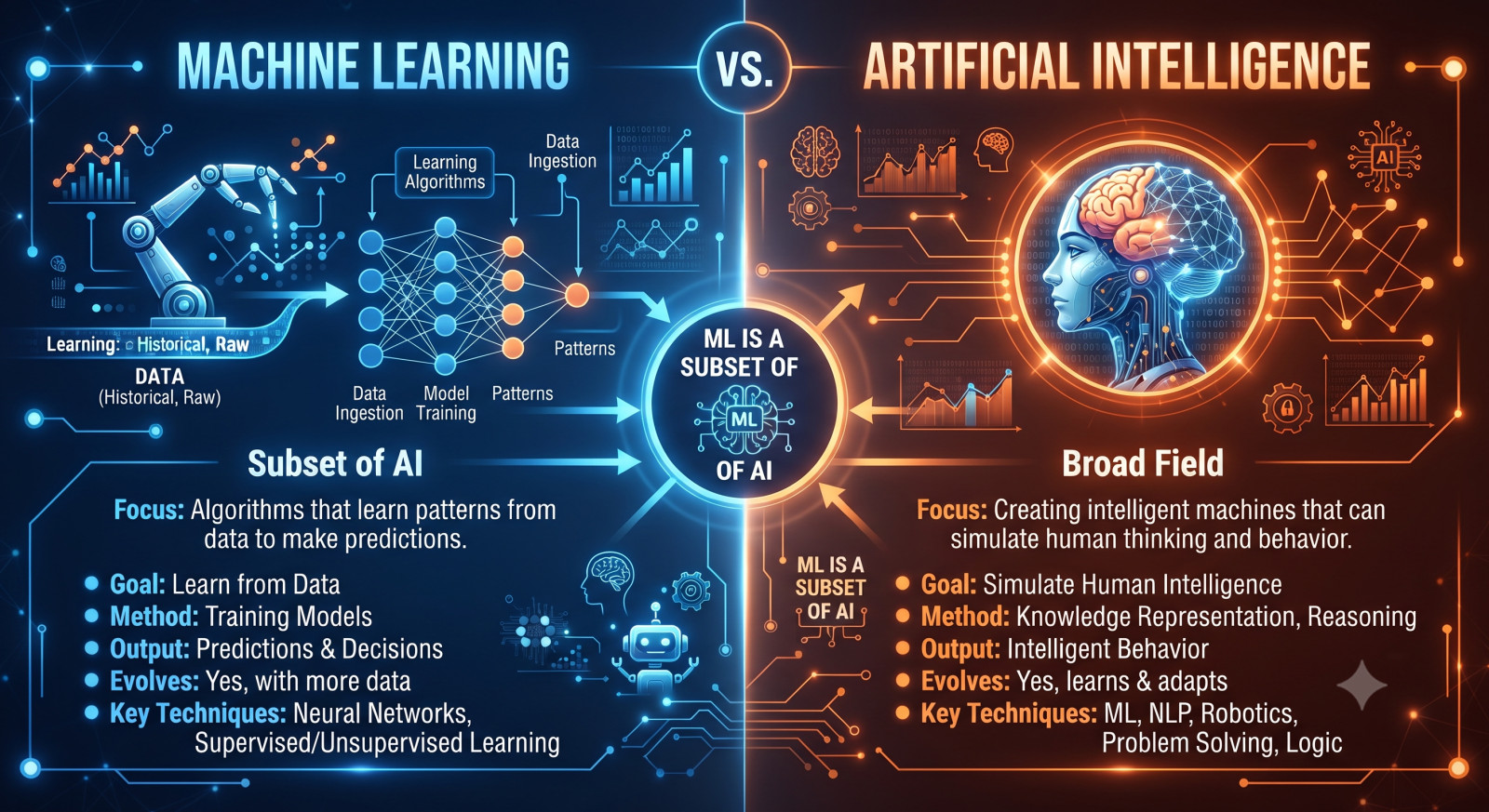
The basic relationship is hierarchical in nature: AI represents the broader concept of developing systems able to replicate human-style cognitive capabilities. ML is the highly specialized tool used to create the most advanced modern AI implementations. If AI represents the end goal—the system that can reason, plan, or perceive—then ML represents the primary means through which this is accomplished.
Why the Confusion Matters
Such a failure on the part of the industry to distinguish between the two paradigms results in what might be called "AI-washing" of marketing as well as misunderstandings in the boardroom. The consequence of such a misunderstanding between the two technologies is the misallocation of compute power, the misuse of appropriate data infrastructure, and incorrect time-to-market for intelligent functionality.
Roadmap
In this guide, we aim to dispel the hype and provide the technical insight that your company needs. In the following sections, we will take a look at the evolution of artificial intelligence as well as the statistical nature of machine learning, and how the two areas intersect in contemporary data pipelines.
2. Defining the Boundaries: Artificial Intelligence
Artificial intelligence is nothing but the branch of computer science that deals with the creation of computer programs for imitating the intellectual abilities of man. Instead of executing a set routine task, the AI program is designed in such a way that it can understand the world around it, think about the situation, solve the problem, and behave in a manner that reflects human intelligence. Despite the common usage of the term as a marketing tool nowadays, at the very essence of artificial intelligence lies the interpretation of information and decision-making by a software program to accomplish a specific task.
From Symbolic Logic to Generative Synthesis
In its development, the key change in AI is the transition from determinism to probabilism. During the early days of AI research, much of the work was done using "Symbolic AI" approaches, otherwise known as "Good Old-Fashioned AI" (GOFAI). Such approaches were based on hard-coded decision trees. Whenever an engineer was able to model all of the possible states or rules such as allowed moves in a board game, the machine would be able to navigate through them.
GOFAI had the "brittleness" issue: such machines were not good in dealing with noise, ambiguity, or incomplete data. The breakthrough came when researchers switched from prescriptive models to the ones capable of developing internal representations based on data. Today's AI systems incorporate generative models able to generate content, ideas, and solutions by modeling the distributional structures of huge amounts of data instead of working with hard-coded decision trees.
The Spectrum of AI
In order to make sense of the current AI environment, one needs to understand the two principal categories of intelligent machines:
-
Narrow/Weak AI (ANI): These are the artificial intelligences we deal with currently. ANI represents a machine that is excellent at executing particular tasks. Be it a chess program defeating a Grand Master, a recommender algorithm optimizing the shopping experience, or even a sophisticated virtual assistant, such as Siri, analyzing natural language, these algorithms are confined to their specific domains. Even though they do a fantastic job, they don’t possess general awareness or any transferable knowledge of different tasks.
-
General/Strong AI (AGI): This is the concept of a machine that is often considered the holy grail of artificial intelligence. AGI is an artificial intelligence capable of cross-domain knowledge, abstract reasoning, and learning similar to a person. An AGI would be an expert not at some particular task, but at intelligence in general.
It would be capable of solving any problem and adapting to new situations without pre-training. Even though there have been incredible advancements in multi-modal models, AGI remains an unachieved objective in the area of computer science, neurology, and philosophy.
The Pillars of Intelligence
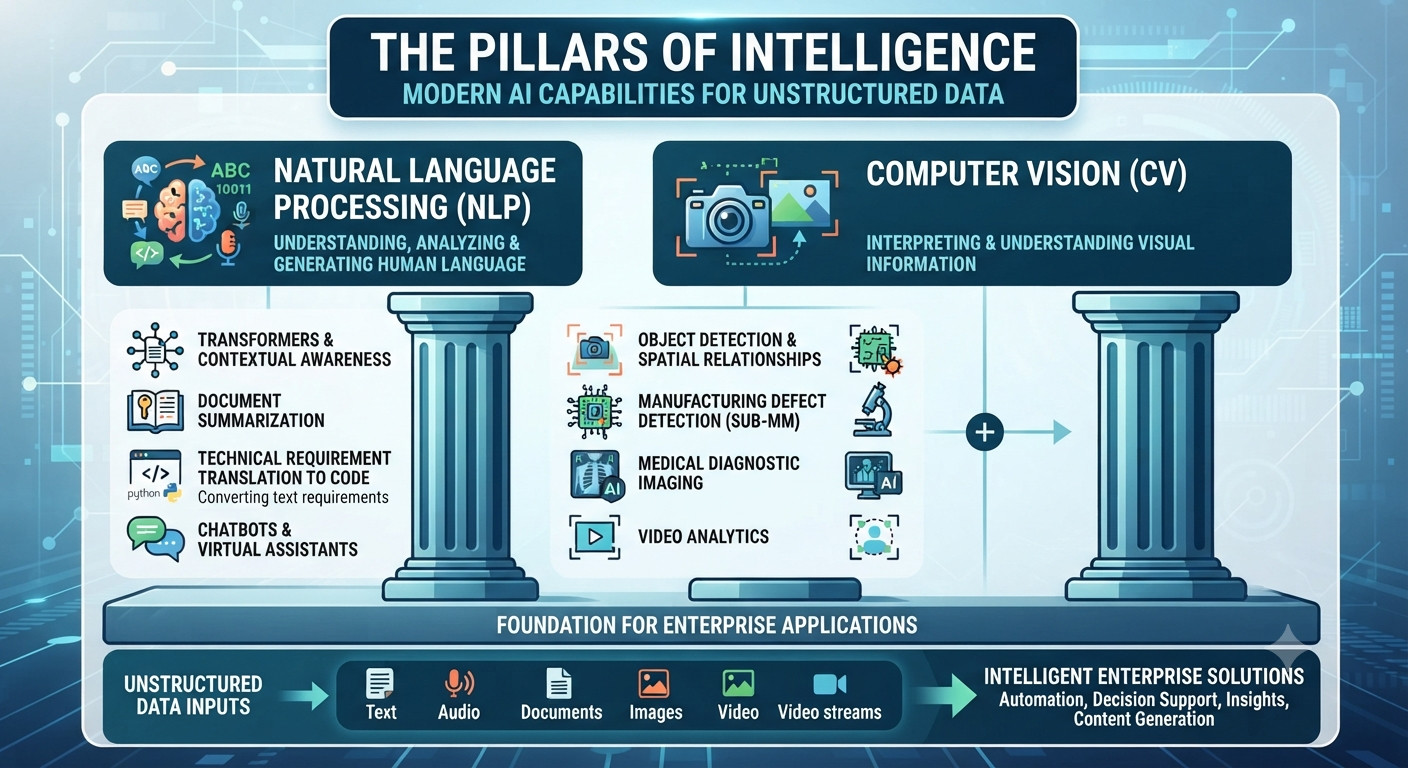
The modern age of AI is characterized by the capabilities that enable interaction with unstructured data using three main pillars that act as architecture blocks for enterprise applications:
-
Natural Language Processing (NLP): NLP is the ability of the system to understand, analyze and generate language in human form. With the help of advanced methods like Transformers, the modern AI is capable of keeping contextual information, summarizing long documents and translating sophisticated technical requirements into code.
-
Computer Vision: Using Computer Vision, systems have been able to go from detecting simple objects in an image to understanding complex spatial relationships in videos, detecting defects in manufacturing processes with sub-millimeter accuracy and processing images in the field of medicine for diagnostic purposes.
Autonomous Reasoning: Arguably the most important difference, autonomous reasoning refers to the ability of a system to analyze opposing factors and reach conclusions at an abstract level without continuous intervention from human beings. In terms of the enterprise, it means taking the ability to automate processes a step further to the point where the AI can manage the balancing act between time, cost, and accuracy.
These three pillars do not stand independently of each other but rather increasingly become interdependent. The combination of these pillars makes it possible to create intelligent agents capable not only of analyzing data but also of performing complex workflow operations.
3. Machine Learning
The concept of Artificial Intelligence revolves around the creation of systems that imitate the workings of human intelligence, Machine Learning (ML) is the practical approach that enables the fulfillment of that dream. The very basic definition of Machine Learning could be seen as that it is a field within Artificial Intelligence dedicated to the creation of algorithms that learn through experience, as opposed to explicit programming.
Change of Paradigm – From Explicit Programming to Statistical Learning
The traditional software engineering process involved developers being the architects of logic for the program, that is to say that developers would write the "if-then" rules. In the case of Machine Learning, it is not the case. In place of the machine being provided with the explicit rules, we give it lots and lots of data to work with along with the statistical model to find out the pattern.
Types of Machine Learning
All learning processes are not alike. Depending on the nature of the input data and the intended purpose of the model, ML algorithms can be grouped into three basic categories:
-
Supervised Learning: This is the most popular type of ML algorithm, comparable to the process of studying with a mentor. The model is trained on the basis of labeled datasets, where the “correct answers” (or target variables) are known.The algorithm is able to predict because of the thousands of samples used to make the algorithm learn how the input variables depend on the label.
-
Unsupervised Learning: The model is trained using unlabelled data. It is up to the algorithm to find some hidden structures, clusters or patterns. This approach is very useful for detecting anomalies, customer segmentation and reducing dimensionality, when the underlying truth behind the disorganized and unlabeled data needs to be found.
-
Reinforcement Learning (RL): This paradigm is focused on achieving a certain goal by means of interaction with the environment. The system becomes an “agent”, which performs actions to get rewards and learn from its mistakes. This technology is behind all kinds of robotic motor control and game playing AI systems.
The Role of Deep Learning
Deep Learning acts as the advanced connection between the simple statistics-based machine learning and human-like perception. Deep Learning employs multi-layered artificial neural networks, which help computers process data in a non-linear and hierarchical manner.
In conventional machine learning algorithms, it would be necessary to intervene manually to choose important features through a process called "feature engineering," Deep Learning algorithms are able to do so autonomously. Such a capacity makes it possible for such high-end applications to occur as image recognition, natural language fluency, and audio processing.
4. Key Differences: The "At-a-Glance" Comparison
In the world of technology, efficiency means clarity. While they can be used interchangeably in layman's terms, these two actually denote two different structures. The main distinction between the two is in the application scope; Artificial Intelligence is the idea of an intelligent system, while Machine Learning is the statistical approach used to make that happen.
Comparison
|
Feature |
Artificial Intelligence |
Machine Learning |
|
Scope |
Broad (The overarching goal) |
Narrow (A sub-discipline of AI) |
|
Primary Goal |
To simulate human cognitive tasks |
To learn from data and improve accuracy |
|
Data Dependency |
Can function on logic/rules |
Requires large datasets for training |
|
Human Intervention |
High (in rule-based systems) |
Low (focus on algorithm optimization) |
|
Outcome |
Goal-oriented task execution |
Prediction, pattern discovery, classification |
Decision-Making Paradigms: Logic vs. Pattern Recognition
The traditional systems are deterministic and are called Symbolic or Rule-based AI systems. These run on the basis of a well-defined 'if-then' system. In case the input goes out of the predefined rules, then the system crashes.
ML systems are probabilistic systems. They do not know the rule but discover the statistical patterns present in the data through the use of mathematical formulas such as the objective function $J(\theta)$. The decision tree of AI gives the solution while in ML, the output is calculated through predictive models.
Data Requirements: The Architectural Divide
Data is what drives Machine Learning, but data is not required by all forms of AI. An expert system (one type of AI), for example, can work well with a thousand rules coded by human experts and no data at all.
For ML algorithms to develop a good model, lots of good data is required. If your objective is to automate a process where the logic does not change, you will do better using a rule-based AI approach. If your objective is to deal with high entropy and highly complex systems where it is impossible to code all the rules, ML is the only way to go.
5. How They Work Together
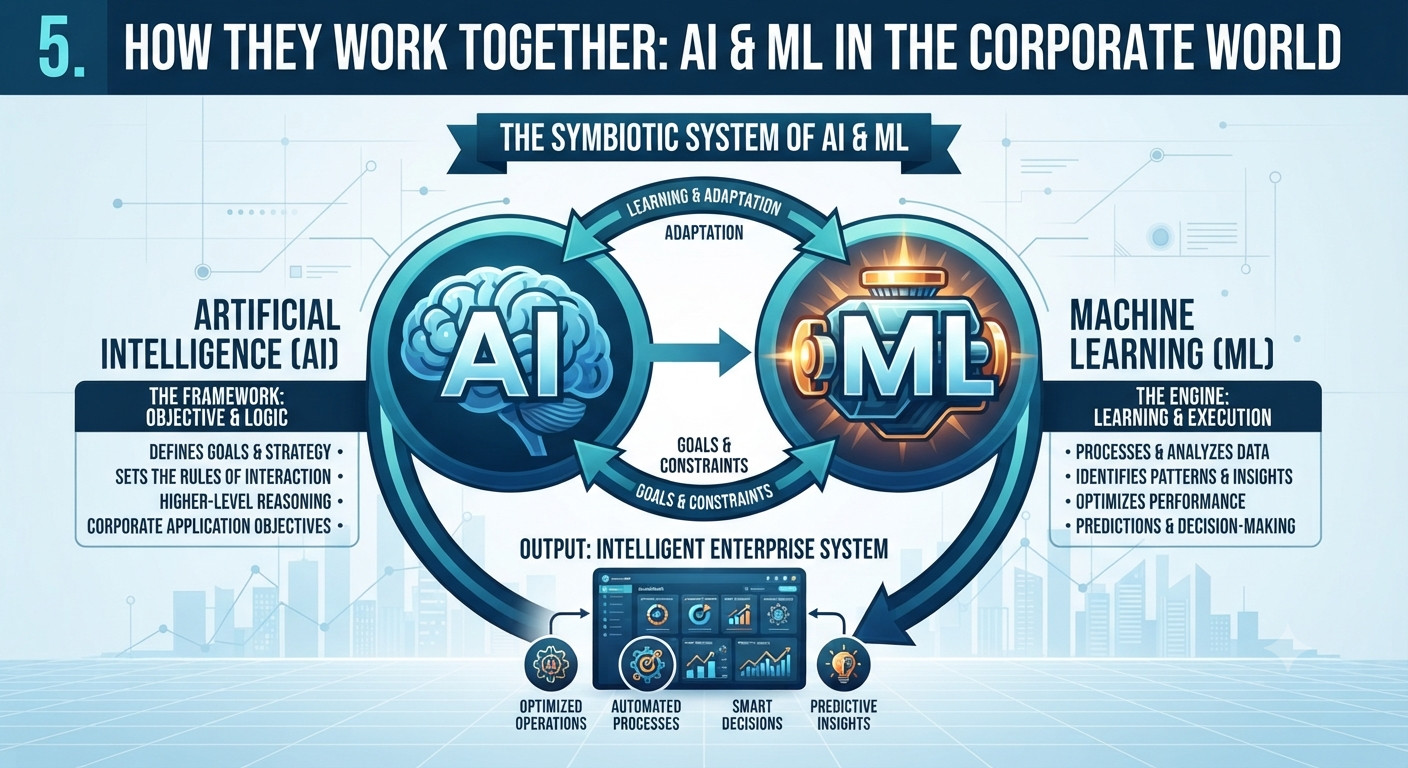
While it is essential to make a distinction between artificial intelligence and machine learning, in practice in the corporate world, the two techniques operate almost inseparably from each other. The two create a system that is symbiotic in nature wherein artificial intelligence works as the framework in terms of the objective and logic of the interaction, machine learning is the engine of that system.
The Symbiosis
Imagine AI as an "application layer," which interacts with users, coordinates processes and workflow, and makes decision-making. Machine learning can be considered an "intellectual layer," which is built into the application.
Without machine learning, AI systems become inflexible and are bound by their initial programming provided by humans. Without AI, Machine Learning becomes just a black box model, which provides probability estimates without any goal-oriented logic.
Case Studies in Integration
This integration can be seen through the following real-world applications in complex business domains:
-
Recommendation Engine: The contemporary recommendation engine (used by companies like Netflix or Amazon) relies on a combination of ML and AI. ML algorithms (for instance, collaborative filtering) analyze the patterns of the user’s behavior and make predictions.
The AI platform uses these predictions for user-oriented decision-making – when, where and how to deliver recommendations to users to ensure maximum conversions without compromising user experience.
-
Fraud Detection: The combined power of the ML model and AI platform is especially important for the finance industry, where there is need for speed and precision. ML serves as a sensor which monitors the transaction history of the customer and searches for any anomalies that appear to differ from typical behavior.
When any anomaly is detected, AI kicks in to orchestrate the response – whether it is to engage security protocol, trigger identity verification process or notify human investigation team.
Infrastructure Considerations
In order to sustain this ecosystem, the tech stack you need should go beyond standard software infrastructure. The combination of AI and ML necessitates a strong data foundation:
Data Pipelines: These guarantee the continuous flow of quality and relevant data into your models from different sources.
Data Cataloging: This will help you with keeping transparency and governance, letting your team know about the origin and quality of the data fueling your intelligence.
Feature Store: This is where the process of transformation of raw data into performance for machine learning begins. By centralizing features (the preprocessed data points utilized by your model), you can avoid the problem of “training-serving skew.”
Thus, for a modern CTO, the key point isn’t deciding on the choice of AI vs. ML, but creating a pipeline where they can co-exist.
6. Strategic Implementation for Businesses
FFor CTOs and technical leads, choosing between rule-based AI and Machine Learning is not about which one is better—it’s about which one fits your business goals, data maturity level, and budget. In order to thrive in the era of AI, organizations must overcome all the hype and come up with a proper strategy.
Which Strategy is Better for You?
The worst mistake one can make is going for an overly complex machine learning approach, while there is a much simpler rule-based AI alternative.
If you are solving a business problem which involves deterministic logic (such as compliance checks or routing using territory maps), then a rule-based AI system will be a better fit for you. It is highly understandable, requires no maintenance, and is predictable.
If you have to deal with a high-entropy environment, where many factors can vary unpredictably, then Machine Learning is what you need to invest in. If you cannot formulate the rules for a certain task (such as recognizing a defect on a picture), then machine learning is your only choice.
Operational Challenges: The Lifecycle of Intelligence
Deployment marks just the start. Transitioning from a working prototype to a production-quality system calls for the establishment of stringent operational methodologies:
-
MLOps and LLMOps: As you scale out, you have to consider your models as one more piece of software, but an even more complicated one. MLOps guarantees the accuracy of your models through version control, automatic testing, and CI/CD for your data. The emergence of Large Language Models (LLMs) has led to LLMOps being just as important, involving prompt engineering, model fine-tuning, and the handling of "hallucinations."
Cost vs. Complexity
Training "intelligent" models with big models requires lots of computational power in terms of GPU and TPU. If handled improperly, it can result in an exponential increase in the costs. There are many things that CTOs should keep in mind to evaluate the return on investment (ROI):
Data overhead: The cost of data preparation and its storage often exceed costs related to the training of models.
Infrastructure: You have to consider whether you can benefit from developing a self-hosted infrastructure or you will need to use cloud-native AI.
Avoiding the Hype Cycle
In a market of saturated "AI-washed" tools, skepticism is a professional quality that should be developed. If the tool is said to use AI without any additional explanations, it would be better to avoid it. The things that make the tool good are:
AI fit to problem: Does the AI resolve an inefficiency within your organization?
Provenance of data: Does the provider have experience with training models and knows the methods for preventing bias?
Compatibility of solution: Has the tool been incorporated into your data pipeline?
7. The Future of AI/ML
What is required for technical leaders is not merely being aware of where the technology is today, but also having a view into where it will be going. Currently we are seeing a paradigm shift within the development, deployment and governance of intelligent systems, as the technology shifts away from niche, handcrafted models to generalized, accessible and regulated intelligence.
Shift to Generative AI: From Discriminative to Generative Intelligence
The advent of Large Language Models (LLMs) and Generative models has fundamentally changed our industry's conception of "intelligence". Previously, most of the enterprise AI solutions were discriminative models, doing classification, prediction, anomaly detection. Generative models bring a new ability - synthesis.
These models represent a huge step forward in multi-modal understanding. With training on a huge corpora of data LLMs learned something like a "stochastic reasoning", which allows them to accomplish things, for which they were not even trained, including zero-shot code generation, summarizing documents and creative writing.
For CTOs it means that future tech stack will rely more on building workflows using "Agentic" architecture, which will use LLMs as an orchestrator for transforming high-level business logic into complex multi-step code and data operations.
Automated Machine Learning (AutoML): The Democratization of Intelligence
In the past, for any successful machine learning, the need was for a group of data scientists who would have to manually curate features, fine-tune hyperparameters, and choose the right architecture.
Automated machine learning (AutoML), is bringing an end to this constraint. By automating the process of selecting models, feature engineering, and optimizing hyperparameters, AutoML is making it possible for generalist programmers and software engineers to use production-ready models without having to be experts in statistics.
As the field becomes mature, data scientists will no longer have to be "model builders"; instead, their focus will shift to becoming "data architects" who worry less about code optimization and more about data quality, pipeline, and architecture.
Ethics, Governance, and the Rise of XAI
As AI increasingly integrates into the critical infrastructures of our world, the "black box" nature of highly complex models will become one of the main drawbacks. The next stage of AI evolution will be marked by strict inclusion of Ethics and Governance principles.
Explainable AI (XAI): Companies can no longer afford models which cannot be audited. The transparency of algorithms is demanded by regulators and stakeholders. XAI approaches, which provide information regarding the reasons for particular decisions made by models, will transition from "nice to have" to mandatory tools in such domains as finance, medicine, and law.
Addressing Model Biases: We are increasingly aware that models reflect training data they were built upon. Future-proofing your tech stack will require proactive efforts in bias mitigation and auditing of data pipelines for any historical biases that might result in discriminatory behavior.
The future of AI is not only about performance or size of models. It is about trust. Companies which will succeed in the next decade will be the ones who will embrace transparency and governance of data as technical skills, and not as secondary compliance tasks.
Frequently Asked Questions
To better elucidate the differences and considerations discussed in this guide, we've gathered the answers to the most frequent questions by technical leaders and decision makers.
1. Are Artificial Intelligence and Machine Learning the same thing? No. AI is a field that involves creation of intelligent systems. Machine Learning is a narrow subfield of AI concerned with algorithms capable of learning from the data to perform better.
2. Why do industry marketers confuse these two notions? Because of marketing purposes: "AI" may be used to describe the overall scope. It may not be fully correct, but at least it conveys the idea of automation while ML is more technical.
3. Do I need Machine Learning to create my AI system? It's not always necessary. "Rule-based" or "symbolic" AI doesn't use any statistical learning algorithms – it operates based on logic trees and code.
4. What's the major benefit of Deep Learning compared to traditional ML? Deep Learning algorithms learn feature representations automatically, hence saving effort of engineers. Also, they can handle unstructured data much better than regular ML algorithms.
5. How do I choose between a rule-based AI system and ML model? Choose a rule-based system when the process is deterministic and the reasoning is based on clearly documented rules. Choose ML when you have to solve problems in high-entropy environments with complex and non-obvious patterns.
6. What is MLOps for an enterprise that builds AI products? MLOps uses DevOps practices in the life-cycle of ML models, including versioning, testing, and monitoring the degradation of model performance.
7. Why is it important for an enterprise to implement Explainable AI (XAI)? XAI offers insight into the workings of your models, making it possible to comply with regulations and gain confidence of stakeholders in industries such as finance or medicine.
8. What does the term “Agentic AI” mean for future tech stacks? It means advancing from the stage of mere task performance towards the development of technologies capable of planning, reasoning, and orchestrating complex multi-stage workflows.
9. What effect does AutoML have on a Data Scientist’s job? AutoML makes model creation and tweaking a routine procedure for Data Scientists, which allows them to concentrate on the quality of data, architecture design, and solving business problems.
10. What is the main obstacle to the adoption of AI by large corporations? The major obstacle is not the model but rather data maturity — availability of clean, structured, and accessible data pipeline needed for model training.
8. Conclusion and FAQ
It is important to remember that Artificial Intelligence and Machine Learning are related to each other but they do not mean the same thing. AI can be described as the development of intelligent technology whereas Machine Learning is one of its subsets which allows this technology to learn and develop.
Having an idea of how these technologies differ from one another will help businesses, developers, and decision-makers select the right way of resolving their issues as it will become even more crucial in the future when both of these technologies continue developing together.
So, whether you are considering Artificial Intelligence for business purposes or are learning more about it in general, being aware of the differences between them is very important.