Navigating Compliance: The Benefits of Hiring a Freelance Legal Consultant

Navigating Compliance: The Benefits of Hiring a Freelance Legal Consultant
The New Regulatory Frontier
This could perhaps be described as an era where running a gauntlet seems inevitable. The current business environment is a much more regulated world compared to what it used to be.
It is not enough for startups and small and medium enterprises (SMEs) just to focus on compliance with data privacy laws, employment rules and other legal aspects related to their industries; legal compliance has become almost an all-time affair. With concepts like GDPR and CCPA plus industry regulations growing ever longer, there is little scope for legal compliances being only sporadic events.
The old "big law" approach has been highly regarded, but it has become outmoded in its inability to cope with the agile nature required by the new way of doing business. It involves high overheads, expensive retainer fees, and cumbersome partner relationships that do not allow for the necessary speed and agility.
This is where freelance legal consultants provide a practical advantage . They offer business access to specialized legal expertise on demand without the long-term costs associated with traditional law firms or inhouse legal teams. Unlike typical legal firms, such fractional consultants give access to high-level and specialized advice without requiring the burden of full-time employment and general counsel costs. Using the services of an on-demand legal expert allows your business to get all the necessary advice at once exactly when you need it. If you have some problems with data privacy laws, complicated contracts, or foreign trade legislation, a freelance legal consultant becomes a very important link between minimizing liability risks and having your operations free.
Regulatory compliance in the startup world is not only a defensive measure anymore but a very useful competitive advantage for your business development. In this article, I am going to explain why giving up old-fashioned and costly legal systems and switching to the freelance option is the most strategic step to take for your startup. Let us see how you can secure your business and minimize liabilities effectively.
The True Cost of Non-Compliance: More Than Just Fines
Financial Erosion: The Solvency Threat
For most CEOs and managers, regulatory compliance is seen primarily in terms of the cost of compliance. But when considering the consequences of non-compliance financially, the term "financial erosion" would apply far better – a sudden depletion of a business' capital that can prove to be irremediable. The sheer magnitude of regulatory fines today has raised the issue of legal risks to a completely new level.
Take, for instance, the General Data Protection Regulation (GDPR), where the fines may amount to as much as €20 million or 4% of worldwide annual turnover. The intention behind such fines is not only to penalize the company but also to discourage them from repeating the mistake.
The costs related to defending oneself, conducting forensics and paying for the remediation measures will double or even triple the amount of the initial fine. In case of a marginally profitable business, one non-compliance case can become fatal.
Reputational Fallout: The Trust Deficit
In the age of heightened awareness about data, a company’s brand equity and reputation are intertwined with the company’s integrity. Financial fines are always measurable, but "the reputational repercussions of the non-compliance" are often intangible and harder to fix.
Once customers put their faith in a company to handle their data properly or stay within the ethical limits of legality, there is a social contract. Failure to comply with the regulations is a social contract violation.
After the scandal is out, there will be churn, and the cost to acquire new customers becomes exorbitant. In the world of instant news, a company's scandal will go out into the ether faster than you would expect, and become an inseparable part of the search results history.
For a brand that is trying to expand, such "organic visibility" can stunt growth for years ahead. While there will be huge efforts in rebuilding the image through PR and marketing campaigns, the aftermath of the breach will remain the major conversion obstacle.
.
Operational Stagnation and "Legal Debt"
Similarly, companies face “legal debt”—a buildup of regulatory failures, badly-written contracts, and missing forms. Legal debt leaves a business in a state of operational limbo that quietly kills any strategic aspirations the firm may have. For startups wishing to scale, legal debt will be one of the main barriers to success in due diligence.
When the company is trying to get VC funding or explore M&A opportunities, the investors and the buyers will undertake an exhaustive audit. If a compliance problem is uncovered, then the value of the firm is significantly reduced, or the transaction falls through. What's more, legal debt stops you from entering the market. You cannot start operations in the EU or California if there is non-compliance. And if your operations are not compliant, then you can only look from the outside while others take the market.
Compliance as an Offensive Enabler
Opportunity cost is definitely the biggest cost that comes along with noncompliance. When organizations think of compliance as some sort of protective barrier, they ignore the opportunities they could have if they used compliance as a business enabler. Proper compliance frameworks act as a "trust signal" for all of those who interact with an organization. That is how the maturity of the organization and its readiness to operate for a long time can be shown.
When compliance is incorporated into business strategies, it becomes easier to operate and not difficult at all. It helps build organic visibility and become a "best-in-class" business operator, which makes partnership much easier and allows making sales quicker. All businesses need to hire the right lawyers, such as freelance legal consultants, and turn their potential cost into a strong foundation of the company's work.
The Strategic Advantage of Freelance Legal Consultants
The move towards a freelance legal system is not a strategy to reduce expenses but a whole new way of accessing intelligence for business growth amid an increasingly regulated environment. The adoption of freelance legal consultants can be said to mark the coming of age of businesses looking to take advantage of the new approach.
Unmatched Cost Efficiency
The legal field has long been plagued by the "retainer trap" phenomenon. Big firms have traditionally followed a billing practice where the client ends up funding overheads, training of associates, and building of offices, which do not necessarily contribute anything positive to the current project. For startups and small to medium enterprises, the "retainer trap" results in misaligned incentives, whereby you end up footing the bill for the firm's costs rather than what it delivers.
In freelance legal consultants, you get rid of that costly inefficiency. In a project/fractional basis hiring, you pay for output and not the inputs, hence shifting your legal costs from a high-fixed labor expense – the largest cost component on a balance sheet – to a variable performance expense.
With this kind of system, it is possible to have accurate allocation of capital. Rather than tying up capital in an unused monthly retainer fee, you will be able to use your capital exactly when you need it; during fundraising, product release, and even when you are undergoing a regulatory audit.
The lack of significant administrative expenses that come with a traditional consultancy firm means that the costs associated with using the services of freelance legal consultants are usually lower than those for similar service providers. With this approach, you are ensuring that you maximize your legal budget in order to conserve money.
Specialized Niche Expertise
A company that relies on a "generalist" approach in its in-house legal service is always prone to getting stuck in case of facing some particular and sophisticated problems. A professional general counsel is an indispensable employee; they cannot possibly be a guru in the constantly emerging spheres such as international trade, data privacy (GDPR/CCPA), intellectual property and labor law.
Freelance legal consultants provide an opportunity to have a "surgical strike". Thus, by working with particular experts in those aspects that you need you will immediately get access to people who "have seen it all". A consultant who has worked in the sphere of cross-border e-commerce for five years will definitely give you something more than an average lawyer.
Specialists of this type provide their services from the cross-sector point of view. Since they usually work with several firms within the same field, they can say something more than just read laws. They understand the realities of the business world and know very well where there are the biggest challenges and how other companies solve their problems. They can give you advice not only on law but also on process optimization.
.
Agility and Scalability
Speed is the key asset in the startup sphere. Law firms are generally associated with cumbersome and lengthy processes of partnerships, approvals and other bureaucratic practices that can make even a simple document check a matter of several days. Freelance legal consultants were made for the pace of the modern digital economy.
The most revolutionary thing about this approach is called "fractional" consulting. There are many situations when the company needs to have an expert, but there is no need to hire him on a full time basis. With the help of a freelancer, you will be able to have access to a top-notch professional for just ten hours a month – and get as many strategic decisions as from a senior attorney working full time.
Freelance legal consultants are very helpful when it comes to quick market entry. In case you plan to enter the market of a certain country such as the EU or even a state within the United States, you need a legal audit on that particular market, and not at some point next month. Through freelance services, you can have an expert who understands the market right away and helps you get things done legally right from the start.
How to Find Top-Tier Talent

In today’s digitally dominated world, the skill of being able to vet and onboard specialized legal resources becomes a valuable competitive asset. But the plethora of options available through the digital platform becomes a whole other issue altogether, which is known as the "vetting challenge."
Given the fact that there are hundreds of thousands of freelance resources online on different platforms, organizations find it hard to distinguish between true subject matter experts and regular lawyers who may not be equipped to handle the complex regulatory challenges that the organizations face.
The Power of Vetted Marketplaces
As a means of minimizing risks involved in the recruitment process, astute business people are beginning to shift their attention to curated marketplaces like GigMint. This solves the problem of verification by going beyond just listing and employing what has been referred to as the "1% Standard."
The 1% Standard entails the employment of a strict and several-stage verification process that takes into account issues like qualifications, whether the lawyer is registered with the Bar Association, and previous projects. When less than 1 percent of the applicants are admitted, then quality becomes assured.
Secure Infrastructure for Peace of Mind
Safety is an issue that cannot be compromised in any legal and regulatory issues. The conventional method of hiring exposes companies to payment disputes and incomplete work. Current platforms address the matter through their security framework, which involves using escrow facilities. In this system, money is kept safe until the deliverables of the project have been inspected and approved by your company’s team. Thus, the incentives of the consultant are fully aligned with those of your business.
Efficiency Through AI-Powered Pipelines
The second most essential aspect of this process is speed. Previously, finding an expert for a certain legal task could have taken weeks of searching and interviewing. New technology in the form of "Task Pipelines" is reshaping the industry.
With these tools, businesses are able to enter their tasks in natural language – such as "Draft an EU-compliant data processing agreement" – which is then instantly turned into a professional legal brief. Using the capabilities of these smart matching engines, businesses are able to cut their hiring time down from weeks to just 24 hours. This ability allows your business to turn on a dime, secure in the knowledge that the expert is working on the task while you work on the product.
Unlocking Global Reach
The contemporary freelance system destroys geographic silos that were once a hindrance to growth. Compliance goes beyond the borders of your country; as your organization grows, it needs professionals who have experience in handling international transactions, know the intricacies of international and regional privacy laws, and can handle your organization’s cross-border taxation issues.
The benefit of accessing an international pool of professionals spanning more than 90 countries allows you to conduct localized legal audits which are not possible through local firms. No matter whether you decide to expand in the EU, Asia, or South America, you have immediate access to a professional familiar with the regulations of the region.
Managing the Workflow: Best Practices for Integration
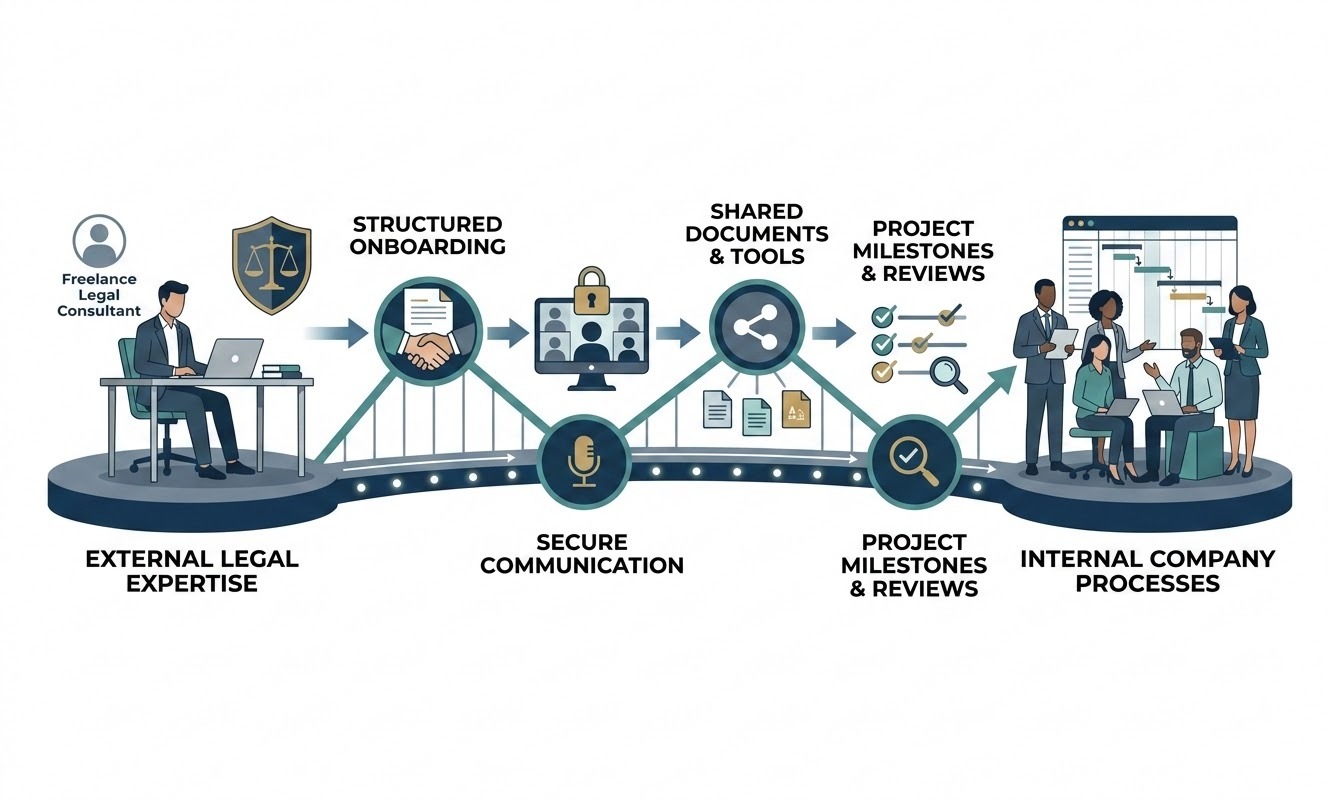
Hiring a freelance legal consultant and integrating him or her into your business goes beyond having a signed agreement; it entails employing a systematic process of project management to close the gap between external expertise and the internal process. To successfully collaborate with freelance partners, you have to view them as part of your team from the beginning and give priority to systematic protocols.
Structured Onboarding
To begin with, it’s important for you to have structured onboarding. Do not give your consultants free rein to access internal servers. Set up data security protocols and sign NDAs before engaging in projects. Providing read-only access—or limited access to certain folders—will protect your confidential information and provide the consultant with enough information to work effectively. Having a structured onboarding document explaining the style of your company’s internal communication and project management tools will allow the freelance legal consultant to work independently.
Communication & Project Management
Distance should not be equivalent to disorganization. Use a central, collaborative platform for managing versions of the documents—like Google Docs, Notion, and Slack—so that everyone is operating with the latest information. Avoid the dangers of “email-only” communication that will result in piecemeal feedback and lost documents.
Create detailed milestones at the beginning of the process. Instead of keeping the scope vague, establish certain deliverables and deadlines. This way, the project stays on course, you stay within budget, and there is no room for any form of scope creep. Regular check-ins help solve bottlenecks and keep the legal process on point with the changing needs of the business.
Quality Control and Professional Standards
The process will only be effective as long as the review process itself is effective. Despite the fact that you have very well-vetted experts, there will be a need to conduct reviews on all deliverables on a consistent basis. It is not just an issue of correctness from a legal perspective, but also to make sure that the tone of the work matches with your brand's voice.
The Role of AI
Lastly, take advantage of the benefits offered by AI in helping achieve this. Contemporary legal processes are facilitated through the use of AI that helps in organizing the briefs of the project and standardizing the requirements and finding a freelancer who has the necessary skills. Through the use of AI in structuring your briefs, you help avoid ambiguities and ensure that there is clarity for the legal professional.
Compliance as a Catalyst for Growth

In this ever-changing environment, it is not enough to regard compliance as something "to do." We have seen how the most progressive companies in today's world consider the process of legal monitoring as a strategic offensive weapon.
With the help of a freelance legal consultant approach, businesses can get the necessary skills at a fraction of the cost compared to traditional law firms. Not only does it provide protection against risks, but it also offers the flexibility, scalability, and specific knowledge required to access new markets, obtain financing, and maintain brand equity.
There is no doubt that the future of legal services will revolve around the idea of an "agile legal department"—a small legal core with the help of a worldwide network of trusted specialists.
As regulations continue to evolve , businesses that invest in proactive compliance gain a competitive advantage . Hiring a freelance legal consultant provides flexible expertise ,reduces compliance risk and enables companies to focus on innovation and growth while remaining legally protected.
Audit your internal legal debt, assess where you lack coverage, and use proven platforms for searching the best 1% of legal experts out there. In hiring the right Freelance Legal Consultant, you not only solve a problem but create a reliable basis for sustainable development.
Frequently Asked Questions (FAQ)
Q: Are freelancers equally or even more qualified than lawyers working at regular law firms?
A: In many cases, yes. Many legal freelancers are ex-partners from major law firms or have been specialized in-house lawyers, but now they work as freelancers. They carry all the same skills and qualifications, but they apply them as freelancers with extra experience in their particular fields.
Q: How do I make sure my business information is kept secure?
A: This is critical. Using reputable platforms such as GigMint means using secure technology, standard NDA contracts, and escrow services.
Q: Is it hard to integrate the freelance legal consultant with my existing team?
A: Integration is easy with modern-day project management software and communication protocols. Through proper deliverable definition, milestone planning, and version control of documents, integrating an external expert will be as effective as onboarding an internal hire, even more so in some cases.
Q: What makes freelancing better than retaining a law firm?
A: Freelance legal services will help avoid the "retainer trap." You will be paying for actual results, not fixed expenses that will bog down your company.