The Role of Data in Machine Learning: Why Quality Matters
The Role of Data in Machine Learning: Why Quality Matters
In an ever-changing environment of artificial intelligence (AI), companies tend to believe that the more data they have, the better the outcome. There are a great number of situations when the data itself may become an obstacle preventing an AI-based application from generating valid results.
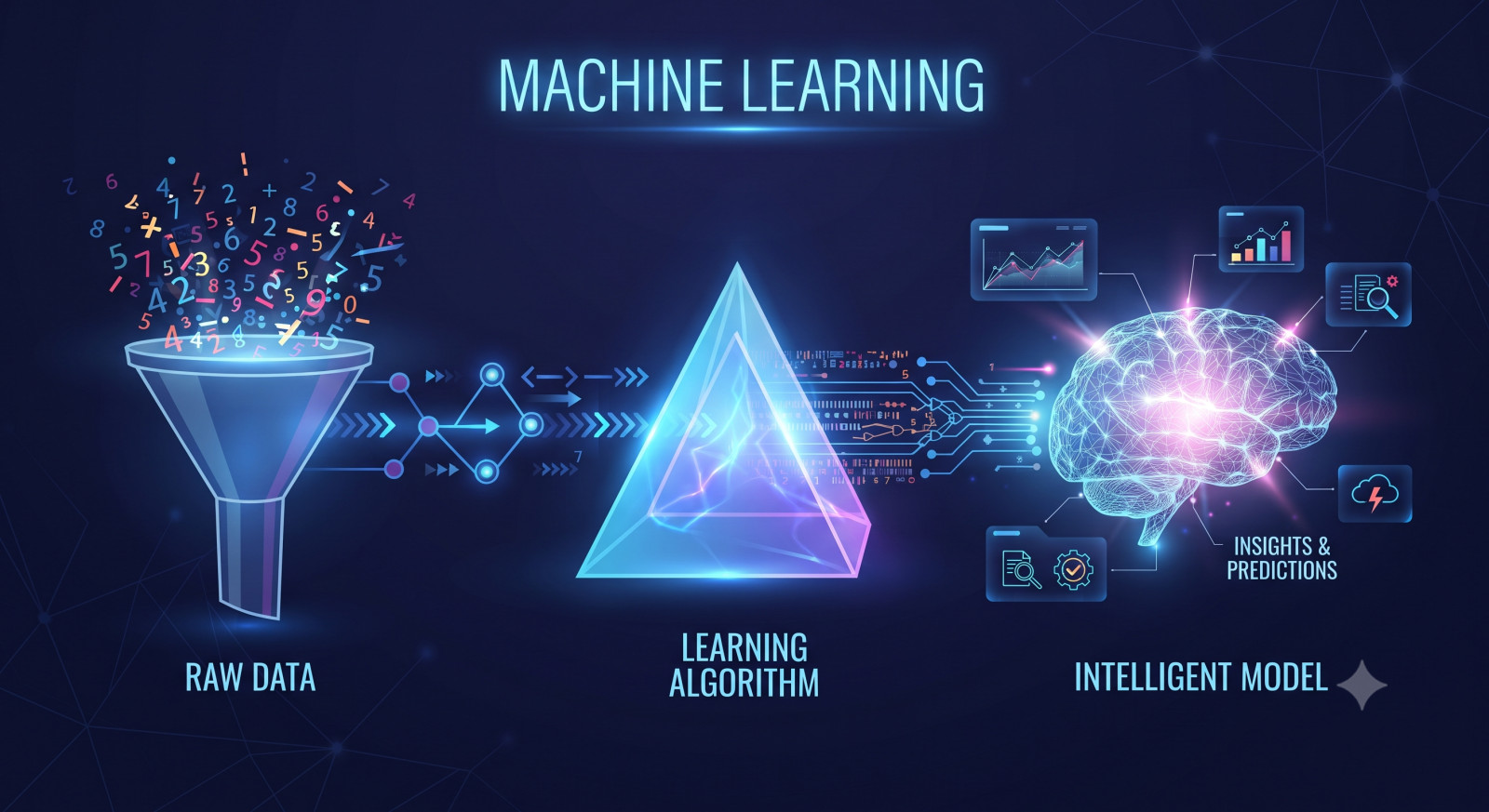
Machine learning applications use data to identify patterns, provide forecasts, and make decisions. In case of inaccurate, insufficient, inconsistent, or outdated data, the result obtained by means of the most sophisticated AI application might not be correct.
That is the point where such a notion as "garbage in garbage out" (GIGO) becomes important. In case a machine learning application receives garbage data, it would definitely generate garbage as well as a result. Using high-quality data allows for developing a solid basis for developing a high-quality machine learning application.
This article is devoted to discussing the issues related to the importance of data quality in machine learning, dimensions of the problem, possible risks, and ways of improving data quality.
Defining Data Quality
In striving to achieve excellence in machine learning, “data quality” is a phrase that has been thrown around with many different meanings. The creation of an efficient strategy for an AI involves doing more than using broad terms. High-quality data can be measured against five primary pillars called the “Dimensions of Data Quality.”
1. Accuracy
Accuracy is at the foundation of machine learning. It poses one very important question, does the data truly reflect the reality of the entity or event in question? If the lifetime worth of your client in your CRM system is $500 but in actuality it is only $50, your algorithm is being taught about an entirely different audience than the one you are trying to target.
2. Completeness
A model can only be as effective as the quality and completeness of the data it is trained on. Completeness implies having all the necessary data points. Incomplete data points, missing values, and null fields form "blind spots" in your training set.
While some models may be able to deal with incomplete data by employing imputation techniques, in case there are too many blind spots, bias becomes inevitable since the model makes assumptions about things it hasn't seen before.
3. Consistency
Data in large corporations tends to reside in separate silos such as marketing database, sales database, product database etc. and do not necessarily speak the same language. Consistency of data implies uniformity of the data throughout all the different systems. If a customer is marked as "Active" in one system and "Churned" in another one, your model receives contradicting information leading to unreliable results.
4. Timeliness
The value of data can decline over time Timeliness is the degree to which the information is up-to-date for the specific application being considered. In a fast-changing market environment, behaviors observed yesterday can become completely outdated tomorrow. If your training dataset has become outdated with respect to current market dynamics, then you optimize your prediction models to work in the past but not in the present.
5. Relevance
Relevance asks one very simple question: does it help in solving your specific problem? It does not always pay to have more and more data. By including too much data, which is unnecessary, you add noise to the dataset and create more difficulty for the model to detect valuable signals, resulting in overfitting. The high-quality data set is consciously curated.
Why Data Quality is the Foundation of AI Success
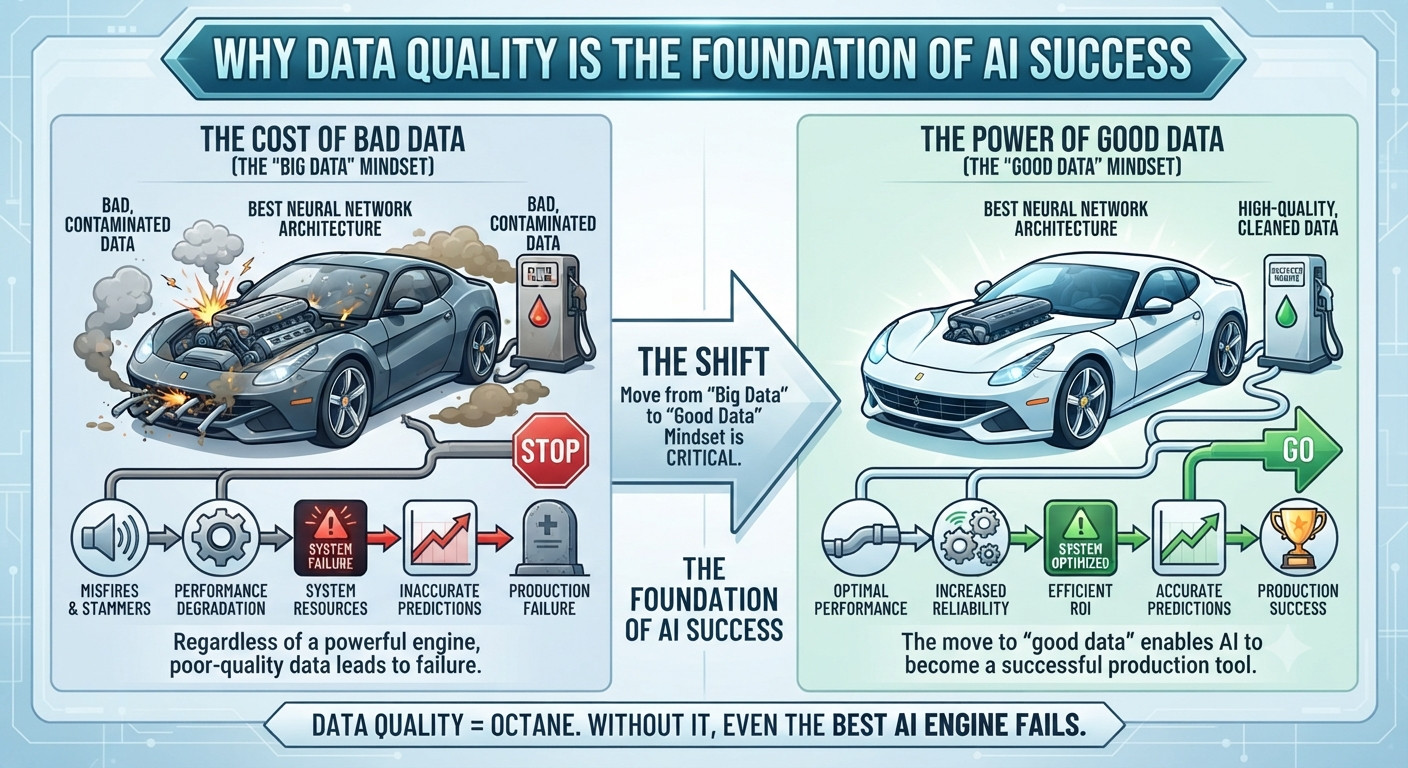
While the fuel for the machine learning process is the data, the equivalent of octane in this analogy would be data quality. No matter how powerful an engine you have—the best neural network architecture currently available—if it’s fueled by bad-quality, contaminated data, the machine will not perform well; it’ll stammer, miss fire, and fail. The move from "big data" to "good data" mindset is the most important step in turning AI into a production tool.
Higher Model Precision
The first and foremost aspect in which data quality affects the performance of artificial intelligence is model precision. Machine learning algorithms are basically pattern recognition systems that learn certain rules to predict a target label based on a set of features.
So if inputs are incorrect, noisy, or incorrectly labeled, the algorithm would learn some patterns of garbage. Cleaning up inputs allows reducing the noise to signal ratio, and thus, increases the chances that the algorithm would converge to the true data distribution, thus increasing model precision.
Faster Training Cycles: Solving the Bottleneck
The data scientist has been quoted saying that 60%-80% of their time is consumed by the "data preparation" stage which involves cleaning, wrangling, and feature engineering. This is the AI bottleneck in reality. In situations where there is poor quality data from the sources, the engineering efforts to "fix the data in post" become exponential.
If there is investment in the quality processes for example through automation of the validation process as well as the schema enforcement at the point of ingestion, one can be assured of reduction in the time spent during the preparation stage. The effect of such is that the time to market will be enhanced.
Generalization
There are situations where a model does well on the training set but fails in application to the real-world input. Even though such situations are considered as the architecture issues, most of the time it is due to poor quality data. When there is high-quality data in terms of diversity, the model will do well even in the unseen world.
Reduced Bias and Fairness
Today’s world sees the importance of AI ethics in governance. Poor quality of data is the leading cause of problems. In case your data set does not have adequate representation or includes any biases historically, your algorithm will incorporate and expand them. The data pipeline should be thoroughly audited in order to ensure high quality of information.
By ensuring that a dataset is balanced and representative, companies can prevent themselves from creating biased models that cause reputation loss and possible regulatory issues.
Stakeholder Trust: The Human Factor
Lastly, adoption of AI technology within an organization significantly relies on stakeholder trust. Executives and decision-makers do not want to work with black box models. They want to be able to see how the model made its decision through a clear traceable data lineage. High-quality data becomes a key component of this process. When decision-makers are sure that data is good and verified, they are more willing to make business decisions based on this information.
The Anatomy of Poor-Quality Data
Quality data acts like engine oil which lubricates the functioning of your AI system while poor quality data is like sand that clogs the gears. Being aware of what forms bad data comes in is crucial for dealing with it. It's not about one bad file causing problems; it's a combination of problems within the whole process of development of an ML system.
Noisy Data: The Noise-Signal Ratio Dilemma
In the most basic sense, bad data is "noisy," meaning there's a bunch of unnecessary stuff such as redundant data, duplicate data, and extreme outliers in it. Algorithms can take a certain amount of variability, but if the level of noise in the dataset is higher than the signal level, a model will be unable to separate it from actual signals. The result is a highly unstable model that will always chase meaningless "ghosts."
Data Silos and Integration Nightmares
Data quality problems occur due to organization's design. Databases in marketing, sales, supply chain management, and customer service teams do not interoperate; each team uses its own set of names for fields, date formatting, and units of measurement.
The "integration nightmare" starts when all these heterogeneous datasets have to be merged in order to feed a machine learning model. Inconsistency between the data structure leads to loss of information during transformations and contradictions that the model cannot reconcile. Without a consistent data schema, your model is trying to communicate in four different languages.
The Bias Trap: Poisoning the Well
The most harmful kind of poor data is the bias. Bias sneaks into the pipeline not because of any evil intentions, but rather as a result of poor ways of collecting the data. If the data used for training does not cover all possible demographics or some edge cases are left out of sight by your collection tools, then your machine learning model will learn a distorted logic. The bias gets encoded into the model's weights and biases and turns it into "a poisoned well."
The Hidden Cost of Technical Debt
Undoubtedly, one of the most underrated effects of having poor data is the accumulation of technical debt. Engineers who understand that there is something wrong with their source data would never return and solve this problem at its root. They construct complicated, fragile, so-called "patchwork" pipelines—a whole bunch of custom scripts, regex cleaning functions, and manual overrides that compensate for the chaos they have to deal with.
Such pipelines are very fragile, they fall apart all the time, are hard to maintain, and are almost impossible to scale up. This is the price of having poor data—your most skilled engineers become janitors instead of architects, and the progress is hindered while the whole infrastructure collapses.
Best Practices for Data Preparation
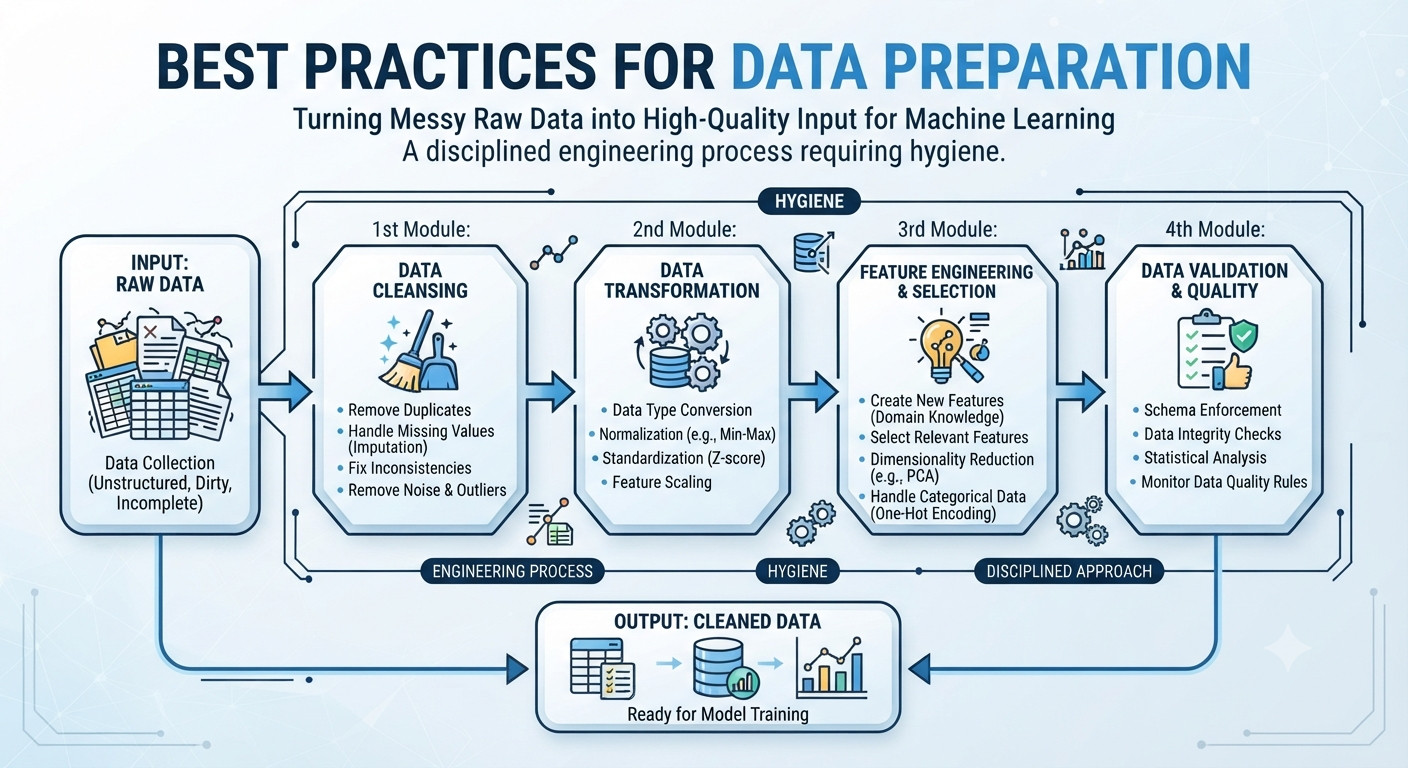
If poor data is a disease, then the preparation pipeline is a medicine. Turning your messy and raw data into a useful tool is not an occasional thing; it is a disciplined, engineering process that requires hygiene. In order to bring your machine learning project from an experimental phase to production, you need a set of best practices to be applied between "data collection" and "model training."
The Data Audit: The Foundation of Health
A thorough Data Audit provides a health check-up on your information environment. It includes setting up quality benchmarks such as acceptable limits of null values and reasonable intervals of numbers as well as regular verification against them. With an audit of data provenance and its lineage, you get the insight required to pinpoint the point at which data degrades.
Automated Validation: The First Defense Line
Your pipeline needs to include:
-
Schema Validation: Making sure that incoming data is consistent with expected schema, data types, and structure.
-
Statistical Validation: Monitoring the dynamics of features' distributions. If one of your sensors suddenly sends you data three standard deviations away from normality, your pipeline needs to detect it right away.
-
Real-time Anomaly Detection: Applying ML models to detecting anomalies in the stream prior to ingestion into your main training dataset.
Advanced Cleaning Techniques
Once the data is acquired, it is not ready for training. The best course of action is to employ three crucial techniques:
-
Imputation Techniques: In case of missing data, don’t just delete it. Use smart imputation – replace the missing data with the mean, median or mode values for simpler data, and use the predictive techniques such as k-Nearest Neighbor for the complex data.
-
Deduplication Techniques: Duplicate data adds an artificial weight, which forces the algorithm to learn on certain historical events only. Use hashing or fuzzy matching algorithms to deduplicate the dataset.
-
Synthetic Data Creation: Imbalanced classes and privacy policies are two of the biggest problems. Through synthetic data creation, you can create an artificial sample of data with the exact statistical features of the real data.
Exploratory Data Analysis (EDA): Visualization Before Ingestion
Never think of your data as a black box. Exploratory Data Analysis is the most crucial stage in this process. Through visualization of your data via heatmaps, scatter diagrams, and distribution histograms, you can "see" the data patterns and abnormalities that cannot be detected in spreadsheet form. The purpose of EDA is not only to discover something new but to develop a kind of intuition that allows you to make sure that the model you are going to build will use the proper architecture.
Data preparation becomes a part of your software development process rather than something you have to do before building a model..
Real-World Impacts: When Data Fails vs. Succeeds
What distinguishes a failed AI project from a successful one is rarely the architecture of the models—this is always the quality of data. To appreciate what can happen as a result of ignoring this point, one needs to consider some examples where things went wrong, as well as the factors behind the success.
Case Study #1: The Failure of Churn Prediction Project
Suppose we have a mid-sized retail company which spent a lot of money building a state-of-the-art predictive model for reducing the churn rate. The engineers used the latest machine learning techniques, specifically the gradient-boosted trees, which they expected to predict the list of 'at-risk' customers with great accuracy.
What happened after weeks of operation was that the model marked loyal and longtime customers as "likely to churn," while being unable to predict the churn of already churned users.
This happened due to the poor quality of CRM data. While the marketing team used one date format, the billing team used another one for tracking account activity time stamps. Since the sales team didn't always update CRM statuses, the "last contact" date became several months old. Thus, the model worked in a fictional version of reality created by
Case Study 2: The Enterprise AI Success Story
In contrast, think about a global logistics company that decided to build an AI-powered supply chain optimization project. Instead of moving immediately towards model training, in the first six months they built a data pipeline automating this process. They implemented schema validation, unification of silos and introduced "Data Governance Council."
Then, when they launched their models to predict maintenance for their fleet, the results were revolutionary. As the data was consistent, up-to-date, and cleaned up, the models reached 95% accuracy of predicting equipment failure. Consequently, they managed to move from reactive fixing of equipment to preventive maintenance, thus reducing the downtime by 20% per year and saving millions of dollars in the process.
Financial Considerations
By ignoring the data quality you are doing more than just ignoring the problem – you are actively reducing your profit. According to Gartner, companies lose an average of almost $13 million annually due to low data quality. It's worth considering "opportunity cost" – when your data scientists spend 80% of their time cleaning the data, you are actually paying for the data-cleaning service, not for AI development. When estimating ROI from your AI projects, always remember that high performing
The Future: Data-Centric AI
For many years now, the machine learning space has been driven by the concept of "model-centricity," the idea that to reach the state of art, one must design more complex and sophisticated neural network architectures. Many hours have been dedicated to hyperparameter tuning, tweaking layer architecture, and playing around with architectural nuances. As the field is maturing, we are seeing a paradigm shift toward the idea of "Data-Centric AI."
Going beyond Model-Centricity
The idea of Data-Centric AI, pioneered by AI legend Andrew Ng, challenges the conventional approach of leaving the data constant while iterating on model code, and vice versa. In practice, model architecture tends to hit a certain point where improvements start bringing less and less return. Improving data, on the other hand, gives us unlimited room for performance improvement.
The Shift in Focus
This transformation has both a philosophical and practical nature. An optimization of a model structure can provide a marginal increase of 0.5% in the performance; curating a certain portion of biased or corrupted data can yield improvements in double digits.
Such a transformation is putting pressure on an engineering culture to transform the role of data curation, annotation, and pipeline into one of the equally prestigious roles like that of model development. The future will be such that Data Operations (DataOps) become a crucial part of all AI initiatives.
The Role of GenAI in Data Hygiene
One of the most interesting developments is that AI itself is becoming a valuable tool for improving data quality. When it comes to cleaning the data which it was taught with. Generative artificial intelligence (GenAI) turns out to be a great helper in the whole process of the data-quality lifecycle.
Today we already have intelligent solutions based on AI which are able to automatically find anomalies in the dataset, provide strategies for filling missing values and even generate synthetic datasets to balance minority classes. With the help of such intelligent solutions, the most time-consuming stages of data pre-processing become automated while engineers can take care of more important tasks.
Recap
The quality of data is the prerequisite to efficient artificial intelligence and machine learning. Despite constant improvements of the algorithms used and enhanced performance of computing platforms, their success will depend largely on the quality of data they use for processing. The use of inaccurate, outdated, or incomplete data may cause flawed predictions, bias, and expensive errors in decision-making.
Data quality has to become a constant activity and cannot be limited to just one-time actions. Data audits, data validation, consistency of data standards, data governance, and other activities can ensure that the data set remains reliable at all stages of the AI process. The use of AI-driven software can facilitate data cleansing, detection of anomalies, and discovery of missing or inconsistent data.
The primary objective should not be collecting more data for its own sake, but creating reliable, pertinent and high-quality data sets.
Frequently Asked Questions (FAQ)
1. How much data cleaning is enough? Strive for "fit-for-purpose" data cleaning. Leverage automated data validation to identify errors and focus on cleaning those data points which correlate best with your target variable in the model. If the model meets its goal, switch to monitoring, not perfection.
2. How is data quality different from data quantity? Data quantity is about how much you have, while data quality is about the integrity of the data.
3. How can I identify whether there is bias in my training data? Do a demographic breakdown and conduct "slice analysis" when testing the model. Accuracy differences in certain subsets indicate bias in your data.
4. Where do I begin in cases of poor data quality? Begin with auditing your most valuable data pipeline that is associated with your most valuable AI use case.
5. What is "Data-Centric AI"? It is the process of keeping the architecture of the model constant while improving the quality of the training data.
6. Does the addition of more data always improve the situation? Not necessarily. Without ensuring its quality, adding more data might only create additional noise and increase storage expenses.
7. How does GenAI contribute to the improvement of data quality? Using GenAI tools helps with automation of anomaly detection, suggestions of data imputation techniques for missing values, and creation of synthetic data.
8. What are the five pillars of data quality? Accuracy, Completeness, Consistency, Timeliness, and Relevance.
9. Why does my model overfit? Overfitting may happen due to the memorization of noise in the dataset rather than understanding its inherent patterns by the model.
10. Is data hygiene a technical problem or a cultural one? This problem is a combination of both. Technical aspects of the problem are needed for automation, but cultural change is required since data management is seen as an engineering core.