Best Machine Learning Algorithms Every Beginner Should Know
Best Machine Learning Algorithms Every Beginner Should Know
The contemporary world of machine learning can appear to be a constantly evolving and ever-changing ocean of architectures, frameworks, and buzzwords. The sheer amount of data available to the novice practitioner may prove to be more intimidating than anything else.
The idea that you have to become a guru of all the complex algorithms ranging from deep reinforcement learning to transformer models before you write any production-grade code may be rather appealing to many. The actual case is far from being so.
The most successful practitioners are not the ones who have the best knowledge of the most complex algorithms, but rather of the fundamental methods powering most of the real-life solutions.
The mission of Gigmint.ai is to remove the unnecessary clutter from your path. We aim to ensure that your experience with AI will be less about getting buried under technical knowledge and more about constructing a strong mental model that enables you to solve any data challenge with ease.
The objective of this guide is to demystify the “black box” so that you can acquire technical proficiency to use AI effectively. Machine learning success is not about an infinite array of tools available, but rather about the “essential few.”
Understanding the ML Landscape
Machine Learning can be understood at the very base level as the art of training computers to make decisions based on data rather than coding. Instead of trying to come up with precise coding rules, one should think about designing a system that would improve itself by acquiring more experience. The more data you feed the computer algorithms, the better it becomes at making certain predictions.
The Big Split: How Machines Learn
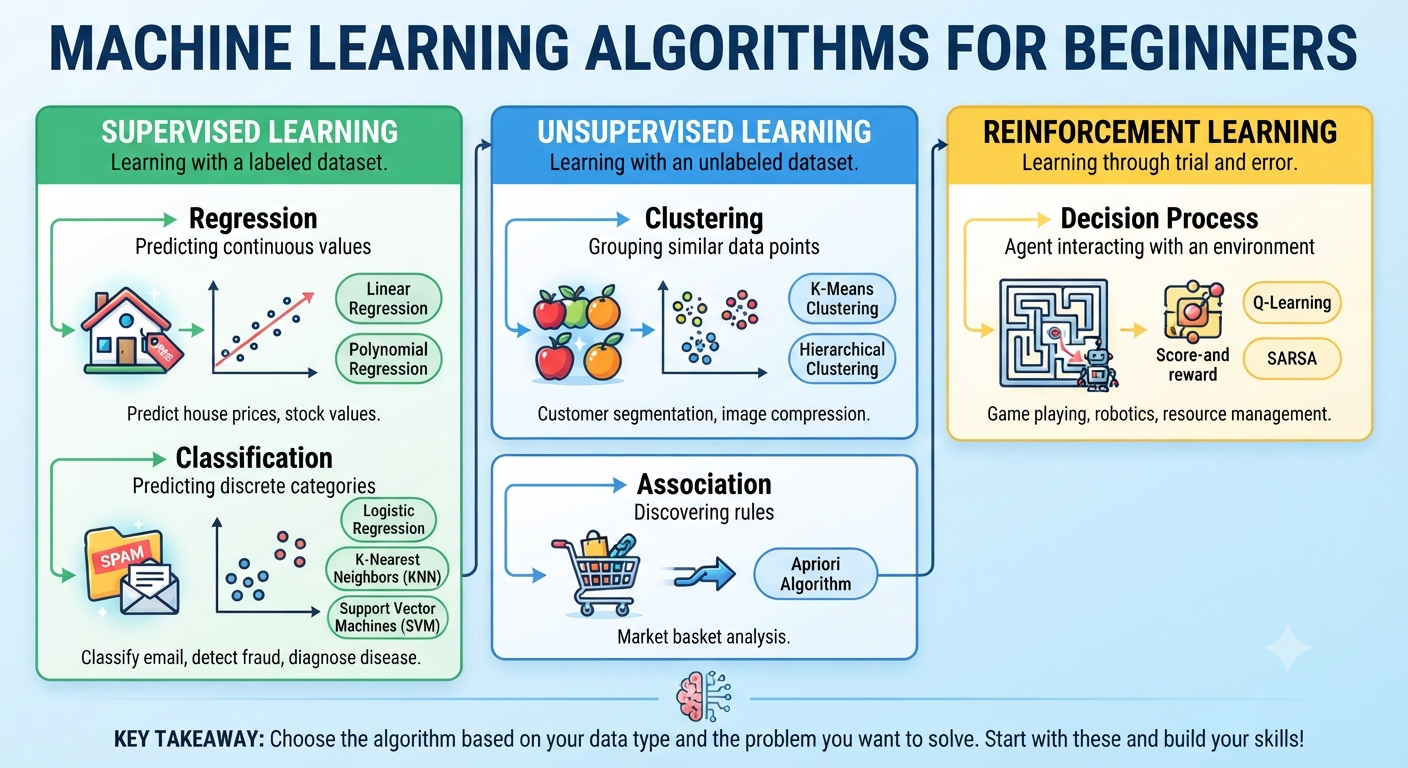
In order to maneuver the machine learning landscape, it’s important to have an understanding of the three main learning paradigms of ML:
-
Supervised Learning: The most common type of ML, where the algorithm learns from "labeled data", which means that the inputs are already paired up with the desired outputs. You are effectively teaching the machine via example. Examples of problems solved using this approach can be classification ("Is this email spam?") and regression ("What will be the price of this house?").
-
Unsupervised Learning: Similar to reinforcement learning, except there is no labeling of data. The machine learns alone and discovers any underlying structure or pattern in the information. Very useful for clustering similar people for marketing or dimensionality reduction, where the task is to compress data as much as possible without losing any information.
Avoiding the "Black Box" Trap
An all too common mistake made by novices is falling into the “Black Box” fallacy. With the advent of potent libraries like Scikit-learn, TensorFlow, and PyTorch, it becomes incredibly simple to load models, train them, and make predictions using only a couple of lines of code.
Relying on such libraries as magical black boxes is a quick fix that may come back to haunt you later down the line. If you lack knowledge of the mathematics involved in the process of minimizing the cost function, the reason behind high variance of one particular model, and the actual process of running gradient descent—you will be at a loss when your model fails in a production setting.
At Gigmint.ai, we value the knowledge of the theory over the know-how of calling some function from some library.
Unsupervised Learning Algorithms
Supervised Learning is like a tutor that gives directions, while Unsupervised Learning is an adventure of exploring something new. In this process, the machine is fed data which does not have any clear-cut labels – there is no "answer key" for the same.
The algorithm needs to play the role of the detective and search the data set for any hidden structures or patterns within. At Gigmint.ai, it is vital for beginners to learn about these concepts, which come in handy when you do not know what you are searching for – for example in discovery analytics or data pre-processing.
1. Understanding Patterns through Proximity
How It Works: The Iterative Process
Cyclical assignment & re-assignment algorithm:
-
Step IInitialization: In order to initialize the process, one selects $k$ random starting points which would act as centroids for the cluster.
-
Step IIAssignment: Next, we have to assign an object from the given data to the nearest centroid using the Euclidean distance formula.
-
Step IIICentroid Update: Centroids of the cluster are updated by calculating the mean of all objects in the cluster.
-
Convergence: assignment and updating of centroids continues until no more changes occur in the centroids' location, and thus convergence occurs and the algorithm terminates.
The quality of clustering can be assessed using Within-Cluster Sum of Squares (WCSS). At the beginner level, one should focus on the so-called "Elbow Method" that allows selecting optimal $k$ through WCSS plotting.
depending on the number of clusters (when the curve bends, it means the addition of new clusters provides marginal improvement).
Real-World Use Case
-
Customer Segmentation: K-Means algorithm allows marketing specialists to group users depending on their behavior or demographics and develop different "personalities" based on the found clusters in order to build effective marketing campaigns with increased conversion rate.
2. Principal Component Analysis (PCA)
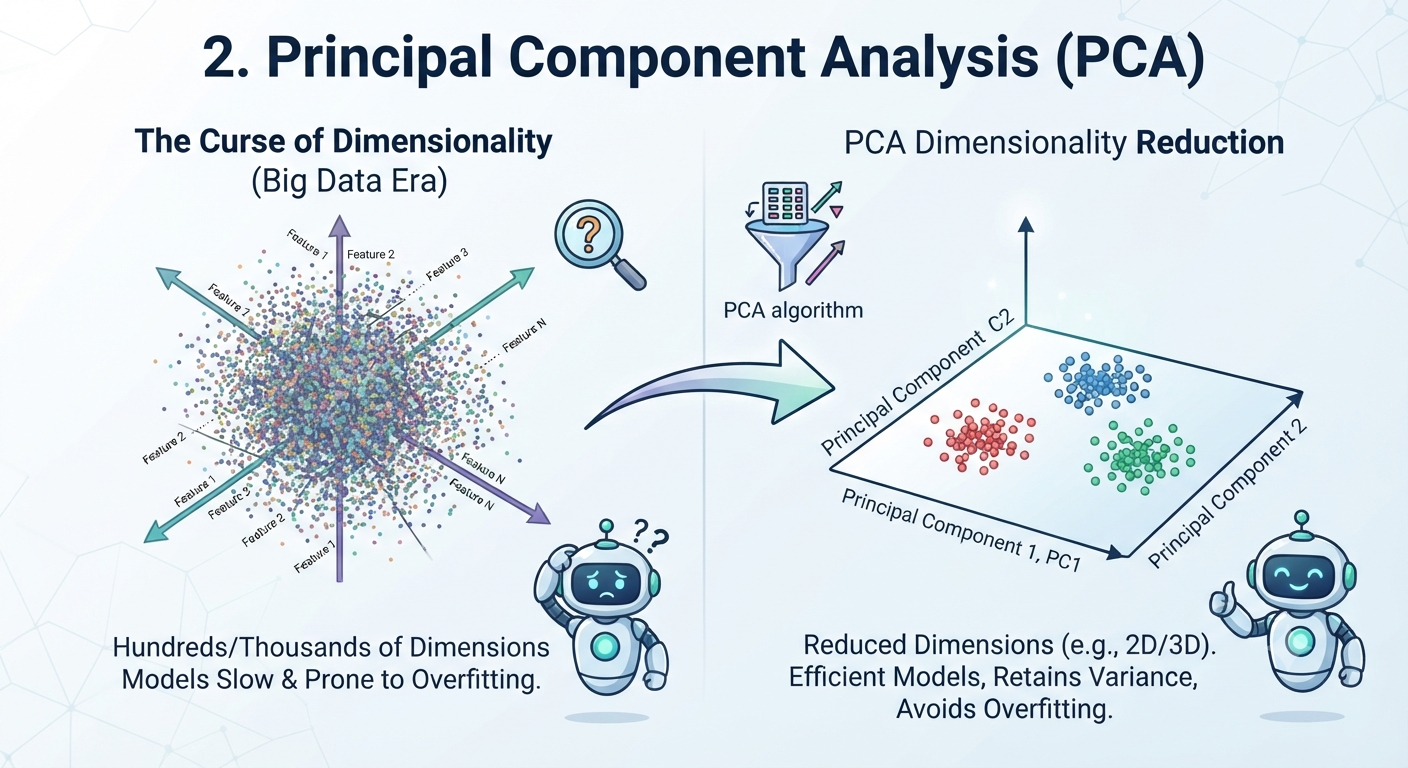
In the era of “Big Data,” you may come across datasets with hundreds or even thousands of features (dimensions), giving rise to the problem of the “Curse of Dimensionality” where models become computationally inefficient and vulnerable to overfitting. PCA is the state-of-the-art solution when it comes to dimensionality reduction.
How Does It Work? Finding the Signal
The idea behind PCA is not just to eliminate features in some arbitrary way but rather to find new uncorrelated variables out of the initial ones.
Maximizing Variance: The first principal component is chosen based on the principle of maximizing the variance in data. The next one accounts for the rest of the variance and is orthogonal to the previous one, etc.
Linear Transformation: PCA makes use of linear algebra techniques – eigenvalue decomposition of the covariance matrix of the data to perform transformation of data.
By choosing the first $n$ components which account for the most variance of the data, you get rid of a large portion of data dimensions.
Real-World Use Case
Visualization of High Dimensional Data: Man can visualize only up to two and three dimensions at once. By applying PCA, it is possible to reduce a 50 features dataset to two components. Hence, you will be able to draw 2D scatter plots for spotting out the outliers or testing for clusters’ separation.
Efficient Preprocessing for Speeds Up Training: With regard to real-time processing, applying a simple and variance dataset to the model (such as SVM), which will save a lot of time while providing no loss of the quality of the output.
Key point about Unsupervised Learning
Contrary to the definitive output of regression or classification tasks, the output of the Unsupervised Learning is rather subjective. You need to know your domain well to determine whether or not the cluster found via K-means is actually the business one and not just some random noise. We at Gigmint.ai advise to treat these techniques more like filters rather than conclusive tools.
Essential Concepts to Complement Algorithms
The choice of a proper algorithm is only the first step. To be a programmer who not only "runs code" but also "solves problems," you need to know and understand all fundamental notions which determine how models will behave in the wild.
The Bias-Variance Tradeoff: Balancing Perfectionism and Flexibility
All machine learning models stand on the Bias-Variance continuum.
Bias reflects the error introduced through simplifying the actual problem to a simpler one. Models that have high bias can be described as too inflexible to describe the actual structure of the data correctly (for example, using linear regression for non-linear data).
Variance measures the sensitivity of the model to changes in the training data. In the case of a high-variance model, we have overfitting, when a model is "learning" the noise in the data rather than the underlying structure.
The task of machine learning engineers is to find the point when both bias and variance are minimal.
Feature Engineering: The 80/20 Rule of Data Science
There is one thing that you should learn from this guide. And that is that the quality of data outweighs the complexity of the model. The process of feature engineering is nothing but taking raw data and turning them into something that improves the effectiveness of the algorithm. This includes the following steps:
Data cleaning – Dealing with missing values and duplicate entries.
Data normalization/standardization - Ensuring that all the features are within a certain scale so that a single feature does not overwhelm the training process.
Feature transformation – Creation of new features using existing ones (for example, creating "weekday" out of raw timestamps).
Data scientists spend 80 percent of their working hours doing feature engineering. In many cases, if a dataset is well-engineered, even a simple model like Linear Regression is able to outperform a more complex model such as a Neural Network.
Evaluation Metrics: Looking Beyond Accuracy
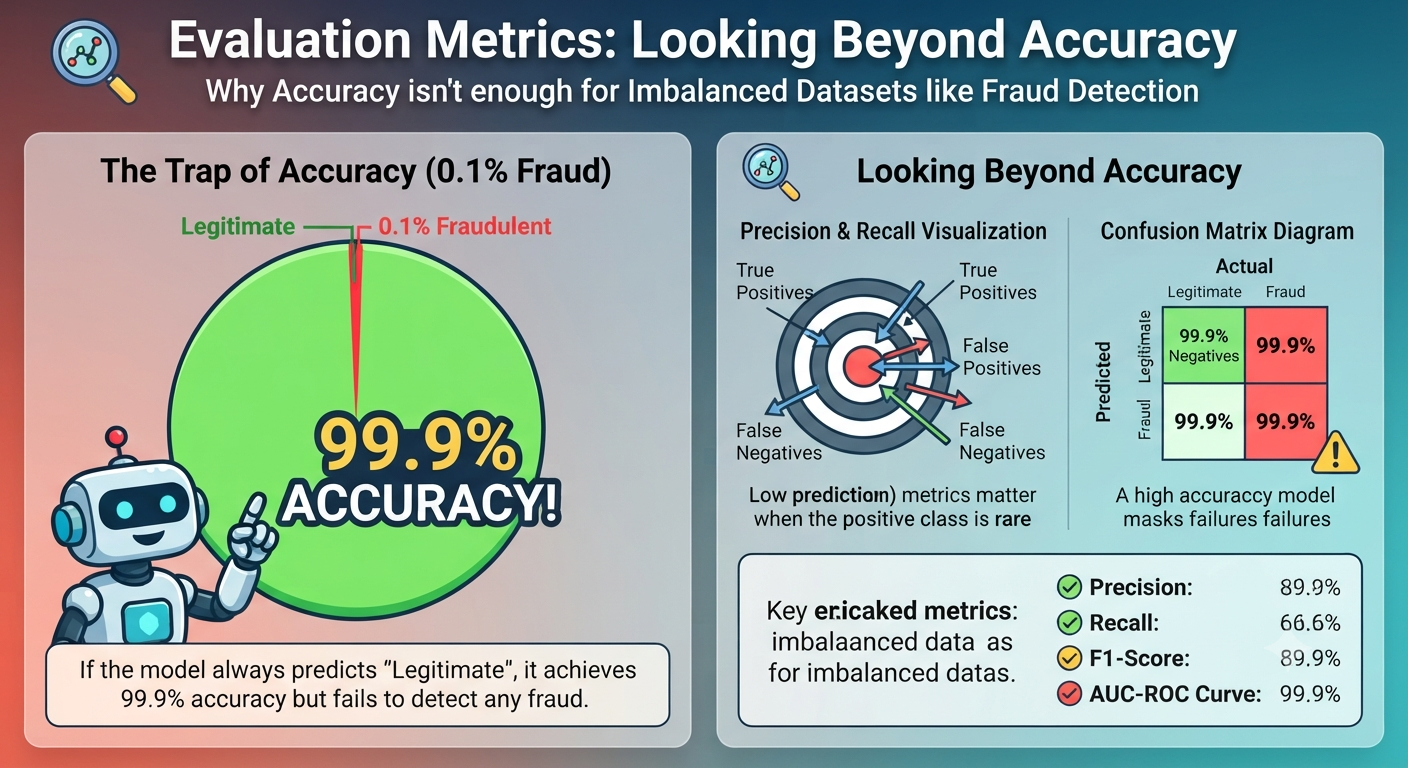
Where beginners use "Accuracy" to evaluate their results, in most cases – especially those related to imbalance dataset (such as fraud detection), accuracy is just not good enough. Since you have only 0.1% of transactions that are fraudulent, if your prediction algorithm always says "not fraud", it will still be 99.9% correct, but absolutely unusable.
Here is when we should pay attention to:
-
Precision: Among all predictions of positive class, how many are really positive?
-
Recall (Sensitivity): Among all real positives, how many were predicted correctly?
-
F1-Score: The harmonic mean of Precision and Recall. This gives us the one measure to rule them all.
Practical Implementation
One cannot understand machine learning just by theoretical concepts but must try to implement what he has learned through coding, data analysis, and also have the patience to face his/her mistakes for the first time.
The Essential Machine Learning Tech Stack
When it comes to machine learning, especially if you are just getting started, there is no doubt that the king among programming languages is Python due to the wide range of powerful libraries at hand:
-
NumPy: The building block of any numerical computing library in Python.Multi-dimensional arrays along with their mathematical operations can be carried out using NumPy.
-
Pandas: Most widely used data manipulation library. This will be the go-to library if you are working on cleaning your dataset and performing EDA.
-
Scikit-learn: Your Swiss army knife. A set of efficient tools for predictive analysis, including almost all of the algorithms mentioned in this article—Linear Regression, K-Means and Random Forests..
Project Ideas for Beginners
To develop your confidence, begin with "classic" datasets that let you compare your results with the rest of the community:
The Iris Dataset: The "Hello World" of classification. Try out some basic supervised learning by identifying the species of irises based on the petal and sepal metrics.
Survival prediction in Titanic: One of the classic tasks for data scientists. It is the right task to get familiar with the concept of feature engineering – filling the missing data in case of the age feature or encoding categorical features, for example.
Customer Segmentation: Start by applying clustering using the K-Means method on an e-commerce dataset. This exercise will help you transition from classification to uncovering the underlying structure of unclassified business data.
Where to learn
Save yourself from unnecessary work – start with the Gigmint.ai resource library that explains in detail how you should implement those projects. For raw data sets, Kaggle is an essential playground – it has real-life data and forums that explain how the engineers approach the task solving. Remember – the best engineers do not have all the formulas memorized but know how to diagnose and troubleshoot their models.
Future-Proofing: Where to Go After the Basics
Since you have gained knowledge about basic algorithms such as regression, clustering, decision tree, etc., you will probably think of applying yourself immediately to big language models, generative AI, and deep learning concepts. This is what any good engineer would do, but at the same time, it is vital to direct your enthusiasm in the right direction.
The Bridge to Advanced AI
Neural Networks and Deep Learning are essentially the next step in the development of what you have already learned. In the simplest sense, deep learning is an advanced system of weighted connections, much like the decision tree and linear regression that you have learned before, except for the ability of these models to automatically detect hierarchical patterns in very large and unstructured data sets.
If you decide to go into Deep Learning without having a good understanding of bias-variance trade-off, feature engineering and metrics for evaluation, you will find it difficult. Models in Deep Learning are known to be "opaque" and easily susceptible to overfitting.
In the case where your sophisticated model is not working well, it is the knowledge that you acquired when learning about simple models that will enable you to troubleshoot problems with your data, regularization parameters, and the model itself.
Your Path Forward
Your current work is the indispensable prerequisite to advanced AI. To become an expert user of Gigmint.ai you need to:
Improve Your Mathematical Sense: From using packages such as Scikit-learn to learning calculus and linear algebra that power them.
Work with Unstructured Data: After working with tabular data, you can dive into Computer Vision (CNNs) and Natural Language Processing (Transformers).
Deployment of Models: Learn how to transition your code from a Jupyter notebook into production by means of FastAPI and Docker.
Do remember that the area of AI develops at a frantic pace. While the algorithms used by you right now might be different from those that you will apply tomorrow, the very foundations and the logic of “learning from data” stays the same.
Frequently Asked Questions
1. Must I be a mathematical genius to get into machine learning? Not really. Even though knowing about the math behind the whole thing is good, you can begin with understanding how algorithms work and implementing them.
2. What is the amount of data required for training the model? It depends on how complex the problem is – simple regression can be trained using tens of samples, while more complex algorithms like deep learning require thousands and millions of samples.
3. What is the difference between AI and Machine Learning? AI is a general concept that means intelligent machines while Machine Learning is one particular approach within the AI field which deals with training models using data.
4. Why does my model work well with the training set but bad with the test set? The classic case of overfitting when your model has “learned” the noise of the training dataset.
5. Which one should I study first, Supervised or Unsupervised Learning? Go for Supervised learning first. It is easier to understand and makes the learning process straightforward.
6. Is Scikit-Learn sufficient for an AI career? Going further down the line, you will have to be acquainted with PyTorch or TensorFlow for purposes of deep learning.
7. How can I choose the right algorithm? Your choice depends on the data itself, purpose (prediction of numbers or classification of objects), and amount of data.
8. Is it possible to carry out machine learning projects on my laptop? You definitely can. The vast majority of basic projects, including those related to the Iris or Titanic datasets, go just fine on regular computers.
9. How long does it take to become skilled in this? Patience is important. By practicing every day, you can achieve the needed knowledge in a couple of months.
Summary
This is a field where the key to success lies in patience and in-depth knowledge much more than in chasing the latest trends at breakneck speed. As we have seen in the entire guide above, the "secret" of becoming a good data scientist or artificial intelligence engineer does not lie in complex and mysterious libraries but in solid knowledge of the fundamental elements: linear and logistic regression, decision trees, support vector machine, and the absolutely crucial techniques of clustering and dimensionality reduction.
Having mastered these foundations, you learn not only how to invoke a set of functions within a script but also develop intuition about when which of the methods can be used to solve a particular problem, to balance bias and variance, to create useful features, and to estimate the performance of the algorithm. This is the sign of a really good engineer: the ability to dig deeper into the details of the architecture and see how it learns from data.
Keep in mind that the domain of artificial intelligence will go through incredibly fast changes in future. The basics—logic of optimization, requirement for high-quality data, and the need for evaluation based on a well-defined objective—will remain eternal.