Supervised vs. Unsupervised vs. Reinforcement Learning: Differences, Use Cases, and Examples
Supervised vs Unsupervised vs Reinforcement Learning: Differences, Use Cases, and Examples
1. The Evolution of Modern Artificial Intelligence
When it comes to supervised vs unsupervised vs reinforcement learning, the world of artificial intelligence has seen a paradigm shift over the last few decades. Until then, software development always involved rule-based programming that depended solely on human programmers writing deterministic if-then-else instructions for the computer to be able to take input and give output
Although successful in solving simplistic problems, this model was unable to withstand the complexity of the high-dimensional real-world data sets. In modern times, artificial intelligence works in an entirely data-driven fashion. We no longer program the logic of the systems; instead, we train them on the data.
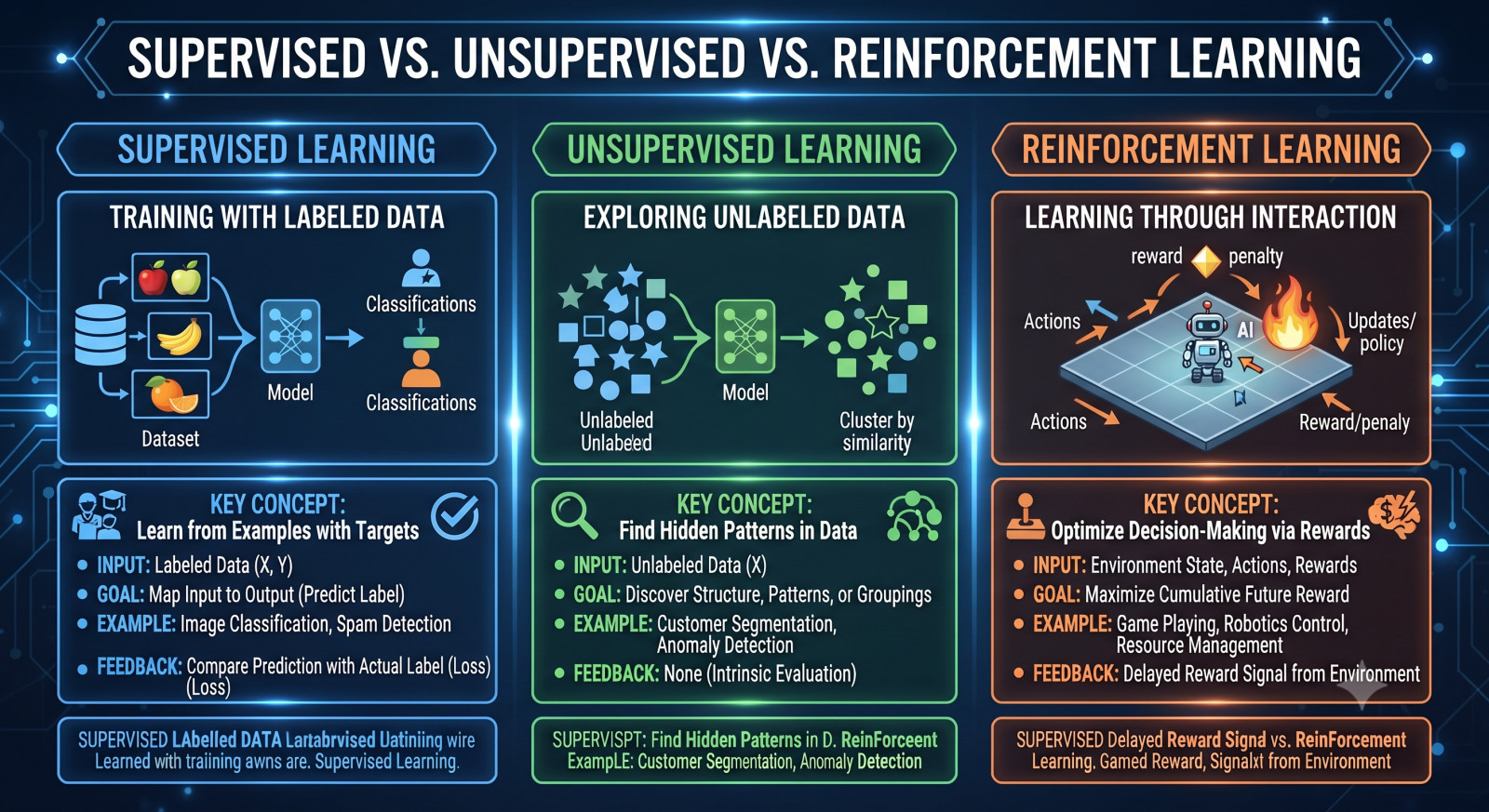
There are three key learning models in artificial intelligence: Supervised Learning vs Unsupervised Learning vs Reinforcement Learning. The choice of learning framework defines how modern algorithms intake data, learn from it, and make decisions autonomously.
In the development of an automated fraud detection system, a strict customer segmentation procedure, or a robot controller that works automatically, you will definitely encounter one of these learning types or even a more complex combination of them.
This tutorial delves into the main machine learning approaches, namely supervised learning vs unsupervised learning vs reinforcement learning. In this course, you will learn how each of these approaches operates, their advantages and disadvantages, common algorithms, applications, and rules for selecting appropriate learning techniques.
At gigmint.ai, we believe that understanding these pillars makes the difference between fragile experiments with code and powerful intelligent automation systems. The idea is not only to choose the right algorithm but to match the right learning paradigm with the structure of the problem you face. Let’s reveal the magic behind machine learning.
2. Foundational Concepts
In order to discuss various paradigms, it is important to know what machine learning actually means from a technical point of view. In essence, machine learning is a subfield of artificial intelligence which allows computers to discover patterns in data rather than follow only the rules that are explicitly programmed into them. Instead of following a set of predetermined rules, machine learning systems learn from examples.
Each learning algorithm has a certain structure, which includes several elements:
-
Features ($X$): The characteristics or independent variables of the phenomenon under observation. Features in contemporary systems are usually pre-processed through pipelines to make sure that the signal and not noise is captured.
-
Labels ($Y$): The ground-truth values that the model should learn.
-
Hypothesis Spaces and Loss Functions ($J(\theta)$): Hypothesis space refers to the collection of all the potential functions that a particular model could adopt. The loss function is the numerical measure that helps assess how well a model does based on how much penalty a function experiences due to the error in prediction of the value versus the actual label. In other words, we aim to minimize $J(\theta)$ over the training distribution with a set of parameters $\theta$.
-
Optimization Methods: Iterative process adopted mathematically to explore the hypothesis space. Gradient Descent is one of the most frequently used algorithms for finding optimal values.
where $\alpha$ is the learning rate.
Training of such models occurs in a very strict training loop. Data gets inputted, filtered, and divided into training, validation, and testing subsets. The training loop passes the training data into an optimization loop where the model tunes its weights according to the validation subset in order not to overfit and then evaluates the model’s generalization abilities on a testing subset before deployment.
Depending on the type of feedback loop, we use different paradigms:
-
When we have historical data with the right answer, we use supervised learning.
-
When we have unstructured data without any labels, we use unsupervised learning.
-
When our model needs to operate in an interactive environment using trial and error technique, we use reinforcement learning.
3. Pillar 1: Supervised Learning Deep Dive
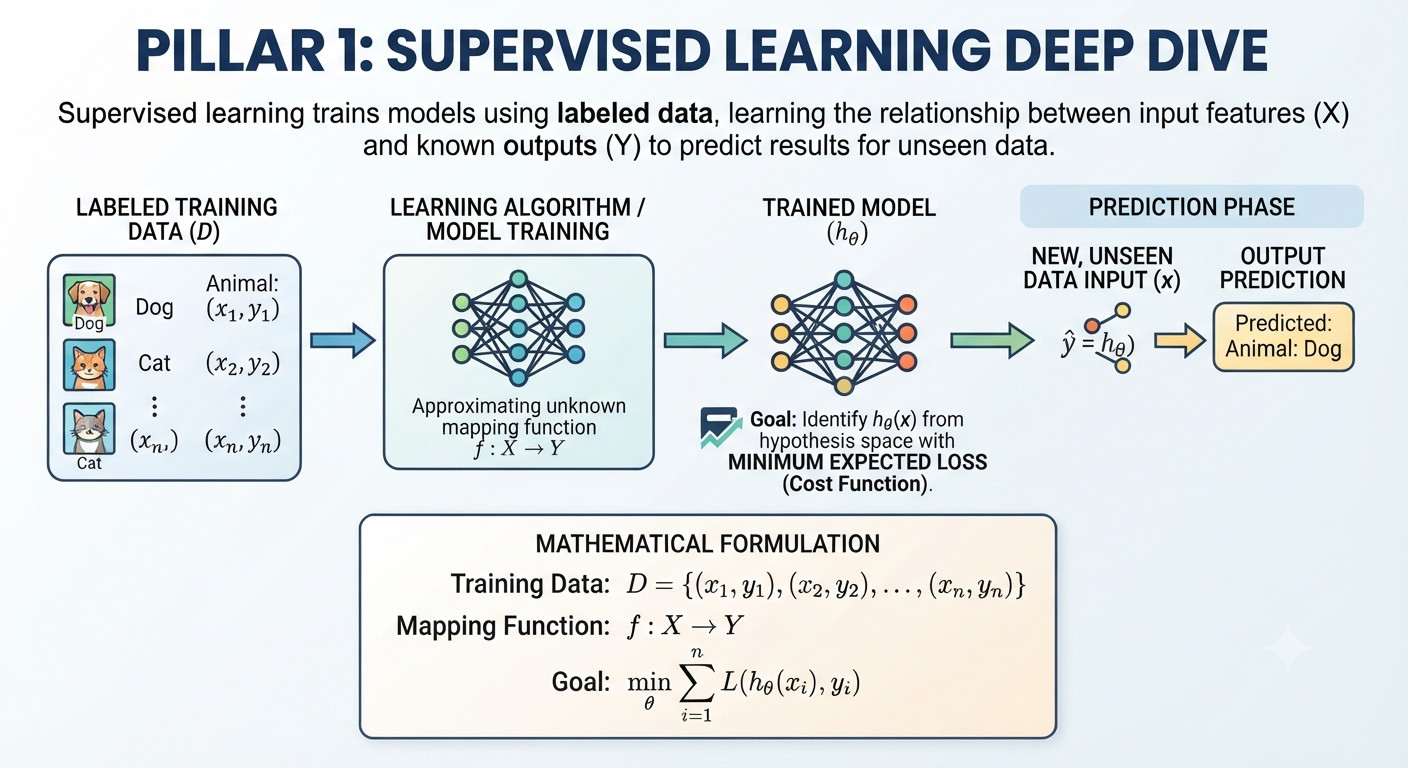
Supervised learning happens to be one of the most commonly employed types of machine learning. This type of machine learning is able to use labeled data in order to train a model on how to connect the input variables to known outputs.
The fundamental idea behind supervised learning completely revolves around learning using labeled data such that each feature vector $X$ has an associated ground truth label $Y$.
The supervised learning task in mathematics consists of estimating the unknown mapping function $f: X \rightarrow Y$. Given the training data set $D = \{(x_1, y_1), (x_2, y_2), \dots, (x_n, y_n)\}$, the task is to choose the function $h_\theta(x)$ from the hypothesis space with minimal expected loss:
Important Subcategories:
-
Classification: Prediction of the class label of a discrete variable (e.g., spam detection, image classification).
-
Regression: Prediction of a continuous variable (e.g., stock price prediction, demand forecasting).
Classic Algorithms & Architecture:
-
Linear/Logistic Regression: The base for statistical modeling.
-
Support Vector Machines (SVM): Valuable in high-dimensional spaces in terms of discovering the best hyperplane.
-
Random Forests/Gradient Boosting: Ensemble models with the use of many decision trees.
-
Neural Networks: Deep network architecture that learns hierarchical representations of data essential for NLP and CV.
Case Study: Detection of financial fraud In a financial application, the model gets input in the form of some features like amount, location, history of the user etc. Every transaction is marked as "Legitimate" (0) and "Fraudulent" (1). The model learns the statistical distribution of fraudulent transactions.
For a new transaction, the model predicts the likelihood of being fraudulent and in case of surpassing a certain threshold marks the transaction. This approach is very efficient because of having access to massive labeled data of historical transactions.
Advantages/Disadvantages:
-
Strengths: High efficiency and easy evaluation through measures such as Precision, Recall, F1-Score and deterministic outcomes.
-
Weaknesses: Expensive process of labeling the data and susceptibility to data drift and sampling bias.
4. Pillar 2: Unsupervised Learning Deep Dive
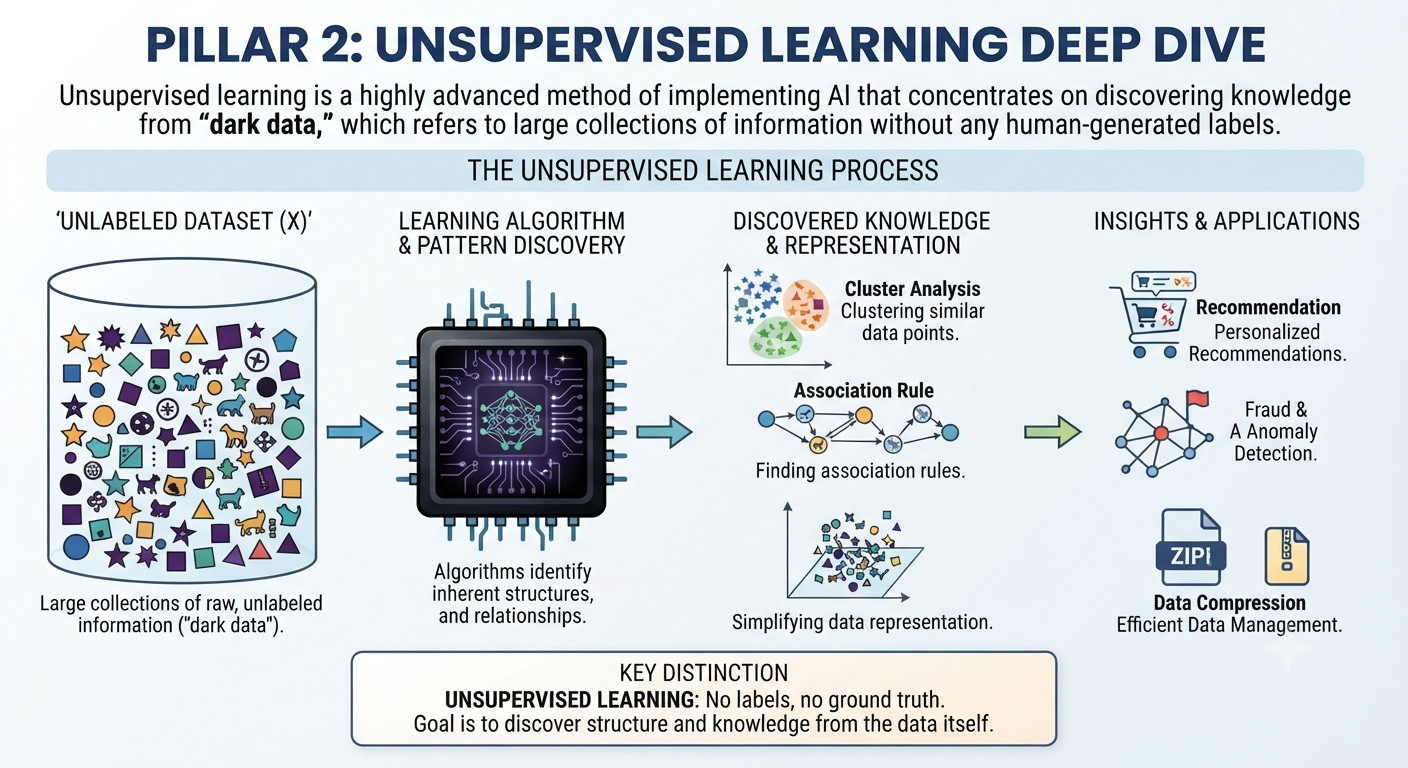
Unsupervised learning is an extremely advanced form of artificial intelligence implementation because it focuses on extracting knowledge from "dark data," which means extensive volumes of data that have not been labeled by humans.
Unsupervised learning becomes extremely important in a world where the amount of produced data vastly exceeds our capacity to curate it in terms of exploring the data, finding patterns and extracting features.
In contrast to supervised learning, which uses the "teacher" input, algorithms based on unsupervised learning have no access whatsoever to the outcome data. The only thing that they can do is to make sense of the structure of the input data and its statistical properties.
Sometimes, manifold learning and density estimation methods become indispensable because the high-dimensional data often lies on a manifold of lower dimensions. Thus, when reconstructing the input or projecting it onto some other dimension, the algorithm learns the causal factors of the data.
Intuition behind mathematical structures Unsupervised learning can be characterized by the process of modeling the probability distribution $p(x)$ of the input data. Unlike supervised learning, these learning algorithms do not use the objective $Y$ in optimization and thus utilize heuristics, such as variance maximization (Principal Component Analysis), entropy minimization (Information-theoretic clustering), or distance based density estimation.
Let us consider Principal Component Analysis (PCA). PCA algorithm allows reducing the dimensionality of the data and keeping the significant signals (variances) at the same time.The transformation that maps the input data to an orthogonal basis, through the principal components, will be used by the algorithm to compute the coordinates of the data where the variances are maximum. The mathematical representation of the PCA problem can be given as follows:
Core Sub-categories and Methodologies
Clustering: Clustering is the process of partitioning objects into groups (clusters) so that objects in the same group are more alike compared to the objects outside their respective groups. In contrast to supervised learning, unsupervised learning does not use labels.
This makes it especially useful for customer segmentation, anomaly detection, recommendation systems, and exploratory data analysis K-Means is the most popular algorithm here which aims to minimize the within-cluster sum of squares:
Here, $\mu_j$ is the mean of cluster $C_j$.
-
Dimensionality Reduction: Methods like t-SNE and Autoencoders are used to visualize the manifolds of high-dimensional spaces. An autoencoder is very effective for this purpose as a neural network is trained on its inputs to get the outputs equal to its inputs ($X' = X$), but via an intermediate 'bottleneck' layer.
-
Association Rule Learning: These methods are used to discover interesting relations between attributes. Popularly used in retail, the Apriori algorithm finds combinations of items that appear together, leading to complex "basket analysis" strategies.
Strategic Trade-offs
-
Advantages: This is the sole approach that can utilize the 90% of organizational data that is currently unlabeled. It becomes essential when it comes to anomaly detection since it helps build a baseline that defines normal behavior, and all deviations from that are regarded as anomalies.
-
Disadvantages: Evaluation still becomes the key issue. Since there are no labels, there are no such measures as "Accuracy". Instead, practitioners need to use such measures as "silhouette score" for clustering or reconstruction loss for neural networks. What is more, the latent features discovered by these models might become quite abstract and hard to understand in very strict industries such as financial or medical.
5. Pillar 3: Reinforcement Learning Deep Dive
Reinforcement learning allows a smart agent to learn based on interactions within its environment. Unlike other learning methods which require labeled instances, reinforcement learning involves carrying out actions and getting rewarded or penalized until the optimal strategies are learned.
The Markov Decision Process (MDP) Framework
$S$: State Space – All the possible states the agent may face.
$A$: Action Space – All the possible actions the agent may take.
$P$: Transition Probability – The probability of going from state $s$ to state $s'$ using the action $a$ denoted as $P(s' \vert s, a)$.
$R$: Reward Function – The reward received immediately after taking the action.
$\gamma$: Discount Factor – The discount factor ranging between 0 to 1. It determines the preference of immediate vs future reward.
The Exploration-Exploitation Dilemma
It is necessary for the agent to use the knowledge that it has to earn some instant reward, but at the same time, it is also necessary for the agent to explore new state-action combinations in order to find better reward.
Deep Reinforcement Learning (DRL)
In case of complicated environments, the size of state-action space is very large for tabular techniques. This problem has been solved through the use of Deep Reinforcement Learning (DRL) technique which makes use of deep neural networks for approximating the value function and policy. Deep Q-network (DQN) makes the agent learn the optimal action value function through the use of a neural network in this way:
This neural network is trained by reducing the temporal difference error that leads to bootstrapping of the agent from its own estimates that are based on the Bellman equation.
Policy Gradient Methods
Whereas value-based approaches concentrate on reward estimation, Policy Gradients approaches (such as PPO and TRPO) optimize policy $\pi_\theta(a\vert{}s)$ directly. They become essential when dealing with continuous control problems when actions are not categories anymore but rather a range of values (for example, motor torque). There is a Policy Gradient theorem which allows us to find the derivative of performance objective and shift policy parameters towards increasing expected rewards:
Challenges and Real-World Implementation
RL is known to be extremely data-intensive and computationally complex, often needing millions of interactions to learn even easy tasks. It is very sensitive to the choice of the reward function. Reward hacking refers to a scenario where the agent finds a flaw in the environment that provides huge rewards without finishing the task. Despite all these difficulties, RL stands out as the most effective approach to decision making in non-linear scenarios.
6. Head-to-Head Comparison Framework
The selection of the right paradigm depends on several critical factors such as the availability of data, desired outcomes, and the characteristics of the feedback loop. In order to help you select the paradigm depending on your technical requirements, a comparative analysis matrix and decision-making tool have been developed.
|
Paradigm |
Data Requirement |
Feedback Type |
Primary Objective |
Classic Algorithms |
|
Supervised |
Labeled ($X, Y$) |
Explicit Labels |
Prediction/Classification |
Random Forests, Neural Nets |
|
Unsupervised |
Unlabeled ($X$) |
None (Structure) |
Pattern Discovery |
$K$-Means, PCA, GMMs |
|
Reinforcement |
Interaction Data |
Delayed Rewards |
Optimal Action Policy |
Q-Learning, PPO |
When to Use Which? A Decision Flowchart Guide:
Need to predict something specific? If you have historical data with clear inputs and labels for those inputs, the most efficient and precise way to do this is through Supervised Learning.
Want to explore the structure of your data? If your data set is a big unannotated one, and you want to segment users, detect features or anomalies—especially during exploratory research at the R & D stage—then Unsupervised Learning is your main instrument.
Want to optimize sequential decision making? If your problem involves making an agent that makes decisions in an environment where its current action changes the states of the future, then Reinforcement Learning is how you do it, applicable in robotics, logistics, and real-time gaming.
Hybrid Techniques: Real-life applications of Artificial Intelligence seldom appear in isolation. One can use Semi-Supervised Learning in cases when only a small amount of annotated data is available as a seed for information propagation across large amounts of unannotated data.
Another example is Self-Supervised Learning, the core technology behind modern LLMs, which generates labels for data from itself. By applying this approach, the team at gigmint.ai could create robust adaptable systems to achieve maximum utility no matter what starting point of your organization’s data you have.
7. Future Trends and Conclusion
Machine learning keeps advancing with supervised, unsupervised, and reinforcement learning being vital components of today's AI solutions. These approaches are not mutually exclusive, and they can be combined and used to solve even more complex problems that arise in the real world.
Modern methods such as self-supervised learning, reinforcement learning with human feedback (RLHF), multimodal artificial intelligence, and foundation models change the way intelligent systems are developed. Understanding which learning approach works best in which situations is one of the most important competencies of people working with artificial intelligence.
The choice of the most suitable learning paradigm in your use case will allow you to build an AI system that really works.
8. Frequently Asked Questions (FAQ)
-
Supervised Learning VS Unsupervised Learning
The key difference between supervised and unsupervised learning lies in the following fact: the key characteristic of supervised learning algorithms is the use of labeled data in order to construct the mapping function. Meanwhile, the key characteristic of unsupervised learning algorithms lies in using unlabeled data to find the hidden structure.
-
When does Reinforcement Learning fit better than any other paradigm? The best way to use RL is when there are dynamics involved, which means that your system is interacting with the environment by making decisions and affecting the next state of the environment, like robotics control, real-time strategy games, or complex supply chain optimization.
-
Am I allowed to combine these types of learning?Yes, certainly, today, it is a norm to develop hybrid approaches for machine learning. As such, semi-supervised learning relies on some amount of labeled data combined with enormous volumes of unlabeled data.Data-driven learning utilizes data to generate labels, while reinforcement learning uses supervised fine-tuning with RLHF.
-
What is “overfitting,” and how does it happen? Overfitting occurs when a machine learning algorithm is able to recognize “noise” within the training data set. The result is that there will be excellent training data outcomes but poor performance on new data. Overfitting is most common in supervised learning and occurs when algorithms are too complex compared to data.
-
Is Reinforcement Learning applicable to straightforward regression problems? RL is computationally intensive and difficult to apply. For straightforward predictive problems, such as regression, there is a much more efficient and understandable way to achieve this task using regular supervised algorithms.
-
Why does labeling emerge as an issue in most cases? Labeling necessitates deep expertise within the domain by humans. It is tedious and expensive. In large-scale projects in enterprises, this usually emerges as the rationale behind moving towards unsupervised learning.
-
How does gigmint.ai help achieve these processes? Gigmint.ai helps to provide the architectural designs and engineering skills required for making the move from AI experimentation to scale-able, production-ready automation by providing assistance in choosing the appropriate paradigm for their business data.
-
What does the term "reward signal" in RL stand for? The reward signal is a scalar value that shows the agent how good it performed in the particular state by performing a particular action. This is the principal component responsible for directing the agent to reach the desired goal.
-
What is dimensionality reduction? This is one of the unsupervised techniques, similar to PCA, used for decreasing the number of features in a data set keeping the structural information.
-
What is the "Exploration-Exploitation" trade-off problem? This is the tension in RL between exploitation – taking the optimal action (exploitation) that leads to some rewards, and exploration – performing a random action to find even more rewarding actions that are not tried yet.