From Blank Page to Bestseller: Hiring Freelance Ghostwriters and Editors
From Blank Page to Bestseller: Hiring Freelance Ghostwriters and Editors
I The Strategic Partnership of Professional Publishing
Every successful book starts with a great idea, but turning that idea into a polished manuscript often requires more than creativity alone. Whether you're writing a novel, business book ,memoir or seo focused content ,hiring experienced freelance ghostwriters and professional editors can help you produce high-quality readers work that resonates
The truth is that revolutionary ideas are often never realized in practice because of technical problems that emerge during the process of writing. The first thing that stands in the way of creating a book is lack of time since the person should have enough time to work on his or her book. Moreover, technical issues and editor fatigue may prevent the person from finishing a book. The final result is often a manuscript that is far from being a bestseller.
Writing a successful book is rarely a oneperson effort, many bestselling authors collaborate with ghostwriters developmental editors and proofreaders to define their ideas and improve the quality of their work, being successful means becoming part of the collaborative effort. By hiring freelancers as ghostwriters and editors, you become a creative director who uses their talents to improve his own voice, his logical flow and make sure his message is conveyed to the fullest extent possible.
This guide will serve as the map of that professional journey. In particular, you will learn how to figure out your publishing needs and hire vetted experts on the platform like GigMint to meet those needs. You will be introduced to managing a complex workflow through the use of an AI-powered task pipeline. From interviewing the candidate to SEO-optimizing the result, this guide will show you how to create your bestseller.
II. Identifying Your Needs: Ghostwriters vs. Editors
Understanding the Professional Roles in Book Publishing
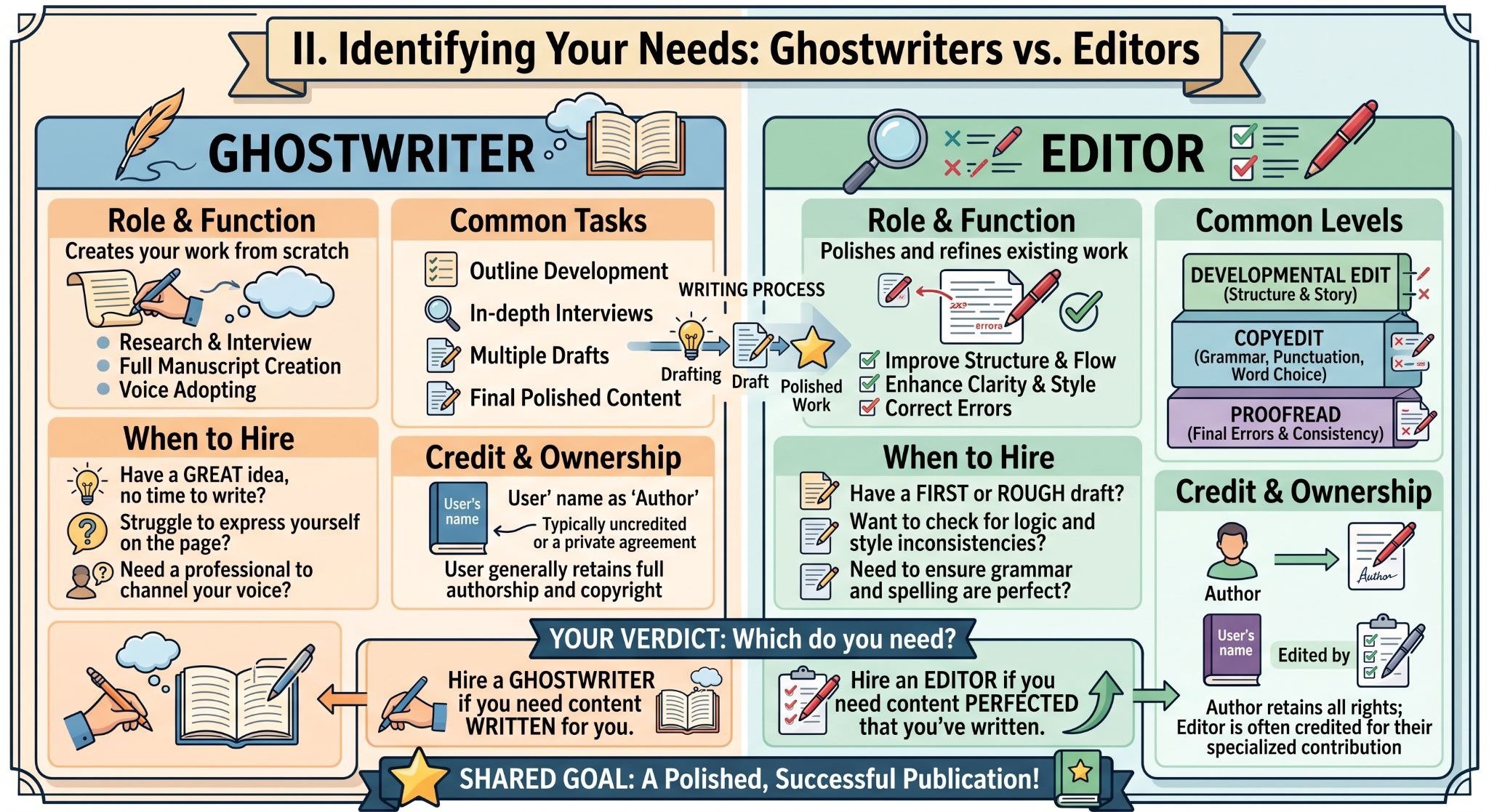
For any quality SEO writing or even for a best seller, one should be able to differentiate between creatives and polishers. Though these terms may seem the same and get easily confused with each other, the fact of the matter is that ghostwriters and editors are very different from one another in terms of their contribution to the publication process.
When to Hire a Freelance Ghostwriter
When you have the knowledge but not the writing skills, a ghostwriter is the most important thing for you.
-
Visionary Work: The majority of entrepreneurs and professionals have a lot of knowledge and their own framework but can’t transform all those ideas into a storyline. A ghostwriter is the prolongation of your own brain. They conduct an interview with you, get your approach and write down everything in a storybook in the style that matches you perfectly.
-
Research: When it comes to the creation of high-authority books, research, fact-checking and data collecting is an integral part of it. Ghostwriting is not only the art of writing but also an investigation process. The professional ghostwriter gathers all the evidence for your book that makes all your claims credible.
-
"The Invisible Partner": It is very important to set the ethics of ghostwriting. In professional ghostwriting services, the ghostwriter acts as an invisible partner. He does the work and you are responsible for the creative part and signing of the book. The process is organized in a way that is regulated by non-disclosure agreement.
The Essential Tiers of Book Editing
Having completed your draft, you move into the refinement phase of the process. Editing is like a three-step filtering process.
-
Developmental Editors: Developmental editors are the structural engineers. They look at the book on the "macro" level—does the book flow? Do the arguments make sense? Is the pace consistent? If your book seems disjointed, then this is who you want to work with first. They are not going to worry about typos; they are going to worry about whether or not your book makes sense.
-
Copyeditors: After getting the structure down, you bring in the copyeditor. At this point, you will look at things on the "micro" level. This means making sure the grammar is consistent and making sure that there isn’t any awkward phrasing that is going to distract the reader.
-
Proofreaders: The final check. Proofreading is done right before you send out the manuscript for publication or distribution. It isn’t meant to change the structure or voice of your book but rather to check for any errors that were overlooked by other people.
III. Where to Find Top-Tier Talent: The GigMint Advantage
Beyond the Basics: Finding Vetted Experts
In the overcrowded field of gig economy, the problem isn't about sourcing for freelancers; it's about separating the wheat from the chaff. Open marketplaces tend to favor quantity over quality, placing the responsibility on the clients to sift through the countless unreliable profiles and their varying levels of competence.
You cannot afford to leave your task to luck if you want to get onto the bestsellers list or be top of the search results. Moving from an open marketplace to a vetted one will save you from many headaches. Vetted platforms act like the ultimate filter that guarantees every professional you hire has already proved himself a star performer.
The GigMint Advantage: The Top 1% of Global Talent
"GigMint Advantage" is characterized by uncompromising quality standards. Where other open networks accept everyone with access to the Internet, GigMint has a strict selection process based on which only about 1 out of 100 candidates gets selected.
Thus, the "1% Rule" guarantees that the talent pool consists only of high-tier professionals who have been vetted through various layers of technical and behavioral evaluation. Besides writing skills, this network boasts extensive specialization within particular fields. If you need an expert in structural editing of a literary piece, technical writing of an IT white paper, or graphic design of an attractive cover, then this network provides specialists who know all ins and outs of your field. Specialization is what will help create E-E-A-T.
Leveraging Modern Tools: The AI Task Pipeline
Long-form publishing does not just depend on skill alone; it needs an advanced process as well. Through its AI Task Pipeline, GigMint ensures that the integration of modern technology fills the gap between the mere thought and the actual masterpiece.
Most of the authors have the problem of "blank pages" during the briefing of projects. With the AI Task Pipeline, this issue is sorted out by converting the unorganized ideas into professional briefings. It creates a project milestone in a manner such that the work is done in phases and with deliverables.
GigMint has a precision matching algorithm. Rather than going through hundreds of bids for finding the appropriate experts for your project, which includes tone, niche, and technicality, it auto-matches the project with the best expert in the network.
Financial Security and Global Payouts
Trust and financial stability are the cornerstones of a professional partnership. In order to offer total peace of mind, GigMint employs a strong escrow mechanism. Funds are put into escrow at the start of the project and are paid out to the freelancer after the milestones are reached and verified by the client.
This means that you are paying only for high-quality work that corresponds to your professional standards. At the same time, the site makes sure that the worldwide workforce stays motivated and paid through effective payment systems operated by Stripe. It provides quick and secure payments to freelancers from more than 90 countries around the world. By taking care of the international money issues, GigMint lets you concentrate solely on the main thing - creating a great book.
IV. The Strategic Interview: Selecting Your Creative Partner
How to Interview Freelance Ghostwriters for Maximum Impact
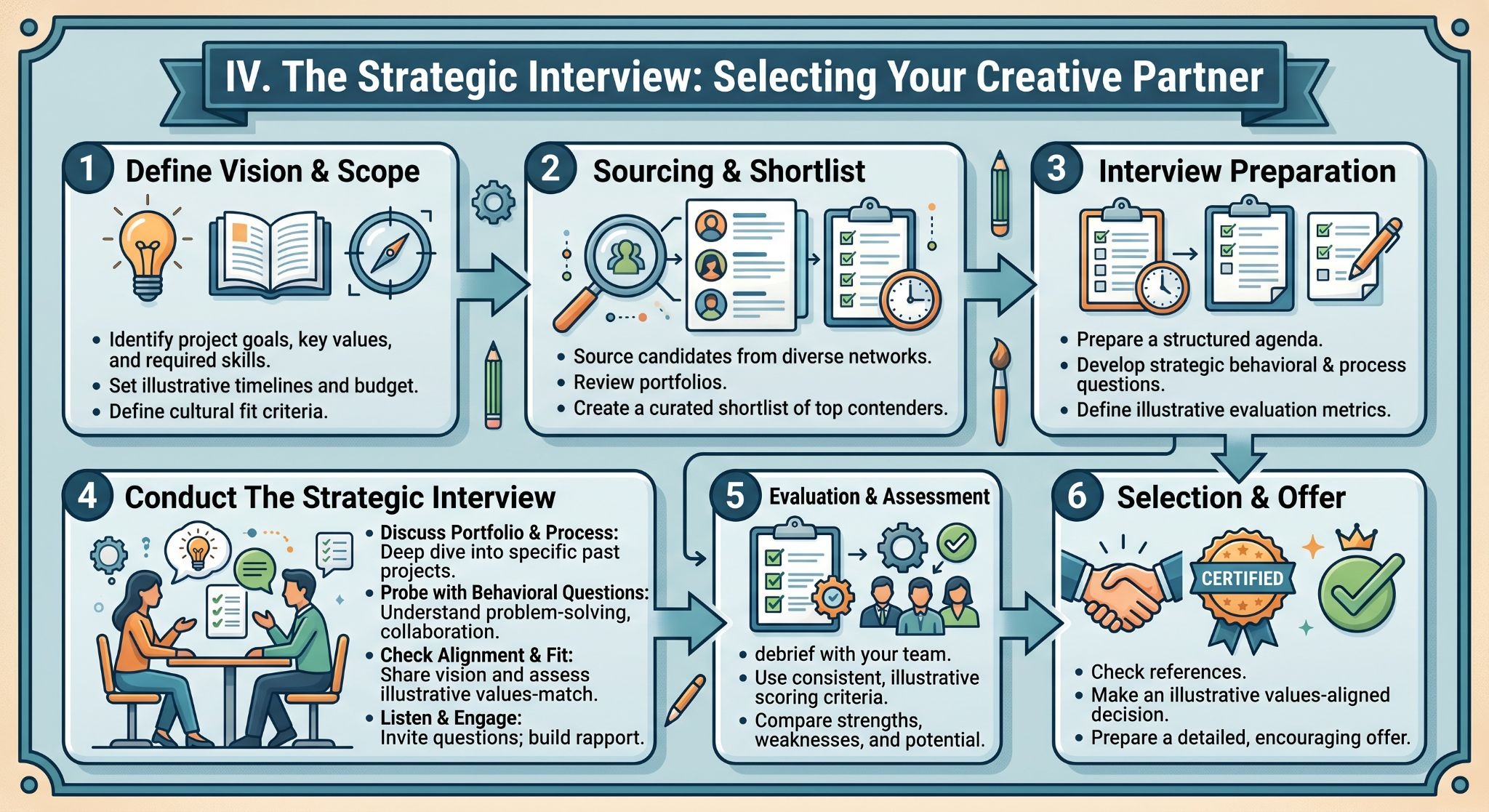
The interview serves as a link between being just another freelancer and having a genuine creative partner. At that point where you've done all the necessary due diligence on your candidates, the interview is your last chance to determine real synergy both in terms of voice and in terms of reliability.
Not only are you choosing someone to type, but also someone to be your creative proxy. A successful interview is not just about "Can you do this," but more about "How do we create this story together."
Portfolio Analysis and "Voice" Matching
Adaptability is the key skill of a good ghostwriter, yet consistency is also essential here. In the course of checking their portfolio, don’t consider only the most fascinating subject – pay attention to the variety of their voices. Is the writer capable of shifting from an energetic business style to an academic instructional style?
-
Consistency: A good portfolio implies the ability to write consistently in different formats. Ask for examples of long SEO articles that worked out well. If you are seeking a ghostwriter for a book or a pillar-page article, you need to be sure that the author will keep up his/her intensity, accuracy and fluency writing thousands of words, not only brief blog posts.
-
The ‘Sample’ Assignment: Feel free to give your candidate a small paid task like writing a 500-word introduction or a chapter plan. It will help you not only evaluate their writing skills but also learn how they use your feedback.
Technical Vetting and Communication
A Writer’s Word is Their Bond. With Distributed Remote Work becoming the norm, reliability of the highest order, in tandem with writing talent of the highest caliber, is absolutely paramount.
That’s why someone who’s a fabulous writer but cannot hold to firm and best schedule as, say, a meeting scheduler, becomes completely, utterly, a non-functioning total liability at work when not totally incorporated and managing collaboration of project related work in a full and effective manner.
-
Communication Audit: The writer actively participates in an initial interview by asking meaningful questions to seek clarity about a candidate’s needs in terms of the tone, style and overall message. An amazing writer would be very involved in a project and be able to challenge very poor ideas and help turn them into amazing ones by offering alternative ideas. A writer who is passive/silent for the majority of the interview is not going to be fully involved in your project’s needs.
-
Professionalism and Security: When hiring someone for sensitive or highly specialized work (e.g. fiction for children, nonfiction for industry), ask about their professional setup. How will you communicate with me? Are the platforms you use to collaborate on my work secure? Are you familiar with standards around data handling (e.g. SOC 2 compliant infrastructure for IP protection)? Does the freelancer take my project as seriously as any businessman would take a project for his company? (As opposed to a part timer who does ‘ghost writing’ on the side and brings a completely different modus operandi to work on your book.)
V. Managing the Workflow: Briefing, Milestones, and Feedback
The Blueprint for a Successful Long-Form Collaboration
The writing of a 3,000-word article or a whole book is a major task that requires more than mere writing skills but an SEO-content strategy as well. Lack of a strategy leads to a phenomenon called "scope creep" whereby one gets distracted from the main goal, misses the deadline, and eventually fails to realize his vision. Long-term projects work well on the basis of proper planning whereby everyone has a clear picture of the target, the way to go there, and how it will ultimately look like.
Crafting the Perfect Project Brief
1) Defining the Target Audience and Keywords: The brief should clearly explain who the reader is and what their search intent is. This includes your primary and secondary keywords as well as the user pain point that you are solving for them. Whether you are writing for C-level executives looking for a high-level strategy for their business or developers looking for specific documentation, you must write as that specific persona.
Setting Clear Expectations for Tone, Style and Formatting: If you can provide a couple of examples of the ‘voice’ you are looking to write in this could be very helpful (ie very formal and academic or more conversational and ‘punchy’ for example). In terms of structure it would be helpful to set out the expected use of headers (ie H2, H3 for example) as well as bullet points and any expected use of internal linking as well as visual ‘cues’ to support the reader. It’s only by understanding the ‘why’ behind the tone, style and formatting that a ghostwriter can hope to maintain consistency throughout a 3,000 word document.
The project brief is the most important document in your collaboration with your ghostwriter. The brief will be your contract for the tone, the audience and the intent of the work. If you write a weak brief, you can expect to go through multiple rounds of revisions until you get it right. Write a strong brief the first time by being specific.
Milestone-Based Management
Dividing the huge task into smaller milestones makes the impossible possible. Here, there is enough time for feedback and adjustments to ensure that one doesn't get too far off the track.
-
Phase 1 – Outline and Research Approval: You shouldn't skip this step. The outline determines what kind of content you will get. Its approval means that the plotline is consistent, the structure meets the criteria for SEO, and the strategy for researching is good. The house cannot stand if the foundation is shaky.
-
Phase 2 – Iterations and Feedback: No one writes the perfect piece from the first attempt. It is necessary to make a milestone out of the "rough cut" and adjust it accordingly. Here you can give some structural comments and evaluate if the voice of the text is correct. In this way, one avoids the "all-or-nothing" syndrome when evaluating the completed 3,000-word piece.
-
Phase 3 – Polishing and Finalizing: This is the stage of minor details. Here you need to check the meta data, the density of keywords, activate internal links, and make final editing touches.
Using Human Support to Resolve Disputes
Even with the best of planning, collaboration between two people can create conflict. When disagreements arise over the direction of a project, or over contract terms, a human perspective is crucial. Modern freelance ghostwriter platforms for high-end work are not just about technology – they are also supported 24/7 by humans.
Whether it is to explain the finer points of a contract, or to intervene to resolve a dispute, having an expert to mediate will ensure that any work stoppages as a result of disagreement are kept to an absolute minimum. This means that you can concentrate on the creative work of your project, safe in the knowledge that there is a team of professionals, available round the clock, who can keep you and your freelancer working productively towards the completion of the project.
VI. Your Journey to the Bestseller List Begins Now
Turning your ideas into a bestseller or lead generating SEO content is a process of development from first idea to final word. We have outlined the development process through the strategic partnership model between creative and technical elements, the process of finding the best writer and maintaining project momentum through the use of AI and a milestone based development process.
Hiring a professional to write or edit a project can feel like an expensive burden that is better left to drain your finances in an era of inexpensive books and other digital content. However, by passing off the time-consuming, grueling, arduous work of the research, drafting and structural editing to a professional, you are not throwing money at a problem – you are investing in a crucial element of your brand.
A manuscript that ends up in the dust bin and a bestseller can look nearly identical when they first hit the page. But it’s the team behind the work that counts.
Take the first step to producing the manuscript of your dreams. Create a free account on GigMint, look at a few quality authors for hire in our marketplace, and post your first writing project today.
We at GigMint have quality writers, published book authors, copywriters, and other word-smithing gurus among our marketplace waiting to provide the best word for your project.
Frequently Asked Questions
Q: Can I maintain ownership of my book?
A: In ghostwriting for professionals for example you are the owner of the manuscript. In the contract it must be stated that after completion of the project the copyrights are transferred to you. You can use websites such as GigMint to create such contracts
Q: How much time would it take to write a book?
While typical projects from the brief to finished book take 3-6 months, utilizing our AI-assisted writing system greatly minimizes the time typically lost with individual, less efficient writers and their writing process.
Q: What if the writer’s voice is not right for your book?
A: We would identify any mis-toned writing at the outset of your book by having done the interviews and having the written assignments at the initial stages of our collaborative process. Utilizing a highly vetted platform to use AI-assisted matching and reviewing at key milestones will aid in us identifying the mis-toned writing prior to it becoming a problem.