Proven Machine Learning Strategy for Growing Enterprises

Proven Machine Learning Strategy for Growing Enterprises
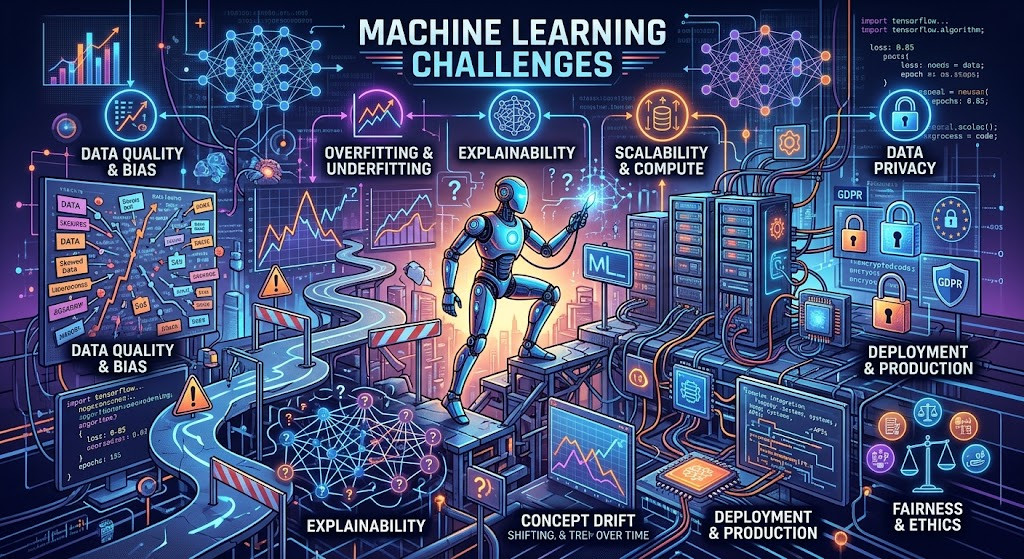
According to Gartner, 80% of all enterprise AI projects are not deployed and die in a sandbox environment. In other words, out of five projects initiated and implemented by enterprises for their benefit, four are lost because they are never made operational and thus bring no value at all.
If you are a CTO, CIO, or IT Director working for a growing enterprise, you are aware of the necessity to implement AI solutions. You have felt the constant pressure from your board, your competitors, and the market itself.
But the last thing you can afford is spending your precious IT budget on a series of Proof of Concepts that are perfect only on the demo dashboard and give no ROI to your business.
That is when the implementation of an AI strategy framework becomes critical. Through implementing a machine learning strategy for your enterprise, you can turn data experiments into a profitable machine. A clear Machine Learning Strategy helps guide these efforts.
Your Direct 7-Step Implementation Roadmap
For turning the promises of AI into bottom line results, here is precisely what roadmap you are going to follow in this guide:
ML Strategy That Aligns with Business Objectives: Find out bottlenecks of high value and ROI measures other than accuracy.
Data & Infrastructure Audit: Modernize your outdated data lakes using a highly efficient lakehouse architecture that is in compliance with regulations.
Formulate the Right Team: Create a perfect blend between role profiles (Data Engineers, MLOps Engineers) with fractional hiring.
Choose the Right Stack: Choose either to have a cloud-based or on-premise environment and deal with the “build vs. buy” dilemma.
Implement MLOps: Implement CI/CD pipeline, automate and continuously monitor model drift.
Enforce Ethics & Risk Management: Identify algorithmic bias and implement XAI.
Scale Beyond the PoC Graveyard: Develop modular, reusable pipeline that scales efficiently from the get-go.
And why is it important? The reason is that by spending some effort to develop such a strategy you will be able to save thousands of man hours of technical debt, not cripple data silos, and ensure that AI will become an actual competitive advantage for your company, not just a buzzword.
Why Your Growing Enterprise Needs a Dedicated Strategy
In a similar manner, the ad-hoc solutions you have been applying to cobble together your initial data models will simply not scale.
Beyond "Startup Agility"
You might ask why you cannot simply hire a great data scientist, grant them access to your primary database and let them do their thing. When you were a lean startup, this scrappiness was fine. Moving fast, breaking things and trying anything you wanted was something you could afford.
As a growing mid-market or enterprise-level company, the rules are completely different. You have all sorts of legal issues to comply with, fragmented data spread throughout numerous legacy divisions of your business, and zero tolerance for downtime. One data scientist, even a great one, quickly turns into an absolute operational bottleneck.
If you lack an enterprise AI strategy, then whatever you do is not machine learning – it is costly scientific experiments.
The Hidden Costs of Winging It
Take for example the case of an e-commerce business experiencing exponential growth, which decided on a whim to construct a recommendation engine. They brought on board an external contractor to design a cutting-edge deep learning model based on past customers' exported data.
Six months and $150,000 worth of investment later, the algorithm reached impressive accuracy levels of 94% during stand-alone testing in a lab environment. But once it was time for implementation, the engineers were in for a surprise – the model took 12 seconds to complete a prediction request. Implementing this into the actual checkout process would have crippled the website's performance.
What happened? The whole project became obsolete. Six months worth of budget down the drain, piles of technical debt accumulated by the engineering department and a bunch of executives now firmly believing that "AI is just overhyped snake oil."
These are the consequences of improvisation. Lack of coordination in information collection, disconnected departments, and lack of proper architectural design during the planning stage will drain your budget before you can calculate the ROI. A Machine Learning Strategy helps address these challenges early.
Step 1: Aligning Machine Learning with Your Business Goals
Even the most advanced neural networks will be of no use whatsoever when performing something that won't make a difference to solving a problem important to your business.
The alignment with the commercial priorities should be ruthless even before you let your engineers start coding in Python. Every Machine Learning Strategy should begin with clear business priorities.
High-Impact Problems Identification
The machine learning application of the enterprise can be broken down into three types at a high level:
Revenue Acceleration – pricing engines, cross-sell suggestions, customer churn and lead scoring.
Cost Savings – document classification automation, logistics supply chain predictive maintenance, and support ticket routing.
Risk Management – fraud detection automation, credit scoring, and regulatory policy compliance.
And the first step here is to interview your departments' heads. Ask your VP of Customer Success where he sees his team spending time unnecessarily. Ask your Logistics Director where the bottlenecks appear in predicting the inventory.
If your operation people spend forty hours a week on manually classifying the unstructured customer feedback and support tickets – this is what you want. This is where a Machine Learning Strategy can identify valuable opportunities.
Defining KPIs and Real ROI
F1 scores, model accuracy, and mean square errors are the metrics which are important for data scientists. On the other hand, EBITDA, cost savings, and customer acquisition cost (CAC) are the metrics that are important for your C-suite and board of directors. It is imperative to come up with a solution on the first day.
When your data science team creates a model for predicting customer churn with 95% precision, this is excellent from a technical point of view. However, what will it do in dollars?
For a sound machine learning project, it is necessary to determine the criteria of success in business terms. Set up your project objectives in the following manner: "Creating a churn prediction engine to cut the number of enterprise customers leaving within two quarters by 4.5%, saving approximately $1.2M annually." This approach makes the Machine Learning Strategy easier to evaluate.
Step 2: Assessing Your Data Readiness and Infrastructure
Your sports car costing millions cannot run on dirty fuel. In enterprise-level artificial intelligence, the data is the fuel. It will be the success or failure of your entire strategy that will depend on how you handle your data. Data readiness is essential to any Machine Learning Strategy.
Data Audit
The first step to take is doing an all-encompassing data audit in your company. You need to identify your databases, find those rogue "shadow IT" spreadsheets and hidden data silos.
Your enterprise data should be evaluated according to four essential criteria:
Quantity: Is there enough data from history to create statistical models? (While deep learning models usually need large quantities of data, other tabular models like XGBoost can produce very meaningful results even with a small quantity of data depending on use cases and data quality.)
Quality: Is the data clean, well-labeled and consistent? Or does it include missing and duplicated data, and data corruption?
Accessibility: Can your data engineering pipelines automatically access the data through secure API's or is the data locked behind manual export interfaces?
Relevance: Is the historical data reflective of current market conditions? (Training your supply chain model now on dirty data from 2020 would give highly inaccurate predictions).
Modernizing Architecture for AI: The Lakehouse Standard
If the essential data your business is operating on is housed in segmented legacy databases that do batch processing on a nightly basis, then your AI initiatives will be hindered. Dynamic real-time streaming data along with flexible storage is required for contemporary machine learning.
Begin transforming your existing storage system into a contemporary Lakehouse model by utilizing platforms like Databricks and Snowflake. Lakehouse data model offers advantages of both data warehouse and data lake in addition to the ACID properties.
Governance, Security, and Compliance
What are the actions that one should be taking when it comes to being compliant with GDPR, CCPA, HIPAA, or even EU AI Act? Leaving data compliance considerations for the last minute is definitely a recipe for failure, which will result in having to pay massive fines and damaging your reputation.
Data security needs to be baked into your ML pipeline. Ensure that you have RBAC access controls in place, as well as end-to-end data encryption and automatic PII masking.
You need to build in "the right to be forgotten." This means that your pipelines have to automatically remove user data from relational databases, as well as your feature stores and training pipelines used by your production models.
Step 3: Assembling Your Machine Learning Dream Team
But even the most cutting-edge infrastructure means nothing without proper talent managing it. Yet, the most frequent misstep that growing businesses make is to assume that "Data Scientist" is a job title for any kind of AI work you can think of. A Machine Learning Strategy requires clearly defined responsibilities.
Key Talent That You Need
Deploying and building models for enterprise-level machine learning solutions calls for a wide variety of unique expertise. But expecting one data scientist to do data cleaning, design cloud architecture, create neural networks and deploy working API is a sure road to disaster.
Data Engineers: The backbone of your team. They will construct ingestion pipelines, sanitize your databases and deliver data at high speed to your models.
Data Scientists: The researchers. They will analyze the patterns in your data, choose model architectures and optimize model performance through hyperparameter tuning.
MLOps Engineers: The creators. They will construct microservices around your algorithms, deploy them on the cloud and build monitoring tools to maintain performance of your models in production.
Expert Domain Knowledge: Sanity check. Now is the time to turn to your knowledgeable product managers, sales directors, and operations directors to see if your model checks out.
In-House vs. Outsourced vs. Fractional Talent
Assembling the full team from within could cost over $800,000 per year in salaries alone, depending on team size, seniority, and location—an astronomical expense for a startup testing out its first AI experiments. AI professionals are hard to come by, and their hiring process could take 6 to 9 months at a time.
To overcome this roadblock, forward-thinking enterprises have been adopting hybrid staffing models. Rather than assuming the permanent burden of employing a temporary workforce, get access to premium fractional talent.
Gigmint.AI is a platform which helps you connect directly with vetted AI professionals, MLOps developers, and data architects.
Through this approach, you will find yourself having premium talent at hand right from the start to develop the initial structure, train your internal IT staff, and make a return on investment.
Step 4: Selecting the Right Technology Stack
With your goals set out, your data arranged, and your talent strategy decided upon, now comes the vital step of selecting the technology stack that is going to make up your machine learning engine.
Cloud or on-prem Infrastructure Choice
The majority of organizations that are expanding require the development of their AI capabilities in the cloud.
However, the AI cloud computing systems of Amazon Web Services, Google Cloud, and Microsoft Azure have automated the services to help reduce the workload of setting up servers, GPUs, and auto-scaling services.
Choosing the Cloud Native approach when:
You require fast prototyping, automatic elastic scalability in case of traffic peaks, and minimal initial Capital Expenditure (CapEx).
Selecting On-Premise or Hybrid model for:
You have strict restrictions for your data residency, which means that you can’t process your data anywhere but locally (defense industry, healthcare) or your volume is too big to use shared servers.
The Build vs. Buy Decision Matrix
One of the most dangerous traps that an engineering leader may fall into is attempting to create all technologies within their company’s walls. Before you let your team spend four months developing your own custom computer vision algorithm, think about the kind of applications that have been developed commercially.
BUY Commodity AI: If your application uses OCR, speech-to-text transcription, or any form of language translation, try commercially available APIs (Google Cloud Vision, OpenAI, AWS Textract). This will save you a lot of money and time, and you’ll be able to roll out the app in days.
BUILD Proprietary AI: Use your budget to create your own algorithms in the cases where it will help you to have a competitive advantage in terms of business process.
Step 5: The MLOps Imperative for Production Scaling
Developing a machine learning model via Jupyter notebook can be compared to developing a concept car out of clay. The car looks amazing, but you cannot drive it on the road. MLOps (Machine Learning Operations) is the engineering process that converts your static ML model to a live service.
Software Engineering vs. Machine Learning Lifecycles
The classical software development process is mostly a straight process: coders write code, perform automated unit tests, and finally deploy the application. In case there are no modifications in code, the behavior of the application remains constant forever.
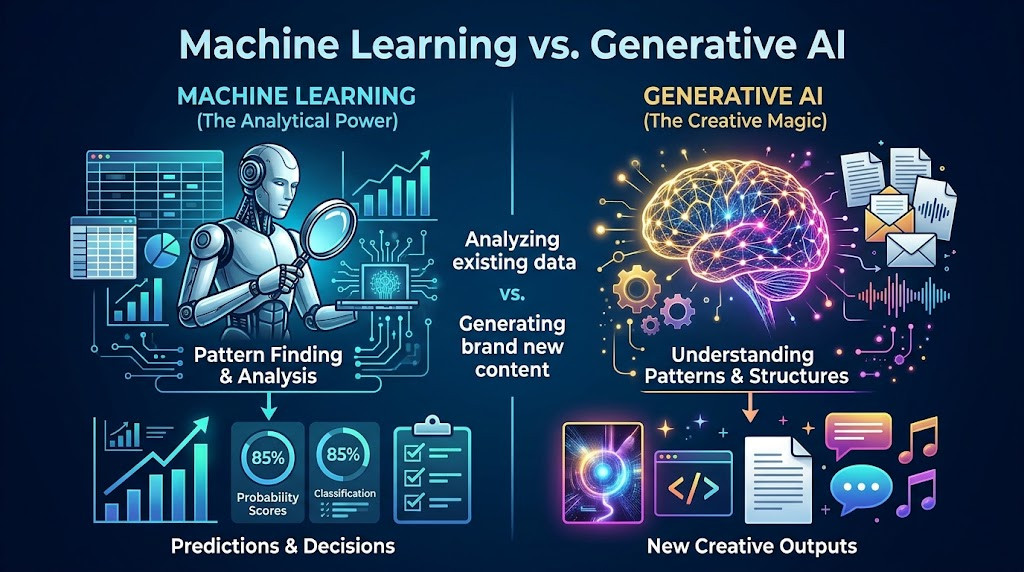
Machine learning is a cyclical process by nature. Your ML service depends on two different things - Code and Data. In case there are any modifications in the real world data, even without changing code, the accuracy of your model will decrease.
Preventing "Model Drift" in Live Environments
In case the MLOps pipeline of your company isn't automated, then your production models will experience Model Drift. There are two types of model drift:
Input Data Drift: Difference between the distribution of input data and the distribution of data used for training the model.
Output Data Drift: Difference in the correlation between the input data and the output variable that is to be predicted.
Step 6: Managing AI Risks, Ethics, and Algorithmic Bias
In reality, algorithms of artificial intelligence are not some objective magic, but the data which was analyzed mathematically when training the algorithms. In the event that you train your model on enterprise data that contains biases by human beings, your algorithm will amplify these biases at great speed. A responsible Machine Learning Strategy must address these risks.
Managing Algorithmic Bias
Consider the enterprise recruitment algorithm created for ranking applications submitted by software developers.
If in the history of the hiring process within the past ten years there was a strong preference for applicants from certain universities, then the model will be trained to discriminate against other equally qualified applicants who are not from the same universities.
Besides being an ethical problem, this will cause huge reputation losses, as well as talent losses and even legal liability.
To proactively mitigate bias:
Do an exhaustive Exploratory Data Analysis to check for any biases before you train.
The methods that have been used include Fairness Metrics like Equal Opportunity Difference and Disparate Impact Ratio.
This ensures that the importance of fairness is taken into account while designing the Machine Learning Strategy.
Implementing Explainable AI (XAI)
It is imperative that as an enterprise leader, you do not depend upon "black box" systems where the input goes in and output comes out and nobody knows how the output came about.
If there is a prediction from your model that could result in rejecting a loan application from your client, classifying a payment as a fraudulent transaction, or changing a supply chain route, then your managers must be able to comprehend the logic of the whole process and explain the same to the auditors, regulators, and clients.
Use methodologies such as SHAP (SHapley Additive explanations) and LIME (Local Interpretable Model-Agnostic Explanations). These are Explainable AI methodologies that help make deep learning models transparent using feature attribution plots. Explainability is one of the key aspects of your Machine Learning Strategy.
Step 7: Scaling and Iterating Beyond the "PoC Graveyard"
In the case of machine learning, success does not come from developing a single successful pilot, but in establishing a process that can be used to develop and deploy multiple models. A scalable Machine Learning Strategy supports this repeatable process.
How To Get Out of the PoC Graveyard?
In order to escape the endless cycle of proofs of concept, design for production from the very beginning:
Never train models locally: Make sure that all your development takes place in cloud container environments (like Docker and Kubernetes) that resemble production environments.
Data Interface Standardization: Apply strict validation of the data schema so that data engineers and data scientists use exactly the same data structures.
Reusable Code Base: Develop pipeline modules for cleaning, features, and evaluation in order to avoid building the same thing from scratch when implementing next models.
These practices allow your Machine Learning Strategy to support consistent development and deployment as the number of models increases.
Continuous Capabilities Development
The market environment will change, consumers' behavior will be different and new architectural approaches will emerge.It is essential that your machine learning approach be considered a dynamic one that demonstrates your capabilities.
Have conversations about model performance with your business colleagues, discover new data sources and learn consistently. Those businesses which will thrive in the future will be the ones which possess machine learning skills as an important part of their organizational culture.
Final Thoughts
The development of a good machine learning model for any company is not an easy task as it requires various elements such as alignment of the business, sound data structure, cross-disciplinary expertise, sound infrastructure, and determination to adhere to MLOps.
With the help of this well-structured 7-step process, you place yourself above all the AI hype. You move past failed projects and create reliable, scalable solutions which bring definite financial gain and improved productivity to your company. A well-planned Machine Learning Strategy helps sustain these business benefits.
Looking to construct an enterprise machine learning strategy without going through all the hassle of the hiring process? Contact the highly recommended AI professionals at Gigmint.AI right now.
Frequently Asked Questions (FAQ)
What is the cost for an organization to deploy a machine learning strategy?
The cost is dependent on the scale and available infrastructure. The cost of an initial PoC project will be anywhere between $30k and $100k, while the cost of a complete deployment, which involves migration of the data pipeline and monitoring via MLOps, will be anywhere from $200k to $500k+.
Fractional talent models and managed cloud solutions will reduce the upfront investment greatly. The overall investment in a Machine Learning Strategy will depend on these project requirements and available resources.
How much time does it take until one sees a visible Return on Investment (ROI) for their ML strategy?
A project with the application of pre-trained API models (like document automation) takes 4 to 8 weeks until ROI is achieved. Deployment of custom-built machine learning models will take 3 to 6 months, due to data analysis, model training, ML deployment, and validation of ROI for profit and loss. Time needed for a Machine Learning Strategy will always be determined by the complexity of the task and deployment.
Is there a need for big data sets before applying machine learning techniques?
Not necessarily. While deep learning needs lots of data, tabular algorithms like gradient boosted tree and linear regression give good results even with smaller datasets but still highly relevant and clean. Machine Learning Strategy can be applied without waiting until all the data is accumulated.