The Ultimate Guide: How to Create a Smooth Freelancer Onboarding Process
The Ultimate Guide: How to Create a Smooth Freelancer Onboarding Process
The future of work is definitely flexible. In the 2020s, we are moving from the conventional 9-to-5 model towards a more agile, project-based work. Independent contractors, freelancers, and fractional workers form an enormous part of today’s workforce, but companies that are eager to make use of these highly-specialized independent workers are failing to implement a proper internal management strategy, especially when it comes to bringing such workers to their company.
Are you still using chaotic emails, uncoordinated Slack messages, poorly-structured spreadsheets, and verbal agreements for managing your independent talent? Then, you are probably facing the worst challenges of the gig economy era, including poor communication, late project starts, legal problems, and talent drain caused by your lack of organization.
This is a harsh reality that most hiring managers do not consider when engaging freelancers: Failure in freelance engagements is usually caused by something other than lack of the freelancer's technical skills. In most situations, failure happens due to lack of structure, confusion or even absence of a proper freelancer onboarding process.
An efficient freelancer onboarding process is not a formality that you need to follow to pass HR. It is a vital part of your strategy because it is an essential link in successfully sourcing top-notch freelancers and then getting their best and most profitable work done.
It provides your business with maximum ROI, helps you comply strictly with laws of the world and create valuable, profitable relationships with top-tier independent professionals.
In this ultimate guide, we will go through all stages of proper freelancer onboarding. We will review the important legal nuances of freelancer vs. employee onboarding, find out what steps you need to take at each stage, what pitfalls to avoid and show how using FMS like Gigmint.AI streamlines onboarding.
Part 1: Why a Dedicated Freelancer Onboarding Process is Non-Negotiable
One of the most commonly made, but also one of the most expensive mistakes, by scaleups is that of trying to shoehorn freelance talent through the same onboarding process as your full-time employees (FTEs). Attempting to do this using your current HRIS system will simply not work and creates huge inefficiencies and legal risks.
Differentiating Independent Talent from Employee Onboarding
In order to create a successful process, one must realize the basic differences in the purpose of onboarding altogether.
Employee onboarding is a marathon. It is thoughtfully constructed for gradual immersion into the corporate culture during several weeks or months. The process involves explanations of complicated health benefit packages, career growth perspectives, obligatory corporate training, and getting acquainted with dozens of colleagues. All of that is done with the end goal of long-term retention and organizational alignment.
Freelancer onboarding is a sprint. Freelancers are hired as external entities to provide very specific deliverables within a very tight timeframe. They do not need to be told anything about your 401(k) matching package, your dental insurance, or quarterly team-building retreats.
In fact, giving them employee handbooks or forcing them through cultural training makes the line between freelancer and employee blur, raising significant red flags from both IRS and regulatory bodies.
What freelancers need is quickness, clarity of project context, availability of specific digital tools and very different kinds of compliance. While an employee gets a W-4 to sign, a freelancer has to sign a W-9 (or even a W-8BEN) and an Independent Contractor Agreement.
The True Business Cost of Poor Onboarding
Not having a well-oiled onboarding process for your freelance team will have an immediate, exponential, and easily quantifiable effect on your bottom line.
1. Long Time to Value and Wasted Money
When you hire a freelancer, it is because you need someone to bring in expertise and speed immediately. But when a freelancer spends his first three days asking for passwords, waiting for a creative brief, or figuring out whom to get approval from on using brand materials, then you are losing money.
A slow onboarding process means delayed project completion and lost time. When a consultant, who is costing you $150 an hour, is just waiting for IT to set him up in Jira, you are losing money on that consultant.
2. Compliance and Worker Misclassification
Compliance with regard to worker misclassification is at an all-time high as governments around the world are going after those who misclassify workers. Frameworks such as the AB5 in California, the IR35 in the UK, as well as increased DOL regulations say that, should you treat a freelance worker as your employee, you'll be fined accordingly.
The IRS has its own set of guidelines based on the behavioral control, financial control and type of relationship. Setting hours for work, requiring unnecessary internal training or not having appropriate business-to-business contracts is a huge red flag.
Onboarding that doesn't have a proper process that leads to placing freelancers in your HR system will most likely result in painful audit processes, huge back taxes, retroactive benefit payments, and class action suits.
3. Cybersecurity and Shadow IT
When getting a freelancer started, IT often allows unfettered access to Google Drive, CRM or AWS of a company. This improper access provisioning is a huge cybersecurity vulnerability. On top of that, an inefficient onboarding process is guaranteed to give rise to inefficient offboarding and, as a result, to "zombie accounts" and "shadow IT".
4. High Churn Rate of Top-Ranking Talent
The absolutely best freelancers are highly sought after. They operate their own profitable business and value well-organized clients. If your onboarding process is a chaotic, disorienting, and unpleasant experience, you will be politely refused for future projects. You will be continually trapped in the costly and time-consuming process of talent sourcing.
The ROI of Getting it Right
On the other hand, taking care of the freelancer onboarding process as an essential business activity will bring in huge rewards. Setting clear expectations right from the very beginning implies spending much less time on revisions.
The freelancer, who has access to all the required tools, briefings, and signed contracts, can charge money for working hours from day one.
Also, gaining the reputation of the "client of choice" (organised, respectful of boundaries and paying bills on time) implies that you will have the privilege of picking the best people out of your field as freelancers.
Part 2: The Core Components of a Successful Freelancer Onboarding Process
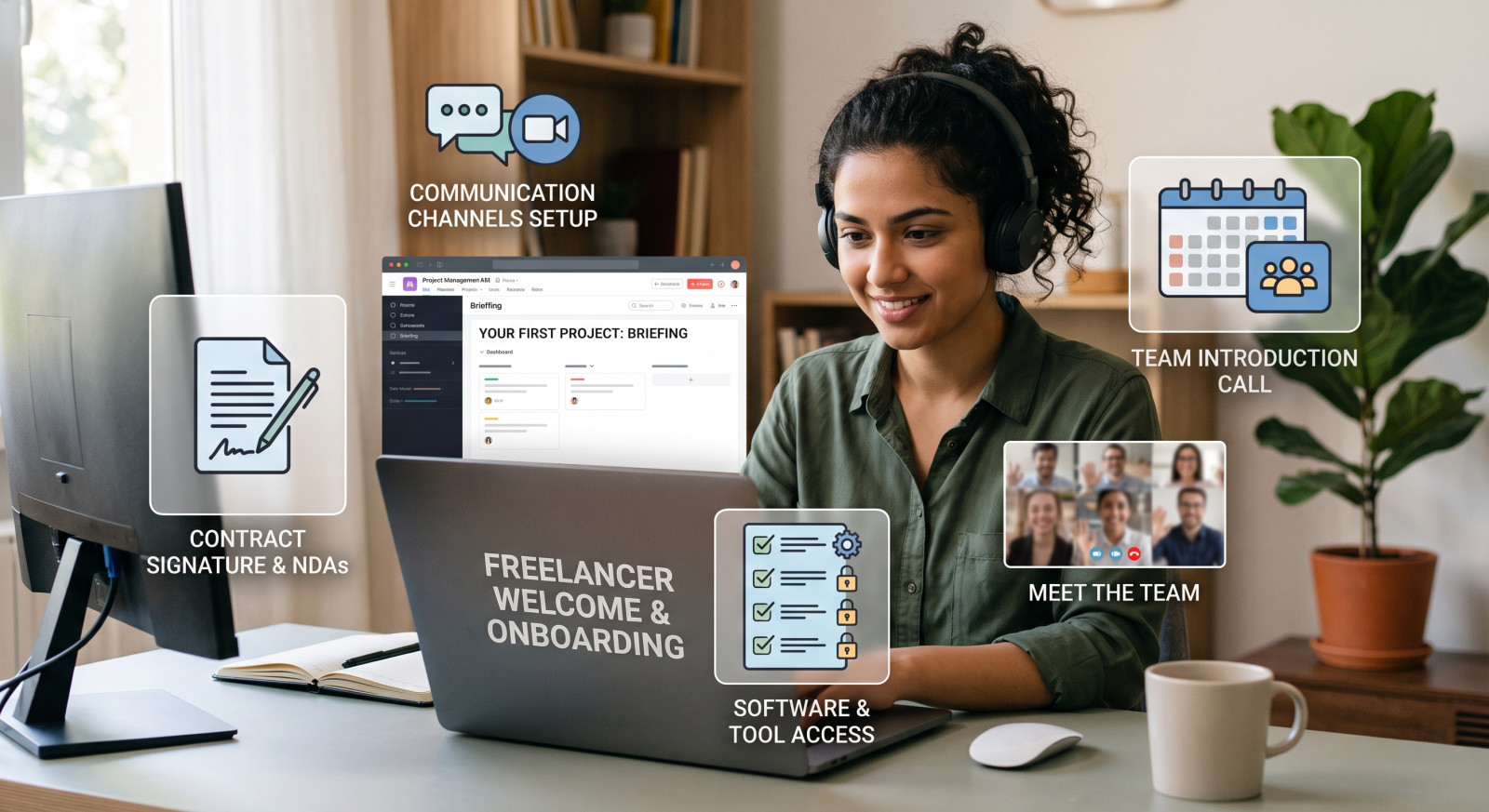
1. Administrative and Legal (Foundation)
This is the layer of protection. It guarantees the legal security of both parties, sets the rules, codifies expectations and creates the financial framework of transactions before any work starts.
-
Master Services Agreement (MSA): This is the contract covering general relations and dispute resolution.
-
Statement of Work (SOW): This is the document outlining all specificities of the work, deliverables, deadlines, payment terms.
-
NDA (Non-Disclosure Agreement), IP (Intellectual Property): This protects your IP and guarantees that your company owns rights to the completed work.
-
Tax Documents: W-9 form (US) or W-8BEN (International) is needed for annual tax issues.
-
Financial Transactions (Invoicing and Payment Details).
2. Operational & Access (The Tools)
This pillar revolves around eliminating any form of friction and minimizing security risks. It guarantees that the freelancer has all the necessary digital keys for the job to be done without any problems and nothing else.
-
Project Management Access: Allotting restricted guest seats on Asana, Jira, Trello, and Monday.com.
-
Communication Access: Giving guest access via a single communication channel in Slack and Microsoft Teams. Do not give full access to the workspace.
-
File Access: Setting up isolated folders in Google Drive or Dropbox.
-
Software Access: Granting access to specialized software such as Figma and GitHub.
3. Cultural & Strategic (The Context)
Though you shouldn’t flood them with HR lingo, they need a lot of strategic background for them to give their best shot. They need to know the "why" of the project so that they don’t work blindly.
-
Brand Guidelines: Visual identity requirements, limitations for logos and typography.
-
Voice Guidelines: Content strategy ensuring their output will fit your brand's voice.
-
Project Objectives & KPIs: What is success to your project quantitatively speaking?
-
Target Audience Personas: Who are they going to work for exactly?
Part 3: Step-by-Step Guide: How to Onboard a Freelancer Smoothly
In order for there to be consistency and scalability in the process, one must dissect onboarding in terms of time. Sending documents randomly as they come to mind will only confuse everyone. Below is the process by which you can on-board freelance talent.
Phase 1: Pre-Onboarding (The Key to Onboarding)
This is absolutely the most key thing about onboarding – and occurs before any billing takes place.
Step 1: The Initial Hand-Off and Welcome Communication
After you agree to work together, you should send out a “Welcome” email right away.
Template: Perfect Freelancer Welcome Email
Subject: Welcome to the team, [Freelancer Name]! Steps ahead of you!
Hello [Freelancer Name],
It’s fantastic to have you collaborate with us on the [Project Name]!
To proceed and get started from our desired starting date [Date], there are several admin actions we need to accomplish for you. We have a platform for making it easy for you.
Action to be taken by [Date]: Kindly visit the secure link below for your onboarding portal to:
-
Review and sign the MSA and SOW.
-
Sign our non-disclosure agreement.
-
Upload your [W-9 / W-8BEN] tax document.
-
Input your preferred payment information.
[Onboarding Portal Link – FMS/Gigmint.AI]
Once done, I’ll introduce you to [Internal Contact] and set up a 30-minute kickoff call.
Best Regards,
[Your Name]
Step 2: Securing Legal and Administrative Setup
Never start the work without having those documents signed and completed. Verbal agreement is why budgets balloon and IP gets lost.
-
The Contract (MSA/SOW): Need to explicitly state that they are not your employee, define the exact scope, deadline, and payment rate/terms.
-
Tax Information: They need to be on your records with either a W-9 or W-8BEN form before you pay them.
-
The Gigmint.AI Edge: Sending PDFs by email back and forth is a huge time-waster. Gigmint.AI lets you create legally-compliant agreements, get e-signed securely, and get tax information at once in a single dashboard, preventing any project from kicking off without meeting all the requirements.
Step 3: Provisioning IT and Access (Least Privilege)
Use the principle of least privilege regarding cybersecurity: provide only the access which they will absolutely require.
IT Provisioning Checklist:
-
Email: Decide whether they need @yourcompany.com email or can do with their own (latter being preferable in case of contractor).
-
Communications: Add them as a Single-Channel Guest on Slack/Teams.
-
File Storage: Provide them access to the designated project folder only. No root access!
-
Task Management: Add them as a guest to the corresponding project board.
Phase 2: The First Day (Orientation & Context)
Day 1 must be solely about clarity, context, and a warm welcome to the project team.
Step 4: Delivering the Digital Welcome Package
Do not feed bits of info in drips and drops. Send one consolidated brief or give a link to a digital workplace where all information is contained.
A Welcome Package includes:
-
The Finalized Brief: A well-defined document with expectations stated.
-
Brand Assets & Guidelines: High-quality logos and exact hex codes.
-
Key Contacts Matrix: "Who is Who" list of the project.
Step 5: The Project Kickoff Meeting
The initial kickoff meeting for 30 minutes on Zoom or Google Meet is quite significant, and it will also provide a question and answer session.
Kickoff Meeting Agenda:
-
Introduction (5 mins): Meet your main point of contact.
-
Project Briefing (15 mins): Explain the project brief and explain why the project is relevant to a bigger picture.
Phase 3: The First Week and Beyond
Step 6: Creating Milestone and Check-In Points
Do not throw a project lasting a month to a freelancer and do not communicate with him/her for a whole month. Divide the project into several milestones and have a "10%" check-in when they will provide you with some kind of outline/wireframe.
Step 7: Delivering Constructive, Objective Feedback
Freelancers don't have osmotic knowledge that your internal teams have. Your feedback needs to be detailed, fully objective, and strictly connected to the original brief.
-
Bad Feedback: "It simply lacks pizazz. Improve it."
-
Good Feedback: "The style in the second paragraph seems too relaxed when compared to the guidelines. Do you think we could make this part more authoritative and B2B focused?"
Step 8: Paying Out the First Invoice Perfectionally
Late payments ruin everything fast. Pay out their first invoice exactly on time. The use of the Freelance Management System such as Gigmint.AI ensures that when a manager approves a milestone, an automatic compliant payout is triggered,
Phase 4: Offboarding (The Final, Crucial Step)
An offboarding process will always be required to complete onboarding, laying down security procedures for collaboration in the future.
Step 9: Securing the Offboarding Process
Once the work under SOW is completed, begin an offboarding process immediately.
Offboarding Checklist:
-
Revoke Access: Take away access rights from Slack, Google Drive, and other proprietary systems to prevent any potential leak of information.
-
Asset Transfer: Make sure that all the source files are transferred internally.
-
Internal Note: Make an internal note about their performance.
-
The "Thank You" Email: Send a thank you email.
Part 4: Best Practices for Retaining Top Freelance Talent
Treat Them as Strategic Partners
While being classified as vendors by law, you get the best results if you treat freelancers as strategic partners. Give them your respect in terms of time and knowledge while avoiding micromanagement. Provide them with strategic information.
Clear Communication is Key
“Ghosting” is one of the biggest problems. In case the project stops, give them this information immediately. If there is delay in feedback, provide them with a quick update.
Payments in a Timely Fashion are Your Greatest Retention Strategy
Freelancers have to be responsible for their own cash flow management. If a client consistently makes payments for a Net-15 invoice in 14 days, he will be prioritized over a client who consistently pays a Net-30 invoice late. Emphasizing the fact that platforms such as Gigmint.AI make the payment process quick and easy attracts the best talent.
Offer Constructive Praise
Positive reinforcement for freelancers is not common. Tell them when they do an awesome job. All that’s needed is an email telling them that the executive team loved their efforts. It goes a long way in creating loyalty.
Create a “Virtual Bench”
The ideal end result of onboarding is the creation of a valuable resource. Record the talents of each freelancer and how reliable he or she is, then put it in your FMS. Building a “Virtual Bench” will take care of the most tedious part of managing freelancers: sourcing and vetting.
Part 5: Common Freelancer Onboarding Mistakes to Avoid
Some of these practices which you should avoid include those mentioned below:
-
Employees in Disguise: Forcing your freelancer to attend all-hands meetings and telling them how they should be working could get you into trouble for misclassifying your freelancers. You need to give them their independence back.
-
The Information Flood: Deluging your contractor with an employee manual on day one makes things very confusing. Stick to sharing only relevant information.
-
No KPIs: Giving a vague instruction such as 'write some blog posts' isn't a good way to set KPIs. Uncertainty leads to disappointment.
-
The Access Barrier: Not giving the needed access to your software till day 3 will end up wasting your money. Provision beforehand is key.
-
Disregarding International Aspects: If you aren't able to consider time zones and local holiday differences, deadlines will be missed.
Part 6: Automating the Process: Why You Need a Freelance Management System (FMS)
Whereas a small startup with just one freelancer per annum may manage to get through without an organized management system, it will never be enough if you have grown beyond that level and need to manage freelancers across different departments and time zones. This is an absolute formula for failure in compliance, inefficiency and breach of security.
Spreadsheets simply will not work for you anymore.
Here comes the role of the Freelance Management System (FMS). An FMS is a software platform tailored to meet the needs of managing independent contractors.
How Gigmint.AI Solves the Onboarding Puzzle
Gigmint.AI was designed to remove friction, risk, and overhead from your entire onboarding process. It makes an extremely chaotic process as smooth as possible.
Below is an exact explanation of how Gigmint.AI changes your workflow:
-
Central Hub for Everything: With Gigmint.AI, say goodbye to multiple emails and spreadsheets and have all your data, contracts, and communication in one place - that is very secure.
-
Automated Contract Creation & Signing: Automatically generate localized, legal MSA and SOW documents and sign them using the built-in electronic signatures.
-
Global Compliance Guaranteed: The system will request and store all necessary tax forms automatically to ensure global compliance and minimize misclassification risks.
-
Milestones & Automatic Payments Integration: Gigmint.AI links your project milestones directly to the payment. After each milestone is completed, Gigmint.AI automates the payment process.
-
Build Your Private Talent Network: With Gigmint.AI, you can use your projects to form a private, pre-vetted, and curated talent network, thus saving time for further hiring.
Call to Action
A streamlined and welcoming onboarding process for freelancers can no longer be considered an HR luxury. Rather, it has become a crucial approach to maintaining competitiveness as a company in this day and age.
Through defining boundaries legally, equipping the digital toolbox quickly, and providing context strategically from the get-go, you make sure that your freelance workers start performing brilliantly right away.
The gig economy is not a fad. It is the future of the worldwide labor market. Those firms who will succeed in the next ten years are the ones who will learn how to change their management strategies so that they could deal with freelancers not as disposable vendors but as flexible and valuable strategic partners.
There comes the time to put an end to the spreadsheet fight, to the manual mitigation of global compliance risks, and to the talent losses because of bureaucratic problems.
Ready to automate and optimize your freelancer onboarding process once and for all? Ready to minimize your compliance risks and assemble a truly exceptional contingent workforce? Ask for a demo of Gigmint.AI today.