The Ultimate Guide to AI Recruitment and Talent Acquisition
The Ultimate Guide to AI Recruitment and Talent Acquisition
1. The Paradigm Shift in Talent Acquisition
There have been changes in recruitment in the last decade, since most organizations use digital technology, ATS, and AI-powered software to identify candidates. While it is possible to make use of digital platforms such as professional networks and recruiting sites, it is difficult to identify candidates with relevant skills for a specific job.
The amount of applications that recruiters receive for one position may be really high, which complicates their work and makes it challenging to evaluate each candidate in a convenient manner and in the same way.
Recruitment processes have been changing slowly from paper application submission to ATS and intelligent recruiting platform use. Earlier systems primarily focused on collecting candidate information and filtering applications using keywords. With the help of artificial intelligence, deeper analysis of candidates' skills, experience, and jobs is possible.
AI is becoming increasingly useful to recruiters without replacing human decision-making. Artificial intelligence allows automating the process of AI recruitment in order to facilitate the work of human professionals who will be responsible for interviews and hiring decision making.
2. What is AI Recruitment and Talent Acquisition?
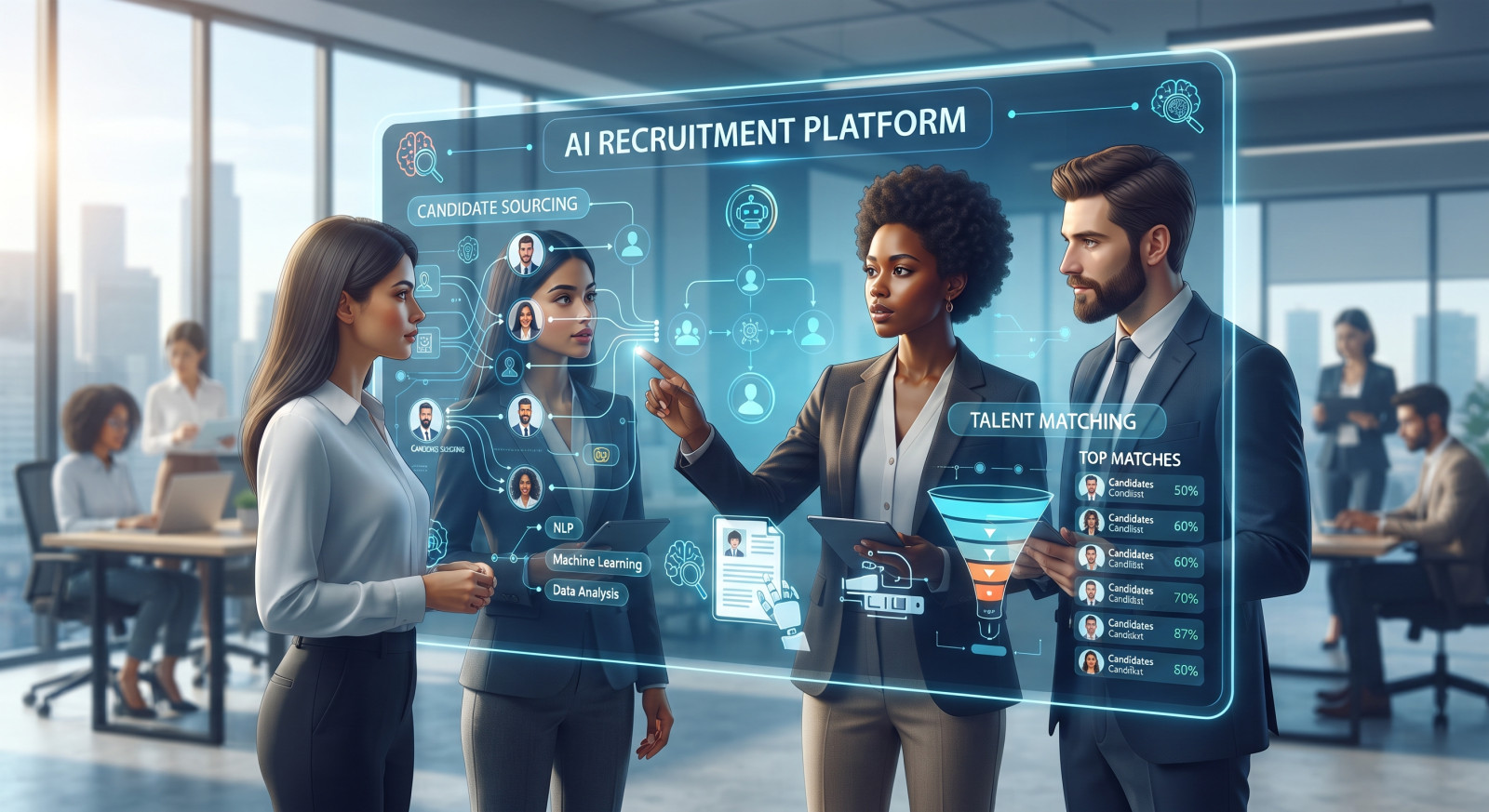
Recruitment with the help of AI entails the application of various techniques of artificial intelligence to recruit candidates at different levels. These include machine learning, natural language processing, predictive analytics, and conversational AI.
Some of the tasks where artificial intelligence technology can help are application organization, identification of suitable skills of candidates, answering some of the frequently asked questions by applicants, scheduling interviews, and more.
Definition and Key Components of AI Recruitment
AI-powered recruiting is designed to be an auxiliary tool for human recruiters rather than replace them in making decisions. This tool can assist with administration and communication while enabling human recruiters to manage candidates.
For instance, natural language processing will assist in analyzing information provided in CVs and job descriptions, whereas the machine learning models will find certain patterns that will enable the recruiters to compare candidates to the set job criteria.
The Shift from Reactive to Proactive
One of AI's most significant effects is the shift from reactive hiring to proactive talent acquisition. Previously, hiring managers only started looking for new talent once the job position became available, which resulted in a rush and delays in filling up the positions.
This approach becomes less applicable thanks to the advent of talent intelligence platforms, which use AI tools to analyze labor market trends, monitor passive talent pools, and predict upcoming requirements in terms of personnel based on the future growth plans and past experience of the company.This will enable companies to be prepared for any shortages of talent that may arise.
3. Key Benefits of Implementing AI in Hiring
Hiring and selecting personnel are being transformed by artificial intelligence. As AI recruitment professionals move from being mere reactive administrators into proactive and data-driven recruiters, there are tremendous values to be realized in four dimensions of speed, quality, cost, and the experience of the applicants.
Speed and Efficiency
Conventional recruitment processes tend to be held back by administration, such as the need to manually screen resumes and the back and forth involved in setting up interviews.This becomes possible through the utilization of an automatic system based on artificial intelligence.
Recruitment through Artificial Intelligence technology will be able to carry out repetitive tasks such as CV screening, communication with the candidates, and scheduling interviews. This will help them save time in conducting interviews and the whole recruiting process.
Quality of Hire
AI can assist in evaluating candidates by ensuring consistent evaluation standards when dealing with numerous candidates due to the ability of AI to organize information related to the job such as skills and experience.
It is not true that AI will definitely remove bias and increase the quality of the recruiting process. The effectiveness of the tool is determined by the nature of the data used, the design of the tool itself, and the amount of human supervision involved in the process.
Cost Reduction
The task of recruiting people usually entails tedious administrative functions like screening resumes, conducting interviews, and corresponding with candidates. All of these can eat up precious time for recruiters, especially in cases where there are a lot of applications.
Using AI recruiting software could assist in automating some of these repetitive functions and allow the team to focus more on meeting potential hires, conducting interviews, and talent planning. Savings would definitely depend on how each company is hiring and what kind of technology they have.
Candidate Experience
Experience of candidates is important for creating an image of the company. Applicants like to get immediate responses, clearness and an easy recruitment procedure starting from their application until the end of the interview.
Using chatbots and other communication techniques based on artificial intelligence will help you answer standard questions of the applicant, update him/her about the status of their application, and support applicants in the recruitment process.
4. Core Use Cases and Technologies Driving AI Recruitment
To understand how AI is changing modern HR, we need to consider the technologies and architectural models underlying today’s most innovative recruitment platforms. Rather than improving processes in HR, they change the way organizations find, qualify, and interact with top-quality professionals around the world.
Resume Screening and Sourcing Based on AI
Current resume screening based on AI is much more sophisticated compared to conventional search using keyword filtering. With the help of advanced techniques of natural language processing and context-based parsing, modern technology is able to interpret unstructured information in a resume, professional portfolio, and even open source codes in repositories such as commits in GitHub.
Unlike legacy methods that punish candidates because of different format options and small mistakes, natural language processing enables extraction of the semantic sense in order to evaluate the actual level of experience and expertise. Passive candidate sourcing involves advanced techniques of web scraping and network graph analysis that enable finding hidden pools of valuable candidates.
Conversational AI & Chatbots
Smart conversational systems act as the first level of ambassadors within the current digital AI recruitment pipeline. Being inherent to career portals, company websites, and instant messaging channels, these AI-powered chatbots perform important functions right at the beginning stages of the process.
In particular, chatbots engage in preliminary conversations and answer complex queries from the candidates related to culture, compensation philosophy, and remote work practices.
They can schedule interviews autonomously via integration into recruiters' calendars. Automation allows for an ensured immediate engagement with each and every candidate despite time zones or number of applications, thus minimizing the percentage of drop-offs at the first stage.
AI-Powered Assessments & Skill Matching
Such evaluations conducted with the use of AI will be able to complement the traditional recruiting process, offering even more information about the skills and competencies that are relevant to the job. The type of evaluation to be performed will depend on the platform – technical knowledge, problem solving, or some other kind of ability relevant to the position may be assessed.
These results may allow recruiters to compare candidates based on their competency profiles, they should be used as only one element of the recruiting process.
Video Interview Analysis
One of the most advanced yet controversial features of modern talent technology is video interview analysis. With the help of computer vision and speech-to-text technology, these tools assess syntax and oral communication as well as technical delivery in asynchronous video interviews.
Even though this technology enables advanced levels of processing power for entry-level and graduate hiring pipelines, the deployment of such tools requires rigorous adherence to an ethical framework. This means that there should be an effort towards transparency and auditing of bias and regulations related to algorithms.
5. Overcoming Challenges: Ethics, Bias, and Compliance
In the midst of AI adoption within recruiting processes, while efficiency may come hand-in-hand, ethics and regulations become essential considerations. Today’s recruiting process entails much more than simply applying new technology; proper supervision is required to keep it lawful, transparent, and fair.
The Dangers of Discrimination Based on Machine Learning Algorithms
Among the various risks involved in AI recruiting, perhaps the most crucial one lies in data itself. The machine learning algorithm is built based on the analysis of past hiring decisions, which are inherently filled with human biases accumulated throughout decades.
Should they not be addressed, the algorithm will automatically detect some proxies for protected attributes, like zip code, university, or organization of origin, and apply discrimination on the large scale.
Transparency and Explainability
The "black box" problem can make AI-assisted hiring decisions difficult to understand or challenge. Recruiters lack confidence in decisions made by AI models which generate scores without explanations, leaving job candidates with no means to address their concerns.
Not using the black box concept will mean that the Explainable Artificial Intelligence (XAI) model will be introduced. Here, the whole procedure shows the various criteria that have been considered in making the decisions, for instance, project experience and technical skills.
Data Privacy and Regulations
The AI recruitment technology space becomes extremely regulated in terms of candidate data protection and automated hiring tools' compliance. Talent acquisition managers are supposed to navigate complex regulations, such as GDPR and EEOC standards as well as new ones, such as NYC Local Law 144 and EU AI Act.
Compliance does not only imply protection of candidates' data but includes mandatory bias reviews of automated employment decision tools, opt-out opportunities, and obtaining consent for automatic processing of personal information.
Human-in-the-Loop Principle
The use of technology should assist and complement, rather than substitute humans in making decisions. The implementation of strict compliance with the concept of human-in-the-loop would make sure that candidates will not face automatic rejection after pre-screening without having a chance to explain the case to the hiring managers. This approach would ensure that people stay at the heart of decision making.
6. Best Practices for Integrating AI into Your Talent Workflow
Utilizing artificial intelligence for recruitment is not about merely subscribing to the latest version of software; it involves taking an entirely different route – a route that demands strategy, discipline, and thorough process execution. In order to realize high ROI while reducing potential risks, recruiting managers have to follow specific best practices throughout the entire process.
Auditing Current Gaps
Prior to searching for outside solutions or attending any sales presentations, an organization must examine its processes from within. Does your main issue involve heavy resume scanning, inefficient interviewing scheduling, ineffective sourcing or even the high drop-off rate after the first assessment? By identifying your current issues, you will ensure that the technological solution being purchased really solves real business problems instead of creating additional barriers and unnecessary complexity to your existing workflow processes.
Vendor Due Diligence
There is no such thing as equal vendors of HR technology, and due diligence is crucial for future success. The talent leaders should demand hard facts from prospective vendors about their data training, proprietary algorithms, external audits, and data security measures.
Ask about testing of machine learning models for disparate impact across different demographics and demand contractual guarantees on regulatory compliance, data privacy, and accountability.
Change Management
Adoption of advanced technology depends on people who use it daily. Change management will help to train recruiters, hiring managers, and talent partners to perceive artificial intelligence not as a threat but as a collaborative co-pilot.
With the creation of a transparent culture of open communication, addressing concerns about job security and comprehensive training sessions, companies will achieve a high level of user adoption and completely overcome internal skepticism.
Continuous Monitoring
Companies need to create the cadence for algorithm performance audits, disparate impact tracking, and hiring outcomes monitoring. Since machine learning models may sometimes have issues with drifting and developing behavioral bias as labor markets change, monitoring is required to maintain the fairness, high accuracy, and alignment with core values of recruitment AI.
7. The Future of Work: Trends in AI and Talent Acquisition
With continued advancements in the field of artificial intelligence, the role of AI in talent acquisition is gradually transitioning from being an operational solution to a strategic one, which would determine organizational designs. Here are some of the key trends that will determine the future of work, as AI evolves in the process of hiring.
Hyper-Personalization and Internal Mobility
The future of AI is bound to have a huge influence on current employees through hyper-personalization in their career development. Using AI and advanced algorithmic solutions, companies are now able to map out personalized career paths for individuals, based on skill gap analyses conducted in real time.
Rather than conducting traditional annual reviews, the platforms evaluate the outcomes of an employee's projects, their performance, and their learning outcomes. They are then matched with internal opportunities, mentors, and training programs, which allow for increased internal mobility and decreased turnover rates among talented individuals.
The Rise of Skill-Based Economies
What we are experiencing right now is a gigantic paradigm shift away from traditional, degrees-focused recruiting requirements to a new, dynamic economy based on the actual skills of candidates. AI becomes the major driver of such change due to its ability to evaluate, verify, and measure micro-skills in a blink.
Parsing information about a candidate and conducting dynamic tests, AI algorithms can move beyond prestigious university names in order to uncover skills which will make the difference in the real work performance. As a result, hiring managers gain access to an extremely qualified non-traditional talent pool which enables them to hire based on skills only, not on education.
Autonomous AI Recruitment Agents
And the highest point on the horizon of our near future is the rise of autonomous recruitment agents. In contrast to old-school chatbots which have been used during the last decade, a new generation of AI-driven agents will be able to perform all the complicated end-to-end sourcing processes with almost no involvement of humans.
Autonomous agents will be able to scan the internet for passive candidates, send them individual outreach sequences, answer sophisticated questions of candidates, test their technical skills, and schedule final interviews. While all of this is happening behind the scenes, the focus of the humans will entirely shift to their higher duties such as relationship building and deal closure.
8. Frequently Asked Questions
1. AI Recruiting Defined
This refers to the use of various forms of AI technology in the AI recruitment process. This form of technology is vital in handling the entire recruitment process including sourcing of candidates, resume screening, skill matching, scheduling and recruiting analytics.
2. How does AI optimize the recruiting process?
AI may allow recruiters to deal effectively with routine tasks and handle large amounts of information about potential employees. In particular, AI may help to organize applications, find candidates that satisfy predefined job requirements, answer candidates' frequent questions, and schedule interviews.
3. Is AI capable of replacing human recruiters?
AI may be implemented to assist human recruiters, but rarely to replace them. It allows handling some routine tasks but not the whole process of recruiting, including candidate evaluation, interviewing, organizational context taking into consideration, and final decision-making.
4. What are the potential benefits of using AI in talent acquisition?
These may include the acceleration of applications' processing, improvements in workflow efficiency, candidate communications, skills matching, and the handling of recruitment data. There will be different advantages based on the technology, the recruitment process itself, and practices implemented.
5. What are the possible risks of using AI recruitment?
The risks of using AI technology in recruiting are: algorithmic discrimination, inappropriate matching of candidates, security and privacy issues, and reliance on the machine's recommendations. It is crucial for companies to evaluate their systems constantly, to employ necessary security measures, ensure the protection of candidates' information, and maintain human involvement in the recruiting process.
6. How can companies use AI recruitment systems efficiently?
Firstly, companies need to determine which of the recruitment activities could benefit from the use of automation, for example, organizing candidates' resumes, communicating with candidates, or scheduling interviews. Next, companies need to select proper technology, set up evaluation criteria, train their recruiters, assess the results, and review the system constantly.
9. Conclusion and Call to Action
AI has completely changed the talent acquisition game. Rather than making the recruiting process soulless, AI removes any unnecessary administrative obstacles, makes recruiters into strategic advisors, and reinstates the human factor in all its importance within HR.
Early implementation of AI recruitment practices is no longer a nice-to-have—this is a must-have in order to stay competitive. Companies which will continue relying on laborious, slow processes of talent acquisition will always be falling behind their competitors who can quickly find, reach out to, and recruit top talent.
Are you ready to upgrade your recruiting engine? See how GigMint uses artificial intelligence together with human curation to revolutionize the way smart businesses form top-notch teams. Get more information about us at GigMint.AI!